

Shutterstock
While it may not be close to the biggest in our solar system, Earth is big.
With over 510 million square kilometers to explore, it’s no wonder that parts of our planet remain unexplored – in fact, every year new parts of our planet are discovered (or often re-discovered), as we travel further, wider, and deeper than before.
This can mean anything from uncovering ancient ruins buried deep within the rainforest to mapping new parts of the ocean floor.
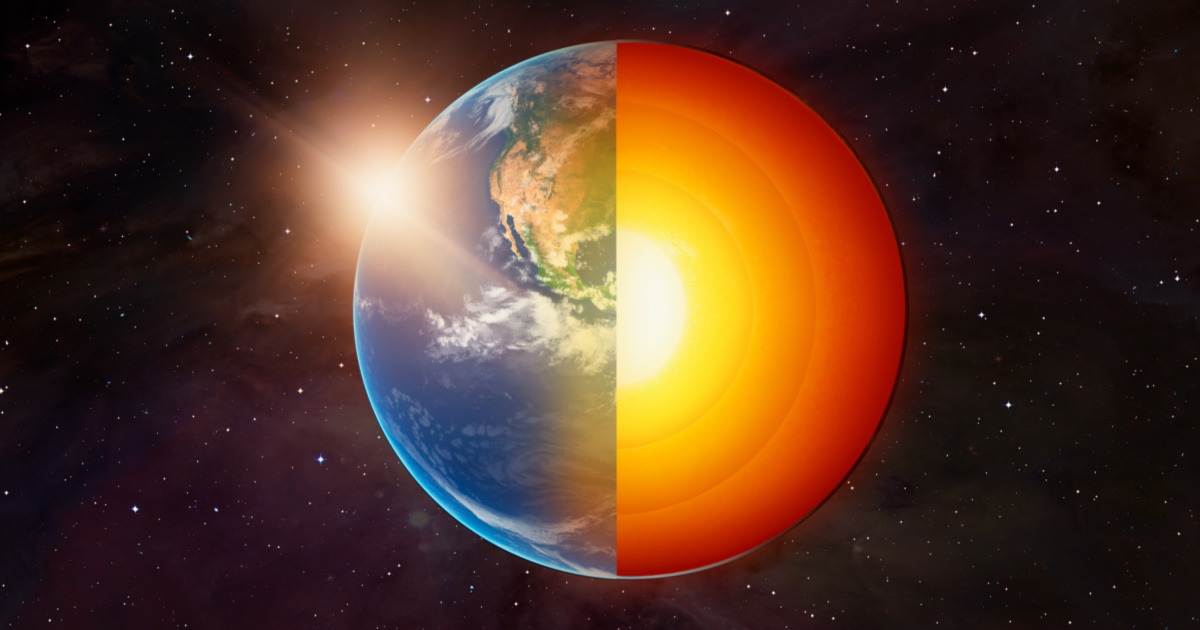
But have you ever stopped to consider what is going on under our feet, deep within the Earth itself?
Shutterstock
You may not have thought about it personally, but scientists certainly have – but exploring and understanding the Earth’s mantle and core is an understandably complicated process.
However, in a recent breakthrough, researchers from the University of Liverpool and the University of Leeds have discovered evidence of two super-hot structures deep within the Earth, at the base of the mantle.
And those two areas of extremely hot material, which are surrounded by cooler rock, have a surprising function in the way our planet works, as explained in the study, which was recently published in the journal Nature Geoscience.
That’s because, as the researchers explain, these two extremely hot structures appear to be crucial to the world’s magnetic field.
University of Liverpool
Situated 2,900 kilometers below the surface of Africa and the Pacific Ocean, these two structures were discovered using computer simulations and palaeomagnetic observations, which helped them to understand how the Earth’s magnetic field has worked through 265 million years.
As well as the location of these hot areas, the calculations have allowed the researchers to understand how some areas of the Earth’s magnetic field have changed little over the years, while other areas have changed a lot, as Professor Andy Biggin explained in a statement:
“These findings suggest that there are strong temperature contrasts in the rocky mantle just above the core and that, beneath the hotter regions, the liquid iron in the core may stagnate rather than participate in the vigorous flow seen beneath the cooler regions. Gaining such insights into the deep Earth on very long timescales strengthens the case for using records of the ancient magnetic field to understand both the dynamic evolution of the deep Earth and its more stable properties.”
It really is fascinating to consider just how much is going on, many miles below our feet.
If you found that story interesting, learn more about why people often wake up around 3 AM and keep doing it for life.