
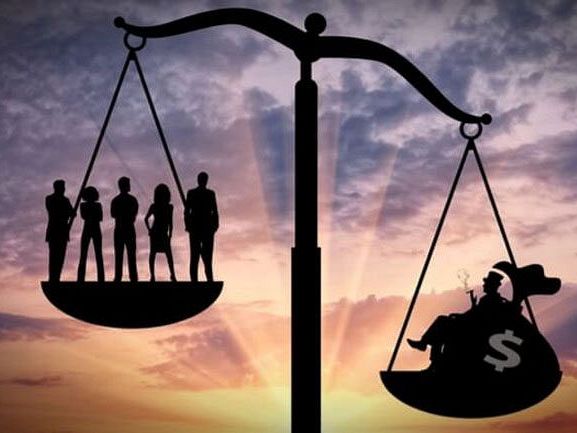
Recent data confirms current policies are gradually reversing Australia’s chronic inequality, as Alan Austin reports.
THE SALARY OF James Hardie CEO Aaron Erter in 2024 was a handy $15.03 million, according to the company’s annual report. This tumbled in 2025 to just $9.26 million.
Macquarie Group’s boss pocketed $32.82 million in 2023. This fell the next year and slipped again in 2025 to $29.27 million.
These are among hundreds of top executives whose salaries have declined as wealth and income in Australia shift from the top end to the bottom and the middle.
Others include Goodman Global’s CEO, whose 2022 salary of $15.8 million was trimmed to $14.2 million in 2025. ANZ Bank boss Shayne Elliott was paid $4.1 million in 2024. His replacement, Nuno Matos, received $975,000 last year.
In 2023, Qantas CEO Alan Joyce was paid a thumping $21.44 million. His replacement, Vanessa Hudson, was paid $6.31 million in 2025.
Don’t worry too much, though. These folks will get by.

Rebalancing is underway
These examples don’t prove all fat cats are taking haircuts, but they bolster the evidence that inequality is easing.
IA has shown that most low and middle-income Australians have enjoyed substantial improvements in living standards under the Albanese Government’s policies. We have reported increased jobs, inflation curbed, interest rates moderated and tax burdens reduced.
We have quantified the hefty rises in the minimum wage, average wages, pensions, benefits and Commonwealth rent assistance, all well above inflation.
We have tracked the surge in investment in new homes across the country, and in public housing in particular.
We have reported record sales of new cars, light aircraft, jewellery, cosmetics and dining out. We have seen a higher percentage of the population than ever travelling abroad, and all-time high enrolments in expensive private schools.
Welfare agencies are now called upon to assist fewer citizens in dire poverty.
Confirmation from the research institutes
Regrettably, Swiss bank Credit Suisse no longer publishes its annual global wealth databook, as it did from 2010 to 2022. This used to reveal wealth distribution among all percentiles of Australia’s population.
We learned from the 2022 databook that the richest 10% of citizens owned 52.4% of all wealth and the other 90% held only 47.6%. The top 1% held 21.8% of wealth, while the poorest 40% held 4.5%. Grrrrr!
We could contrast that with 2012, ten years earlier, where the imbalance was not as stark — the top 10% held 44.9% and the lowest 90% owned 55.1%.
If recent analyses here at IA are correct, we would expect the top cohort in 2026 to hold less than in 2022. Alas, we may never know.
What we do have, however, is a chart from global data analyst MacroMicro, which shows the share of national income received by the top 10%, current to 2024. This is consistent with IA’s reportage in showing the top earners’ share peaked at 35.4% in 2021 and declined each year since. We expect the next two years will be lower still, but we don’t yet know.
The other evidence, of course, is our old favourite chart showing the carve-up of national income between employee salaries and corporate profits. This does not identify discrete income brackets, but does confirm an emphatic shift from profits to wages starting five minutes after Labor took office in 2022. See chart below.

(Data source: ABS)
A bizarre enigma resolved
One puzzling data point in recent years has been real net disposable income per capita, which the Australian Bureau of Statistics (ABS) publishes quarterly in the national accounts. Obviously, if this measures money that citizens get to spend, then the higher the better. And if an economy is enjoying a phenomenal consumer spending boom, this should be rising dramatically. Correct?
Yet since its peak of $20,241 in June 2022 – one month after Labor was elected – this statistic has steadily declined, falling to $19,253 in December 2024 and rising only marginally since then. The latest level, reported two weeks ago for the 2025 fourth quarter, was just $19,426.
Unsurprisingly, given Australia’s appalling political news media, this dismal statistic has allowed the mendacious mainstream newsrooms, the shonky tabloids, the craven Opposition, the anti-Labor institutions and sundry internet nutters to attack the Government for falling living standards.
In fact, the opposite is true, as overwhelming evidence proves. So how is this contradiction resolved? Here’s how.
Imagine a company with two managers and eight workers. If the bosses were paid, after tax, a million dollars a year and the workers $100,000 each, then total disposable income would be $2.8 million.
Imagine now a restructure whereby the managers receive $700,000 and the workers $150,000. How would that affect living standards of this community of ten?
Clearly, with eight out of the ten getting 50% more pay, most are vastly better off. The bosses will survive on their $700,000.
That is a much more equitable and desirable situation — for the individuals and for the group. No question.
But the total net income has now fallen from $2.8 to $2.6 million. The average income per person has also fallen, from $280,000 to just $260,000.
This mirrors Australia since 2022. The total income pie has declined slightly from earlier aberrant highs, due largely to Coalition mismanagement of the COVID stimulus. But the vast majority now get larger slices. Living standards for all are either higher or unchanged. Everyone’s a winner!
This dataset – real net disposable income per capita – actually constitutes evidence that this shift towards greater equality is on.
Let’s hope Lendlease CEO Anthony Lombardo sees it this way. His 2022 salary of $3.32 million was cut to $2.19 million last year.
But cheer up, Tony! You are contributing to the greater good.
Alan Austin is an Independent Australia columnist and freelance journalist. You can follow him on Twitter @alanaustin001 and Bluesky @alanaustin.bsky.social.
Support independent journalism Subscribe to IA.


Related Articles