
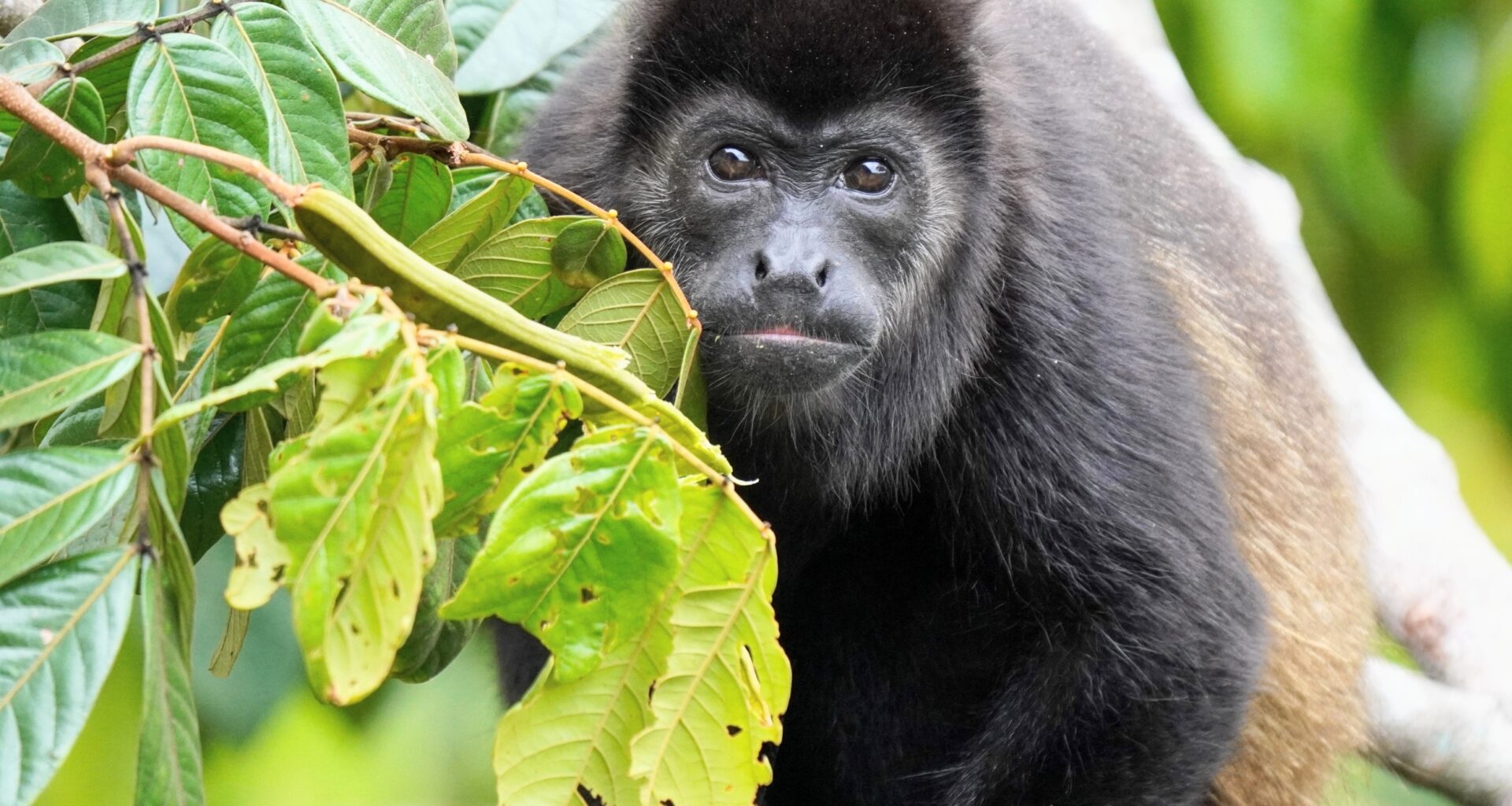
Ancient relatives of howler monkeys were eating leaves 13 million years ago, providing the earliest clear fossil evidence of leaf consumption among South American primates.
That dietary change marked the start of a path that allowed the monkeys to grow larger and carve out a distinct place among the crowded primates of ancient forests.
Howler monkey dietary changes

Fossil lower jaws recovered from the La Venta deposits in Colombia preserved the anatomical clues behind the early dietary change.
By analyzing the fossils, Dr. Siobhan B. Cooke at Johns Hopkins University documented teeth built for grinding and slicing tough leaves.
The fossils place leaf eating in the howler monkey lineage more than 13 million years ago, far earlier than previously documented in South American primates.
The discovery anchors a critical turning point in primate evolution, but leaves open broader questions about how this adaptation reshaped life in the ancient Amazonian ecosystem.
Teeth adapted for chewing leaves
Tall ridges on the molars mattered because they met like blades when the animal chewed tougher plant tissue.
As the teeth closed, those cutting edges helped break down tough plant fibers, which are harder to handle than soft fruit.
Modern howler monkeys show much the same pattern, which made the fossil resemblance hard to dismiss as chance.
“Before the discovery of Stirtonia, we didn’t have any evidence of leaf consumption in South American primates,” said Dr. Cooke.
Leaves and howler monkey size
Body size estimates placed Stirtonia victoriae, an extinct ancestor of modern howler monkeys, at roughly 15 to 19 pounds – far above most older South American monkey fossils.
With leaves available across a forest, that broader food supply could support larger bodies even when ripe fruit ran low.
“Prior to this, the South American monkeys we have in the fossil record are much smaller,” noted Dr. Cooke.
That size makes Stirtonia victoriae the earliest known larger-bodied monkey in the South American fossil record.
La Venta is significant because many monkey species shared one landscape while northern South America was still reorganizing.
By adding leaves to fruit, these early howler relatives likely reduced direct competition with neighbors chasing softer foods.
Researchers counted 12 primate species at the site, making it the earliest known Amazon-like monkey community with striking dietary variety.
“Now, we can begin to pinpoint when different modern lineages started to evolve,” said Dr. Cooke.
Broader environmental change
Evidence from La Venta points to a mostly forested mosaic shaped by shifting rivers, not one stable habitat.
As channels moved and feeding zones changed, monkeys faced a menu that rewarded flexibility more than strict dependence on fruit.
More than 100 vertebrate species came from the site, showing that these primates lived in a busy and varied animal world.
That backdrop made the new jaws more than an isolated fossil, because they captured adaptation during broader environmental change.
Howler monkey “howls” evolved
Deep lower jaws gave the fossils another kind of importance by hinting at when the howler call may have taken shape.
In living howlers, an enlarged hyoid – a throat bone that can amplify sound – helps produce booming calls.
Matching jaw depth in Stirtonia victoriae suggested space for a similar structure, even though that bone was not preserved.
That clue stayed tentative, because fossils cannot record soft tissue, living behavior, or the sound itself.
The leaf diet shaped survival
Leaves are common, but they are tougher and less energy-rich than ripe fruit, so they reward specialized chewing and slow digestion.
Modern howlers manage that challenge with strong shearing teeth, long digestion, and a low-energy routine built around abundant food.
In that light, the fossil teeth suggest not a brief experiment but an early form of a long-lasting strategy.
That continuity gave the jaws more weight, because it linked an ancient diet to a living monkey way of life.
Early branch of the family tree
Timing strengthened the argument because newer family trees place Stirtonia near the base of the howler branch.
By tying a recognizable feeding style to that early split, the jaws turned an abstract family tree into an ecological story.
Another point mattered just as much: Stirtonia victoriae closely resembled living howler monkeys in jaw shape, not just diet.
That overlap gives researchers a sharper marker for when South American monkey branches began to look and live differently.
Plant diet changed monkey evolution
These fossils answered one major question, but they left several others open, including how loudly this animal could actually call.
Lower jaws can reveal diet and possible voice anatomy, yet they cannot show soft tissue, gut biology, or daily behavior.
Body mass estimates also changed with the calculation method, leaving the specialization of some early howler relatives less certain.
Additional skulls, throat bones, and limb fossils may reveal how quickly this monkey line acquired the full modern howler package.
Ultimately, the fossils show that leaf eating was already shaping howler monkey evolution 13 million years ago.
The study reveals how a single dietary shift helped redefine body size, competition, and life in South America’s ancient forests.
The study is published in the journal PaleoAnthropology.
—–
Like what you read? Subscribe to our newsletter for engaging articles, exclusive content, and the latest updates.
Check us out on EarthSnap, a free app brought to you by Eric Ralls and Earth.com.
—–