
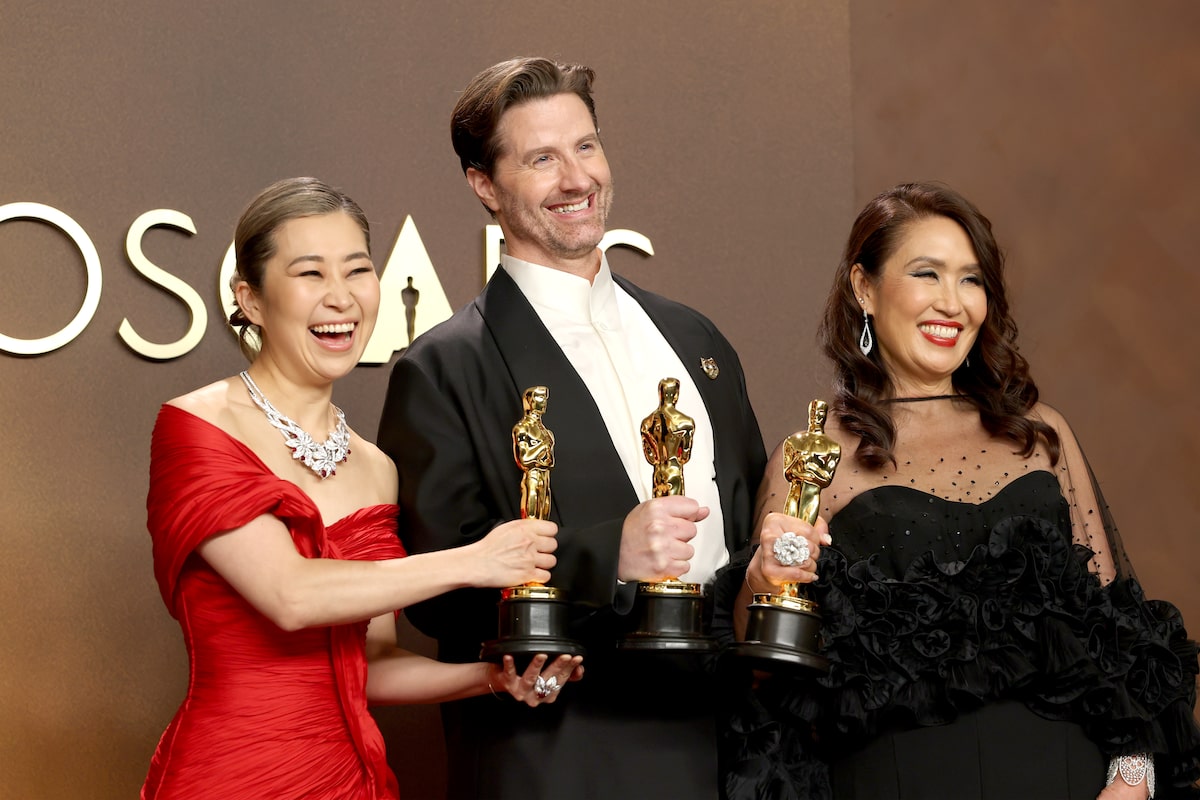
From left to right: Maggie Kang, Chris Appelhans and Michelle L.M. Wong, winners of the Best Animated Feature Film Award for ‘KPop Demon Hunters,’ during the 98th Oscars at Dolby Theatre on Sunday.Frazer Harrison/Getty Images
Paul Thomas Anderson and his One Battle After Another American revolutionaries might have taken home the bulk of the hardware at Sunday’s Academy Awards, but the real winner of the night was Canada.
Homegrown artists triumphed in nearly every category in which they were nominated, for a total of four Oscar wins: Best Animated Feature for KPop Demon Hunters (co-directed by Maggie Kang); Best Animated Short for The Girl Who Cried Pearls (directed by Chris Lavis and Maciek Szczerbowski); Best Production Design for Frankenstein (Tamara Deverell and Shane Vieau); and Best Makeup and Hairstyling for Frankenstein (Jordan Samuel and Cliona Furey, alongside Brit Mike Hill).
The winners didn’t shy away from their roots, either, with Lavis and Szczerbowski in particular offering Canada some serious on-stage love, name-checking the National Film Board, actor Colm Feore, musician Patrick Watson, and the entirety of Montreal in their acceptance speech. “The fact that we accepted the award from Will Arnett makes me feel like we’re taking over back here,” Lavis told reporters backstage.
Chris Lavis, left, and Maciek Szczerbowski, winners of the Best Animated Short Film for ‘The Girl Who Cried Pearls.’Frazer Harrison/Getty Images
It was a beautiful evening for Canadian artists who have long proven that, despite our country’s relatively small market and overwhelming proximity to the Hollywood machine, we can outperform and outshine. And all without even a single Heated Rivalry mention!
Naturally, Canadian politicians used the moment to splash all the usual plaudits across their social-media feeds. Prime Minister Mark Carney: “The masterpieces we celebrate tonight are a testament to the fact that Canada is a nation of diverse and talented storytellers.” Minister of Canadian Identity and Culture Marc Miller: “What an immense source of pride to see Canadian talent shining at the Oscars!” Minister of Finance François-Philippe Champagne: “An amazing tribute to Canadian talent and artists!” Even Conservative Party Leader Pierre Poilievre got in on the act: “Canada is proud of you. Thank you for shining a light on our culture on the international stage.”
Opinion: Why we’re blowing a generational moment for Canadian culture
Yet the words of congratulations cannot help but feel hollow at best and hypocritical at worst given the tremulous state of arts funding in this allegedly “Elbows Up” era.
The Girl Who Cried Pearls was created by the National Film Board, earning the federally funded institution its 12th Academy Award. And the short was only made possible due to the fact that its Montreal-based creators have been working tirelessly within the NFB for 20 years. Meanwhile, the NFB cut 14 per cent of its workforce in 2024, closed regional production studios across the country, and has been chronically underfunded for the past two decades. The winning short was produced by Julie Roy, who now heads the federal arts funding agency Telefilm, which still hasn’t received the permanent annual funding increase that it was promised by the Liberal Party way back in 2021.
Tamara Deverell, left, and Shane Vieau, winners of the Best Production Design for ‘Frankenstein.’Jordan Strauss/The Associated Press
Meanwhile, though it was wonderful to see the made-in-Canada success of the artists behind KPop Demon Hunters and Frankenstein, both of those productions were only made possible because they were funded by Netflix. And it is that U.S. streaming giant that is in the midst of a dragged out legal fight over the Online Streaming Act (Bill C-11), which was designed to compel foreign-owned streamers to contribute a portion of their Canadian revenues to help fund homegrown film and television production.
What is Ottawa’s current position on C-11? While the bill is far from a perfect piece of legislation, and is in fact exceptionally weak in its measures when compared to similar laws in places such as France, it is now apparently part of trade negotiations with the United States, which considers the measure an “irritant,” according to Miller. In other words: Don’t expect Ottawa to fight for C-11 with their elbows or anything else up.
Opinion: In Ottawa, the Heritage Department is a revolving door at best, a nuisance at worst
And then there is the CBC of it all. Whether you appreciate its current iteration or not, the broadcasting corporation is a central component of the country’s screen sector, and so far, everyone in Ottawa – on both sides of the aisle – seems intent on weakening it. There is of course Poilievre’s entire campaign of defunding the CBC – which makes his sop last night to artistic success all the more ridiculous – but also new reports that the Liberals are looking to cut the broadcaster’s funding by $192-million in 2026-27.
If Canadian politicians would like to score easy points off the hard work of artists, that’s their prerogative. But it is also up to Canadian audiences – consumers who appreciate that our country’s boldest and brightest creative voices have important and inspiring stories to tell each other and the rest of the world – to call out double-speak when they see it.
From left to right: Mike Hill, Cliona Furey and Jordan Samuel, winners of the Best Makeup and Hairstyling for ‘Frankenstein.’Mike Coppola/Getty Images
The Oscar-winning Lavis had the right idea when he spoke up for C-11 while in the Academy Awards press room: “You cannot compete with these giants without funding work. It’s impossible,” the filmmaker said. “Part of that involves actually getting a tax from Amazon and Netflix and all those companies that are getting a free ride in this country. I think it’s important that they contribute more than just movies, but actually contribute to the Canadian Media Fund and to Canadian funds. It’s really, really important if we’re going to survive.”
If Ottawa wants to ensure that there is steady pipeline of Oscar winners to congratulate for generations to come – filmmakers who are able to showcase Canadian stories and perspectives and values on the world stage, the most appealing and frankly sexiest form of soft power that there is – then they should pause the empty platitudes and start putting money where their mouths are.