
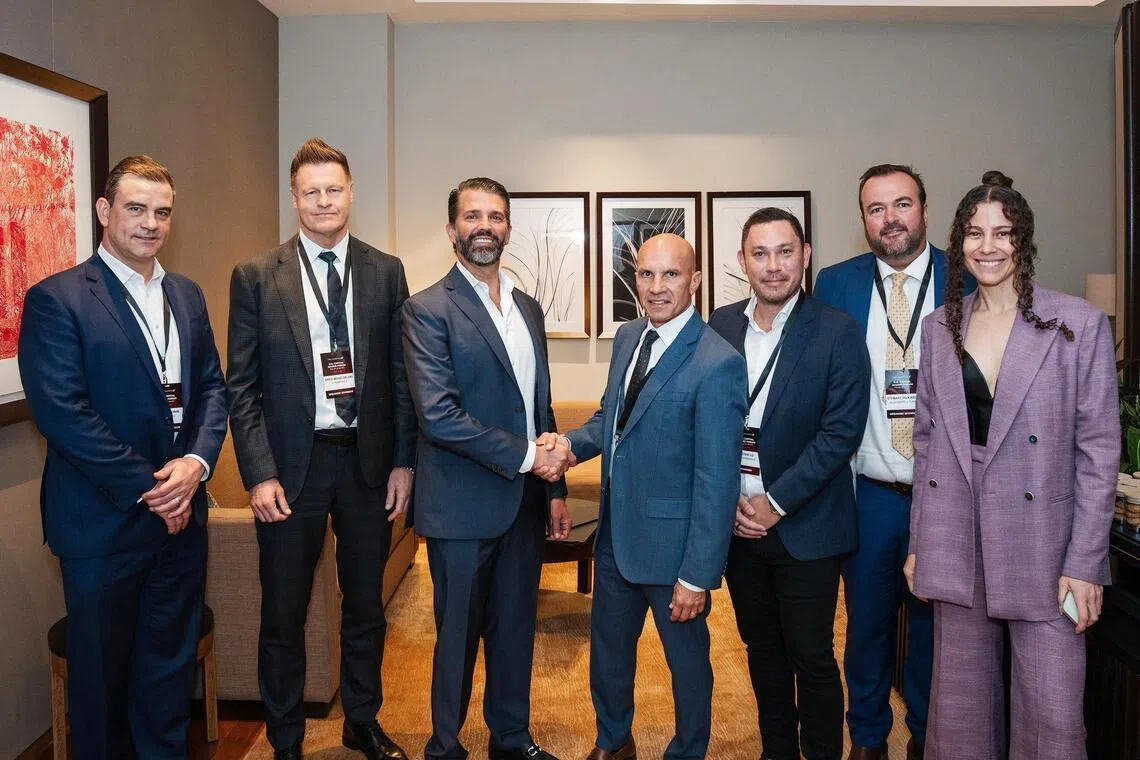
SINGAPORE – The decades-long pursuit of low-cost production has left Western economies dangerously exposed to fragile global supply chains, Mr Donald Trump Jr said, adding that the West has ceded too much control over critical inputs.
In a recent visit to Singapore, the eldest son of US President Donald Trump called for the rebuilding of US industrial muscle in sectors from energy and semiconductors to biotechnology and strategic minerals.
He argued that restoring this capability is now a matter of economic security as much as growth.
Mr Trump Jr, executive vice-president of The Trump Organization, was the keynote speaker at the invitation-only US Capital Access Forum at Capella Singapore.
The two-day forum over March 10 and 11 was convened by Hall Chadwick, an Australian accounting and advisory firm, with Cohen & Company Capital Markets, a boutique investment firm.
During the forum, Australian-based American Tungsten and Antimony said Mr Timothy Morrison, its executive chairman, met Mr Trump Jr to discuss the company’s efforts to re-establish US production of critical minerals vital to defence and strategic manufacturing supply chains.
The event gathered about 400 participants from Asia, Australia and the US, including Singapore-based investors such as Boroo, Santa Lucia Asset Management and DotBio, underscoring Singapore’s rising importance as a bridge between Asian corporates and global capital markets, organisers said.
Speaking to The Straits Times, Mr Drew Townsend, partner at Hall Chadwick, said there is a growing interest in strategic minerals such as rare earths, copper and antimony – a defence-critical mineral that is not mined in the US – amid a global push to strengthen supply chain resilience.
Mr Townsend said more capital is flowing towards projects that strengthen supply chain resilience and domestic production in politically stable jurisdictions like Australia.
He added that Singapore is anchoring many of such cross-border activities.
Many transactions involving Australian assets are being driven by Singapore-based family offices, private credit firms and corporate investors. These investors are active in real estate, mining and infrastructure, he said.
A growing number of fast-expanding South-east Asian companies that once relied on private capital are now considering public listings to gain greater access to international investors, experts say.
The shift reflects a maturing regional investment climate, where companies are looking beyond private equity and venture capital to long-term institutional funding to support expansion across borders.
With the US initial public offering (IPO) market now quieter, Mr Townsend said special purpose acquisition companies (SPACs) and de-SPAC transactions are emerging as alternative pathways for companies seeking access to US capital markets.
A SPAC is a listed shell company that raises money through an IPO with the sole purpose of merging with or acquiring a private business, allowing that target to go public without a traditional IPO.
The de-SPAC phase is when a SPAC completes its merger with a chosen target, after which the combined company trades as a regular public firm and the SPAC structure effectively disappears.
Hall Chadwick is seeing strong interest from companies exploring these structures, particularly in the resources and energy supply chain sectors.
The company is the adviser to California lithium and geothermal power developer Controlled Thermal Resources, which is set to list on Nasdaq through a proposed US$4.7 billion (S$6 billion) merger with blank-cheque firm Plum Acquisition Corp IV.
Hall Chadwick recently secured an exclusive Asian partnership with Cohen & Company, one of the largest SPAC brokers, to assist regional firms pursuing these transactions, especially in resources and energy-linked sectors.
Ms Kayla Hardy, Hall Chadwick’s partner based in Hong Kong, noted that investment appetite across Asia is broadening towards digital economy sectors – from data centres and artificial intelligence-driven industries to healthcare and biotech – while distressed opportunities in real estate also draw attention.
“The rapid growth of AI and digital services is fuelling demand for both data infrastructure and energy capacity,” Ms Hardy said. She said Asian family offices are maintaining flexible portfolios, diversifying beyond property into technology and digital infrastructure.
Despite geopolitical tensions, China remains a hotbed for investments with select investors seeking undervalued opportunities in specific sectors, she added.
To meet demand for cross-border advisory, Hall Chadwick has expanded its footprint in Singapore, Hong Kong and other Asian financial centres.
The firm now employs more staff offshore than in Australia, driven by surging requirements in restructuring, forensic and insolvency services among mid-market firms.
Private equity’s growing interest in professional services firms is also reshaping the advisory landscape. Mr Townsend confirmed that Hall Chadwick remains open to strategic partnerships that could accelerate its international growth.