
an international team of astronomers has detected an extraordinary cosmic event that could redefine our understanding of black hole mergers. For the first time, a binary black hole merger, observed in November 2024, has been linked with a short gamma-ray burst (GRB), a phenomenon that was previously thought impossible. This unprecedented event, detailed in The Astrophysical Journal, could open a new frontier in multi-messenger astronomy, combining the “sound” of gravitational waves with the “flash” of high-energy light.
The Cosmic Event That Defies Expectations
On November 2024, the LIGO-Virgo-KAGRA observatories captured a signal from an immense gravitational wave event, identified as S241125n. What made this discovery particularly extraordinary was the immediate detection of a gamma-ray burst (GRB) that followed just 11 seconds later. Gamma-ray bursts, known for their intense energy and brief duration, are typically associated with neutron star mergers, not black hole mergers. For a long time, scientists believed that black hole mergers would remain invisible to traditional telescopes. This new finding upends that assumption, suggesting that under the right conditions, even the darkest of cosmic collisions can emit visible radiation.
“This estimate is deliberately conservative, and the true probability of a chance alignment may be even lower,” said the research team. “However, in the interest of scientific rigor, we cannot yet draw a definitive conclusion. Regardless, this is clearly a very intriguing event.”
The findings suggest that the correlation between gravitational waves and a gamma-ray burst is not merely coincidental but a rare, albeit possible, occurrence.
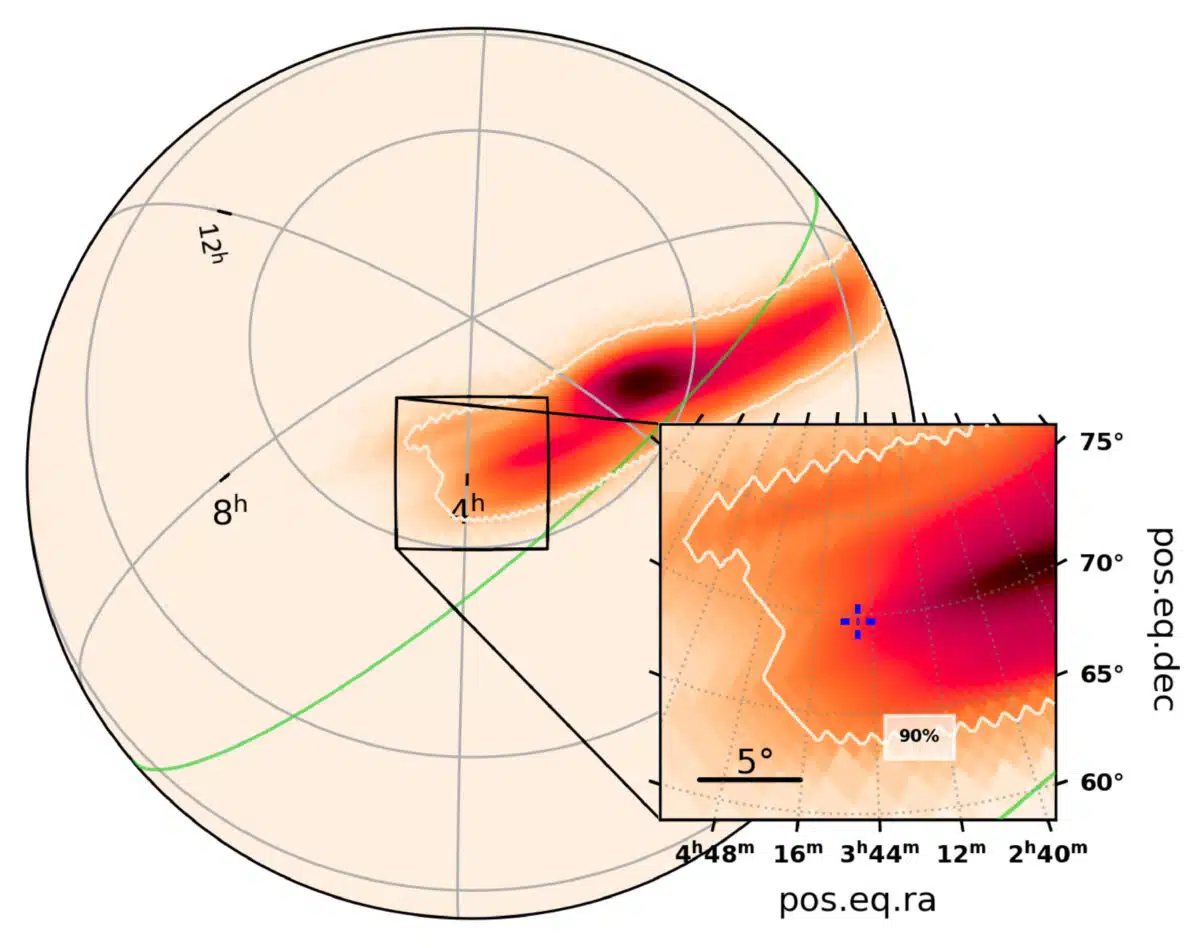 GW skymap of LVK S241125n and the GRB location. The color bar of the skymap represents the relative probability density of the GW source location. The white solid line represents the 90% confidence level contour, while the blue cross in the inset indicates the position of the candidate electromagnetic counterparts. The green curve indicates the Galactic plane. Credit: The Astrophysical Journal (2026). DOI: 10.3847/1538-4357/ae3319
A Rare and Powerful Event Across Multiple Wavelengths
The study, published in The Astrophysical Journal, presents compelling evidence that S241125n is a multi-messenger event that bridges gravitational waves and electromagnetic radiation, specifically gamma rays and X-rays. Gravitational waves, detected by the observatories, are ripples in spacetime caused by the violent collision of massive objects like black holes. In this case, scientists recorded the waves from a black hole merger about 4.2 billion light-years away, an astonishing distance that places the event in the early universe.
Just after the gravitational-wave signal, NASA’s Swift satellite detected a short GRB, followed by an X-ray afterglow from China’s Einstein Probe. These electromagnetic signals were pinpointed to the same region of the sky, making it highly improbable that they were unrelated. Such an alignment, researchers assert, could occur only once in several decades.
The Mystery of High-Mass Black Holes and the Search for Answers
One of the most striking aspects of S241125n is the extreme mass of the black holes involved. The study suggests that the two black holes involved in the merger each had a mass more than 100 times that of our Sun. This is significantly larger than most previous black hole mergers detected by LIGO, which typically involve black holes with masses in the tens of solar masses. These unusually massive black holes raise intriguing questions about their origins, suggesting they might have formed through previous mergers or exotic formation processes.
The discovery challenges existing theories of black hole formation and suggests that such heavy black holes can exist in distant regions of the universe. The large mass of the merging black holes implies that these events could be observed across vast cosmic distances, opening up new possibilities for understanding the history and evolution of black holes and their environments.
Exploring the Origins of the Gamma-Ray Burst
The study also presents an innovative explanation for how a black hole merger could produce a short gamma-ray burst. According to the team’s model, the two black holes may have merged within the dense disk of gas and dust surrounding a galaxy’s central supermassive black hole, an environment known as an active galactic nucleus (AGN). In this fuel-rich region, the merger triggered a process in which the newly formed black hole received a powerful “kick,” propelling it through the surrounding material.
As the black hole moved through the gas, it rapidly accreted matter at a rate that far exceeded the typical limit for black hole growth. This intense accretion likely created powerful relativistic jets of radiation and particles, which then interacted with the dense gas, generating shockwaves. These shockwaves heated the surrounding material, eventually causing it to release high-energy photons, the burst of gamma rays observed by Swift.
A New Era in Multi-Messenger Astronomy
If the association between the gravitational waves and gamma-ray burst is confirmed, it would mark a milestone in the field of multi-messenger astronomy, a new area of research that combines different types of cosmic signals to gain a deeper understanding of the universe. Until now, black hole mergers had only been detected through gravitational waves, offering a limited view of these cosmic events. With the potential confirmation of a gamma-ray counterpart, scientists could begin to study these mergers not just through sound but through light, expanding the tools available for investigating the most violent events in the universe.
This discovery also suggests that gravitational-wave events could be used as “standard sirens” for measuring cosmic distances. With the gamma-ray burst acting as a marker of the merger’s host galaxy, scientists could refine their understanding of cosmic expansion, providing a more accurate measure of the universe’s growth.