
Wearing a One Nation T-shirt, John Tate removes his Australian flag-branded bucket hat before asking the audience to stand, place a hand on their heart and sing the national anthem.
As the final strains of the second verse peter out, a man in the front row bows his head and raises his fist in the air.
It is just after 6pm on a Friday night and about 60 people are gathered inside Williamstown Soldiers’ Memorial Hall, about an hour’s drive north-east of Adelaide, for the launch of One Nation candidate Bruce Preece’s state election campaign.
Tate says he was “shanghai’d” into volunteering as Preece’s campaign manager for the Barossa Valley seat of Schubert. But he loves the Australian flag and hates the net zero emissions target, so he’s all in.
Two One Nation “heavyweights” are here as special guests: the party’s state president and upper house candidate, Carlos Quaremba, and New South Wales senator Sean Bell.
Sign up for the Breaking News Australia email
“What I say to the other parties who say that we are a grievance party is, well, we’re grieving because you’re not listening,” Quaremba tells the audience of mostly, but not exclusively, older men and women.
He says the 21 March state election is a chance to send a message not just to the “uniparty” in South Australia – the label One Nation attaches to Labor and the Liberals – but also to the prime minister, Anthony Albanese, in Canberra.
How can it be that petrol is nudging $3 a litre in some parts of the state, Quaremba asks, without mentioning the Middle East conflict behind the global oil price spikes.
“Because halfwits are running the country,” one attender grumbles in response.
With the federal byelection in Farrer not until 9 May, the SA state election is the first litmus test for the One Nation campaign apparatus and whether it can translate surging poll numbers into seats in parliament.
Can a political brand long associated with racism, internal dysfunction and hollow populist policies resonate with mainstream voters when it matters?
‘Any voice in a step forward’
The seat of Schubert is held by the state opposition leader, Ashton Hurn, and has been in Liberal hands since it was first contested in 1997.
If One Nation wins here, it would almost certainly mean the Liberals have been wiped out in SA in a political earthquake that would send tremors across the country.
Three separate opinion polls in February put One Nation’s primary vote in the 20s, ahead of the Liberals. The party is widely expected to win two of the 11 upper house seats, guaranteeing Quaremba and former Liberal senator-turned-One Nation state leader Cory Bernardi eight years in the state parliament.
It is running candidates in all 47 lower-house seats in an attempt to capitalise on the nationwide momentum, up from 19 seats in 2022 when it received just 2.6% of the vote. The party is expected to poll strongest in the parts of regional SA where Labor is uncompetitive, in particular the York Peninsula seat of Narungga and Mount Gambier and MacKillop in the state’s south-east.
Former Liberal senator turned One Nation candidate Cory Bernardi. Photograph: Sia Duff/The Guardian
Travelling in an aircraft registered to Gina Rinehart’s S Kidman and Co, Pauline Hanson campaigned with Bernardi in Mount Gambier and Narungga and the west coast seat of Flinders on Sunday and Monday in a clear sign of One Nation’s targets.
Hanson received a rousing welcome at the Hotel Maitland during Sunday’s visit with Bernardi and One Nation’s Narungga candidate, 30-year-old photographer and makeup artist Chantelle Thomas.
Major party insiders don’t expect One Nation to pick up those, or any other, lower-house seats when the votes are counted on Saturday, drawing parallels with the 2018 election when Nick Xenophon’s SA-Best party flamed out after surging in the polls months earlier.
Even Bernardi is playing down expectations.
“What does success mean? Success is a voice for One Nation and for South Australians in the South Australian parliament,” he says. “I hope we get one, I hope we get two, I hope we get three, and as many as we possibly can. But any voice is a step forward.”
Whereas Hanson’s backers, such as Rinehart, would be able to pour funds directly into the Farrer race, SA’s new electoral laws banning donations mean the local campaign is reliant on public funding.
One Nation’s SA branch has spent $1,980 advertising on Meta platforms in the 30 days to 13 March, compared with $81,000 from Labor-linked pages and $67,000 from Liberal accounts during the same period.
The new laws do create a incentive to run a statewide campaign, with the higher rate of taxpayer funding per vote set to provide One Nation with a major financial windfall.
The large-scale campaign is stretching One Nation’s resources on the ground. In Schubert, for example, the party was still looking for volunteers for at least five booths just hours before the polls opened.
‘Pauline and the gang have got the answers’
A few hours after voting opened on Saturday, a long and slow-moving queue had formed outside Playford Civic Centre in Adelaide’s working-class northern suburbs.
While One Nation’s surge nationally has come mostly at the expense of the Liberals and Nationals, the party believes it can threaten Labor by peeling off voters in areas such as these.
One Nation polled 10.4% in Elizabeth at the 2022 state election and 9.5% in the overlapping federal seat of Spence at the 2025 federal ballot, two of its best results in the respective polls but well short of the votes needed to win.
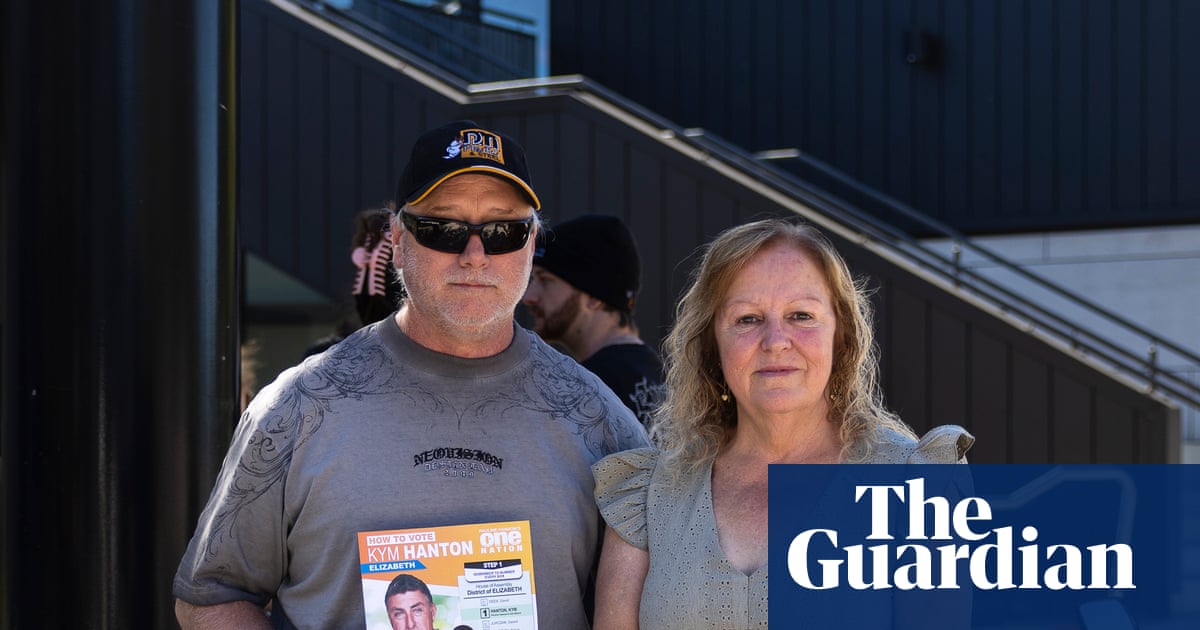
Waiting patiently in line are Chris, an irrigation technician with the local council, and his partner, Tracey. A self-described “working man”, he always voted Labor. But not today.
“We need big changes in this country, mate,” Chris, who did not provide his surname, says.
Bernardi with One Nation volunteers at an Adelaide pre-polling booth. Photograph: Sia Duff/The Guardian
“Pauline and the gang have got the answers, mate. The answers are what the people need. Labor is all ‘yeah, yeah, yeah – here are all the promises’. But then they dip in your pocket, take it out and say ‘yep – see you later’.”
The couple worry if their youngest child will ever own a home while Chris wants a stop to the “wind towers and all that rubbish”.
“Give us a chance to live, we don’t get a chance to live no more,” he says.
A similar list of grievances were aired at the Schubert campaign launch the previous evening, along with claims of “mass migration”, the supposed “brainwashing” of schoolchildren and wasteful local, state and federal government spending.
The audience broke out in applause when Bell, a former staffer to Hanson, remarked how “refreshing” it was to attend an event that opened with the national anthem rather than a welcome to country.
Preece himself made headlines last year after the local councillor was accused of snubbing an acknowledgment of country and using a homophobic slur.
Sitting in the audience on Friday night was 49-year-old Alana, who was raised a Labor voter before Christianity, and then the experiences of the Covid-19 pandemic, pulled her in another direction.
“I feel like the little people just get stepped on all the time,” says Alana, who also did not wish to give her last name. “I don’t feel heard.”
‘A policy-free zone’
Dressed in sharp suits, expensive shoes and a “B”-branded belt buckle, Bernadi comes across as a curious champion for the working class.
After images emerged of the 56-year-old disembarking the Rinehart-owned plane with Hanson on Sunday, the Labor premier, Peter Malinauskas, called out the contradiction at the heart of One Nation’s image.
“Pauline for the battlers, flying around in the richest person in Australia’s private jet? Enough said,” he told reporters on Monday.
Bernardi’s social media content – his main platform to communicate his message – is almost entirely about fanning culture wars, an obsession that defined his 13 years in the federal parliament. He rages about the state-based Indigenous voice to parliament – which One Nation has promised to abolish – mocks the Kaurna language and criticises the ABC.
In an interview with the public broadcaster during the campaign, he stood by comments from 2012 in which he linked gay marriage to polygamy and bestiality.
But fronting reporters at the start of early voting, Bernardi appears more interested in cost-of-living than culture wars, a recognition, perhaps, of the type of message needed to broaden One Nation’s appeal.
The premier, Peter Malinauskas, pictured campaigning at a recreation centre in southern Adelaide, is expected to easily retain government. Photograph: Sia Duff/The Guardian
“I’ve been on the cultural battlefields for 20 years, and I don’t resile from any of them, but you know, the fact is, there are things that we do need to talk about that are more important,” he said.
One Nation poses a challenge to the major parties strategically. Do you ignore them? Do you bite back?
Speaking at a leaders’ debate at Adelaide Oval on Friday afternoon – which Bernardi wasn’t invited to – Hurn says she is not a commentator on One Nation and will leave the party to “row its own canoe”.
Malinauskas, who is expected to win in a landslide on Saturday, offers a more nuanced take, which could serve as a template for his federal colleagues as they wrestle with the threat of Hanson and Barnaby Joyce.
He empathises with the frustration of One Nation voters, which he believes is born out economic inequality and a “sense of lost opportunity” that has manifested most acutely in the housing crisis. Confronting the threat of One Nation means confronting those issues, he says.
“What’s One Nation’s housing policy?” he asks rhetorically at a campaign stop on Saturday.
“Identifying problems in politics, that’s really easy, but the job is to actually provide solutions, and that’s why we’ve got a housing policy which stands in stark contrast to One Nation, which seems to be a policy-free zone at large.”
Waiting outside the Playford Civic Centre to cast his ballot, Chris doesn’t want to hear it.
“One Nation is the go, mate – I’m telling you right now.”