
For years, militaries across the world have sought more advanced, more complex and often more expensive weaponry, in a constant race to ensure they are not outgunned by potential adversaries.
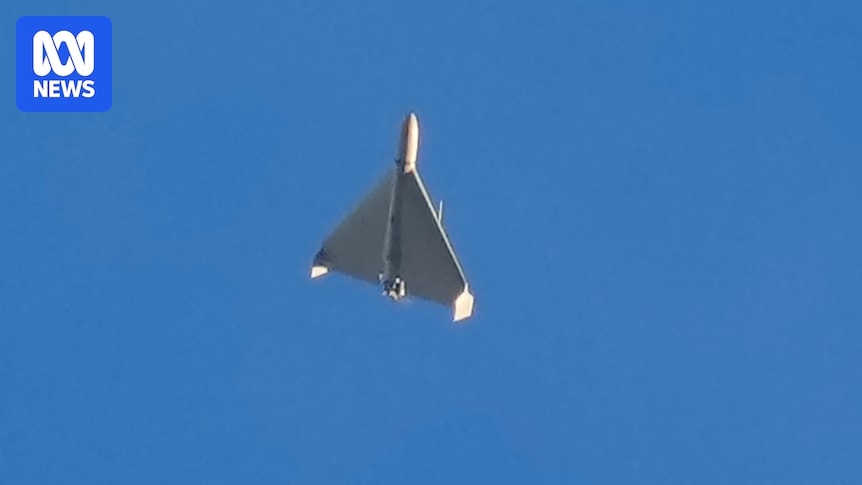
But a $US30,000 ($42,400) Iranian drone is up-ending some of that thinking and forcing those preparing for the possibility of future conflicts — including in Australia — to recalibrate.
Since the Middle East war broke out, Iran’s military has fired more than 1,000 of its Shahed drones at its neighbours in the Persian Gulf, the bulk of them bound for the United Arab Emirates.
Iran war live updates: For the latest news on the Middle East crisis, read our blog.
Iranian ballistic missiles and drones wreak havoc
While the drones cost tens of thousands of dollars to produce, the interceptor missiles used to shoot them down often cost upwards of $US1 million.
Defence analysts say the early lessons of the Iran conflict for Australia are fairly clear: drone warfare is here to stay and Australia needs to rapidly improve its counter-drone capabilities.
And Australia needs to think seriously about how it would defend its most sensitive locations — such as cities and key military bases — from long-range, mass-produced and deadly drone attacks.
A cheap drone and its copycats
The Shahed drone has played a significant role in the Iran conflict, but western militaries have seen it before.
Russia has been using its own version of the Iranian drone in Ukraine, prompting the US and Gulf countries to turn to Ukraine for assistance in dealing with the current threat.
The Shahed 136 (one of the more common forms) has a range of up to 2,500 kilometres and can carry a 50-kilogram warhead, according to the Centre for Strategic and International Studies.
But it is relatively slow-moving, at about 180 kilometres an hour.
The drones are designed to be used in “saturation”. They are deployed in large numbers to overwhelm air defences, so while most will be shot down, a few will get through.
And that is where cost becomes a real concern.
The Patriot interceptor missiles, frequently used by the United States, can cost up to $4 million per shot.
They were designed to intercept ballistic missiles, not large numbers of cheap, slow-moving drones.
Loading…
And fighter jets — like those the UAE has deployed to chase down drones — might be spending $1 million with every AIM-120 air-to-air missile fired.
Ian Langford, a former senior Australian Defence Force officer who now leads the firm Security and Defence Plus, said the swarms of drones aimed to run down stockpiles of valuable interceptors.
“In Iran’s case … they’ve made the quite prudent decision to throw these low-cost effectors at the air defence systems with the sole purpose of overwhelming them,” he said.
“And then once they’re overwhelmed, they use their key hypersonic and other cruise missiles to then target infrastructure to include data centres or refineries, ports, airports.”
But the drone traffic has not all been one-way.
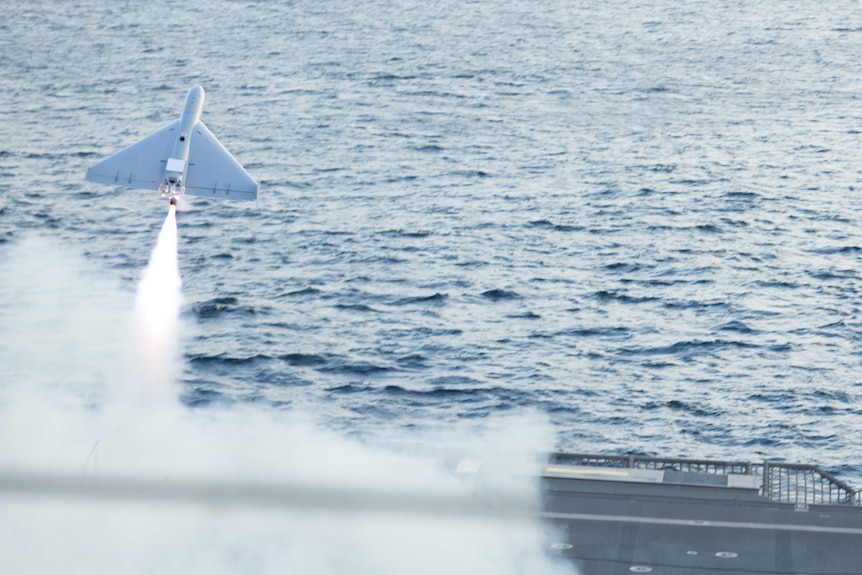
The United States has created its own version of the Shahed drone. (US Navy: Kayla Mc Guire)
In recent years the United States has been working on a cheap, mass-produced drone of its own — the LUCAS, or low-cost unmanned combat attack system.
It was modelled on the Shahed drone, and deployed for the first time in this conflict against Iran.
The risks — and opportunities — for Australia
There is plenty of thought, and a fair bit of money, going into what future drone warfare might look like for Australia.
The ADF is spending $1.3 billion on counter-drone measures over the next 10 years through Project Land 156.
Elizabeth Buchanan from the Australian Strategic Policy Institute said there were “indirect” lessons for Australia from the Iran conflict.
She said the conflict was only relevant to a point, given the very tight geography of the Persian Gulf compared with Australia’s vast and isolated landmass.
US could strike Iran with a copy of its Shahed attack drone
But she said the overarching lesson — that drones were likely to play a substantial role in any future conflict — was worth heeding.
“We are slowly getting there but have a pace issue — especially in terms of an integrated air and missile defence capability for northern approaches or major cities or infrastructure,” she said.
“Key will be mass and scale for Australia’s solution to innovation in modern warfare, and of course, cost.
“For decades, we have been innovators in the defence space so surely we can build low-cost solutions.”
The 2023 Defence Strategic Review sounded the alarm on Australia’s integrated air and missile defence, describing the need as “urgent”.
It criticised the approach the ADF had taken until that point as “pursuing a long-term near-perfect solution at an unaffordable cost”.
Professor Langford said it was vital that Australia worked out two problems: how to counter drones on the modern battlefield and how to counter them at home, too.
“I think about submarine bases like HMAS Stirling, which will host our AUKUS submarines,” he said.
“I think about our northern airfields, our ports and our critical civilian infrastructure as well.
“All of this will need the kind of counter-drone protection that our military assets will need in the event of conflict in our region in the coming decades ahead.”
He said the pace of innovation in this area only added to the urgency.
“We’re in a race, effectively, to out-innovate and out-manufacture the adversary when it comes to these low-cost drones and how we protect ourselves against them.”
The other big lessons
Military analysts watching the Iran conflict from afar say there are other big lessons to be drawn from its first two weeks.
Cost is one big factor. The Centre for Strategic and International Studies estimated a cost to the United States at day 12 of $US16.5 billion, but suggested that was levelling out as the American military switched to cheaper munitions.
Dr Buchanan said the current concerns over fuel supply in Australia also needed to be noted and viewed not just as a problem for those trying to fill their ute.
Expert analysis on the Middle East:
She said the current concerns highlighted the “lack of resilience” in Australia’s logistics systems.
“We are stress-testing our fuel network in real time, but the government is unfortunately only framing this process in terms of ensuring the network has enough fuel for public use,” she said.
“Our defence infrastructure is fuel dependent from jet fuel to road trains to move munitions around the nation for pre-positioning if needed.
“So we must move away from this continued sense of ‘just in time’ framing of security interests in Australia.”
As the war tests supplies of missiles and other interceptors, some argue Australia could and should be doing more to manufacture — and export — missiles.
Loading
Australia’s first batch of locally assembled guided missiles will soon roll off a factory floor in South Australia’s Port Wakefield, with hopes the plant will eventually produce 4,000 missiles per year.
Dr Buchanan said as the United States’s ability to meet its own demands was tested, Australia should respond by further reducing reliance on the country’s exports and even building reliance in the US on Australian products.
“This is about leverage. We must build leverage into our defence ties with Washington, at least some semblance of agency in the relationship,” she said.
“If we integrate ourselves in defence industrial base terms in the US system, then we can garner a level of reliance.
“We don’t need to be manufacturing entire systems, but we can bring online rapidly component-level manufacturing, [like] rocket motors or components of the Virginia Class submarines.”
Professor Langford said the lessons of this conflict for militaries across the globe would continue to come, from drones, to the use of AI, to the future impact of things like quantum computing and more.
“We are at what many have called the ‘revolution in military affairs’ moment, where the character of conflict is changing to such a degree that everything changes,” he said.
“The opportunity [is there] for Australia to embrace this technology early and be a beneficiary in that regard, or if we wait, we risk being outmatched by an adversary in our region come the next conflict.”
Loading…