
Losing access to the stars
The report comes as Australia faces a decision about its future access to some of the world’s most advanced astronomical facilities.
Australia currently participates in the European Southern Observatory (ESO) through a strategic partnership that began in mid-2017.
The organisation operates several major telescopes in Chile’s Atacama Desert, one of the best locations on Earth for optical astronomy thanks to its high altitude and dry air.
The partnership allows Australian researchers to apply for observing time on facilities including the Very Large Telescope (VLT), an array of four eight-metre telescopes capable of observing extremely faint objects in the distant universe.
But the agreement is due to expire in 2027 and no decision has been made to support Australian optical astronomy once it has ended.
Australia has been invited to apply for full membership of ESO, which would secure long-term access to its telescopes.
“Once our strategic partnership ends, we’ll lose access to those fantastic facilities,” Professor Brough says.
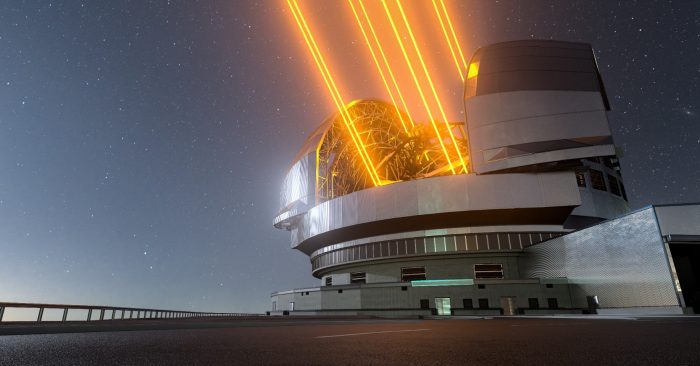
ESO membership would also give Australian astronomers access to the Extremely Large Telescope (ELT) under construction in Chile, which will be the largest optical and infrared telescope ever built when it is completed next year.
With a mirror 39 metres in diameter, the ELT will allow astronomers to observe galaxies forming near the beginning of the universe and study the atmospheres of planets orbiting distant stars.
“With a larger telescope you can see further away, closer to the beginning of the universe,” Prof. Brough says.
“That lets us study how the earliest galaxies formed and evolved, and understand how planetary systems like our own formed.”
Without full ESO membership, Australia will not get access to the Extremely Large Telescope.
Australia is helping build the Square Kilometre Array (SKA) in the remote deserts of Western Australia and South Africa, a multibillion-dollar global project that will be the largest radio telescope ever built when it starts operating next year.
As a radio telescope, the SKA is designed to observe gas in the universe, while the ELT is an optical telescope designed to see the stars.
Professor Brough says the two projects were planned to complement each other, and if Australian scientists lose access to the ELT, their research will become a lot harder.
But, she says, together these facilities would allow Australian scientists to conduct the most advanced astronomy for decades to come.
“We need both to do our science,” says Professor Brough.
“If we don’t get access, we could end up sitting in the dark while the rest of the world moves ahead.
“Right now, we’re world leaders in the science.
“But without access to cutting-edge facilities it really limits our future.”
Membership fees amount to about $40 million per year either in cash or in-kind support, such as cutting edge instruments and engineering assistance.
That ‘in-kind support’ has historically led to a boon for local Australian businesses working in high-tech and precision engineering fields related to the project.
Professor Brough says the federal government is considering a proposal by ESO.