
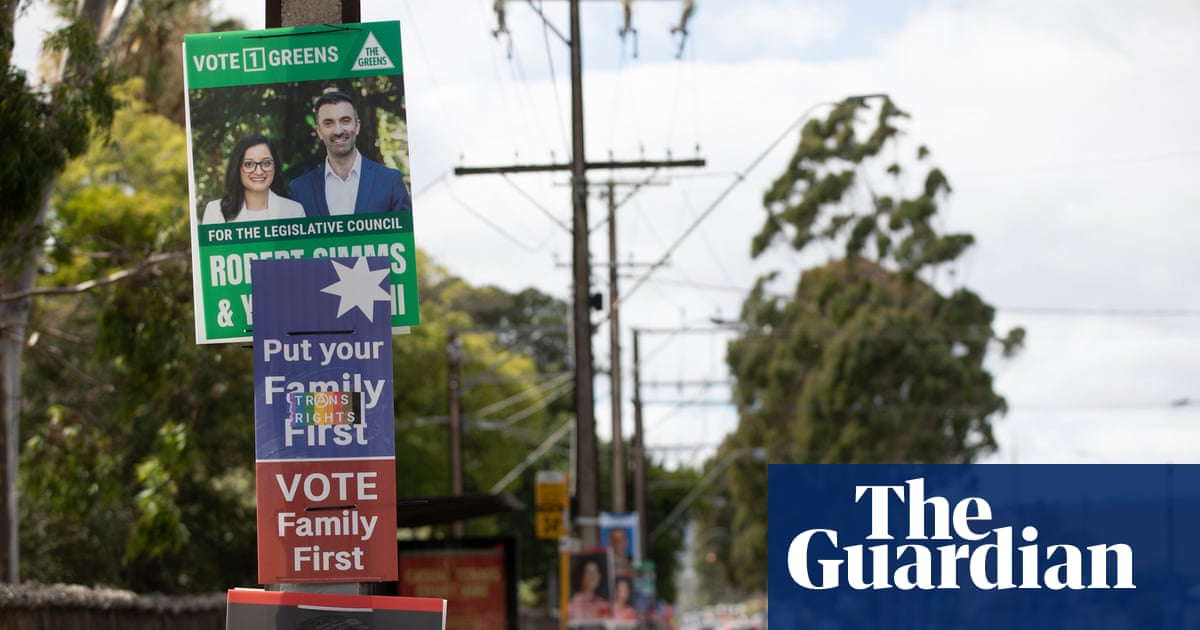
Saturday’s South Australian election is the first since laws banning donations to political parties were introduced, a move which some warned would lead to funds being diverted to external groups.
A number of organisations have registered as third parties in time for the ballot, meaning they can raise and spend funds, but disclosure deadlines mean the full amounts will not be known until after polling day.
Among them are the rightwing lobbyists Turning Point Australia, the anti-abortion activist Joanna Howe, the Australian Christian Lobby, the progressive lobbying group GetUp, various unions and the former Liberal MP Christopher Pyne, who describes himself as a “minnow” and is supporting a few Liberal candidates.
Turning Point Australia is the local version of the US organisation founded by the late Christian conservative influencer Charlie Kirk, part of the Maga movement.
The Australian body, its SA coordinator, George Mamalis, and Howe each have hundreds of thousands of social media followers, and are urging supporters to vote for One Nation.
‘Loopholes and perverse outcomes’
The legislation bans donations to political parties, independents and MPs, replacing that money with public funds and putting caps on donations and expenditure.
New entrants can accept individual donations of up to $5,000.
Third parties that intend to spend more than $10,000 must register and meet disclosure and auditing requirements.
Sign up for the Breaking News Australia email
“Significant penalties including fines of up to $50,000 or a term of 10 years’ imprisonment are available for any individual who seeks to deliberately circumvent the laws, including third parties doing so by colluding with registered political parties,” a government spokesperson said.
The director of the Australia Institute’s democracy and accountability program, Bill Browne, says banning direct donations will not necessarily improve the system.
“The problem with a so-called political donation ban is that the money can be spent on third-party campaigning which, if anything, is less accountable,” Browne says.
Browne argued when the laws were passed they would deliver too much taxpayer funding to the major parties. The premier, Peter Malinauskas, said on Monday the “opposite was true”, and that public financing would be provided based on how people voted, “as distinct from wealthy donations from uber-rich individuals with a vested interest”.
“This election is going to be determined by the quality of policies, the quality of candidates, not the size of the bank balance in candidates’ or political parties’ pockets,” he said.
Expenditure by third parties is capped at $450,000. There are various rules around reporting giving and receiving donations, but the deadline for third-parties’ spending in March is 7 April – several weeks after the election.
Browne says third-party groups have a legal right to political communication, but that the reforms have led to “loopholes and perverse outcomes”.
“Under the new laws, a candidate who takes on a powerful interest group can be out-fundraised and outspent by that group many times over,” he says.
“That’s perverse given the candidate is accountable to voters while the lobby group may be opaque, self-interested or an astroturfing operation.”
Anne Twomey, constitutional law professor emerita at the University of Sydney, has similarly written about the risk that the donation ban would lead to money flowing to lobbyists.
“It has the potential to distort election campaigns, with well-funded interest groups dominating the discourse and forcing political parties to dance to their tune,” she wrote in the Conversation.
Adelaide-based anti-abortion activist Joanna Howe said she encourages people to vote for people committed to stopping abortion. Photograph: Matt Turner/AAP
GetUp says it has registered as a third party in response to Turning Point’s registration and support for One Nation, as well as separate “concerns about opacity, astroturfing and dark money distorting elections”.
“One Nation is surging in the polls,” its interim chief executive, Paul Ferris, said.
“GetUp’s campaign is about making sure … the voters hear another perspective.”
Several recent polls have put One Nation’s primary vote in the 20s, ahead of the Coalition.
Asked about how she funds her campaigns, her objectives at the election and concerns about third parties, Howe said she encouraged people to vote for people committed to stopping abortion and “to opposing discrimination against children based on their age, location, disability, sex or stage of development”.
Turning Point Australia have been approached for comment.
Podcast push
In a podcast Mamalis and Howe recorded together last week, they discussed abortion, the “trans agenda” and the idea that One Nation could replicate the success of Nigel Farage’s Reform movement in the UK.
Mamalis said the left had “demonic ideas”.
“I think it’s because they’re possessed by some evil entity,” he said. He also said misogynist Andrew Tate, who is being investigated in connection with human trafficking, was not a good role model but was a “necessary evil”.
“The reality is, sometimes you need some toxic men to do some toxic stuff to help boys,” he said.
The Liberal leader, Ashton Hurn, shadow treasurer, Ben Hood, and former leader David Speirs (who is running as an independent after a conviction for drug supply) have appeared on the Turning Point Australia podcast in recent days.
The group’s how-to-vote cards put One Nation in the No 1 spot in most of the state’s 47 seats and in the upper house.
In a video called How you Should Vote in the 2026 SA Election, Howe recommends voting One Nation first in both houses.
She says she supports One Nation and Bernardi because they are pro-life – One Nation’s policy is to roll back access to abortion.
On the podcast Howe was also critical of the Liberals’ decision to disendorse its candidate Carston Woodhouse, who described feminism as “demonic” and asked what “demonic realms” had been opened up “by accepting homosexuality”.
“They’ve disendorsed him for having mainstream Christian views,” Howe said.