
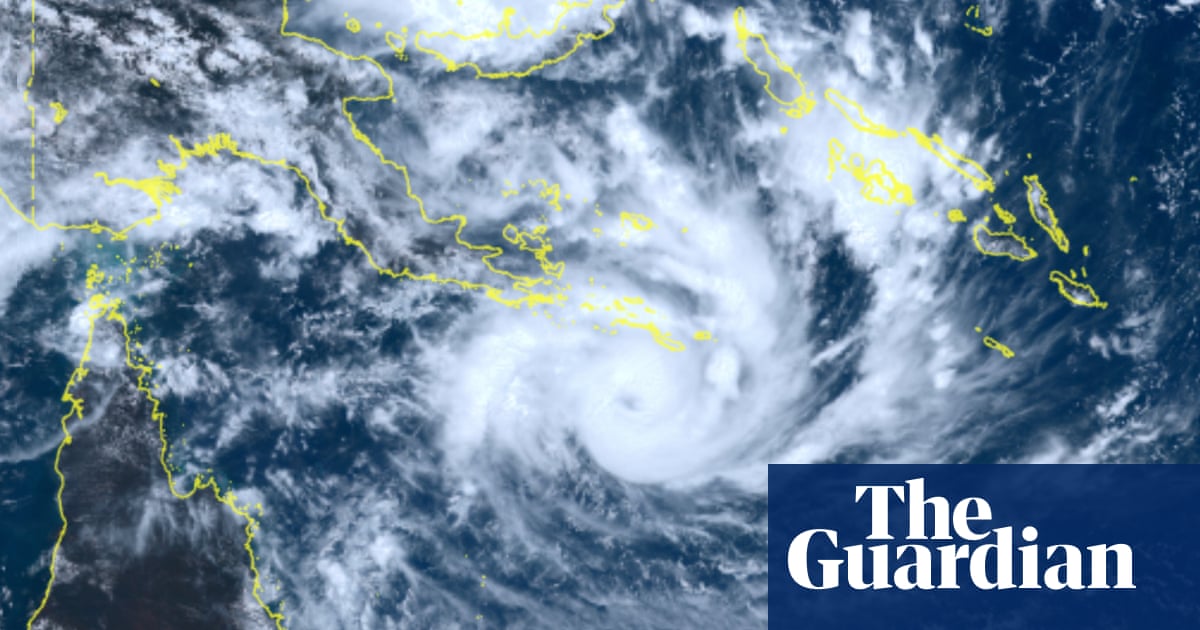
North Queenslanders could be facing the biggest tropical cyclone “in living memory”, with the massive Tropical Cyclone Narelle expected to cross Cape York on Friday.
Narelle formed on Tuesday evening, south of Solomon Islands, and on Wednesday was heading towards the far north Queensland coast. Sue Oates from the Bureau of Meteorology said the storm had a 90% chance of heading west, making landfall likely near Coen on Friday.
“An estimate of wind gusts at that time is about 200 to 250 km/h, noting that’s the intense core around the eye of the system, with the destructive winds extending out from that core,” she said.
Oates also warned of intense rainfall, flash flooding and strong tides.
A satellite image from Japanese weather satellite Himawari-8 showing Tropical Cyclone Narelle in the northern Coral Sea. Photograph: Himawari-8
The Queensland premier, David Crisafulli, said the state government was sending emergency services resources to the area. The luxury resort on Lizard Island has been evacuated, with a handful of staff staying behind, he said.
Lizard Island is also home to a coral research station run by the Australian Museum.
A museum spokesperson said: an Australian Museum spokesperson said the station was monitoring the cyclone and had activated a cyclone management plan.
Seven people have departed the island and eight essential staff remain on-site, with cyclone shelter arrangements in place ahead of the forecast system.
Vulnerable people are also being flown out of the cyclone zone, such as those who need dialysis or who are pregnant.
“This may be the biggest system that many people have seen in living memory, and that’s why we’re asking people to prepare as we have,” Crisafulli said.
He urged people to use Wednesday to prepare or evacuate.
Queensland police disaster coordinator Chris Stream warned of potential loss of life.
“This is not the opportunity for you to be outside during the cyclone, getting that tick tok moment. Do not do it. A piece of debris being propelled at 100 kilometers or more will likely kill you,” Stream said.
The Bureau of Meteorology released an update map of the likely track and intensity of the cyclone late morning on Wednesday.
On Wednesday afternoon, Senior meteorologist Jonathan How said the cyclone was expected to make landfall near the town of Coen on Friday morning as a Category 4 system.
After that, the system is likely to hold it’s cyclone status as it reaches the waters of the Gulf of Carpentaria where it will likely intensify from a Category 1 to a Category 3 before making a second landfall on Saturday night.
How said it would likely loose its wind speed and become a tropical low as it moved west, but could drop significant rain over the Top End – a region where the ground is already saturated with some areas such as Katherine and Daly River still in recovery mode from floods.
What happens after that is more uncertain, How said, but there is one scenario where the system leaves the land and re-intensifies into a cyclone and makes a third landfall in Western Australia early next week.
The bureau is due to issue a new track map before 5pm Queensland time today.
Cyclone categories are dictated by the average expected maximum wind speed which, at category 4, is between 160 km/h and 199 km/h. Category 5 systems have wind speeds of 200 km/h or above.
Cyclone categories don’t take account of other hazards, such as flooding or tidal surges.
Category 4 storms can deliver significant roofing loss, structural damage and can blow away caravans and generate dangerous airborne debris with widespread power failures.
Category 5 storms are described by the bureau as “extremely dangerous with widespread destruction of buildings and vegetation.”