
March 18, 2026 — 7:55pm
Save
You have reached your maximum number of saved items.
Remove items from your saved list to add more.
Save this article for later
Add articles to your saved list and come back to them anytime.
Got it
AAA
To submit a letter to The Age, email letters@theage.com.au. Please include your home address and telephone number below your letter. No attachments. See here for our rules and tips on getting your letter published.
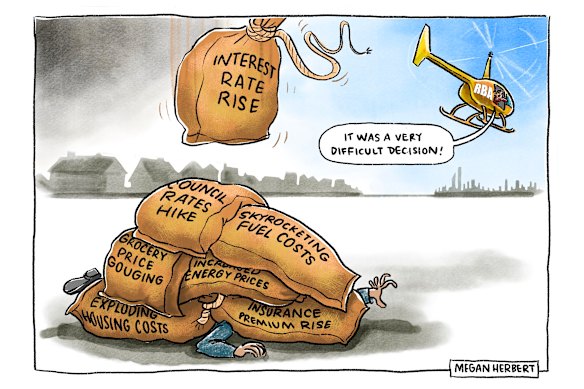 Photo: Megan HerbertCOST OF LIVING
We may never know how much global inflation has influenced the Reserve Bank’s decision to raise interest rates (“RBA warns Chalmers of recession”, 18/3). There are at least two economic systems, our national and global systems. Some inflation pressures, such as supply and demand, poor productivity, labour supply, and wage increases, will be unique to us. Interest rates are clearly one possible lever to confront the challenges of inflation. However, I would ask whether it is sensible or useful to raise interest rates when the global system, over which we have no control, is subjected to the same pressures? Raising interest rates will only put more pressure on a significant number of Australians, while the whole world is subjected to inflation pressures outside of anyone’s control – apart from a crazy few.
Howard Tankey, Box Hill North
Circular conundrum
Rent is part of the CPI calculation measuring inflation. A rise in interest rates “forces” property investors to seek increases in rent to cover the higher interest costs they will incur, which further increases inflation. Does the home-ownership concentration mean this circular conundrum will never end?
John Murray, Hawthorn East
Rough after smooth
The flaw in Alison Pennington’s claim (“There are more, better ways to fight inflation than hikes”, 18/3) that interest rates are a blunt instrument in 2026 is that opponents of RBA policy were extremely scarce when interest rates were very low a decade ago. We had the smooth, now we have the rough.
Alun Breward, Malvern East
RBA vote requirements
An inconclusive 5-4 RBA vote raises interest rates and causes more mortgage stress and ruined aspirations. Maybe the RBA should be required to have a minimum 75 per cent vote in order to change rates. No clear majority, no change.
Arthur Pritchard, Ascot Vale
Need for tax reform
Allegra Spender represents one of the wealthiest electorates in the country, but has nonetheless proposed a set of substantial tax reforms around property and superannuation (“Slash income tax, lift it on assets: Spender’s plan for tax reform”, 11/3). Why can’t the ALP do likewise? Treasurer Jim Chalmers is at least giving signs that he is toying with similar ideas, but we are getting little to no sign that the PM has much appetite for reform. If Anthony Albanese is again found to have stymied the push for tax reform, it is surely time to challenge his leadership. He can’t continue to boast of his willingness to “fight tories” when he remains committed to policies that are so obviously conservative in nature.
Tim Thornton, Northcote
Where’s the economic policy?
Listening to shadow treasurer Tim Wilson on ABC TV respond to the RBA’s decision to lift the cash rate, when asked what his economic policy would be, he declared he would pursue the alleged fraud and corruption associated with the NDIS and the CFMEU. Last I checked, these are examples of the enforcement of existing laws, but not an economic policy.
Michael Cowan, Wheelers Hill
Government not RBA
Before every election, we hear that one party or another is the better economic manager, and we elect our choice accordingly. I don’t remember ever voting for the members of the Reserve Bank, yet this body is allowed to ignore the causes of inflation, and hit the people who don’t cause it, and can’t afford to pay for it. It is overdue time that the government took this activity off the Reserve Bank, and ran the economy as it should be doing.
Geoff Schmidt, Richmond
A brake on spending
Did we really need a rate rise when the soaring price of fuel, caused by US President Donald Trump, is going to stop people spending which will reduce inflation?
Michael Brinkman, Ventnor
THE FORUM
Where’s the ambassador?
It’s a bit rich for US President Donald Trump to have a hissy fit over Australia’s decision not to send troops to the American and Israeli attack on Iran (“Trump blasts Australia as US official quits over Iran war”, 18/3).
Perhaps, he should think about appointing an ambassador to Australia. I’m sure that Charge d’Affaires Erika Olson is doing her job, but not appointing an ambassador is an insult.
Dr Juliet Flesch, Kew
Voting for regime change
As yet another generation of federal politicians blindly follow the United States into a war based on dubious intelligence, it is my intention to seek regime change through the ballot box at the next federal election.
No bombs will be dropped, no intercontinental ballistic missiles will be launched, no blood will be shed; the only sound will be that of a completed voting paper dropping quietly into the ballot box.
Ruth Richardson, North Fitzroy
Related Article
War without a plan
Donald Trump starting a war without a plan? Chaos is immediately created and the war can be won only by an invasion that involves boots on the ground and/or other countries joining in.
On the other hand, Iran has no need to attack or invade. Just a need to hold on for a few weeks, or maybe a few months, and watch the lack of oil bring the world’s economies to their knees. Thanks, Donald.
John Ellis, Golden Point
Others need haven, too
The excellent article, “‘No other choice’: Iranians fighting for their lives out of the spotlight” (18/3/), draws attention to asylum seekers who have been in Australia for more than 13 years, waiting for a resolution to their application for a haven. While they are not high-profile soccer players, their need is just as great, having fled war, persecution and abuse.
While the article focuses on the Iranian community, there are many others from other countries, who are equally deserving. They have already proven they are good citizens, by working, paying tax and supporting their families, many without government support. It seems to those of us who have been involved with this cohort that it was grossly unfair to rapidly grant humanitarian visas to one group, without extending the same courtesy to the other.
Could it be political point-scoring and a photo opportunity?
Joan Schoch, Avondale Heights
Big dumb cars
Compared with Europe, giant cars have become the most popular in Australia over the past 10 years. The top gas guzzlers include large SUVs, 4WDs and utes that are becoming common family cars. Rare are the sedans and hatchbacks, once the most popular cars on the road. While families are becoming smaller, it’s ironic that car sizes have become bigger.
In 2023, the Australia Institute report, In reverse: The wrong way to fuel savings and falling transport emissions, concluded: “Australians buy big dumb cars and that means we spend a lot more on petrol than we should.” So, with the current war in Iran posing restrictions on future oil supply in Australia, can Australia’s “car-besity” problem be addressed to reduce oil consumption at the bowser?
Frank Collins, Selby
EV no-brainer
Charging my EV between midnight and 6am costs me about $4 for 400 kilometres (even less using my home battery and solar energy), instead of about $92 for unleaded petrol for the same kilometres. So, no bowser anxiety (or price gouging by the oil companies) with commuting by EV. Pumping electricity instead of gas has never made more cents, while saving the planet.
Tony Danino, Wheelers Hill
Uber drivers taxed
The challenges drivers face due to Uber maintaining the prices they charge customers and pay drivers (“Fuel crisis could drive Uber, taxi fares higher”, 18/3) further call into question the Australian Taxation Office’s absurd view that it is the driver providing the service. The ATO makes drivers remit GST, not Uber.
When I book a ride on Uber, I have no choice over the driver nor do drivers have a choice over the fare charged. Clearly, Uber is responsible for the service and should be responsible for collecting the GST paid by the consumer, not the driver. This is reflected in Victorian law which regards Uber as the service provider. The ATO should modernise its thinking.
Sam Gow, Hughesdale
Egging on obesity
A correspondent (Letters, 18/3) decries the apparent shrinking of Easter eggs. Considering the ongoing “cocoa crisis”, which has resulted in the more than doubling of cocoa prices in recent years, surely confectionery manufacturers are asking themselves what’s better for business: larger expensive eggs or smaller affordable eggs? I’d wager our cost-of-living crisis has had a hand in answering that question.
But perhaps a different, more altruistic and overriding decision has been made. Given rapidly increasing obesity rates, might it be true that manufacturers are simply encouraging healthier lifestyles? I’d like to think so.
Peter Myers, St Kilda
Teachers gift labour
Unsurprisingly, the ongoing teachers’ dispute is significantly impacting the education sector, with schools confronting the repercussions of staffing shortages. The 18.5 per cent pay rise offer by the Allan government fails to consider a fundamental economic principle: labour follows value.
By the projected end of 2026, the state anticipates a teacher’s earnings that are $15,000 less than those of their New South Wales counterparts. The branding of the “Education State” conflicts with a funding shortfall of $2.4 billion and an average of 12 hours’ unpaid weekly overtime per teacher.
A system that heavily depends on “gifted labour” is not sustainable. According to the Australian Education Union, the long-term viability of the teaching profession and the quality of Victorian education are fundamentally interconnected.
The government must go beyond discourse regarding keeping schools open with retiring teachers (“Schools to be open during strike: Carroll”, 18/3) if it is to prevent the pedagogical standstill that results from persistent staffing shortages.
It must offer a competitive, fully financed structure that accurately represents the genuineness of human resources.
Amalia Alvarez, Burwood East
Anger at philanthropy
Re “A bottle shop spat could pave way for new women’s refuge” (18/3): I couldn’t help but get frustrated to downright angry as it begs the question, should essential services depend on philanthropy?
While I agree we should celebrate this generosity of a well-meaning philanthropist, we should never depend on it for safety. As a society, we are relying on the donations of a stranger to save the day, rather than the government, which exists to provide a baseline safety and equity to its citizens, particularly when it comes to violence against women, which is a national crisis.
A government that leaves its most vulnerable women waiting for charity is not just underfunded, it is under-prioritised. A refuge may literally determine whether someone lives or dies.
The Victorian government has the capacity to fund a $125 million settlement for the hotel quarantine class action, a further $13 million on the discarded machete amnesty program, and let’s not forget the nearly $600 million lost on their decision to cancel the Commonwealth Games.
Yet, a women’s refuge requiring just $2.9 million in funding
remains dependent on private philanthropy.
Yvette Bulhakow, Altona Meadows
Heartbreaking rules
Thank you to your corespondent (Letters, 18/3) for your reminder to all readers of the 10-person limit at funerals during the COVID-19 pandemic days. Having to farewell both my son and my mother within a few weeks of one another during 2020 under those “needless” restrictions was more than cruel … it was heartbreaking.
The ongoing repercussions of stripping a family of the right to respectfully mourn the death of a loved one surrounded by supportive extended family and friends cannot be ignored or dismissed. No class action for our losses could ever compensate. We will never forget.
Sue Skahill, Bendigo
AI not the problem
Sean Kelly’s column (“AI is great, except when it gets everything wrong all the time”, 16/3) captures a frustration many people are feeling. But it risks drawing the wrong conclusion.
Generative AI isn’t like Google, where you expect a single correct answer. It’s closer to a tool that helps you think through a problem, and the quality of the result depends heavily on how you use it.
If you know the topic, AI can be useful. If you don’t, it can sound convincing while still being wrong.
We’ve seen this before. When spreadsheets first appeared, people made plenty of mistakes. The problem wasn’t the software, it was people not using it properly.
AI is similar. It can be powerful, but it doesn’t replace judgment.
Blaming the technology misses the point. The real challenge is learning how to use it well, and knowing when to question the answer.
Josh Rowe, Coburg
Cherry-picking issues
Our world is in extreme disarray, and yet two young Hawthorn footballers are being charged and exposed through the media in Australia for climbing up on a cherry picker on a night out (“Hawks ‘didn’t know’ boom lift wasn’t theirs, video shows”, 18/3).
Come on Australia. Shouldn’t we get behind these two young men and stop being the Granny State? America, don’t you have more important issues? Why do you need to spend time on such a frivolous issue? Let’s get real and be concerned about the issues that make a difference for our communities and our world, and let our young be young.
Helen Anderson, Rosanna
AND ANOTHER THING …
Iran war
What percentage of Australia’s toilet paper supply is shipped through the Strait of Hormuz?
Colin Nicholson, Brunswick West
Someone no longer wants our help. A perfect time to get out of AUKUS and for the bases to go.
Sergio Bobbera, Curlewis
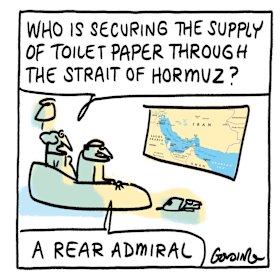 Photo: Matt Golding
Donald Trump’s “excursion” into Iran will be over as soon as US fuel prices climb nearer to $7-plus a gallon. Such pain is just too much for Americans to bear, no mater how great they are.
Mark Kennedy, Sebastopol
POTUS redefined: Pompous Obstinate Tyrannical Un-presidential Sociopath.
Robert Latimer, Bairnsdale
The obscenity of the American and Israeli war on Iran is overwhelming but does it mean that the war in Gaza is now over? I’ve seen no mention of it for the past three weeks.
Keith Fletcher, Glenlyon
Politics
Our tomatoes didn’t ripen this season. Which government do I blame, state or federal?
John Bye, Elwood
There appears to be a disconnect between the Reserve Bank being repeatedly surprised by the strength of the economy and consumers struggling with “a cost-of-living crisis”. Can both be true?
Garry Meller, Bentleigh
I cannot go past the obvious: If One Nation is the answer, what is the question?
Alan Gamble, Boronia
Furthermore
Jacinta Allan’s priorities: Games in the bin. Ducks in the bag.
Malcolm Cameron, Camberwell
If we ever have to deal with another once-in-a-hundred-years pandemic, it’s good to know the government will have any number of armchair experts to rely on for advice.
Peter McGill, Lancefield
Finally
Any truth in the rumour that Carlton want to recruit Queen Mary of Denmark for the forward line, after that goal-kicking session on Tuesday at the ’G?
Brian Kidd, Mt Waverley
Editor’s pick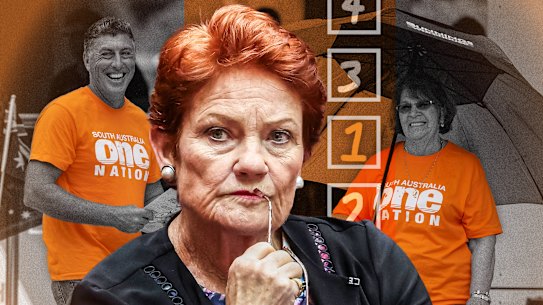
The Opinion newsletter is a weekly wrap of views that will challenge, champion and inform your own. Sign up here.
To submit a letter to The Age, email letters@theage.com.au. Please include your home address and telephone number below your letter. No attachments. See here for our rules and tips on getting your letter published.
Save
You have reached your maximum number of saved items.
Remove items from your saved list to add more.
From our partners