
Key events
Show key events only
Please turn on JavaScript to use this feature
 Luca Ittimani
Some borrowers will soon have expenses beyond their incomes, RBA warns
More households will soon be spending more than they earn as interest rates and petrol prices rise, the Reserve Bank has warned.
The share of mortgage holders spending more than they earned had been falling steadily from about 4.5% owner-occupiers in 2023 to about 1.3% as interest rates and inflation eased, the RBA’s checkup of the Australian financial system showed.
That will now rise to at least 1.6% by the end of 2026, mostly due to rising interest rates, worsened by a slight rise in unemployment. With inflation set for an unpredictable surge, the share is likely to be higher.
However, those people whose expenses start outweighing their incomes this year will not likely default on their mortgages thanks to their strong savings buffers, the RBA said.
Borrowers are increasingly making extra mortgage repayments and generally have enough of a savings buffer to keep paying debts even if a recession or higher inflation and interest rates crunches their disposable income, the review found.
Even if a severe financial shock sent house prices crashing 40%, the recent surge in home values has been so strong that only one in five mortgage-holders would go underwater with loans bigger than their home values. The rest would be able to make the “difficult and disruptive” decision to sell their home, the review found.
Updated at 20.54 EDT
Unemployment rate rises to 4.3% as full-time losses offset part-time boom Patrick Commins
The unemployment rate has lifted to 4.3% in February, from 4.1% the month before, despite a solid 48,900 increase in the number of employed Australians.
The mixed picture of solid jobs growth and a higher unemployment rate is a result of a lift in the workforce participation rate, the latest figures from the Australian Bureau of Statistics showed.
Employment growth was thanks to a 79,400 jump in part-time workers, offset by a 30,500 fall in full-time employment, the seasonally adjusted figures revealed.
Underemployment – which adds in those with work but who can’t get the hours they want – was steady at 5.9%.
The Reserve Bank has repeatedly pointed to a tight-ish labour market as part of its concerns around returning inflation back to its target range of 2-3%.
The jobless rate has been in the low fours for the past two years.
Updated at 20.55 EDT
Victorian chief health officer warns of legionnaires outbreak in Melbourne’s north
Six cases of legionnaires’ disease have been detected in Melbourne’s outer north, prompting a warning from Victoria’s chief health officer.
Dr Caroline McElnay said in the CHO warning issued on Thursday that the department of health was investigating the outbreak in Craigieburn and surrounding suburbs.
People who have been in Craigieburn or the surrounding suburbs of Mickleham, Greenvale and Roxburgh Park from late February and who develop flu-like illness should seek urgent medical care, the warning said.
Updated at 20.50 EDT
Luca Ittimani
AI and super funds adding to Australia’s financial vulnerabilities, RBA says
Heavy investment in AI and superannuation funds’ growing clout are adding to risks of sudden turns in Australia’s financial system, the Reserve Bank says.
AI investment has surged and companies have started propping each other up, adding to risks a re-evaluation of AI’s potential could destabilise the world economy, the RBA warned, in its financial stability review. Companies that earn more than 20% of their revenue from AI projects now account for huge proportions of market values, at about a third of the US S&P 500.
Investors are demanding relatively low returns for their high-risk exposure, increasing the chance of share prices suddenly plummeting if things went wrong, putting the whole financial system at risk, the review read.
In the event of a shock from overseas conflict or an AI market meltdown, superannuation funds’ response would be crucial, the RBA said. Super funds have historically helped stabilise Australia’s financial system but could accidentally turn a shock from global to domestic if they all tried to sell assets and free up cash at the same time, the review found.
ShareLuca Ittimani
‘High and rising’ risk of severe shock to world economy amid Iran war, RBA warns
Conflict in the Middle East could trigger a shock that sends the world economy into a tailspin, the Reserve Bank has warned.
Risks to financial systems rose in recent weeks and an extended disruption to oil and other markets will increase the chance of a major shock, the RBA has said in its twice-yearly check-up of the Australian financial system.
Oil prices surged to US$110 a barrel this morning after Iran and Israel attacked energy infrastructure. The review was finalised yesterday but said Australians should prepare for “a more shock-prone international environment”.
Australia has a “good degree of resilience” and banks are not heavily invested in the Middle East but international markets’ reaction to a major shock could still force global interest rates up and slash asset value RBA analysts wrote.
Brad Jones, the RBA’s assistant governor for the financial system, said:
double quotation markWe see international risks as high and rising. In terms of financial risk, volatility has risen sharply … and further shocks could lead to markets becoming somewhat disorderly.
Updated at 20.39 EDT
Albanese says he’s ‘hopeful’ Iran conflict nearing an ‘endpoint’
The prime minister was asked about how long the conflict in the Middle East will last. He said:
double quotation markWe are not participants in the conflict. So what we will say, though, is we will continue to argue for de-escalation.
It is not certain, that is the truth, how long this will last.
But I am hopeful you can see an endpoint. The objectives of denying Iran the opportunity to have a development of a nuclear weapon have been secured.
Updated at 20.32 EDT
Albanese alludes to ‘more measures’ on fuel supply in coming days
The prime minister added that while the government had taken steps to ensure the fuel supply remained stable, he would announce “more measures to prepare the nation” for any challenges in the coming days and weeks.
He maintained that fuel supply commitments had been met thus far:
double quotation markEvery single ship that was due to land here has landed here. There is not less supply, this is an issue that has been an issue of increased demand.
Updated at 20.27 EDT
PM appoints Anthea Harris to head national fuel supply taskforce
The prime minister said national cabinet had acknowledged that the longer the conflict goes, “the more significant impact will be for the global supply chain, fuel prices and the wider economy”.
Still, he said, there “was a good feeling of common purpose expressed during that meeting”.
He has appointed Anthea Harris as a national fuel supply taskforce coordinator. She will work across government and the private sector, and every state and territory will appoint someone in a similar capacity to work with her. Albanese said:
double quotation markI cannot think of anyone better with more experience, more knowledge, as well as that experience in a state government, to be able to coordinate these efforts.
Anthea Harris in 2012. Photograph: Alan Porritt/AAPShare
Updated at 20.20 EDT
Albanese repeats call for Australians to only buy fuel they need
Prime minister Anthony Albanese is up in Hobart after a meeting of national cabinet.
He said:
double quotation markI want to assure Australians at this time that Australia is well prepared. Our fuel supply is currently secure, however I want us to be over prepared.
I reiterate today my message to Australians is please do not take more fuel than you need.
That is how you can help. That is the Australian way.
Updated at 20.17 EDT
ACCC investigating fuel suppliers over alleged anti-competitive conduct Nick Miller
Australia’s competition watchdog is investigating each of the nation’s major fuel suppliers over allegations of anti-competitive conduct.
In a press release on Thursday morning the Australian Competition and Consumer Commission (ACCC) said it had “launched an enforcement investigation into allegations of anti-competitive conduct by each of the major fuel suppliers, Ampol Ltd, BP Australia Pty Ltd, Mobil Oil Australia Pty Ltd, and Viva Energy Australia Pty Ltd”.
Photograph: George Chan/Getty Images
It said it had received reports concerning diesel availability to independent wholesalers and distributors servicing regional and rural Australia.
ACCC chair Gina Cass-Gottlieb said:
double quotation markThe ACCC is closely scrutinising all fuel markets during this period, and we have received reports of alleged anti-competitive behaviour. We are therefore investigating these matters urgently.
It is not our usual practice to publicly announce investigations, but given the significance of the issue, the ACCC is confirming this enforcement investigation. We recognise the widespread concerns held by consumers, businesses and farmers about fuel pricing and supply issues arising during the Middle Eastern conflict.
It is important that fuel market participants and the community know that we are closely watching market conduct in relation to all fuels and we will not hesitate to act swiftly to enforce Australia’s competition and consumer laws.
Updated at 19.57 EDT
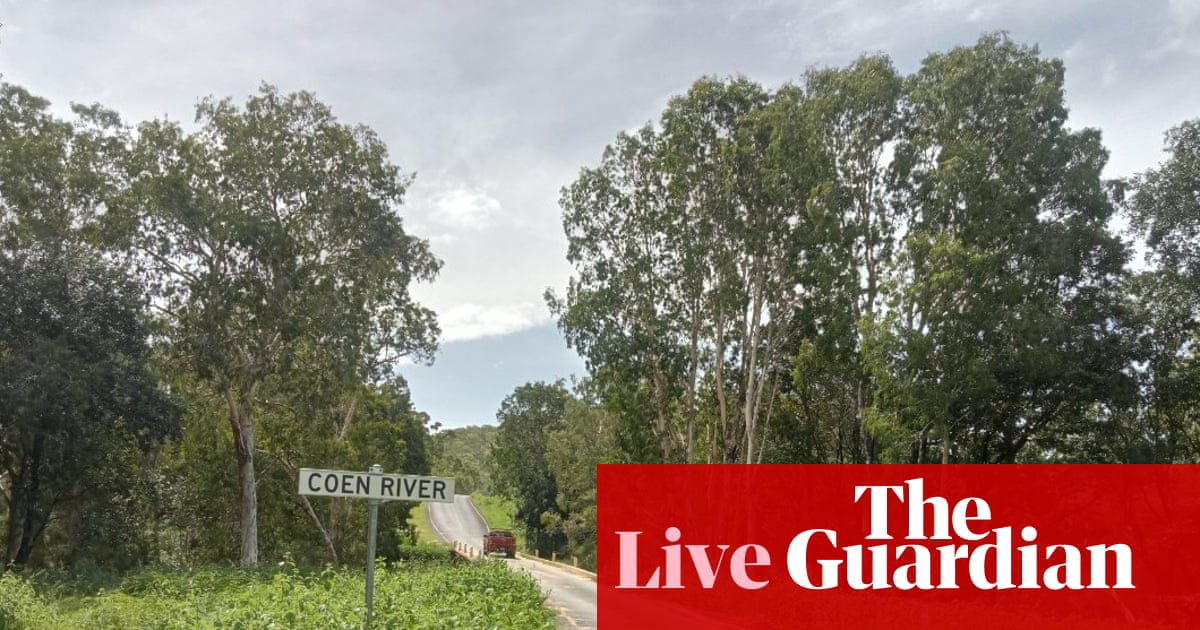
Eerie calm in Coen as remote Aborignal community prepares for category 5 Narelle Joe Hinchliffe
An eerie quiet has descended upon Coen, as the remote Aboriginal community prepares to bear the brunt of what has the potential to be a category five cyclone – and could be its worst in living memory.
Wind and rain began buffeting areas farther south overnight, but there were patches of blue sky in Coen on Thursday morning. The trees in town stood unruffled. A crow cawed and a few birds cheeped in the streets but the bush, normally raucous, was largely silent.
The Coen Regional Aboriginal Corporation general manager, Lucretia Huen, says the town had no official cyclone shelter, was low on fuel and had already not had a food truck come for several months.
People from surrounding outstations and homesteads have been evacuated, she says, some moving into the town of approximately 400 people, others fleeing further afield.
“They are on high alert,” she says. “They are not panicking. But they are concerned. They are worried about how this will impact them and, obviously, long term issues – if houses get damaged.”
double quotation markBut they are also quite happy how the community has come together.
Huen herself was in Brisbane, saying it was highly stressful to think of what her family and community was about to go through, not just in coming hours, but the potential weeks of isolation to follow.
“They say it’s very calm and still,” she says. “Very eerie. It’s eerily silent. They can’t hear birds.
double quotation markWe anticipate that this is the calm before the storm.
The small town of Coen is preparing for Cyclone Narelle to cross the coast later today or early tomorrow. Photograph: Coen Regional Aboriginal CorporationShare
Updated at 20.50 EDT
The prime minister, Anthony Albanese, is due to speak any moment on the country’s fuel supply. We’ll bring you live updates shortly.
Updated at 19.47 EDT