
Benchmark power prices across parts of the country are set to fall in the coming year as renewables reduce wholesale electricity costs.
The Australian Energy Regulator (AER) has released its draft for the default market offer (DMO) for 2026-27, which acts as a safety net for consumers in south-east Queensland, New South Wales, the ACT and South Australia.
It is the maximum price power retailers can charge consumers who are not otherwise on a competitive market offer, and it works as a benchmark for comparing prices across energy providers.
The draft DMO proposes that annual prices for households would fall by between 1.3 and 10.1 per cent, while small business prices would decrease by between 7.6 and 21.2 per cent, depending on the region.
“This draft decision points to the potential for some welcome relief for households and small businesses after several years of rising energy costs following Russia’s invasion of Ukraine,” said Clare Savage, chair of the AER.

Clare Savage says the regulator is monitoring the conflict in the Middle East. (ABC News: Daniel Irvine)
Last week, Victoria’s default market offer was announced, with prices falling by 3 per cent.
The drop in electricity prices will offer some reprieve after the shock of 20 per cent increases after the Russian invasion of Ukraine.
“This last 12 months we have seen a reduction in the need for more expensive gas-fired generation and hydro facilities, as a result of having more renewables and in particular battery capacity in the system,” Ms Savage said today.
However, the regulator said the modelling did not take into account the current conflict in the Middle East.
“It is a very uncertain time, and we are seeing increases in international coal and gas prices [and] Australia’s power market is still exposed to international coal and gas prices, so we could see increases moving forward as a result of that conflict,” she said.
“At this point, we are cautious but calm. We haven’t seen the increases we’ve seen in 2022. This particular draft decision doesn’t yet have the impact of that conflict on those prices, but we have only seen very small increases in the domestic prices at this point.”
Iran war live updates: For the latest news on the Middle East crisis, read our blog.
It is the first release since the regulator submitted a raft of reforms and includes a new tariff offering three hours of free daytime power for customers in most of the eastern states.
Why are power prices falling now?
Wholesale power prices have been coming down across the National Electricity Market (NEM) as renewables put downward pressure on prices during the day.
The benchmark price drop was foreshadowed after wholesale prices dropped at the end of last year.
The Grattan Institute’s energy and climate change program director, Alison Reeve, said batteries were starting to play a bigger role in the electricity system.
“It seems like what the drivers were more wind generation, which is cheaper, and then also more batteries coming in,” she said.
“The effect of those batteries is that they reduce the prices at peak times, which means that we’re using less gas and hydro, which were otherwise the most expensive forms of generation.”
But how much prices drop will vary considerably depending on where you live.
“If you’re in South East Queensland, they’re dropping by about 10 per cent; if you’re in South Australia they haven’t dropped very much at all. There’s definitely some real regional effects going on. But I think it’s positive that, overall, we’re starting to see prices moderate,” Ms Reeve said.
She said South East Queensland had the steepest price rises in 2022 and 2023 due to its exposure to coal, with the export coal price being a major driver of electricity prices back then.
“That’s kind of come off a lot now because coal prices have really dropped a lot,” she said.
In 2022, gas made up 6.6 per cent of electricity production compared to 4.5 per cent in 2025 — although gas use usually fires up in the evenings when solar production fades and households start using more power.
For coal, it has gone from 58.3 per cent in 2022 to 51.9 per cent in 2025.
But even as more renewables enter the grid, gas and coal still play a major role in setting prices in the market.
Climate Change and Energy Minister Chris Bowen said the reductions showed the benefits of renewable energy.
“It is no coincidence that energy price reductions are coming as Australia surpasses the milestone of 51 per cent renewable electricity in the National Electricity Market for the first time,” he said.
“That is a direct result of more of the cheapest form of new energy entering the grid.”
Ms Savage said what set the price jumps of 2022 apart from today was that several factors at home coincided with Russia’s invasion of Ukraine.
“We saw a rapid increase in international coal and gas prices. We also had quite challenging domestic conditions — we had flooding over summer that led to some coal mines getting wet and unable to produce coal at the time,” she explained,” she said.
“We had significant flood levels through the hydro facilities, so they were not able to generate in quite the same way, so that combination of international and domestic pressures led to a really quick increase in contract prices in Australia. We haven’t seen that at this point.”
The conflict in the Middle East is already affecting global energy prices, but it is unclear how much that will be felt in Australia.
The Strait of Hormuz remains effectively closed, choking off a critical supply route for global fossil fuels.
Australia is the third-largest gas exporter in the world, but remains exposed to international prices, as there is no policy forcing gas companies to reserve gas for the domestic market. The federal government is working on a reservation policy to start next year.
Electricity producers usually buy gas from the short-term market, known as the spot market, which means that they are more exposed to fluctuating prices.
“… to the extent that international fossil fuel prices are driving our prices, the more that we’re not using fossil fuels, the more shielded we are from that,” Grattan’s Alison Reeve said.
Free daytime power for east coast customers
From July, eligible customers in Queensland, New South Wales and South Australia will get three hours of free electricity during the day when solar power generation is at its peak under the Solar Sharer Offer (SSO).
There were concerns when the policy was first announced that retailers would raise prices outside the free hours, but Ms Savage said the program had been set up to avoid this situation.
Instead, the latest market offer calculates the average cost of power across the day, but only for the periods outside those three hours of free electricity.
If people do not shift much of their power to the middle of the day, they will be charged about the same as everyone, but if they are able to shift more to the free period, they will be able to save money.
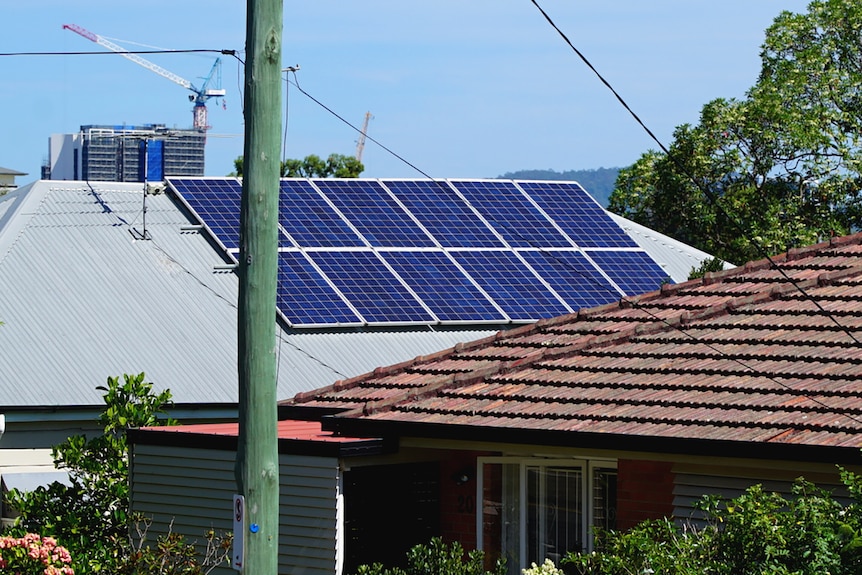
The regulator hopes the free power offer will move demand from evenings to the day. (ABC News: Curtis Rodda)
“That actually helps give that regulated protection to customers that they know that they’re not going to get ripped off in the morning or the afternoon if they decide to go on to a solar sharer tariff, and they can move some of their load. So I think that’s an important principle,” Ms Savage said.
Ms Savage said the program should result in cost savings for all power customers, regardless of whether they signed up to the offer or not. Less demand on the evening peak meant less expensive gas, which would lower power prices across the board.
“For everybody that does shift load, it gives bill savings for all of us, right, because we flatten the load profile,” she said.