
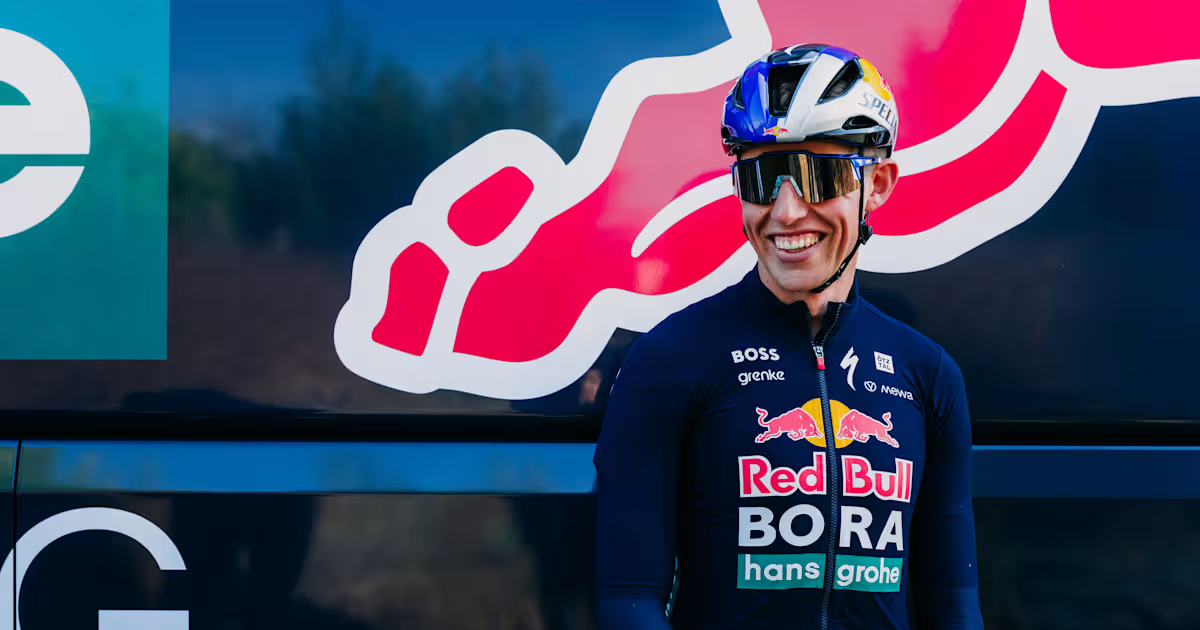
There are riders who command attention all at once, and riders who earn it by accumulation. A good result here, another there. A presence that keeps returning until it begins to look less like coincidence and more like pattern.
Laurence Pithie’s opening months of 2026 have unfolded in that second manner. Across different races and different terrain, he has kept surfacing where it matters: near the front, near the moment, near the result. Most recently, at Paris-Nice, he came close again, finishing second on a stage and leaving with the sense that his first victory in the Red Bull – BORA – hansgrohe colours is not a distant idea, but one hovering just out of reach.
None of it feels accidental. “I think it’s been a positive start to the season,” he says. “We definitely started off well in Australia and have built my form from there. We took a bit of a different approach this year, skipping the national championships and coming straight to Europe for a training camp. We had a few of the Classics boys there, and Jai as well, so it was a really good environment. We could train properly, train hard, and I think the work we did has shown itself already in the races.”
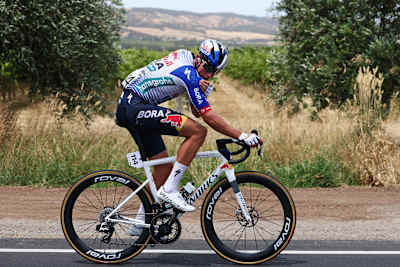
Laurence Pithie at the Tour Down Under
© Getty Sport
Paris-Nice offered the clearest expression yet of where Laurence stands. It was, he says, “a super good week for us”, not only because of individual placings but because of the way the team functioned throughout the race. Red Bull – BORA – hansgrohe placed Dani Martínez second overall, and while the week did not yield a stage win, it brought repeated confirmation that the group was moving in the right direction.
“We worked really well as a team and everyone was on great form to go for the results we wanted,” Laurence says. “We were often in the top five on most stages, so that was a really nice week. Even if it almost came undone on the final day, we managed to salvage it with good teamwork, and Dani brought home the GC podium.”
For Laurence himself, his near miss on the second stage only sharpened his appetite. A second place can sting, but it can also clarify. It can tell a rider not only that he is close, but how close.
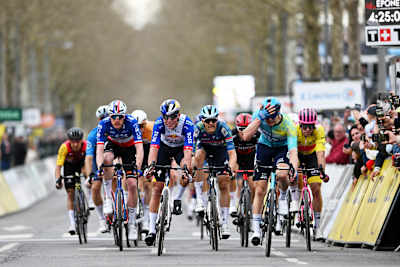
Laurence Pithie takes second place on Stage 2 of Paris-Nice
© Getty Sport
“I’ve been chasing a win since the start of the season,” he says. “I’ve been close a few times now, and that second place definitely keeps me hungry to fight for more. I think I just need a bit of luck to go my way and for things to pan out well. The win shouldn’t be far away, I hope.”
That hunger is made more interesting by the kind of rider Laurence is becoming. His value lies not in fitting cleanly into a single category, but in operating between them. He’s not the purest sprinter, by his own admission, but he’s far more than simply durable. A rider who can survive the climbs, read a changing race, and remain useful when the cast of contenders has already been reduced.
“For sure, versatility is one of my strengths,” he says. “I’m not the best sprinter, but I can climb quite well. If I can make it over the climbs with a select group, then that versatility definitely helps me. At the moment, I’d say it’s one of my better strengths.”
I’ve been chasing a win since the start of the season. I’ve been close a few times now, and that second place definitely keeps me hungry to fight for more
That versatility has been underwritten by something more fundamental. Laurence speaks less about a revolution in race craft than about a strengthening of the whole structure around him. The physical gains matter, certainly, but so does the network that supports them.
“Physically, I’m stronger this year,” he says. “We had a really good block of training in the pre-season and I’ve worked really closely with Mark to hit my targets and be in good shape from the start of the year through to the end of the Classics. That relationship helps a lot. And with Stephen on the nutrition side, Shane in the car, it’s really my own little performance group. We came into this season with some big goals. We work really well together and everyone has a good understanding of what the targets are and how we can achieve them.”
There is something telling in that description: a little performance group. Not a grand slogan, but a working unit. Close-knit, communicative, trusted. In elite cycling, confidence is often discussed as if it were a mood. But more often, it is a product of preparation. Of knowing that the work has been done, and that it has been done with precision.
All of which brings Laurence back to Milano-Sanremo, and to a race that resists mastery even as it demands it.
This year’s edition begins in Pavia, heading north towards Milan before returning through Pavia and, after a brief variation on recent roads, reconnecting with the race’s more familiar southern line. From Tortona, the route resumes its old logic: Ovada, the Passo del Turchino, the descent to Genova-Voltri, then west along the Ligurian coast through Varazze, Savona and Albenga before the race tightens towards Imperia, the Capi, the Cipressa and finally the Poggio. As ever, Sanremo is shaped less by its opening roads than by the way it contracts towards those final, decisive points. After 298 kilometres, the race asks for precision at the very moment fatigue is at its most indiscriminate.
Laurence will line up for his third consecutive start at La Primavera this weekend, and if familiarity offers any comfort, it is only partial.
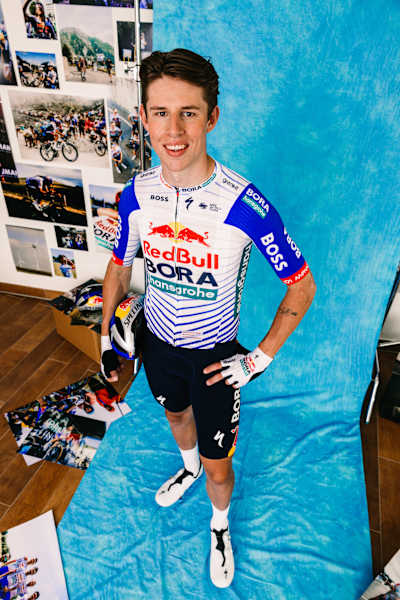
Laurance Pithie
© Laurance Pithie
“I think Sanremo is a hard race to understand, and it’s always changing,” he says. “With Pogačar trying to go full gas on the Cipressa, it used to be more of a sprinter’s race but now you really have to climb well. I don’t think you can ever fully understand the race, to be honest, but for sure the positioning is very important.”
That feels like the essential truth of Milano-Sanremo. It is often spoken about as a race of waiting, but that can obscure how violent its decisive moments are. The Cipressa is not steep enough to tell the whole story, and the Poggio is not long enough to make everything obvious. What matters is how the race arrives there, who arrives where, and with what left. Positioning into the Cipressa, especially, can determine which ambitions remain realistic and which are already over before the television images catch up.
“My first participations in the race taught me where I need to be, and when to use my bullets,” Laurence says.
I don’t think you can ever fully understand the race, to be honest.
He knows the roads to a degree from his time based in Nice, though he is careful not to overstate that familiarity. “I don’t train out here too much,” he says, “but we’ve done some recons in the past. They’re nice climbs and I like them.”
As for the decisive point this year, he is clear. “It’s got to be the Cipressa,” he says. “It was last year as well, when Pogačar went, and I think they’ll probably have the same goal this year. Our plan will be to follow that move if we can with Primož and Giulio. For me, it’s to see where I’m at and try to be there. And if it comes back for a sprint, then sprint for the best result possible. Positioning into the Cipressa is going to be the most important. If I can be there, then I’ll try to follow.”
In that sense, he sits precisely where modern Sanremo can reward a rider most: at the intersection of resilience, speed and judgement.
Positioning into the Cipressa is going to be the most important. If I can be there, then I’ll try to follow.
“A good race for us would be one of the guys being able to follow,” he says. “And if they can’t, then me trying to finish it off in a sprint after getting over the Cipressa and Poggio in the front group.”
Reflecting on what success would look like for him personally, he says: “a successful Milano-Sanremo for me personally would be top five, to be honest,” he says. “I think I’ve shown some good form. It’s a race I really like. It’s a big goal, but top five in a Monument is also no mean feat.”
It is an ambition expressed without inflation. Not small, certainly, but measured. And perhaps that is what makes Laurence’s spring so compelling at the moment. He is not speaking like a rider searching for an identity. He sounds like one refining it.
The first win may come soon, or it may ask for a little more patience. But the shape of his season already suggests something significant: Laurence Pithie is no longer merely appearing in the right places. He is beginning to turn presence into consequence.