
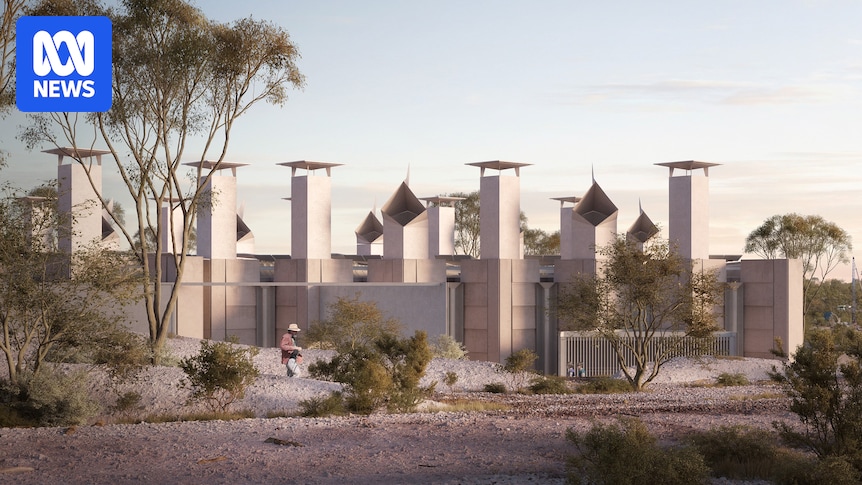
A $37 million monument being built to celebrate Australia’s national gemstone risks becoming a “white elephant” with work on the site indefinitely stalled in the face of severe financial losses.
The new Australian Opal Centre in Lightning Ridge is about 85 per cent finished and was due to open last year as a showcase of the world’s greatest public collection of opalised dinosaur fossils and an array of valuable gems.
It was pitched as a major tourist attraction for the north-western New South Wales town and attracted $29 million in government funding.
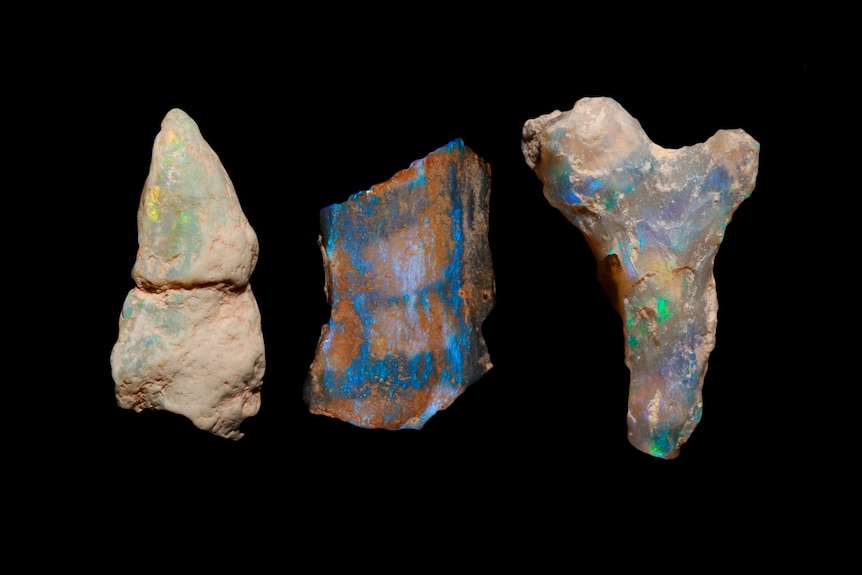
The Australian Opal Centre was set to showcase opalised dinosaur bone fossils, like these found in Lightning Ridge. (Supplied: Bob Smith)
However, an independent audit last month warned that the not-for-profit organisation behind the project, Australian Opal Centre Limited (AOCL), could collapse.
“A material uncertainty exists that may cast significant doubt on the [AOCL’s] ability to continue as a going concern,” the audit report said.
“Unfortunately, at this stage, there is not the money available to continue with the build,” recently-appointed AOCL chairperson David Lane told ABC Western Plains Breakfast.
He estimated the resumption of construction “could be a couple of years” away.
“So, that will be put on ice for a time.”Construction stalls
Construction at the site stopped last May, before the AOCL posted a $5.4 million cash loss for the 2024-25 financial year.
“The project suffered cost overruns and inflation overruns,” Mr Lane said.
Since May, AOCL has also been paying the builder a monthly site maintenance fee of “tens of thousands” of dollars, according to Mr Lane.
“That has been an ongoing drain on the company’s resources.”
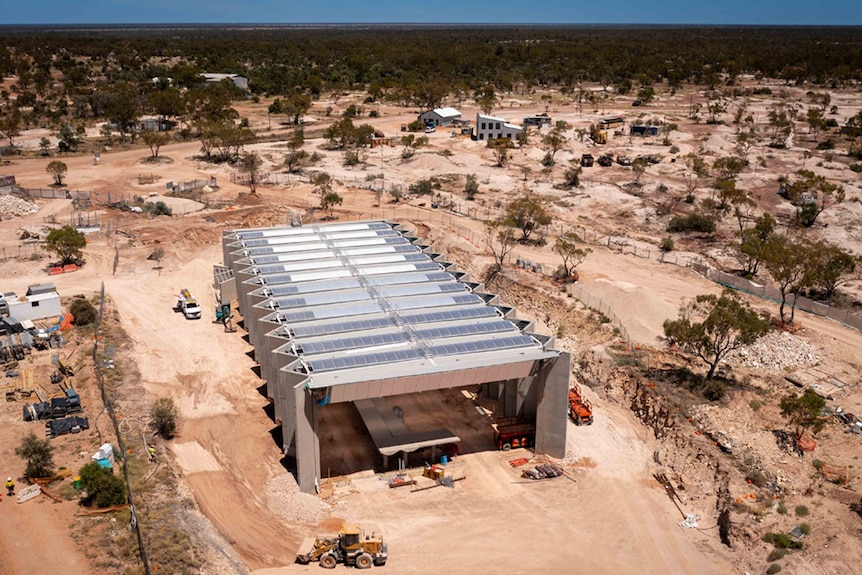
An aerial view of the centre in January 2025 shows the soaring ceiling that uses natural light to illuminate the interior. (Supplied: Australian Opal Centre)
He said the AOCL’s new board, appointed in November, had resolved to end the builder contract, but an outstanding payment to the builder was still being negotiated.
“There’s still a risk we may be insolvent,” he said.
“But once we’ve got [the builder] paid out, then we’ll figure out how much we need and start rebuilding the business.”
Finding ‘a way forward’
The project was billed on its website as an energy-efficient “architectural icon” with a semi-underground design filled with natural light, “using ancient and cutting-edge modern technologies”.
It has received $9.5 million from the Australian government, $17.5 million from the NSW government, and $2 million from Walgett Shire Council, alongside $1.8 million raised from community donors and benefactors.
“It’s a significant investment, so it can’t be just left there as a white elephant,” Mr Lane said.
“We just have to find a way forward, and that’s what the board’s committed to do.”
The audit by Pilot Partners warned that the “significant doubt” of the organisation’s survival was due to cash flow.
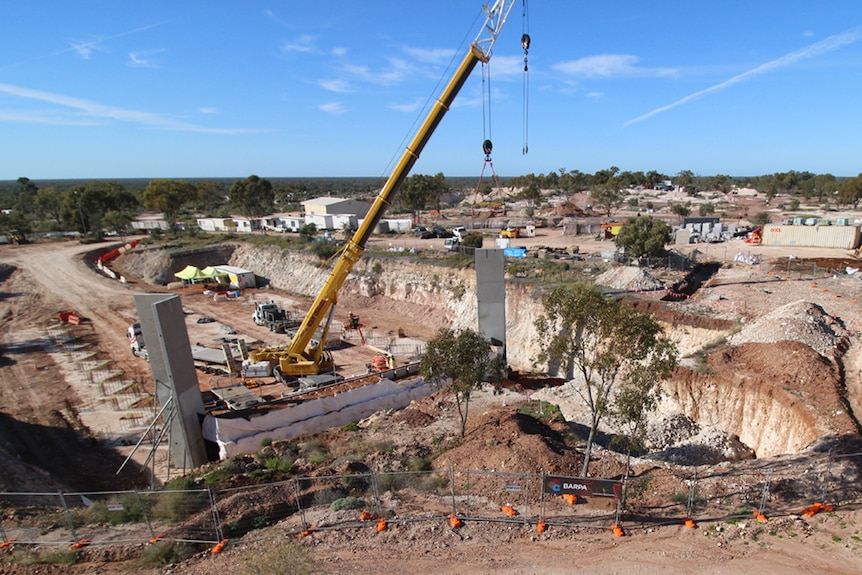
By June 2024, the centre’s foundations were ready for the installation of 12-metre high wall panels. (Supplied: Australian Opal Centre)
The report highlighted the overall negative cash flow of $5.4 million, with $15 million spent on construction and $9.2 million received from government grants.
Daily operations also ran at a loss of more than $230,000 for the year, mostly stemming from employee and supplier costs.
The AOCL still has nearly $1 million in the bank, but 93 per cent of that is tied to building-specific grants that must be spent on construction, meaning it cannot be used to pay the bills.
A vision decades in the making
The construction halt has been “a great disappointment to the community and people who’ve invested so much of their own time and money”, said Jenni Brammall, a palaeontologist and gemmologist who has been AOCL principal’s representative since 2004.
“But good things can take time; the Sydney Opera House, which was a comparable visionary project, took even longer.
“We really are close and we just need to retain heart, to find a way to completion.”
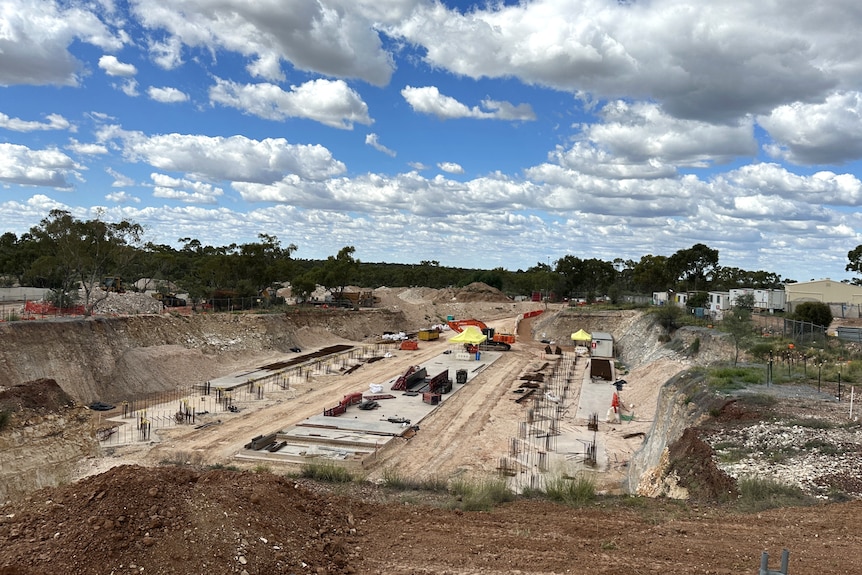
The foundations of the partially-subterranean centre in March 2024. (ABC Western Plains: Catherine James)
The idea for the new centre was sparked in the late 1990s by a local group wanting to diversify Lightning Ridge’s economy and give Australia’s iconic gemstone a global platform.
Ms Brammall said it grew from a small association working from a still-existing shopfront in the town to now 380 members around Australia and abroad.
It fundraised more than $1 million for the project before all three levels of government decided to invest.
“This is a small community punching way above its weight, delivering a nationally significant project,” she said.
Possible council takeover
One recovery option being explored is handing the project to the cash-strapped Walgett Shire Council.
Mr Lane said the council was better placed to attract further government and corporate funding.
But council general manager Andrew Brown said it could not take on financial responsibility without more government support.
“We accept how important this is for the future of the area,” Mr Brown said.
“However, any decision that council makes needs to be backed by funding from the state and/or federal government.”
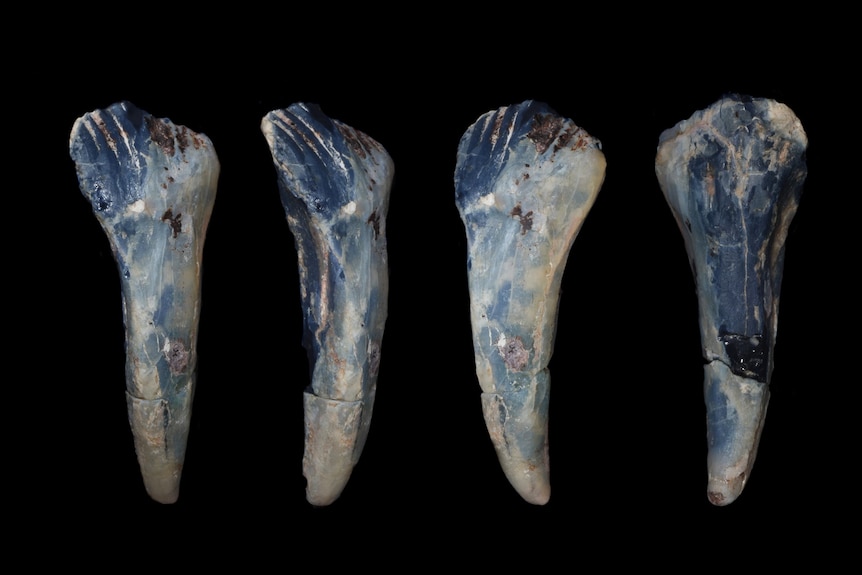
Opalised fossils like these dinosaur teeth from an ornithpod found near Lightning Ridge are part of the centre’s attractions. (Supplied: Bob Smith)
As of late 2025, the AOCL estimated the cost to complete construction and a full fit-out to be operationally ready to be between $6 million and $7 million.
In an email to members on February 28, Mr Lane outlined multiple recovery strategies the board was exploring, including keeping the museum director role vacant, boosting donations and selling non-core assets.