
In the days before the last US presidential election, a senior Australian diplomat in Washington explained the equation to me.
If Donald Trump won, they said, Canberra was ready for whatever that meant.
If things got difficult, they said, the Albanese government could even lean on former prime minister Scott Morrison to help safeguard our national interests in the White House.
Trump and Morrison formed a bond as world leaders that transcended their time in office. We could leverage that relationship if we had to, the diplomat said.
Iran war live updates: For all the latest news on the war in the Middle East, read our blog.
It was clear at that time that Australian officials — in the US at least — were confident in our country’s ability to negotiate a second Trump presidency.
Pretty much everything was on the table, it seemed, including the possibility of a Labor government reaching across the political divide and tapping an old Liberal sparring partner for assistance.
Less than 18 months later and that belief is being put to the test. In fact, this week we might have found out what Australia’s red line with the US president is.
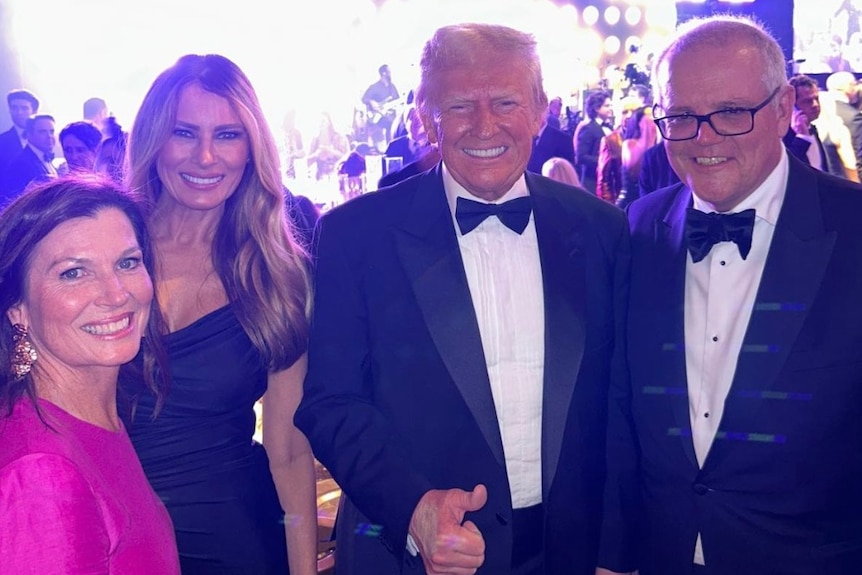
Jenny Morrison, Melania Trump, Donald Trump and Scott Morrison ring in 2026 together at Mar-a-Lago. (X: @ScoMo30)
The war in the Middle East is heaping pressure on Australia’s relationship with the US. Australia’s involvement has developed over the course of the fighting, which is now in its third week.
Earlier this month we sent a surveillance aircraft, plus the 85 people required to operate it, and missiles to the United Arab Emirates, our closest ally in the Gulf.
Early on Wednesday, local time, Australian medical and accommodation facilities at the Al Minhad Air Base near Abu Dhabi were damaged in an Iranian attack.
The facility is Australia’s primary military hub in the Middle East and hosts about 100 ADF personnel, none of whom were injured.
The federal government has been careful not to use incendiary language like, “We are at war,” even if lawyers have argued that is technically correct.
The US president has publicly encouraged allies to send naval assets to the Strait of Hormuz, although Australian officials maintain no official request has been made of them.
In any case, the Albanese government has declined. It appears this could be our red line when it comes to Trump.
Loading…US president blasts allies
Trump wants Australia and other allies to help end Iran’s blockade of the strait — a narrow stretch of water that links the gulf to the rest of the world.
It’s vital to international supply chains. About 20 per cent of global oil exports is shipped through it.
Restricting access pushes up petrol prices elsewhere and, ultimately, the vast array of goods and services that rely on fuel to function.
Iran has targeted several vessels with drones and explosive-laden boats since the war began.
Loading
Trump has mused that a coalition of nations could use their naval assets to provide tankers safe passage through the strait.
Albanese has described Iran’s actions in the strait as “reckless”, but his government has ruled out sending warships to the region. Several other US allies have done the same.
That has prompted Trump to lash out.
In a social media post this week he blasted NATO countries, as well as Australia, Japan and South Korea, for declining to help, but added the US did not “need or desire” their assistance.
Loading
James D Boys, a senior visiting research fellow at University College London’s Centre on US Politics, says Trump’s criticisms make sense.
“For Trump, I think we’re seeing two things are coming together in a perfectly defined moment,” he said.
“It’s important to realise that Trump has been saying that Iran poses an existential threat to the United States since 1980.
“He also has a longstanding belief that NATO and other allies do not contribute enough to defence and global security.
“His rhetoric right now is reflecting all this. He goes about it in his own unique way that’s different to other American presidents.”
Australia has often been described as having a special relationship with the US — even Trump’s America — but it appears this week we might have found the limit.
Albanese had, on the day the US joined Israel in launching air strikes on Iran late last month, intimated his support for that decision. But sending naval assets, for now at least, is clearly a bridge too far.
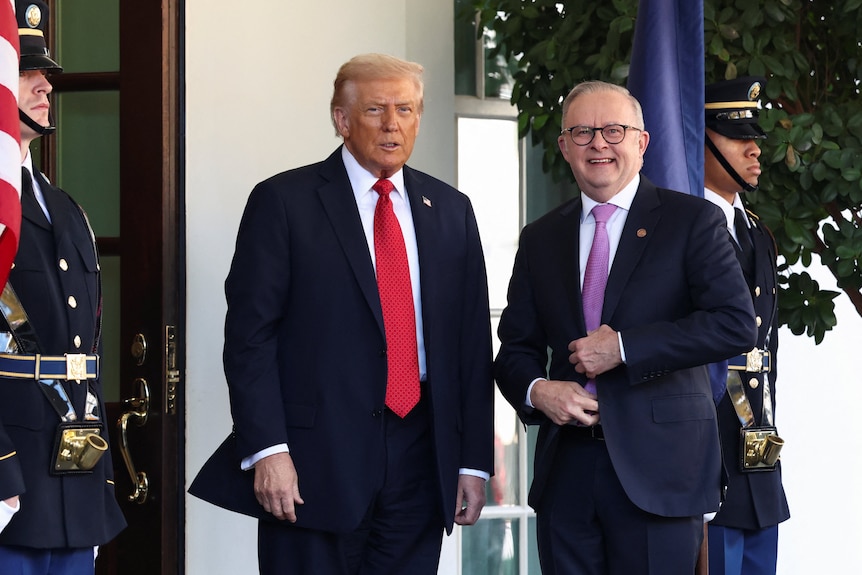
Donald Trump and Anthony Albanese were all smiles at the White House during their October meeting. (Reuters: Kevin Lamarque)
‘You have to see it from Trump’s perspective’
Australia is on Trump’s radar when it comes to the war in the Middle East.
Even before his social media broadside was fired earlier this week he had appealed directly to Albanese, via another online post, to offer members of the Iranian women’s football team — who had been in Australia competing in the Asian Cup — asylum.
While the US president has singled out Australia for criticism this week, he’s been more scathing elsewhere.
For example, Trump has threatened to cut off all trade with Spain because its government has refused to let the US military use its bases for strikes against Iran.
Britain has also been cautious about its support of the fighting — something that has prompted Trump to say the UK-US relationship is “not what it used to be”.
More than once the US president has openly criticised his counterpart in London, Sir Keir Starmer, saying: “He’s no Winston Churchill.”
Polling has consistently shown Starmer is deeply unpopular in Britain, but standing up to Trump appears to play well.
Ben Judah, a special adviser to UK Deputy Prime Minister David Lammy from 2024 to 2026, believes “Trump’s chaotic interventions … will only accelerate Britain’s realignment” away from America.
“Starmer may be unpopular but his foreign policy isn’t,” he wrote in The Washington Post this week.
Trump’s rhetoric and surging global oil prices may have had an impact.
On Thursday, local time, the leaders of the UK, France, Germany, Italy, the Netherlands, and Japan issued a joint statement, calling for an end to fighting and saying: “We express our readiness to contribute to appropriate efforts to ensure safe passage through the Strait. We welcome the commitment of nations who are engaging in preparatory planning.”
Canada later joined them. Could Australia be next?
Defying Trump could be a vote-winner for Albanese at home, where analysts point out the US president is not trusted. But it also comes with risks.
Australian foreign policy has long been aligned with Washington. Our two nations are in multiple alliances.
Boys, the author of multiple books on US presidents, says there could be consequences stemming from any departure to the status quo.
“If history has taught us anything … it’s that anything is possible, and that with President Trump that’s doubly the case,” Boys says.
“It’s remarkable that Australia and the US have close defence ties, but you have to see it from Trump’s perspective. He would be looking at this relationship and others like it and thinking, ‘Where are you?’
“Donald Trump has no compunction about withdrawing from alliances or threatening to withdraw from alliances, agreements and treaties.”
We might have found Australia’s red line with Trump.
But as the war drags on, we are still waiting to see if it will get moved, or if it’s not whether there will be repercussions from the White House.
Loading…