
Save
You have reached your maximum number of saved items.
Remove items from your saved list to add more.
AAA
Just after dawn, as Adelaide commuters flick between traffic updates and talkback, the attack ad cuts through on FIVEAA’s breakfast show.
“It’s been a busy four years for the Liberals,” the voice begins, before zeroing in on the churn – “four leaders in four years” – and then the scandals. A former MP “convicted of serious drug offences”, another “charged with domestic violence”, and one “even jailed for theft”. It ends with a sting: “They say they’re tough on crime … All that in just four years. Imagine four more.”
It is brutal, relentless and – Liberals privately concede – uncomfortably effective.
On polling booths around Adelaide this week, Liberal volunteers report repeatedly being called a “shambles” by voters – a word deployed heavily in Premier Peter Malinauskas’ advertising. One anecdote circulating on talkback has one volunteer so demoralised on pre-poll they were consoled by a Labor counterpart after struggling to find takers for how-to-vote cards.
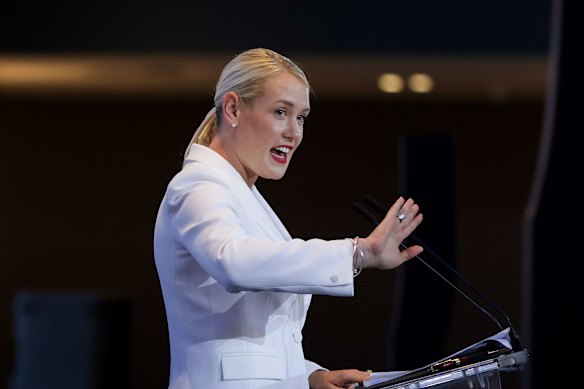 Opposition Leader Ashton Hurn was installed as leader just 100 days before the vote.AAPIMAGE
As 1.3 million South Australians head to the polls, the state’s Liberal Party is not merely staring down defeat. It is confronting the possibility of a generational wipeout – one that could reshape conservative politics nationally, test the electoral ceiling of One Nation, and intensify internal fractures that have been simmering for years.
Drafted in as leader barely 100 days out from polling day, Ashton Hurn became the fourth Liberal to take the helm in as many years – following the underwhelming tenure of Vincent Tarzia and the collapse of David Speirs’ leadership amid a cocaine scandal.
Praised internally as a talented and hard-working, the 35-year-old is nonetheless expected to lead the party to its heaviest defeat in a generation – potentially the worst result since Labor’s 1993 rout after the State Bank collapse.
A new experimental AI poll, conducted by Resolve Political Monitor on March 16, underscores the scale of the challenge. The survey of 1112 registered voters – involving a phone interview between respondents and an AI voice – has 31 per cent giving Labor their first preference, with One Nation on 28 per cent, the Liberals trailing on 18 per cent, the Greens on 10 per cent and others 11 per cent. It has a margin of error of 2.9 per cent.
That trajectory reflects not just Liberal weakness but Labor strength.
Led by Malinauskas, the government enters the campaign with extraordinary levels of popular support. Strong economic growth, combined with an aggressive pursuit of major events – from AFL Gather Round to LIV Golf and the MotoGP – have left Labor in a seemingly impregnable position.
Even vulnerabilities have struggled to cut through. Labor has paid little political price for failing to “fix” ambulance ramping, despite making it a centrepiece of its 2022 campaign, while rising state debt has done little to dent its standing with voters.
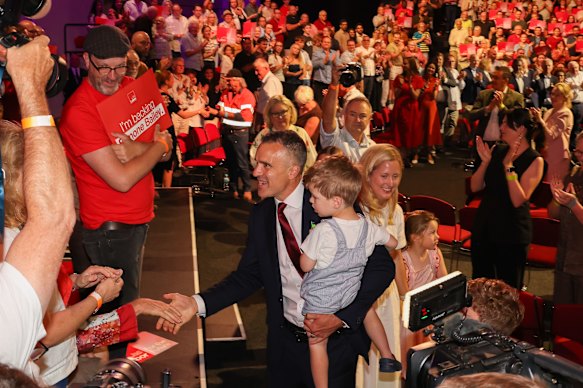 Peter Malinauskas with his family and supporters at Labor’s official campaign launch last month.AAP
The electoral picture is stark. The Liberals are defending just 13 of 47 lower house seats and are at risk in both metropolitan Adelaide and parts of their rural heartland. In the city, Labor’s dominance looks entrenched. In the regions, the threat is more complex – One Nation on one side, independents on the other, and volatile preference flows cutting across both.
As Clement Macintyre, emeritus professor in politics at the University of Adelaide, puts it: “It’s not a stock-standard South Australian election … we’re not used to seeing polls showing interest in the third party to the extent that we’re seeing for One Nation.”
He says the surge reflects a familiar Liberal dilemma.
“At the moment the Liberal Party is caught between ‘does it appeal to that more rural conservative wing?’ or ‘does it move to try and take back the cities with its more moderate and smaller liberal policies?’”
That tension has defined the party for decades and remains unresolved. Malinauskas has deftly reminded voters all week about difference between the state and federal Liberals on issues such as the Indigenous Voice to parliament and net zero.
South Australia has long produced lopsided outcomes. Since the end of Thomas Playford’s 26-year reign in 1965, the Liberals have spent only about 17½ of the past 56 years in government. Labor has typically dominated metropolitan Adelaide, often winning enough city seats on narrow margins to offset large Liberal majorities in the regions.
That balance has shifted further against the Liberals. Labor is pushing deeper into once-safe suburban territory, while the Liberals’ rural base is fragmenting – challenged by independents, candidate controversies and now a rising One Nation vote.
Even with that surge, translating support into seats is another matter.
South Australia’s electoral geography – and preferential voting – work against minor parties in the lower house. Labor is expected to direct preferences to the Liberals ahead of One Nation, meaning challengers must either top the primary vote or leapfrog both major parties after preferences.
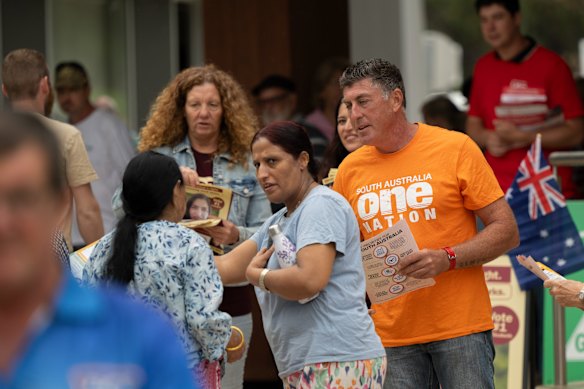 South Australians have voted in droves on the first days of pre-polling ahead of Saturday’s election.Ben Searcy Photography
“My gut feel is I don’t think One Nation are going to win seats in the lower house in South Australia,” Macintyre says. “But I could be wrong there.”
Either way, the Liberals are squeezed – bleeding votes to One Nation while still relying on Labor preferences to survive.
The party’s problems are not just electoral but cumulative.
Hurn’s elevation in December, while widely seen internally as overdue, has not stemmed the slide in the polls. She has stood out in a weak shadow cabinet but the legacy of policy shifts and three leadership changes in a single term – riven by scandal – continues to drag on the party’s fortunes.
That pressure has been compounded by events during the campaign itself.
Midway through, the party was forced to dump candidate Carston Woodhouse after his “shocking and extreme” views surfaced, including comments on abortion, same-sex marriage, gender transitioning and feminism aired on a podcast.
Related Article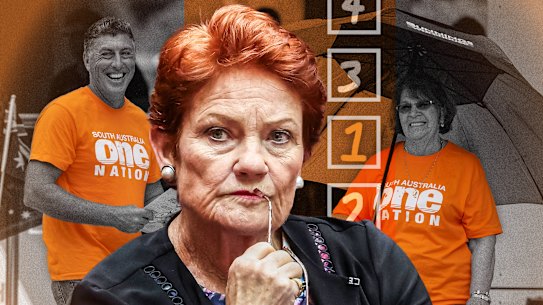
Hurn initially stood by him, before reversing course within 24 hours.
The episode exposed deeper tensions. Liberal senator Alex Antic, a key conservative factional figure, defended Woodhouse, warning that if candidates were forced out over such controversies “we might as well shut the doors on this election with one week to go”. Antic has also been openly flirting with defecting to One Nation.
In the Barossa Valley town of Tanunda this week, Hurn continued the ongoing reset.
She argues voters are turning to parties focused on practical concerns, insisting the Liberals have centred their campaign on cost of living and health rather than internal debates. There has been too much “navel-gazing” across politics, she says.
“Frankly, I’m not going to be one of these politicians who becomes a commentator,” she says, framing herself as focused on “bread and butter” issues, arguing a vote for One Nation only entrenches Labor and promotes chaos.
Within the party, there is a recognition it may be too late. More positive forecasts predict just eight seats but some fear a nightmare scenario of being left with three or fewer. Metropolitan seats at risk to Labor include Unley, Hartley, Morphett and Colton.
South Australian Liberal Party president Leah Blyth, a senator, is blunt.
“I sort of lament and think what if she [Hurn] had had more time,” Blyth, a member of the party’s conservative faction, says.
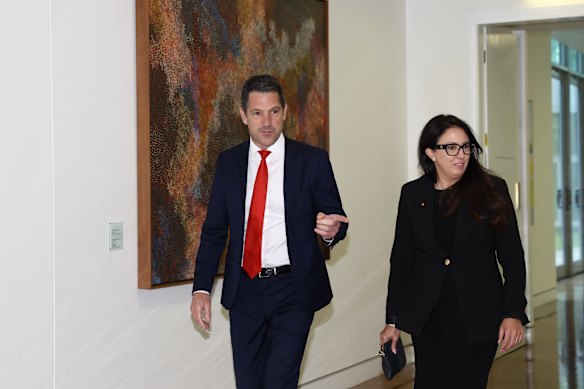 South Australian Liberal senators Alex Antic and Leah Blyth arrive to last month’s federal leadership spill in Canberra.Dominic Lorrimer
She argues Hurn has improved as the campaign has progressed and could have made it a different contest with a longer runway. But she concedes the broader challenge.
Labor has delivered a “whole lot of broken promises”, particularly on ambulance ramping, Blyth says. But the Liberals have also “not delivered on what we said we would”.
Rebuilding trust will require a return to core principles – economic management and lower taxes – so the party is “taking less from hard-working South Australians … allowing them to keep more in their pockets”.
But Resolve pollster Jim Reed says the shift appears durable, with One Nation holding its support into the final week and, polling at 28 per cent, potentially converting it into seats in regional seats such as Narungga and Mount Gambier, with outside prospects in Flinders, MacKillop and Chaffey.
“Labor will still do well in urban Adelaide but this result would mean One Nation taking some lower house seats, especially as the Liberals are directing preferences their way,” he says.
“Labor voters are voting for Malinauskas because they think he’s doing well, the remaining Liberals are voting against him because they think he’s not, and One Nation voters are voting against them all for a bigger change.”
That prospect gives the result national significance. It shapes as the clearest test yet of whether One Nation’s support can translate into seats – and whether the Coalition faces a structural challenge on its right flank.
Inside Liberal ranks, the argument about the future is no longer contained.
One camp believes the party must win back voters drifting to One Nation, sharpening its message on cost of living and law and order. Another warns that chasing those voters risks alienating moderates and fuelling talk of centrist breakaways – splits that could leave the party even weaker.
Editor’s pick
Several senior Liberals contacted by this masthead said Hurn deserved everyone’s support but that there would be “blood on the walls” after the election.
Both sides agree on one point: the party cannot continue as it is.
Rob Manwaring, an associate professor at Flinders University, says the Liberals face a deeper post-election reckoning.
“I think they’re in a world of pain,” he says, pointing to three core problems: leadership churn, ongoing factional infighting, and an inefficient vote base.
Structurally, he says, the Liberals’ vote is “locked up in regional and more rural areas”, while Labor’s is more efficiently distributed, leaving Hurn with a party room that “doesn’t actually really speak” to inner-city voters.
Back in Tanunda, Hurn is pitching renewal. But for many voters, the verdict on the past four years is already in. The only question left is the scale of the damage.
Cut through the noise of federal politics with news, views and expert analysis. Subscribers can sign up to our weekly Inside Politics newsletter.