
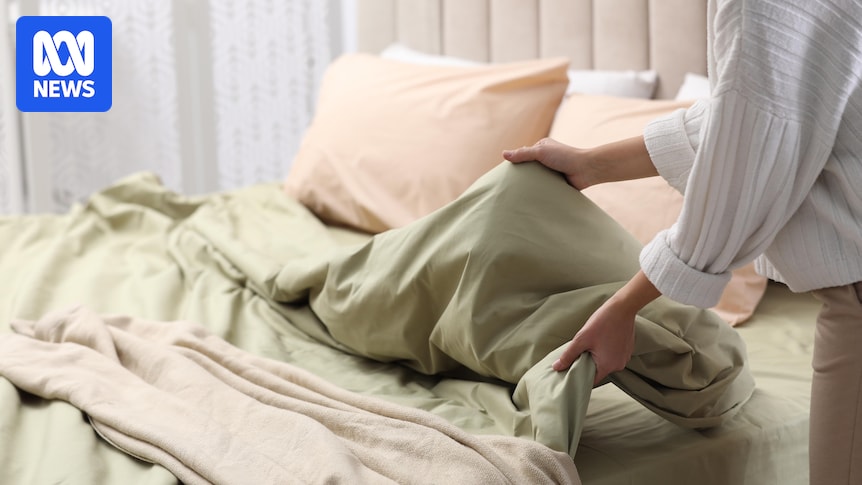
Sleeping in a great set of sheets is one of life’s little pleasures.
But buying bed linen can be overwhelming and expensive. It’s probably not a task you want to be doing often.
So, how can you choose good quality and long-lasting bed sheets, and is linen worth the extra cost?
This is what textile experts have to say.
How long should bed sheets last?
“That’s a little bit like asking how long is a piece of string,” says Rebecca Van Amber, a senior lecturer at the School of Fashion and Textiles at RMIT University in Naarm/Melbourne.

Rebecca Van Amber says she exclusively buys cotton bed sheets. (Supplied)
Dr Van Amber says it depends on factors including how frequently they’re washed, how many sets of linen (if any) you’re swapping between, and whether you use a dryer.
“If you’ve got a few sets in rotation, I would say at least five years as a minimum.”
Carolina Quintero Rodriguez — a senior lecturer and program manager of the Bachelor of Fashion Enterprise at RMIT in Naarm/Melbourne — says some research has suggested that sheets will last between 200 and 400 washes.
Assuming sheets are washed about once a week, she says you might expect to get somewhere from five to seven years out of a good set.
But Dr Quintero Rodriguez says the appearance of the sheet might not last as well as the fabric. For example, sheets may become “yellowish” over time because of sweat.
Is it better to sleep in cotton or linen?
“Cotton is a very, very good fibre to sleep in,” Dr Quintero Rodriguez says.
It’s popular because it’s affordable, she adds, but it’s also a good option for sensitive skin.
Dr Van Amber agrees.
“[Cotton sheets are] really comfortable, they’re really practical for Australia, and they’re often quite reasonable to purchase as well.
“You can get really nice cotton sheets at a not very expensive price.”
Dr Van Amber says linen sheets, on the other hand, are “beautiful”, “soft” and — generally — linen uses less water to grow than cotton. It’s often considered the more sustainable choice.
But it is also the more expensive one, she says.
Dr Quintero Rodriguez says the main issue with linen is the price. It’s less widely produced than cotton and is harder to manufacture.
She says it’s moisture-wicking and breathable and, while it can feel rough initially, the fabric softens after washing.
But it is also wrinkle-prone. So, if wrinkles feel uncomfortable on your skin or the look of them bothers you, it’s not the best option.
What about synthetic sheets?
There are also a lot of polyester and synthetic blends available. These are usually produced to be more affordable or durable and some people may find them less comfortable, Dr Quintero Rodriguez says.
Which are the coolest sheets for hot nights, and why?
Dr Van Amber says cotton-polyester blends often pill, and they feel “more rough to the hand”. They are also more difficult to recycle at the end of their life span.
Synthetic fibres are not naturally breathable and are also less effective at absorbing moisture than natural fibres such as cotton and linen.
Sheets marketed as bamboo can also be misleading, Dr Van Amber says.
“It is viscose or rayon of bamboo origin … what we consider a semi-synthetic.”
Which sheets last the longest?
Dr Quintero Rodriguez says linen is generally the more durable option.
“It’s more expensive, but it’s going to last longer.”
An expert says the better option for sheets ultimately comes down to individual preferences. (Pexels)
This is because linen uses longer fibres, Dr Quintero Rodriguez says.
However, the longevity of the fabric will differ according to how it is used, washed and the quality of the particular item.
Dr Van Amber is less convinced by the longevity of linen.
She has a few linen items — a blanket and bed cover — that she puts in the dryer after washing and says the lint trap is full of fibres every time.
“That means that the fibres are coming out of the fabric … it does make me wonder how long [it] will last.”
Unfortunately, Dr Van Amber says there’s very little published research on bedsheets, making definitive answers hard to give.
“As much as we want to attribute performance and quality of textile items to the fibre, the way that fabric behaves and its durability is the result of the fibre, the yarn, the fabric structure and then any finishes.”
Are higher thread count sheets better?
A thread count usually indicates the number of threads within a one-inch or 10-centimetre square of cotton.
Dr Van Amber says the thread counts listed on cotton sheets don’t guarantee longevity or durability.
What to do about that musty laundry smell
“I think it’s more about how that bed sheet feels when you touch it,” she says.
Sydney/Gadigal country-based home expert with consumer group Choice, Peter Zalunzy, says, “Thread count does matter up to a certain point and then … it becomes more of a case of marketing.”
Cotton sheets with a thread count of 200 to 400 will generally be comfortable and good quality, he says.
Sheets with thread counts beyond 400 to 500 have usually been manufactured using two-ply or multi-ply threads and have limited benefits, Mr Zalunzy says.
How to choose good quality sheets
Dr Quintero Rodriguez recommends choosing 100 per cent linen or 100 per cent cotton sheets.
Heaviness can be an indicator of quality (to a point) because the number of yarns used increases the weight of the fabric.
Price also tends to reflect quality when it comes to bed linen, she says.
To help extend the life of your sheets, Dr Quintero Rodriquez recommends washing them about once a week on a low temperature and line drying. And avoid fabric softeners, which “tend to clog the fibres”.
If fading is a concern, Dr Van Amber suggests drying them in the shade.