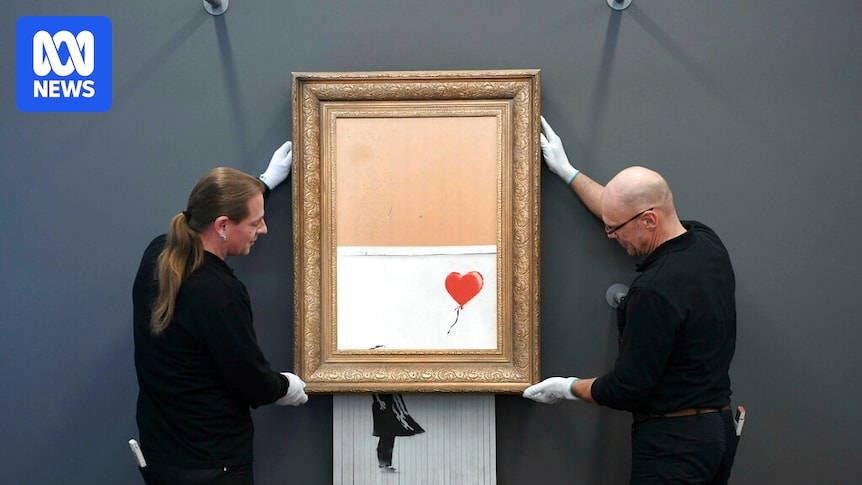
Why, in an era such as this, when there are so many feeds to fill and platforms to posture on, might someone, like an artist, wish to remain anonymous?
With the most recent attempt by Reuters to unmask and identify the globally renowned street artist Banksy, it seems many people find it unfathomable. It’s as though wanting to let art speak for itself is seen as an act of provocation and narcissism, not the opposite. As though we need to expose.
Now, according to his neighbours in West Country England, the Times tells us, we know that one of the world’s most significant contemporary artists “tends a vegetable patch, drives an ageing SUV and sometimes goes to church.”
Banksy’s real identity revealed in new investigation
Banksy is, of course, a famous British-based artist who has, for decades, graffitied, stencilled and painted art in public spaces, often decrying consumerism, war, greed, fascism, authoritarianism, imperialism and fundamentalism with a touch of whimsy.
His work was spawned by a late 1980s countercultural underground music and art scene where the establishment was considered fertile grounds for satire.
You will likely know works such as the little girl letting go of a red, heart shaped balloon (Girl With Balloon), two policemen locking lips (Kissing Coppers) and the House of Commons filled with chimpanzees (Devolved Parliament).
In 2018, he caused a shock when a print of Girl With Balloon was auctioned for a record price, then, at the moment the gavel fell, began to slide out of the frame and shred itself. Now viewed as commentary on the commodification of art, it has been retitled Love is in the Bin.
Do we need to know who he is?
Banksy’s prominence and success has drawn criticism over the years, including from other street artists who query his artistic skill, complain that he is often allowed to vandalise and bend rules and laws in a way the lesser-known aren’t, and suggest that the many millions of dollars his works now attract at auction place him firmly in the mainstream he so viciously mocks.
Yet Banksy has always been consistent. He still takes risks, enters war zones, tries to draw attention to the plight of the suffering, including funding a boat rescuing refugees in the Mediterranean. He designed a boutique hotel in Bethlehem, West bank, called “The Walled Off Hotel”, and recently stencilled a man bathing on a wall of a bombed building in the Ukrainian village, Horenka.
But the central question is: do we need to know who he is?
Does his success mean we are more entitled to demand he pull his mask off, show his face? Does it matter that he says his anonymity is core to his art?
Banksy says we don’t need to know. His lawyer told Reuters not to publish its new report, saying it “would violate the artist’s privacy, interfere with his art and put him in danger”. For years, he said, Banksy had “been subjected to fixated, threatening and extremist behaviour”.
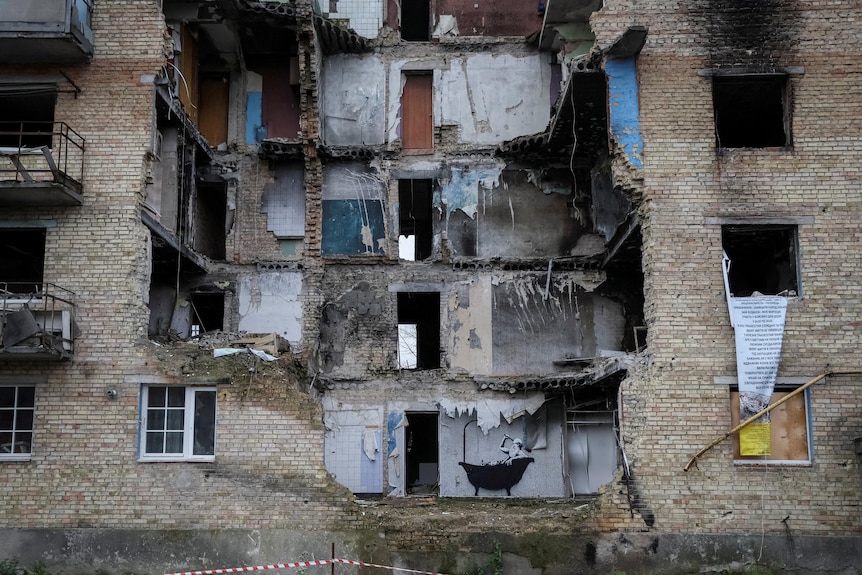
Graffiti in Banksy’s signature style was seen on the wall of a destroyed building in the Ukrainian village of Horenka in the early days of the Russian invasion in 2022. (Reuters: Gleb Garanich)
Reuters says we do. They said that they “took into account Banksy’s privacy claims — and the fact that many of his fans wish for him to remain anonymous”. But their rationale, after an extensive, detailed investigation, was that “the public has a deep interest in understanding the identity and career of a figure with his profound and enduring influence on culture, the art industry and international political discourse.”
They insisted this was basic journalism: “we applied the same principle that Reuters uses everywhere. The people and institutions who seek to shape social and political discourse are subject to scrutiny, accountability, and, sometimes, unmasking.
“Banksy’s anonymity — a deliberate, public-facing, and profitable feature of his work — has enabled him to operate without such transparency. As for the risk he might face of retaliation or censorship, Britain’s legal and political establishments seem comfortable with Banksy’s messages and how he delivers them.”
This last point has some merit — his influence his sizeable and his acclaim broad — but I’m not convinced. The identity they claim for Banksy — a Bristol born man called Robin Gunningham — has done nothing to enlighten us about his work, told us nothing new except to provide some details of a run-in with police (common to graffiti artists) and confirmed Banksy was so intent on remaining anonymous that he changed his name to, they say, David Jones, to avoid detection.
Loading Shouldn’t the work speak for itself?
The problem with the Reuters investigation is that you could have googled and found out what Banksy’s real name was after he was first unmasked in 2008 by The Mail on Sunday. In 2016, researchers at Queen Mary University of London used geographic profiling of his work to come to the same conclusion.
And now people are disappointed that a photo shows Banksy to be… a middle-aged white bloke. What were they expecting? Isn’t his work the best indicator of the man, not his clothing?
I’ve seen Banksy’s work all around the world, I seek out street art wherever I go, and just a few months ago went to his pop-up museum in Madrid. I was acutely conscious of the irony of seeing his work on well-lit interior walls, as instead of amidst rubble and mess, upturned shopping carts, in streetscapes and war zones. It seemed incongruous to have a museum shop at the end of an exhibit where consumerism was mercilessly mocked.
But I have never thought, while staring at his work, that I need to know more about his identity to understand it.
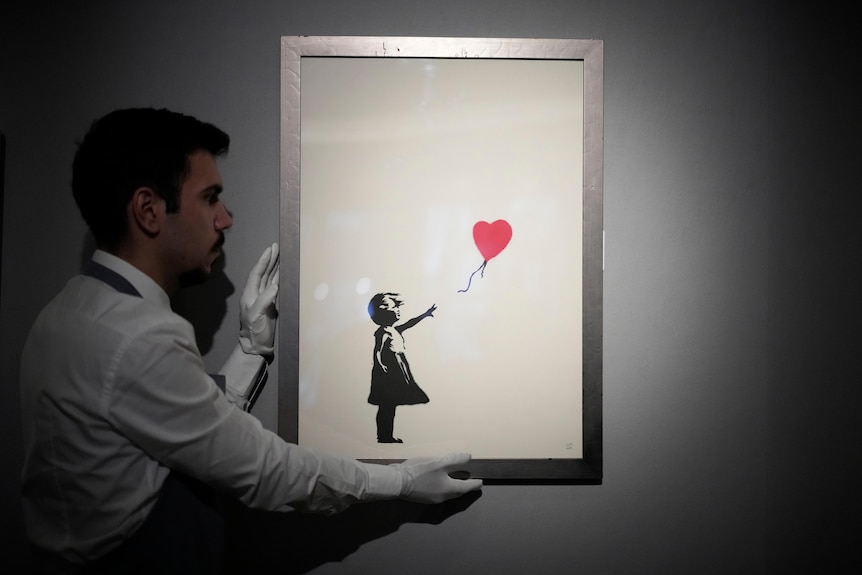
A print of Banksy’s “Girl With Balloon, 2004” at Bonhams auction house in London in 2021. (AP: Matt Dunham)
Think of the mad rush to expose Elena Ferrante, the talented author of the My Brilliant Friend series, which tells the story of a friendship between two women born in Naples. She (we presume it is “she”) has sought anonymity since her first book was published in 1992, saying “books, once they are written, have no need of their authors”.
I agree — let the work speak for itself, don’t drag a possibly reclusive, maybe introverted creative person into the spotlight of unforgiving lenses, to be asked all manner of views on random things, risking shunning, cancelling, or — worse — endless parsing. And yet people try.
Ferrante told the Paris Review: “I was frightened at the thought of having to come out of my shell.”
But still some were determined to pull off her mask and thrust her into the public eye.
It would be different if the person seeking secrecy was corrupt or committing heinous criminal acts.
Pseudonyms are core to street art, often created by people creeping along walls and tunnels at night, spraying and tagging, remaining hidden for decades or lifetimes.
In an era where the briefest of digital footprints can enable you to find out the most intimate details of a person’s life, where celebrities walk near-naked down red carpets, I do sometimes miss mystery.
It seems that Banksy has picked the right place to live, though, with his neighbours speaking of the need to respect each other.
Said one: “I don’t know what most of my neighbours do for a living and I honestly wouldn’t know if he was Banksy or not, but if he is then good luck to him.”
Julia Baird is an author, broadcaster, journalist and co-host of the ABC podcast, Not Stupid.