
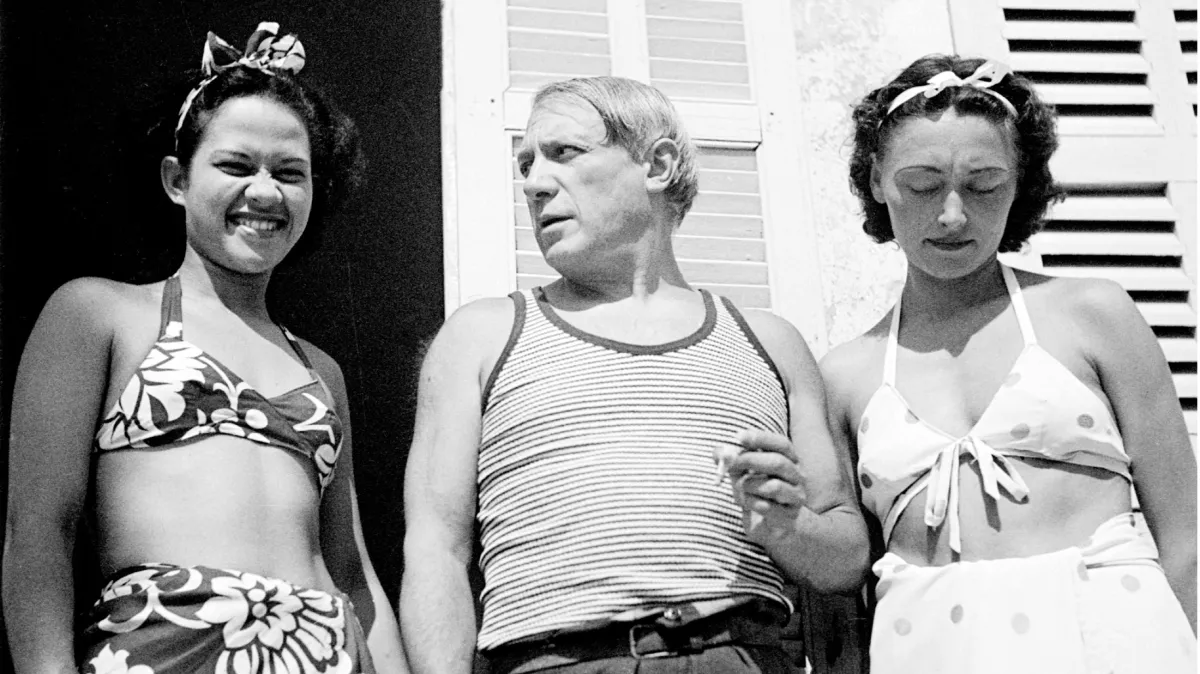
There’s something dangerous about a group holiday. Apparently sturdy social arrangements have a way of softening under the influence of heat, exposed skin and clinking cocktail ice. Spouse, friend, stranger: in the bright sunlight, these ordinarily robust distinctions might bend and rearrange themselves. Such thrilling, destructive energy is catnip to writers and artists: Iris Murdoch’s novels, David Hockney’s California paintings and The White Lotus are all versions of the same holiday plot. Add to that list a pile of photographs and paintings made in the summer of 1937 in the south of France by a group of artists and bohemians enjoying a sexy, if slightly disturbing vacation.
Among the group was the extraordinary Lee Miller, the New York-born model turned fashion and war photographer and subject of a recent Tate Britain retrospective. She was escaping marital boredom in colonial Egypt for a few weeks with her lover, the British painter Roland Penrose (whom Tate visitors might remember from her portrait of him, sweetly muffled up in bed with mumps). Also, Pablo Picasso, perennially stripped to the waist to reveal his compact bull’s body, deeply tanned, playful but with one eye on his brushes, crying out after lunch that it was time to get to work while the others dozed or slipped off for sex. He was there with his latest muse Dora Maar, another talented photographer.
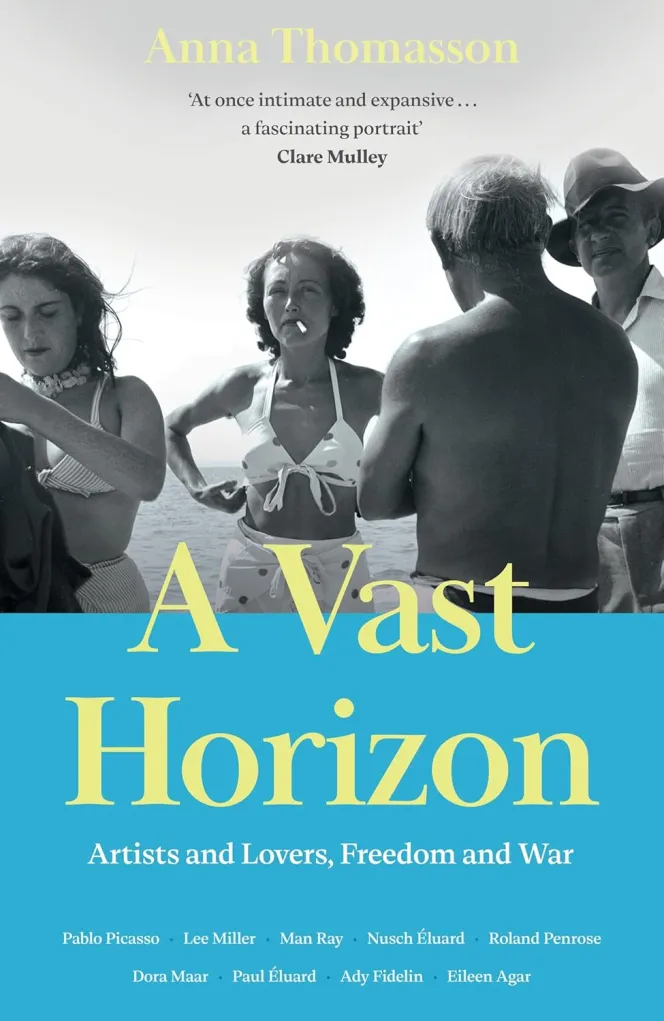
Then there was Miller’s ex-lover Man Ray and his young Guadalupian girlfriend, the dancer Ady Fidelin. Also, the consumptive communist poet Paul Éluard, his wife, Nusch, a photographer, and the Argentinian-British photographer Eileen Agar. This was the gang who in July 1937 took over the superbly named Hôtel-Restaurant Vaste Horizon, perched on an olive-and-oleander-covered hillside above Cannes. The summer they spent there, plus the war years that followed, is the subject of Anna Thomasson’s “collage” cum group biography A Vast Horizon.
The book begins with a single snap: Miller’s Picnic, a bucolic lunchtime scene showing the group stretched out luxuriantly on sun-striped grass. The date adds a poignant dramatic irony — war is coming for the picnickers, gathering like the dense forest in the background of the photograph. Fascism was no friend to the experimental artist: just a couple of months earlier, Picasso’s Guernica, inspired by newspaper reports of the brutal Nazi bombardment of the small Basque town, had gone on display in Paris as part of a city-wide international art show that also included the Nazis’ pet architect Albert Speer’s enormous, swastika-crowned granite pavilion. In July Goebbels’s anti-exhibition of “degenerate art” went on display in Berlin, uniting works by Max Beckmann, Otto Dix, Edvard Munch, Henri Matisse, Picasso and more in one of the great modernist exhibitions, an irony that comforted no one.
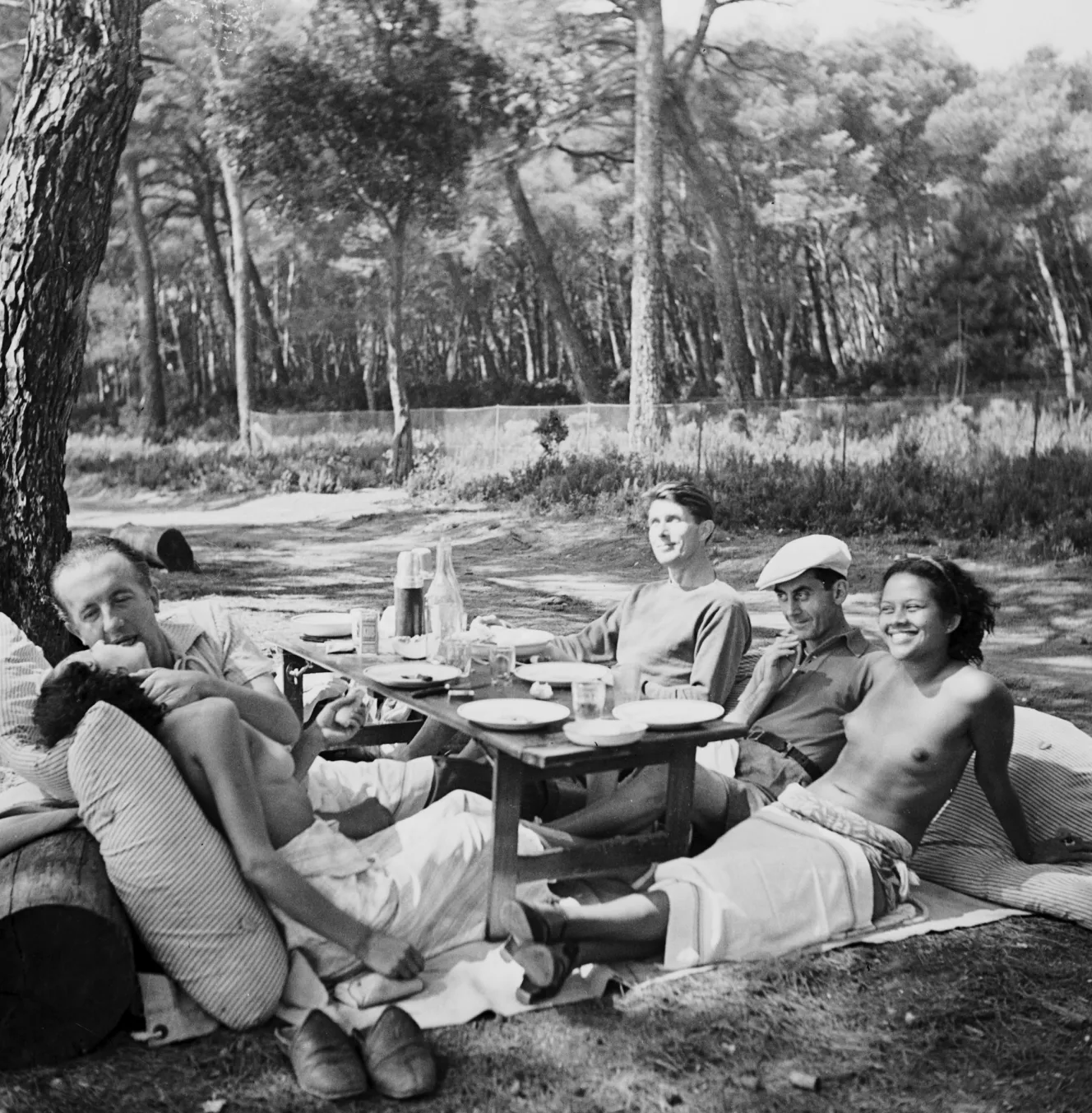 Nusch and Paul Éluard, Roland Penrose, Man Ray and Ady Fidelin in Lee Miller’s photograph Picnic© Lee Miller Archives, England 2026. All rights reserved. leemiller.co.uk
But for now, it was still summer. Picnic is a photograph of friendship and friendly sexuality: Nusch and Fidelin are topless, Nusch and Paul about to kiss. Of the hundreds of photographs taken on this holiday, many suggest their subjects were enjoying a summer of love, 1937-style. The women wear brazenly modern two-piece swimsuits called bikinis (Nusch, pictured on the book jacket in a polka-dot halter-neck with a cigarette sticking out of her mouth, wears it best). Everyone is constantly touching, sometimes playfully — Fidelin perched on Roland’s shoulders, her hands in his hair — and sometimes more explicitly. Man Ray took a series of erotic shots featuring cupped breasts, penises in hand, heads between bare legs. The intention is clear: the surrealists, which most of these artists would identify as, were all about limitless freedom of imagination — melting clocks, furry teacups, tangerine-robed cows — but also other kinds of freedom. Here, by the sea, they shared their bodies and minds.
Which sounds lovely in theory, but power imbalances, peskily entrenched, are not always easy to magic away, even at the beach. As Thomasson notes of Picnic: “There’s a jarring asymmetry to half-naked women sitting amongst fully clothed men.” Even the way Paul leans over Nusch for a kiss, his fingers spread across her neck, feels a bit sinister. The book’s account of the holiday’s cross-couple skirmishes are more depressing than enviable. It sounds like less a joyful free-for-all than the women being passed round like luxury cigars. Thomasson writes: “Paul liked to offer Nusch to his friends as a gift, a gesture of friendship, an hommage, he called it.” According to Picasso’s biographer John Richardson, Paul was hurt by his friend’s rejection of this thoughtful present.
Books newsletter
News, reviews, author interviews and suggested reads from our literary editors.
Sign up with one click
Nusch, born in the Alsace region to a family of street performers (her father was an acrobat), was picked up by Paul, aged 23, outside the Galeries Lafayette, probably while she was selling sex. He took her to a café where she devoured a basket of croissants. For Paul, this was a terribly romantic first encounter; for Nusch, as Thomasson writes, she was perhaps “just hungry”. Similarly, Fidelin had to leave Guadeloupe, aged 15, after a cyclone devastated the island in 1928 and killed her mother. She was working as a nightclub dancer in Paris when she met and moved in with Man Ray who, like Paul for Nusch, represented not so much romance, or at least not only romance, as an escape route from poverty. He was 44 years old and married — she was 20.
Thomasson writes about these unequal relationships with something approaching an abdication of judgment. Even to someone, like me, who prefers their history served without excessive moral custard, this feels odd. Penrose apparently made his own “hommage” to Picasso in the form of Lee’s body. “It’s not clear whether Picasso accepted,” Thomasson writes, adding soothingly, “but it’s difficult to imagine [Lee] doing anything she didn’t want to do,” as though confident women are immune to sexual coercion.
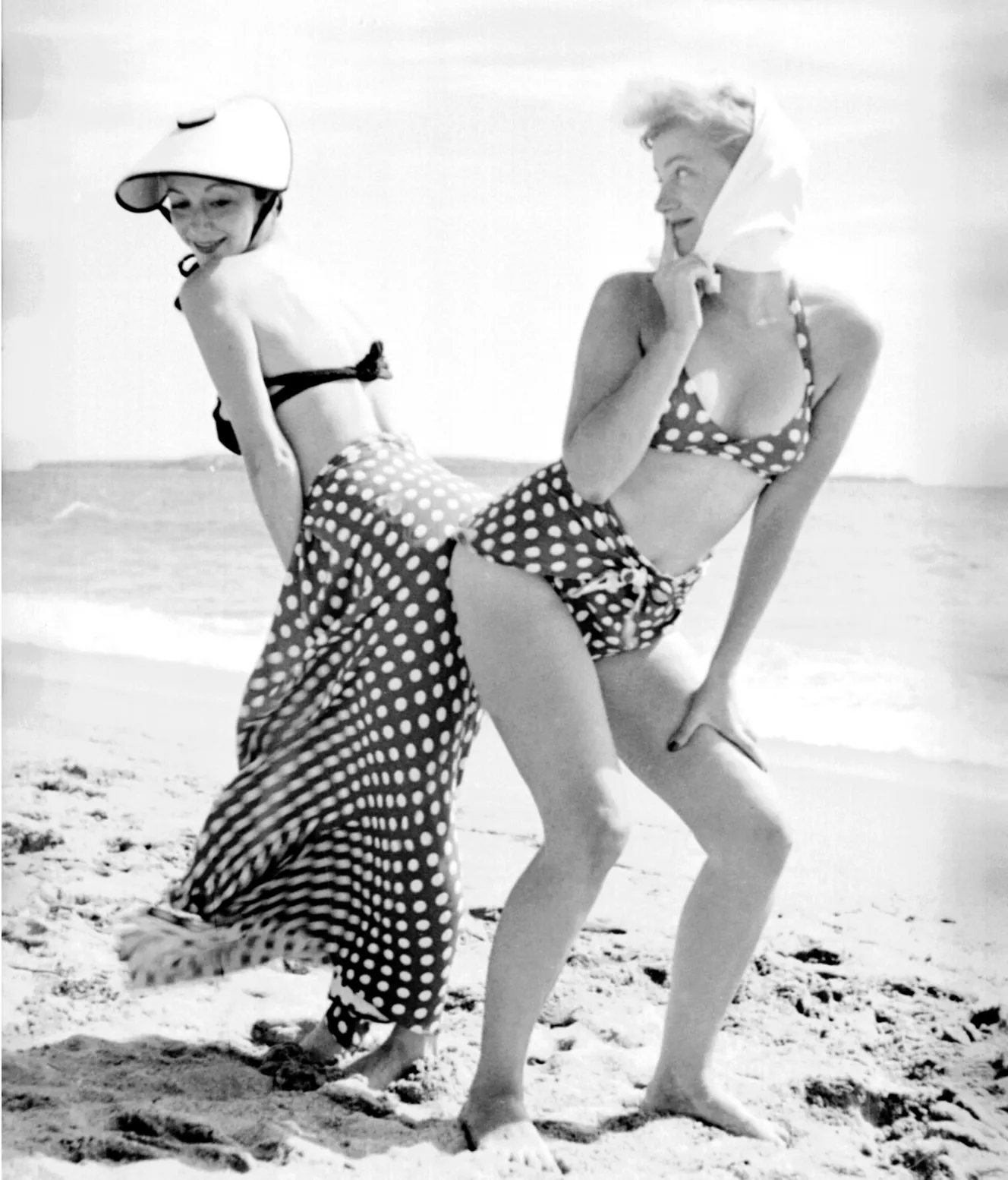 Nusch Ėluard and Lee Miller in 1937© Lee Miller Archives, England 2026. All rights reserved. leemiller.co.uk
People sometimes behave better in a crisis than on indulgent holidays, and several of these artists are much more likeable when war arrives. Picasso hunkered down in occupied Paris, despite offers of asylum from America and Mexico, “singing at the top of his voice to drown out the clamour of the gunfire” when the Allies approached. Penrose made himself into an expert in camouflage, so impressing General Montgomery that he was put in charge of the Eastern Command’s camouflage school. In his lectures, he used a photograph of Miller, her naked body stretched kinkily out beneath a net, saying that if he could conceal her beauty, he could conceal anything.
Paul’s poem Liberté became a hymn of the resistance, while its writer and his wife spent the war in terrified restlessness, moving from hiding place to hiding place in France. But Miller’s war was the most momentous: ignoring the American embassy’s instructions to board the next ship home, she shot hats for a beleaguered but bullish Vogue in the rubble of Blitz London, then, restless for action, got herself to Europe, following in the liberating armies’ wake. Incredibly, it was American Vogue that published her pictures of Dachau, beneath the headline “BELIEVE IT.” In Munich, she and her lover at the time, the photographer David Scherman, blagged their way into Hitler’s private apartment and, in a piece of performance art so bizarre, tasteless and death-defyingly funny it still feels avante-garde, snapped themselves naked in his bathtub, washing off the death camp mud.
Not everyone came out of the war well: Man Ray made his way back to America, but left Fidelin behind, telling Penrose he couldn’t get her a visa. There he married a beautiful young model and moved to Hollywood, while his lover had to survive the war in Paris as best she could, protecting his studio like a shrine and largely disappearing from history.
A Vast Horizon is not a terribly good book, favouring clotted description (“The freedoms they sought were social, sexual, creative, political, physical, psychological…”) over primary sources. Where are the letters, diaries and memoirs of these wonderfully idiosyncratic, compulsively self-mythologising people? You crave their voices. Given the book’s subject, there are also frustratingly few photographs — so google them instead, especially Miller’s shots of Picasso, which bottle something of his sinister pocket-rocket charm. Enjoy the wonderful photograph of the two of them reunited in Paris in 1944, Miller towering over Picasso, both of them beaming — a moment of joy, relief and friendship between two great artists who had somehow survived it all.
A Vast Horizon: Artists and Lovers, Freedom and War by Anna Thomasson (Picador £20 pp294). To order a copy go to timesbookshop.co.uk. Free UK standard P&P on orders over £25. Special discount available for Times+ members