
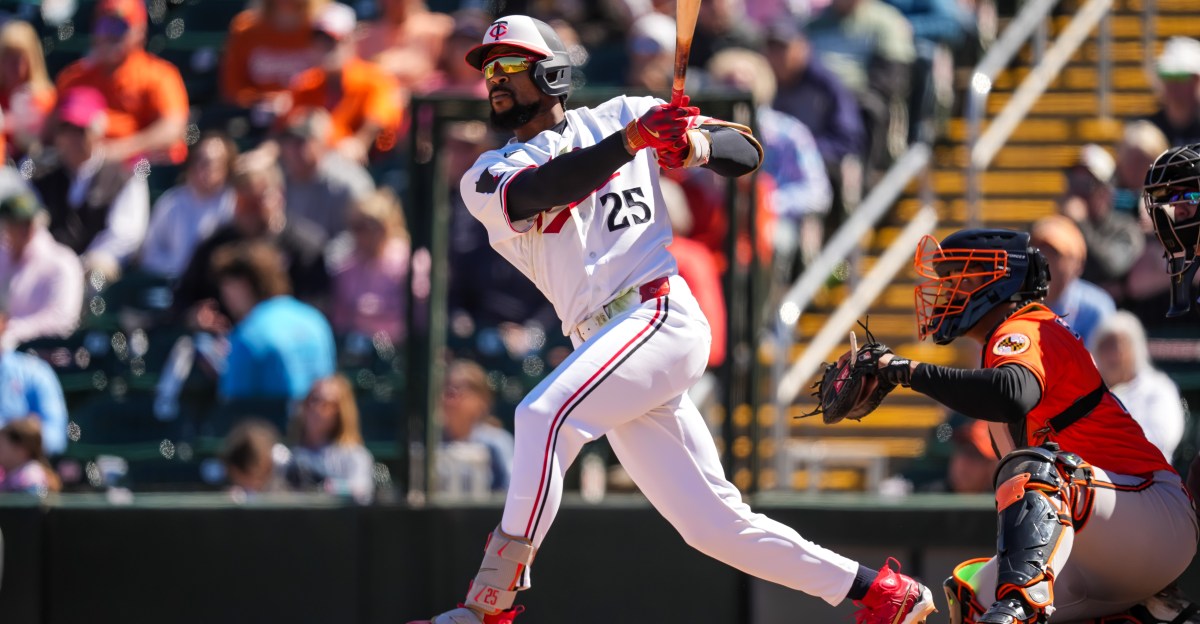
With the start of the Major League season just around the corner, here’s episode 3 of our 4-part series sizing up the rest of the AL Central Detroit will be contending with. We started with the KC Royals and Cleveland Guardians, the two best teams besides Detroit last year. Now, we’ll be checking in on the Minnesota Twins, who rate surprisingly well in pre-season projections despite a mid-season sell-off and a very inconsistent path over the last 12 months.
First up will be the projected records from both PECOTA and the Depth Charts and a summary of the Twins’ offseason dealings. There was a lot of action, not all of it good; it felt more like spinning your wheels than anything intentional. Then we’ll get to the biggest strengths and weaknesses of the the team, and finally the x-factors. These are the players that, in my eye, serve as the tipping point between a good and a not-good Twins’ season.
Projected Record and Team Summary
The projections agree here: Minnesota is ok. That’s it. Both PECOTA and Depth Charts have Minnesota as a 79-83 win team with a puncher’s chance of overperforming and chasing down a division title. Despite a chaotic, messy winter, the team has a decent bit of returning talent, so counting them out entirely is pretty unwise. At the same time, there are enough holes that expecting anything great is hard, too. They’re mostly stuck in between and hoping things go their way.
Their offseason, generally, reflects that treading-water mentality. After a mass deadline exodus that included Carlos Correa, Willi Castro, and their entire bullpen, the Twins entertained trade rumors on the rest of their roster. Speculation that Pablo Lopez, Joe Ryan, Byron Buxton, and Ryan Jeffers could be on the way out ran rampant, and then none of them got traded. They did send out Edouard Julien and a few other depth types, but nothing major. Instead, the major departure was their President of Baseball Operations, Derek Falvey; word is he wanted nothing to do with this half-baked approach and the two parties “mutually agreed” upon his departure.
The Twins additions included signing a handful of ok veteran hitters like Josh Bell and Victor Caratini and buffering their minor league depth with non roster invites. Andrew Chafin has strong odds of making the Opening Day bullpen, which says a lot about the state of the bullpen. With Duran, Griffin Jax, and Louis Varland all traded away, it’s hard to imagine them putting together a pen they can really lean on. They did take a major hit to the rotation already, as their ace, relatively speaking, Lopez underwent UCL surgery in February. He’ll miss the entire season rehabbing.
Greatest Strength: Young Rotation Depth
Minnesota is embracing the age-old axiom that you can never have too much pitching. Right now, Minnesota projects to run approximately 9 deep with fringe-average or better arms, most of them in the form of MLB-ready 45 FV and better prospects or recent rookie graduates that haven’t quite performed to expectations. Taj Bradley and Mick Abel have good stuff, and the duo headlined the returns from the 2025 deadline selloff, while Andrew Morris, Connor Prielipp, Kendry Rojas, and Zebby Matthews are all strong depth options stashed in AAA. With any group of young starters, it’s fair to assume a few will be good, a few will be bad, and a few will get injured, so having this many options is very important. The core of a pretty good rotation is in the making here, but they’re mostly still in the development stage trying to establish themselves as major leaguers. Of course, none of these are sure things, either.
Focusing on the major league arms, Abel is approximately 5 years into a professional career of too many walks offsetting huge stuff. Philadelphia tried and failed to harness that stuff and chose to cut bait for a dominant reliever, Jhoan Duran; now it’s Minnesota’s turn. Bradley is a similar story, except he has 2 years of the same issues at the major league level, too. Minnesota has long-term control of both these young arms, so if they can fix either of them, they’ll be reaping the rewards for several years. There’s plenty of risk attached here, but lots of upside if things break right.
Greatest Weakness: Offensive Upside
By no means do the Minnesota Twins have a bad lineup. That’s important to get out of the way early. I’m just not sure how they could have a good lineup, either, which is also important to note. Last year’s version posted a 97 wRC+ as a team, 18th best in the league. That’s really not bad! It’s just also not good, and their offseason additions didn’t do much to change that.
Bringing in Josh Ball and Victor Caratini isn’t inherently bad. Those are competent major league hitters. That’s just also all they are at this stage. Bell has roughly a 105 wRC+ and has been traded twice over the last three years; he projects for about the same again. The same holds true for Caratini, who has been an average hitter – no small feat for an adequate catcher – and projects for the same again. Considering the 2025 team already had a lot break right offensively – a stellar, mostly healthy Byron Buxton season and an emergent Luke Keaschall were the highlights – and lost Carlos Correa at the deadline, adding some veteran depth doesn’t feel like enough. Maybe I’m underrating the offensive potential of guys like Matt Wallner or Brooks Lee here, but without a major breakout, neither projects to be any more than useful. Top hitting prospect Wakler Jenkins had a rough go of it in his late summer first look at the Triple-A level, but if he puts it together he has the tools to be a quality, above average big league hitter. Still, it’s a struggle to view this offense as anything more than OK.
X-Factor: Luke Keaschall and Bailey Ober
The best chance for the Twins’ offense surprising me runs through Luke Keaschall. A strong contact bat with surprising pop throughout the minors, his game translated nearly immediately to the major leagues. Injuries interrupted a very strong rookie season, but his .302/.380/.445 slashline and 4 HRs in 49 games certainly opened some eyes. That’s a small sample and probably the result of some good luck, but his 0.66 BB/K rate and 14 SBs is an excellent foundation for a basestealing threat that lives on base. If he can maintain the power, the Twins have a breakout star to build around, but even without it, he’s tracking as a Whit Merrifield style pest. Getting Keaschall to the next level is critical for the Twins to succeed next year.
Equally important is Bailey Ober. Owner of the “invisiball” fastball thanks to spin, extension, and arm angle, Ober has generally been an underrated, durable mid-rotation arm for the Twins. Last year, though, everything fell apart. His fastball velocity dropped from roughly 92 to 90 mph, his strikeouts dipped, and his home runs allowed spiked. None of that is good. It’s likely that the hip impingement he pitched through impacted his entire season, so if he’s healthy, maybe he bounces back. Right now he’s projected for the second slot in Minnesota’s rotation behind Joe Ryan, so a healthy and effective season from Ober is absolutely vital. Unfortunately, a season that bad can be hard to bounce back from entirely, and the rest of their young rotation will likely have to pick up some of the slack.
On some teams, an adequate offense can be more than enough. That’s basically Detroit’s plan this year, and they project well because their pitching staff is excellent and they have a deep pool of average or better hitters. Right now, that isn’t how Minnesota’s roster is constructed. Their rotation depth is excellent, but “Joe Ryan and friends” isn’t the dominant pitching staff needed to support their offense. Furthermore, their bullpen is light, too; Taylor Rogers and Cole Sands just aren’t that intimidating at the backend. Counting on anything from Liam Hendriks, as much as I hope he’s dominant, isn’t a very wise bet in 2026 either.
Generally, being average across the board is the beginning of a plan, not the end stage; without a carrying facet to separate themselves from other teams, I have a hard time seeing the Twins really making much noise. Most of the noise they’ve made over the last year has been the dysfunction between ownership and management. Their saving grace, honestly, is that the rest of the Central lacks a dominant force to put them down, so their fringe-.500 projections aren’t nearly as punishing as they would be elsewhere. This isn’t quite a bad team, but they’re probably a Buxton injury or a mid-season selloff away from 72 wins.