
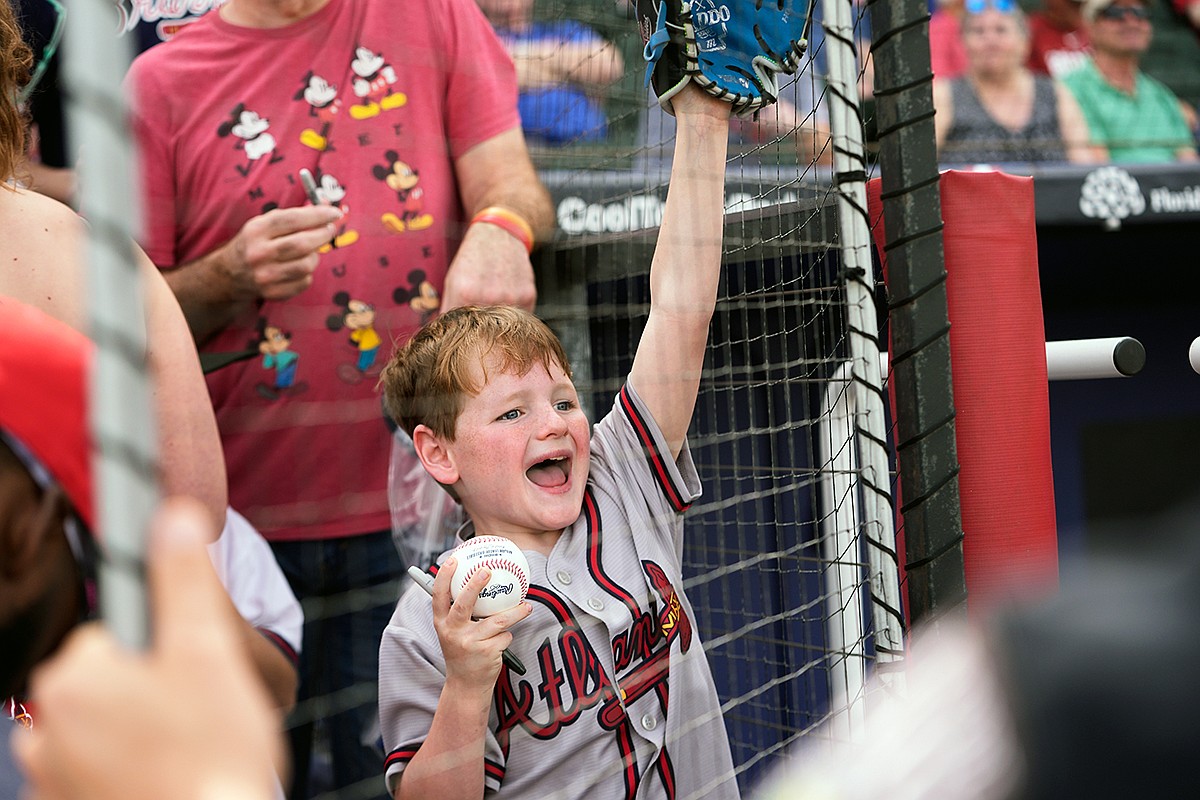
This time of year, office conversations often turn to the Atlanta Braves.
Optimism springs eternal, right? Well, for most that might be true, but where the Braves are concerned, there has been more angst than usual for Major League Baseball’s 2026 season.
While some national media members are predicting a bounce-back year for the Bravos, those of us who claim the team as our own have, for the most part, a differing view.
Let’s explain the causes for concern and, because it’s spring, plot a path back to postseason relevance.
OK, we all know last season was a disaster filled with injuries to key players, subpar individual performances, less-than-stellar managing/coaching, and a front office that flat-out disappeared when it was needed most.
The early portions of the offseason were quite positive, with a new coaching staff (though first-year Braves manager Walt Weiss isn’t exactly new) and what were then strong moves to re-sign shortstop Ha-Seong Kim and acquire 40-save reliever Robert Suarez.
It was reported that right fielder Ronald Acuña Jr. was well on his way to a healthy start to the season.
Since then? Crickets. Not only crickets, but throw in a strong mix of crows and vultures and the “Jaws” soundtrack. And then more crickets.
The Braves soon found out that Kim injured himself doing nonbaseball stuff and that pitchers Spencer Schwellenbach, AJ Smith-Shawver, Hurston Waldrep and Joey Wentz would either be out for the season or seriously delayed with various injuries.
Then came outfielder Jurickson Profar’s season-long suspension for being, well, Jurickson Profar.
So, how did renowned Atlanta general manager Alex Anthopoulos respond? He added Mike Yastrzemski, Mauricio Dubon, Jorge Mateo, Dominic Smith, Kyle Farmer and Jonah Heim — and zero starting pitchers.
At least when AA did very little a year ago, there was some logic to it. The Braves, the sport’s only publicly traded team, wanted to get under the MLB tax threshold after going above it for a couple of years. OK, we get it, but now they are well under the current threshold, and once again the team has gone thrifty despite major needs.
The problem is, according to financial reports, Atlanta Braves Holdings, Inc. generated $732 million in 2024, with $635 million coming from baseball revenue, an uptick of 11% from the previous year.
By contrast, the Los Angeles Dodgers generated $1.1 billion, but they’ll spend right at half of that on the team’s payroll this year, according to Spotrac, after tax penalties. Despite winning back-to-back World Series titles, Dodgers brass added pricey free agents Kyle Tucker and Edwin Diaz.
The Braves are set to spend $233 million, less than a third of the revenue, and added … well, we won’t go over that again, but you get the idea.
(The only good thing about baseball’s economics is that next year we won’t be so angry about it because there likely won’t be anything to write about with a strike looming due to the sport’s spending gap).
On the field, much has to go right for the Braves to return to the playoffs.
First, there can be no more big injuries, and how likely is that? If there is lineup-wide health, few teams can match what the Braves can offer one through four in the lineup with Acuña, catcher Drake Baldwin, first baseman Matt Olson and third baseman Austin Riley.
(READ MORE: Bats might stink, but stacking arms is Atlanta’s best chance)
We’ve seen what center fielder Michael Harris II can do when his swing isn’t all wanky, and at times you can still see second baseman Ozzie Albies being a positive instead of a negative in the lineup. At shortstop (Kim when he returns, Dubon for now), left field (Yastrzemski, Farmer, Eli White) and designated hitter (Yaz, Sean Murphy, Jorge Mateo, etc.) the Braves are among the weakest in baseball. The bench could be epically bad, and there’s not much help in the minors.
However, with the strength of the top of the order, the rest just need to be adequate to make it an above-average lineup.
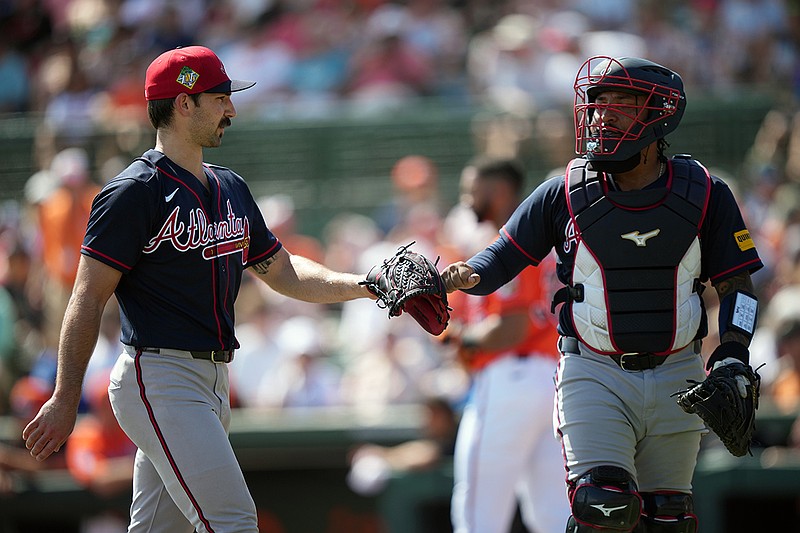 Atlanta Braves pitcher Spencer Strider and catcher Chadwick Tromp celebrate during a Grapefruit League exhibition game against the Baltimore Orioles at spring training on Feb. 28 in Sarasota, Fla. (AP Photo/Matt Slocum)
Pitching is another story. As of today, the team’s starters will be Chris Sale (7-5, 20 starts, 2.58 ERA in 2025), Spencer Strider (7-14, 23, 4.45), Bryce Elder (8-11, 28, 5.30), Grant Holmes (4-9, 21, 3.99) and Reynaldo López, who missed 2025 with a shoulder injury.
The math doesn’t paint a pretty picture. Even the most optimistic projections have that group totaling 650 innings in 2026, and that’s asking for good health. There are 1,458 innings in a 162-game season (assuming no extra innings). If a team wants its starters to go six innings, that’s 972 innings.
So how does that rotation get the Braves to the postseason, which likely means winning the National League East Division, or at least finishing ahead of either the New York Mets or Philadelphia Phillies?
Let’s assume Sale, the 2024 NL Cy Young Award winner, makes 25 to 30 starts and keeps dealing; Strider, after a mostly healthy season, returns to some level of previous success; and Lopez can make 20 starts and be effective. Even the most optimistic of Braves fans can only hope for so much from Elder and Holmes, but if they can combine for 300 innings and keep the ERAs in the 4-range, it’s doable.
Unlike the lineup, though, there is mound help on the way. Schwellenbach and Waldrep could return for the stretch, and 20-year-old spring phenom Didier Fuentes has apparently made the final roster. Top prospect J.R. Ritchie was sent down but remains on schedule to help this season, which begins for the Braves on Friday, when the Kansas City Royals visit Truist Park to open a three-game series.
The bullpen is the team’s strength with Iglesias and Suarez on the back end and newcomer Tyler Kinley joining Dylan Lee, Aaron Bummer and Joel Payamps as setup men.
Hopefully, Weiss and crew will be better with managing that pen and, if we get really lucky, Anthopoulos will add a piece or two to shore up weak spots. The Mets lost Pete Alonso and Diaz, and the Phillies are among the oldest teams in baseball this season.
Hey, it’s spring. It’s a time of hope, even for Braves fans.
Contact Lindsey Young at lyoung@timesfreepress.com.