
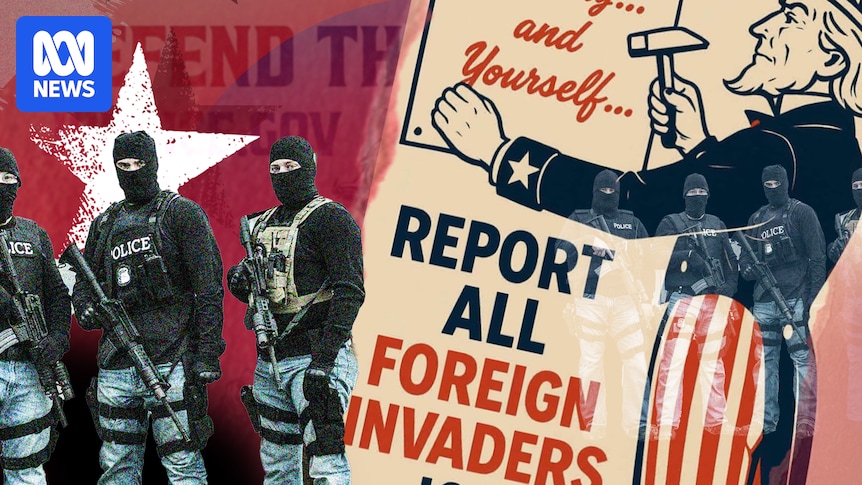
It was October last year and the US Department of Homeland Security’s social media team had shifted into overdrive.
Among a flurry of new videos, each more nationalistic than the last, one stood out.
A grainy montage depicting an American golden age is spliced with scenes of patriotism, consumerism and military might.
An American flag is planted on the moon. Fighter jets fly in formation. And a spritely Donald Trump strides through New York City.
Overlaid are the words “LIFE AFTER ALL CRIMINAL ALIENS ARE DEPORTED”.
But buried in the 50 second video is a clip with far more sinister undertones that many viewers would likely miss.
For a fleeting moment, a crescent moon in sunglasses appears seated at a grand piano.
To most it scarcely registers. But to those steeped in extremist online subculture, the reference is unmistakable.
‘Flat out white supremacist’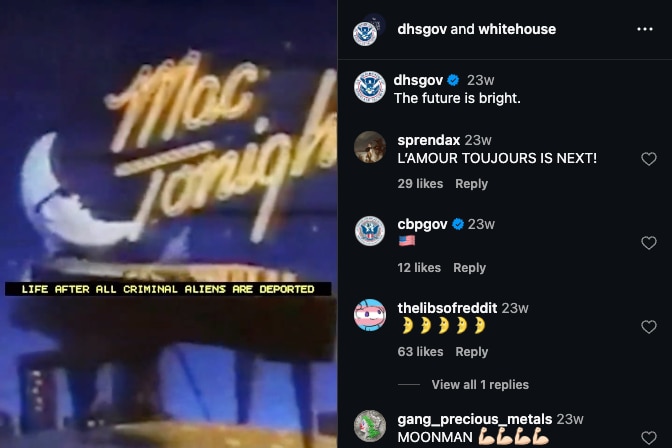
A segment of a video posted by the White House and the Department of Homeland Security’s Instagram pages. (Instagram: White House)
“Moon man” is an internet meme that was appropriated by white supremacy groups on fringe forums such as 4chan, where it was often paired with racist songs and swastikas.
It has since joined a growing catalogue of hate symbols, including Pepe the Frog, that have been co-opted by the alt-right.
Experts who track extremist movements say its inclusion was unlikely to be accidental.

The Moon Man meme has been co-opted by the far right online. (Supplied: Anti-Defamation League)
The video was posted at a critical moment in US President Donald Trump’s immigration crackdown.
Immigration and Customs Enforcement (ICE) had just announced an unprecedented hiring spree of thousands of new agents to carry out the largest deportation operation in US history.
ICE’s tactics had also become more aggressive, with scenes of federal agents rappelling out of Black Hawk helicopters onto the roof of an apartment amid Chicago’s immigration raids.
For researchers who study white supremacy networks online, this was not an innocent inclusion of an internet meme — it was a deliberate dog whistle to some of the nation’s most extremist groups.
“Some of the images have been flat-out white supremacist,” said Heidi Beirich, co-founder of the Global Project Against Hate and Extremism. “There’s just no question.”
Ms Beirich, who has studied the online activity of extremist movements since the late 1990s, said the content was clearly targeted at a specific community who understood the coded imagery.
“I don’t see how this is anything but absolutely terrifying and completely irresponsible,” she said.
References to far-right extremism on official US government channels have since become more overt.
In January, the US Department of Labor posted to X with a grainy black and white image shows Donald Trump saluting a stadium.
The words “TRUST THE PLAN” are written in both the image and the caption.
That same phrase has been a foundational mantra associated with the far-right political movement QAnon, which is built on the conspiracy of a secret plan to combat a supposed deep state cabal.
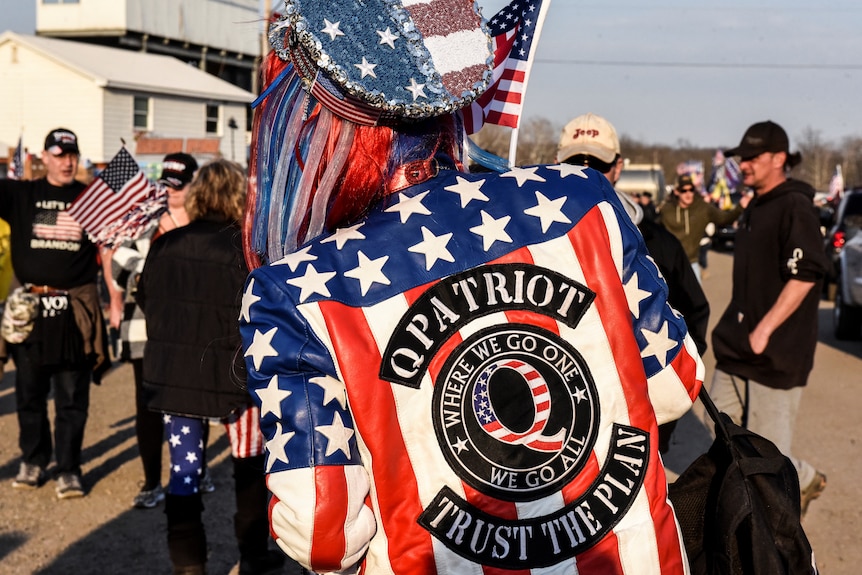
“Trust the Plan” became a catchcry of the QAnon movement. (Reuters: Stephanie Keith)
Days later, the Department of Labor shared another video showing former president George Washington, who led the American Revolutionary War.
The caption reads “One Homeland. One People. One Heritage.”
Experts say the phrase “One Homeland. One People. One Heritage.” bears striking similarity to the Nazi-era slogan “Ein Volk, Ein Reich, Ein Führer.”
This slogan was used by the Nazi Party to promote unity of all Germans into a single state under totalitarian leader Adolf Hitler.
The Nazi motto translates to “One People, One Realm, One Leader.”
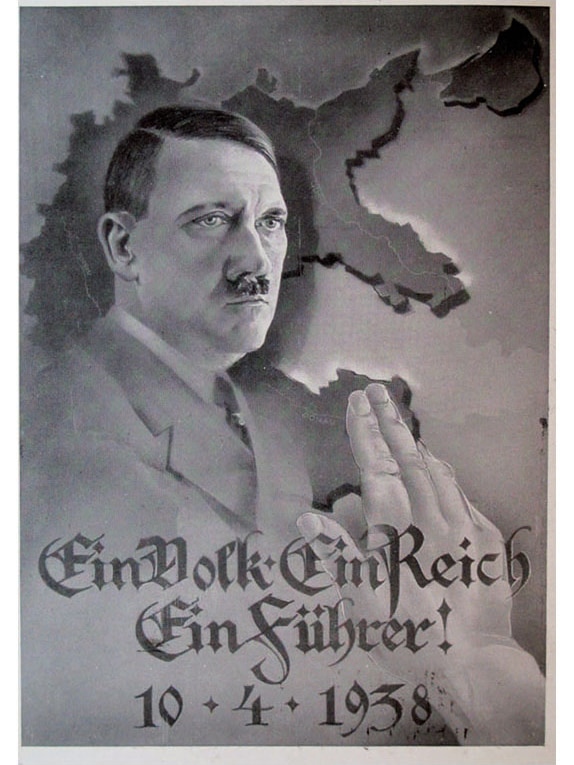
A poster of Adolf Hitler with the words “One People, One Realm, One Leader!” from the 1930s. (Supplied: Abe Books)
But it’s not just images that are causing alarm. That same month, the official White House account posted to X with the caption “Which way, Greenland man?” — language critics say has been purposefully taken from the 1978 book Which Way Western Man by neo-Nazi author William Gayley Simpson.
The book, which promotes anti-Semitic and white supremacist ideology, is regarded by experts as influential in extremist circles.
That same month, The Department of Homeland Security (DHS) posted to X with a recruitment ad to join ICE.
“WE’LL HAVE OUR HOME AGAIN,” reads both the caption and the image, coupled with a figure on horseback galloping across a wide-open plain with a fighter jet overhead.
The phrase shares the title of a song We’ll Have our Home Again by Pine Tree Riots, which Ms Beirich said has become an anthem of neo-Nazi groups and is often seen circulating online.
Other lyrics in the song include:
“In our own towns, we’re foreigners now. Our names are spat and cursed…”
The same post appeared on the DHS Instagram page along with an excerpt of the song, which was later removed by the department.
Another song by the same group appears to reference the 2017 Unite the Right rally in Charlottesville, Virginia where neo-Nazis and members of the Ku Klux Klan clashed with protesters.
The lyrics read:
“Well, another Charlottesville wouldn’t do us any harm.”
The Department of Homeland Security did not respond to the ABC’s questions but, in a statement to the New York Times, it rejected suggestions the posts were intentionally referencing extremist material, claiming any similarities were coincidental.
“There are plenty of references to those words in books and poems,” then Homeland Security spokeswoman Tricia McLaughlin told the Times.
Ms Beirich dismissed that argument as “ridiculous”.
“These are symbols that come from a particular subculture that is involved in race hate. You don’t just randomly find them,” she said.
“You actually have to know something about these movements to find these images and references — so somebody up in DHS knows something about these movements.”
Ms Beirich said the government’s ICE recruitment ads resonated with extremist groups online, such as The Proud Boys and Patriot Front, who actively shared them on platforms like Telegram.
Both groups are considered extremist due to their promotion of white nationalism, misogyny and Islamophobia and have a history of violence and intimidation.
The ABC contacted members of the Proud Boys seeking comment about white supremacy in ICE content.
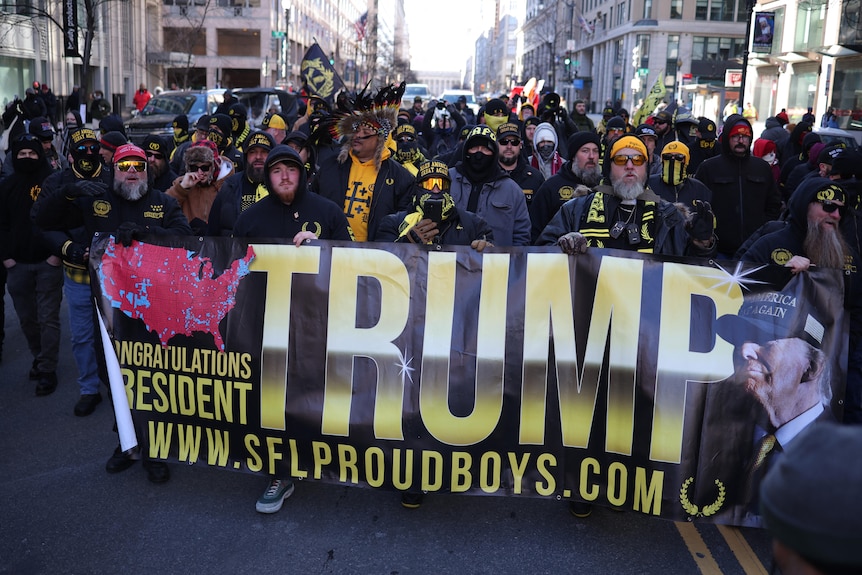
Experts have tracked the circulation of ICE recruitment ads by Proud Boys in far right forums. (Reuters: Marko Djurica)
One current member, Dan Tooze, told the ABC he would be interested in working for ICE if it weren’t for his busy role as the Vice Chair of the Clackamas County Republican Party in Oregon.
“I would do what I could, anything I could to help, like drive cars or prevent weirdo blue-haired lunatics from harassing them [ICE agents] or interfering with their duties,” Mr Tooze told the ABC.
‘Death cards’ left by ICE agents
Meanwhile, on a winter’s day in January in a rural area of Colorado, the families of 10 Latino workers made a chilling discovery.
Their vehicles had been abandoned on the roadside after ICE agents detained drivers during what immigrant advocates alleged were unlawful traffic stops in Eagle County.
In the aftermath of the arrests, relatives said they found cards inside some of their cars, each bearing the ace of spades and the address of a nearby detention facility where their loved ones had been taken.
The ace of spades is known as the “death card” in some circles. During the Vietnam War, US soldiers used death cards as a tool of psychological warfare to mark targets for assassination.
The tactic was later adopted by white supremacist groups as a means to intimidate or threaten minority groups.
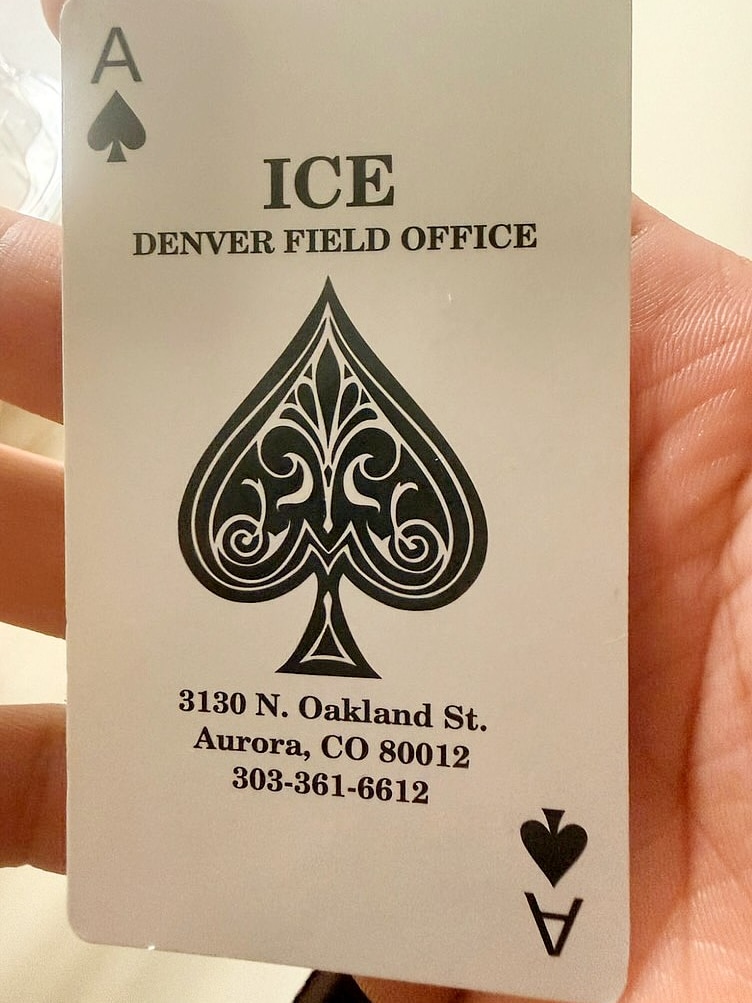
The cards were found in the cars of immigrant workers who were taken to an ICE detention centre. (Supplied: Voces Unidas)
Local immigrant rights organisation Voces Unidas, which was contacted by family members, was shocked to learn ICE agents now appeared to be using them on migrants.
“Leaving a racist death card behind after targeting Latino workers is deliberate intimidation rooted in a long history of racial violence,” said Alex Sanchez, the group’s president and CEO.
The Department of Homeland Security (DHS), which ICE is part of, condemned the incident and promised to investigate. It did not respond to the ABC’s questions about the investigation.
Local Democrats were also alarmed. In a letter to then DHS secretary Kristi Noem, they expressed concern about “racially-motivated intimidation tactics” and demanded an independent probe into ICE’s Denver Field Office.
Noem did not respond to their letter. She was fired by Trump earlier this month after she testified before a US Senate committee that he approved a $US220 million ad campaign featuring her prominently amid mounting criticism of her leadership.
Trump’s nominees for senior roles in his administration have also sparked concerns with what critics have described as racist beliefs.
Jeremy Carl — Trump’s nominee to become Assistant Secretary of State for International Organizations — faced scrutiny at his confirmation hearing last month over his beliefs which critics have described as white supremacist.
Carl, who served in Trump’s first administration, wrote a book that claimed white Americans were victims of “cultural genocide” and supported a popular conspiracy theory that white people were being deliberately replaced by non-white immigrants.
Last year, Trump’s pick to lead the Office of Special Counsel, Paul Ingrassia, came under fire after he allegedly sent racist text messages to a group chat with fellow Republicans. One of his messages reportedly said, “I do have a Nazi streak in me from time to time, I will admit it”.
He withdrew his nomination after those reports emerged. A month later, Trump appointed him as deputy general counsel at the General Services Administration.
“Maybe we shouldn’t be so surprised to see both the Department of Labor and the Department Of Homeland Security pushing out racist imagery because these are the kinds of people who are working in those places,” Ms Beirich said.
A ‘militarised’ agency
Former DHS spokesperson David Lapan has watched the agency’s drastic change in messaging with grave concern.
Lapan served as the department’s spokesperson during Trump’s first administration under then-secretary John Kelly.
But after Kelly became Trump’s chief of staff in 2017, Lapan said he noticed the White House became “much more aggressive in their communications”.
“Talking about the fake news, attacking the press,” he said.
“I was not willing to be part of that.”
He eventually quit in 2017, but has continued to observe the department from the outside.
The messaging of today’s department has deteriorated further, he said, taking on a “nationalistic, jingoistic, aggressive, and belligerent” tone in an agency that is increasingly “militarised”.
“They’ve used music, videos, memes and slogans, all that have connections to either WWII propaganda or extremism and white nationalism,” he said.
“This is different to anything I’ve ever seen in the time I’ve been in government service.”
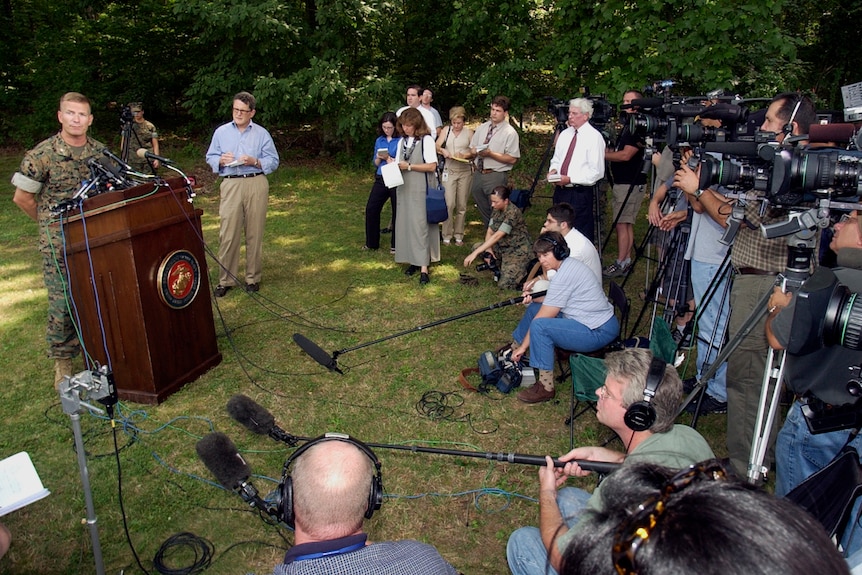
Dave Lapan, pictured at the podium, spent many years working as a US government spokesperson. (AP: Steve Helber)
Lapan also has grave concerns about the speed the agency has been recruiting at, as well as what he describes as a drop in standards.
The department he worked under had rigorous vetting, including polygraphs, drug tests, and a five-month training program, he said. It sought experienced law enforcement professionals.
Today’s recruitment, he said, targets a younger demographic with a specific mindset, using ads with imagery from the popular video game Halo.
“It’s much more targeted at people who believe the homeland has been invaded by foreigners — very much an aggressive wartime type approach,” Lapan said.
His concerns were echoed by former ICE lawyer and training instructor Ryan Schwank, who resigned last month and blew the whistle on a training program he described as “deficient, defective and broken”.
Schwank told Congress the fundamentals of the constitution, use of force and how to use firearms safely had been cut from training programs and that new agents were being encouraged to violate the constitution.
Training slashed amid hiring spree
The Trump administration has set a staggering goal of approximately one million deportations per year.
Aided by $US75 billion in funding, the department underwent a hiring spree. In early January, the agency had received more than 220,000 applications to join ICE.
It resulted in an additional 12,000 ICE officers, more than doubling the number of officers and agents to 22,000.
Lapan alleged training periods have since been slashed from five months down to as little as six weeks, and recruitment standards lowered to expand the applicant pool.
The department did not respond to the ABC’s questions regarding vetting processes and training standards.
In a statement, it said its officers rank among “the world’s most skilled and experienced law enforcement… and undergo rigorous training and preparation before going out into the field”.
Democrats in Congress have been pushing for sweeping reforms to ICE operations, including requiring judicial warrants for home entries by federal agents, body camera mandates and bans on masks worn by officers during raids.
The demands have led to a month-long shutdown of the department’s funding as parties remain deadlocked on reforms with no end in sight.
Democrats have refused to back the funding bill without greater ICE accountability but Republicans have rejected many of the proposed reforms.
This week, Trump’s pick to replace Kristi Noem as Homeland Security Secretary, Markwayne Mullin, struck a more conciliatory tone, signalling he would be willing to require officers to obtain warrants from judges in most cases.
It comes amid reporting that the president told top advisers that the administration’s deportation policies went too far and directed his team to adopt a new approach.
As for Lapan, he has seen no change in the type of people the department has sought to recruit.
“The focus seems to be looking for people that want to engage in behaviour, like we’ve seen on the streets of Minneapolis and other places, that’s very aggressive and is more military‑like than law enforcement‑like.”
Loading…