
Iranian official warns strait of Hormuz open to all but enemy-linked ships
An Iranian official has said that with the right security and safety arrangements the strait of Hormuz is open to all vessels except the ships of “enemy” countries, according to Iran’s Mehr news agency.
Iran’s representative to the UN’s International Maritime Organization, Ali Mousavi, was quoted as having said that US-Israeli “aggression” was the “root” of the key oil passage remaining effectively closed.
“Diplomacy remains Iran’s priority, however, a complete cessation of aggression and mutual trust and confidence are more essential,” Mousavi said.
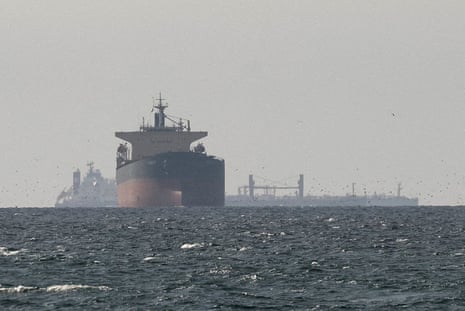 About a fifth of seaborne crude oil traffic passed through the strait before the US and Israel launched its war on Iran on 28 February. Photograph: Reuters
Iran has permitted some friendly countries, including China, India, Pakistan, to secure safe passage of their ships through the strait, but has effectively closed it down for others by attacking ships and reportedly laying mines in the waterway, causing a major crisis in global energy markets. Iran has listed its enemies as the US, Israel and its “allies”.
The US is reportedly considering plans to occupy or blockade Iran’s strategically crucial Kharg Island to pressure Tehran to reopen the vital waterway, in what would mark a huge escalation in the US-Israeli war on Iran.
As we have been reporting, the US president, Donald Trump, who is facing domestic pressure as oil prices soar, has warned the US will “obliterate” Iranian power plants if the strait is not open before a 48-hour deadline.
Key events
Show key events only
Please turn on JavaScript to use this feature
Bahrain’s defence force says in an update on social media that it has intercepted and destroyed 246 drones and 145 missiles from Iran since the war started.
Bahrain, a close American ally, hosts the US Navy’s fifth fleet along with the regional US naval command, making it a strategically significant target.
In an earlier post, we mentioned a report of a drone attack targeting a military base near Baghdad International Airport on Sunday.
The AFP news agency is now reporting that at least six overnight attacks targeted a US diplomatic and logistics centre at the airport.
“Eight separate attacks, carried out until dawn with rockets and drones targeted the US centre,” a senior security official told AFP, while a second official said there had been six strikes, not saying who was behind them. We have not yet been able to independently verify these reports.
ShareIranian official warns strait of Hormuz open to all but enemy-linked ships
An Iranian official has said that with the right security and safety arrangements the strait of Hormuz is open to all vessels except the ships of “enemy” countries, according to Iran’s Mehr news agency.
Iran’s representative to the UN’s International Maritime Organization, Ali Mousavi, was quoted as having said that US-Israeli “aggression” was the “root” of the key oil passage remaining effectively closed.
“Diplomacy remains Iran’s priority, however, a complete cessation of aggression and mutual trust and confidence are more essential,” Mousavi said.
About a fifth of seaborne crude oil traffic passed through the strait before the US and Israel launched its war on Iran on 28 February. Photograph: Reuters
Iran has permitted some friendly countries, including China, India, Pakistan, to secure safe passage of their ships through the strait, but has effectively closed it down for others by attacking ships and reportedly laying mines in the waterway, causing a major crisis in global energy markets. Iran has listed its enemies as the US, Israel and its “allies”.
The US is reportedly considering plans to occupy or blockade Iran’s strategically crucial Kharg Island to pressure Tehran to reopen the vital waterway, in what would mark a huge escalation in the US-Israeli war on Iran.
As we have been reporting, the US president, Donald Trump, who is facing domestic pressure as oil prices soar, has warned the US will “obliterate” Iranian power plants if the strait is not open before a 48-hour deadline.
ShareSummary
In case you’re just catching up, here’s today’s most significant developments:
President Donald Trump has threatened to “obliterate” Iran’s power plants if Tehran does not fully reopen the strait of Hormuz within 48 hours – threatening a new escalation, just a day after the president spoke of “winding down” the war.
Trump’s warning triggered a response from Iran’s military that it will target all US “energy, information technology and desalination infrastructure” if its own facilities are attacked.
More than 100 people were wounded on Saturday when Iranian missiles struck the cities of Arad and Dimona in southern Israel. Officials said 84 wounded were taken to hospitals in Arad, including 10 in serious condition, according to Agence France-Presse, while 30 people were wounded in Dimona. The Israeli Air Force is investigating its failure to prevent the attacks.
The International Atomic Energy Agency said it had received no indication of damage to the Negev nuclear research centre, which is near to Dimona.
Several blasts could be heard from Jerusalem on Sunday, after the Israeli military warned of incoming Iranian missiles. It also announced in a brief statement that it was conducting strikes in Tehran.
Iranian attacks on Gulf nations continued on Sunday morning, with Saudi Arabia’s ministry of defence saying it had detected three missiles launched towards Riyadh. One of the missiles was intercepted, while two fell in an uninhabited area, it said.
A drone attack also targeted a military base near Baghdad International Airport on Sunday, according to Iran’s official IRNA news agency.
Sri Lanka raised fuel prices by 25%, the second increase in two weeks, as the economic shockwaves triggered by the war and the effective closure of the strait of Hormuz continued to ripple across the world.
Japan said it could consider deploying its military for minesweeping in the strait if a ceasefire is reachedthe foreign minister, Toshimitsu Motegi, said on Sunday. Iran has been accused of laying mines in the waterway.
The death toll has risen to more than 1,500 people in Iran, more than 1,000 people in Lebanon, 16 in Israel and 13 US military members, and a number of civilians on land and sea in the Gulf region, according to Associated Press. Millions of people in Lebanon and Iran have been displaced by the Israeli war on the country.
Updated at 04.09 EDT
Trump’s threat to “obliterate” Iran’s energy facilities if it doesn’t open Strait of Hormuz within 48 hours risks again roiling global energy and financial markets, reports Reuters.
“President Trump’s threat has now placed a 48-hour ticking time bomb of elevated uncertainty over markets. If the ultimatum is not walked back, we will likely see a Black Monday reopening of global equity markets in free fall and oil prices spiking significantly higher,” said IG market analyst Tony Sycamore.
Tehran would likely target Gulf energy facilities in Saudi Arabia, the United Arab Emirates and Qatar, which “would deepen and prolong the pain of higher energy prices and drag the conflict into a broader regional crisis,” Sycamore said.
Oil prices jumped on Friday and settled at their highest in nearly four years, after Iraq declared force majeure on all oilfields developed by foreign firms, Israel attacked a major gas field in Iran and Tehran responded with strikes on neighbours, Saudi Arabia, Qatar and Kuwait.
Iranian attacks have effectively closed the Strait of Hormuz, a narrow choke point that carries around a fifth of global oil and liquefied natural gas supplies. Its near-closure sent European gas prices surging as much as 35% last week, and has prompted countries across Asia to search for ways to conserve energy, urging employees to work from home and introducing four-day weeks.
ShareRocket fire from Lebanon kills one person in north Israel: officials
Israeli first responders said rocket fire from Lebanon killed one person on Sunday close to Israel’s northern border, according to a report from AFP.
The individual was pronounced dead after a strike on their vehicle. Local firefighters said flames had engulfed two vehicles after a “direct hit”.
Updated at 03.34 EDT
 Robert Tait
Iran has radically overhauled its social media strategy in an all-out information war launched by the country’s Islamic rulers in response to US and Israeli military attacks.
Cyber experts say Iranian foreign influence operations have gone into overdrive as part of an “asymmetric” campaign designed to complement its military retaliation and intensify moral pressure on the US and Israel into curtailing their war efforts.
It has meant flooding platforms such as X, Instagram and Bluesky with targeted postings calculated to exploit the war’s unpopularity in the US, including among supporters of Donald Trump.
Previous multi-pronged communications aimed at fomenting support for causes such as Scottish independence and Irish unification have been jettisoned in favour of a single-issue message that has included AI-generated videos and memes mocking Trump and Benjamin Netanyahu, Israel’s prime minister.
Some AI generated footage has faked successful strikes on the USS Abraham Lincoln aircraft carrier, bomb damage supposedly inflicted on buildings in Tel Aviv, and Israeli soldiers supposedly crying in fear over Iranian retaliation.
Share Richard Partington
In the days after the US and Israel first bombed Iran, financial markets bet the economic fallout from Donald Trump’s “little excursion” in the Middle East would be short-lived.
“There are risks from higher oil prices longer term. But this is a tail risk,” one US-based fund manger said after the airstrike killing Iran’s supreme leader, Ayatollah Ali Khamenei. “History has shown time and time again that geopolitical flare-ups like this tend to be short-lived. This one should prove to be no exception.’’
Three weeks later, the prospect of a drawn-out war is causing mounting economic problems. Oil prices have soared above $100 a barrel, European gas prices have doubled, volatility stalks financial markets, and consumers worldwide are bracing for a surge in living costs. Central banks, including the US Federal Reserve, Bank of England and European Central Bank, warn the war could have a material impact on inflation and dent global growth.
With each day, more problems are emerging. From the soaring price of petrol and diesel for motorists, to cancelled flights and the worst travel disruption since the Covid pandemic.
Israel’s health ministry has said 4,564 people have been taken to hospital since the start of the US-Israeli war on Iran on 28 February, with 124 currently hospitalised, 13 of whom are reported to be in a serious condition and one in critical condition.
Updated at 04.34 EDT
Mojtaba Khamenei absent from Eid al-Fitr prayers
Tehran has marked the end of Ramadan and the Persian New Year, Nowruz – but the country’s supreme leader Mojtaba Khamenei has remained absent from public events.
Iran’s supreme leader traditionally leads Eid al-Fitr prayers, but Mojtaba Khamenei, who came to power earlier this month after his father Ali Khamenei was killed, has remained out of the public eye, reports Agence France-Presse.
Instead, the head of the judiciary, Gholam Hossein Mohseni Ejei, attended prayers at central Tehran’s overflowing Imam Khomeini grand mosque.
“The atmosphere of the New Year was spreading through the city,” said Farid, an advertising executive reached by AFP through an online message.
But he added: “The thought that some people could be dying right at the New Year dinner table was painful.”
A veiled Iranian woman walks at a holy shrine before the Eid al-Fitr prayer ceremony, in southern Tehran. Photograph: Morteza Nikoubazl/NurPhoto/ShutterstockShare
Updated at 02.34 EDT