
Want more ways to catch up on the latest in Bay Area sports? Sign up for the Section 415 email newsletter here and subscribe to the “Section 415″ podcast wherever you listen.
First of all, congratulations to former Giant Bill White, the winner of the latest prestigious Buck O’Neil Lifetime Achievement Award who’ll be honored during Hall of Fame weekend in late July in Cooperstown, N.Y.
White, 92, was a splendid player and broadcaster, but it’s his work as National League president in November 1992 that should make every Giants fan forever grateful — he had a heavy hand in preventing the Giants from relocating to St. Petersburg, Fla.
White spearheaded a group of National League owners including the Dodgers’ Peter O’Malley that rejected then-Giants owner Bob Lurie’s sale to Florida interests by a 9-4 vote, which opened the door for a local group of investors led by Peter Magowan to buy the team and keep it in San Francisco.
Second of all, with all due respect to any other candidates for the next Buck O’Neil Award, which is presented every three years and next given in 2029, Giants legend Felipe Alou ought to be a cinch to win. He hasn’t been inducted into the Hall of Fame, and winning the Buck O’Neil Award would be a perfect way to honor and secure his legacy as one of the sport’s great ambassadors.
For years, I’ve believed Alou, 90, has deserved recognition in the Hall of Fame because of his overall impact on the game. He never campaigned for a spot in Cooperstown but recently told me, in typical humble fashion, that if it were to happen, he’d like his brothers to get equal billing. Felipe, Matty, and Jesus played together with the Giants in the early 1960s and formed MLB’s only all-brother outfield in 1963.
“You put all of us together, and we’re one pretty good ballplayer,” he said. Actually, no. All were tremendous players, combining for more than 5,000 hits, which is more than the three DiMaggio brothers.
What sets Felipe aside is that he was a trailblazer for Spanish-speaking players. He was the first born-and-raised Dominican to play in the majors (Ozzie Virgil Sr. came from the Dominican Republic but largely was raised in New York) and then the first Dominican born manager. He’s known as the “Jackie Robinson of the Dominican.”
Alou’s Hall of Fame case should be judged in a different manner than other managers considering he was denied a chance to manage in the majors for so long because of the color of his skin and his primary language. As he repeatedly was passed over, he plugged along for 17 seasons as a minor-league manager in the Montreal Expos’ system.
Major League Baseball wasn’t ready to embrace a manager who was both Black and Latino. Decades after he experienced harsh racism as a minor-league player in Lake Charles, La. — he couldn’t stay or eat with his white teammates and was forced out of town and moved to another affiliate after just five games — Alou was being denied again. When he finally got his chance to manage in the majors, he was 57.
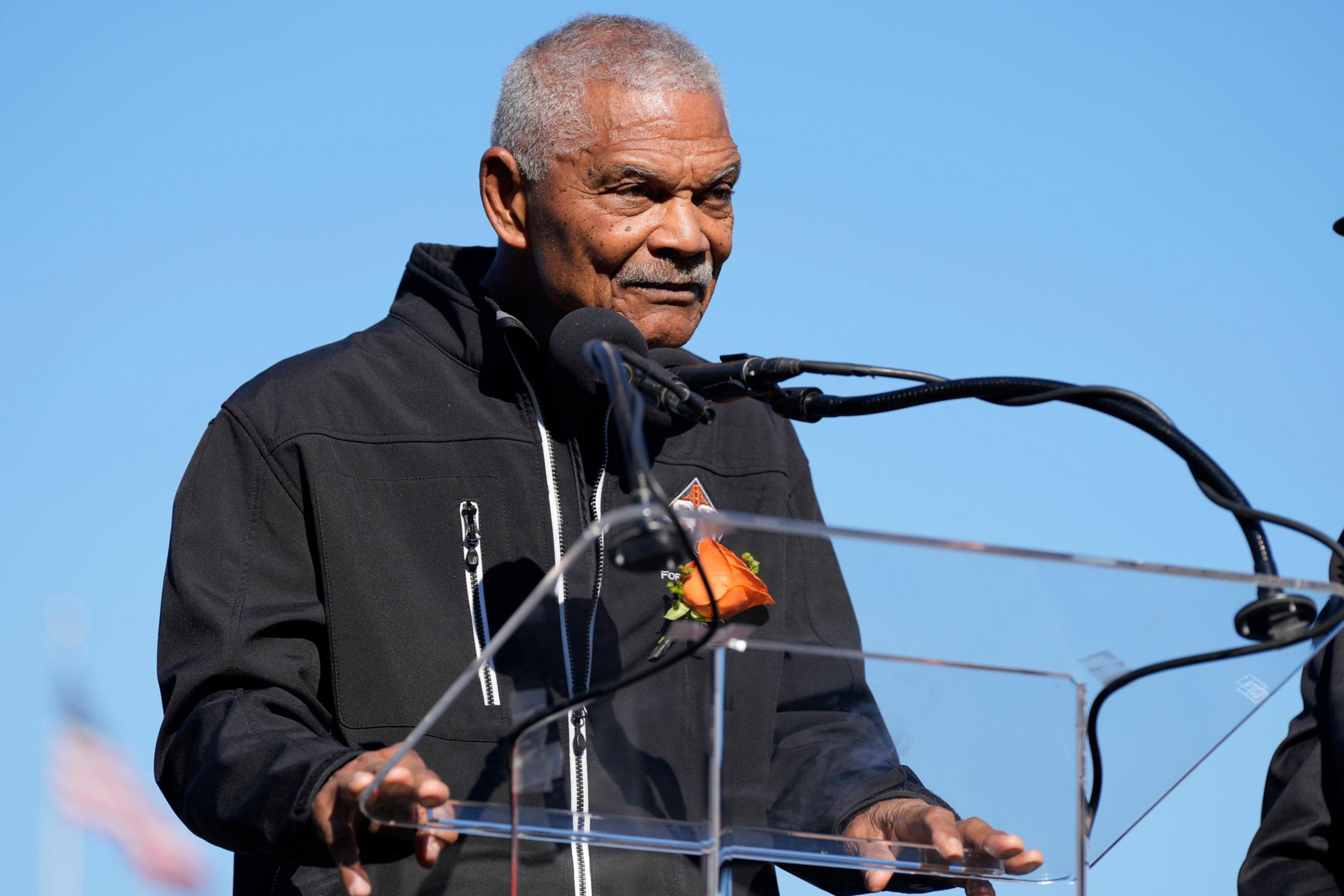 Alou played for 17 seasons and managed for 14 more in the majors. | Source: Tony Avelar/San Francisco Giants/Getty Images
Peter Kerasotis, who co-authored with Alou the 2018 book (“Alou: My Baseball Journey”), told me, “Felipe should not have been held back to his late 50s until he became a big-league manager. If Felipe got a chance earlier, he could’ve been top five in wins today.”
Hall of Fame manager Tony La Russa told me Alou should have joined him in Cooperstown long ago: “He paid a hell of a lot more dues than I did to manage in the major leagues, and he opened the door for Latin Americans as a player and with his success as a manager.”
Alou never got serious consideration to reach the Hall of Fame’s hallowed grounds as a player through the writers’ ballot — he received three votes and came off the ballot — and never appeared on a veterans/era committee ballot as a manager, which is a shame and an injustice.
Alou was an original San Francisco Giant in 1958 (like White) and played 17 seasons, becoming one of just three men with 2,000 hits and 200 homers as a player and 1,000 wins as a manager. The other two are enshrined in Cooperstown, Frank Robinson and Joe Torre.
By the way, when a manager is considered on the Hall of Fame’s Contemporary Baseball Era Committee ballot, the totality of his career is supposed to be discussed. That was the case with Torre, who would have been inducted anyway based solely on managing the Yankees’ dynasty, but his 18 years as a player also were part of the equation — the process never got that far with Alou.
Again, Alou’s numbers don’t define him. As a young outfielder with the Giants in the early 1960s, the most diverse team in the majors, Alou stood up to divisive manager Alvin Dark, who embarrassingly insisted that all Spanish speakers speak English in the clubhouse, even when Felipe was alongside his brothers.
That Alou challenged Dark and spoke out against racism was a reason he was traded after the 1963 season, he told me, but he never stopped serving as a role model for other Latinos. After playing alongside Willie Mays for six years, he spent the next six seasons as a teammate of Hank Aaron and wound up with a .286 career average and .761 OPS with six clubs.
White had his own challenges with racism, including in the very city that he denied a major-league franchise in 1992: St. Petersburg. He played for both the New York Giants and San Francisco Giants and was traded to the Cardinals before the 1959 season because the Giants had too many quality first basemen. When he reported to spring training, he was told he couldn’t stay with white players and had to move to a Black section of St. Petersburg.
1 day ago

4 days ago
Friday, Mar. 13

In White’s 2011 autobiography, “Uppity,” he wrote that a couple of prospects including Bob Gibson greeted him when he arrived, and White told them, “So this is the way it is here? Black players can’t stay in the team hotels?”
Gibson: “Welcome to St. Petersburg.”
It was a recurring theme for White, Alou, and many other players of color. Alou began his long minor-league managing career at 41, and five Expos managers were hired before he got his chance. He took over a team that lost 90 games and started winning right away. His 1994 team was probably the best in Expos history and seemed World Series bound, but a labor strife ended the season in mid-August, the Expos finishing 74-40. He was named National League manager of the year.
After 10 years in Montreal, Alou was hired by the Giants in 2003 to replace Dusty Baker and won 100 games his first of four years. He remained with the team as a special assistant and was an influential voice during the Giants’ championship runs in 2010, 2012, and 2014.
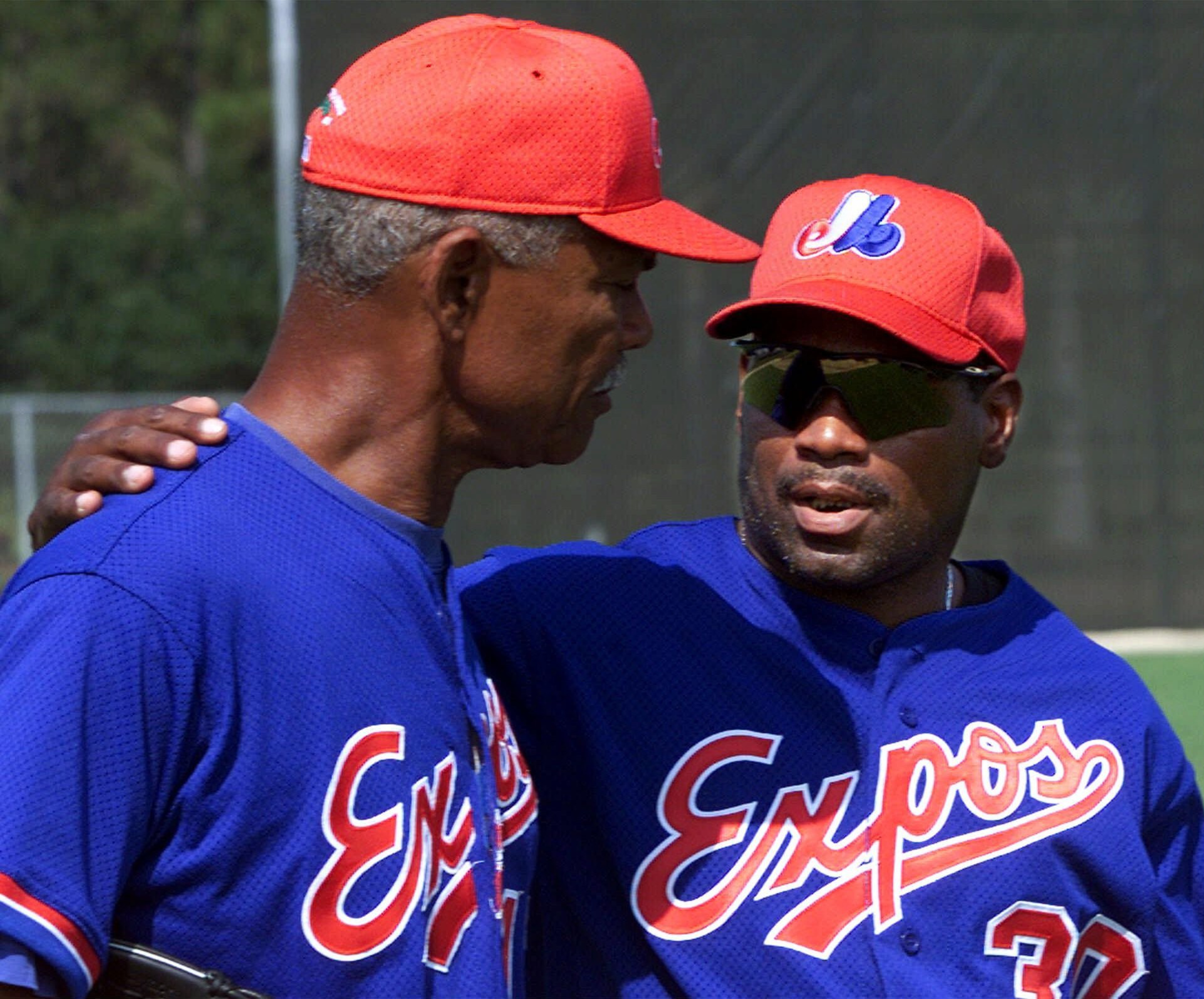 Alou managed Hall of Famer Tim Raines, right, during his tenure with the Expos. | Source: Ryan Remiorz/Associated Press
Through it all, Alou managed more than 3,600 games in the majors and minors and too many winter-ball games to count, including as a player-manager, winning championships in the Dominican and Venezuela. He’s in both the Caribbean Baseball Hall of Fame and Canadian Baseball Hall of Fame.
The Buck O’Neil Award is named after the legendary player-manager in the Negro Leagues who was the award’s first recipient in 2008. According to the Hall of Fame, it honors “an individual whose efforts broadened the game’s appeal and whose character, integrity, and dignity is comparable to” O’Neil’s.
Other winners were Roland Hemond (2011), Joe Garagiola (2014), Rachel Robinson (2017), David Montgomery (2020), Carl Erskine (2023), and now White. If Alou were to win the award next time, he’d be the first Latino recipient.
The award is voted on by the 17-member Hall of Fame board of directors, six of whom are Hall of Famers: Torre, Craig Biggio, Tom Glavine, Ken Griffey Jr., Cal Ripken Jr., and Ozzie Smith.
Anyone can nominate anybody for the award, and the Giants were among those who submitted a nomination for Alou. As was I.
Does Felipe Alou deserve recognition in Baseball’s Hall of Fame? Let us know in the comments, a new feature exclusively for SF Standard members.