
 Late last week, the Australian Energy Regulator went and shoved a Default Market Offer document onto the internet. But don’t worry — that’s normal behaviour for an Energy Regulator around this time of year. The important thing is, it came with information on the Solar Sharer Offer that will make 3 hours of free daytime electricity available in NSW, SA, and South East Queensland to anyone with a smart meter who wants it, from July 1.
How Will Solar Sharer Work In Practice?
Based on the Australian Energy Regulator’s latest details, I can now confidently state the following about how Solar Sharer is going to work:
Plans with free daytime electricity will be available from July 1 to those with smart meters.
It’s opt in — no one has to have one of these plans if they don’t want it.
Expect a 3 hour free electricity period every day.
In NSW and South East Queensland, the proposed free period is from 11am to 2pm.
In SA the proposed free period is from 12pm to 3pm.
There will be a daily 24 kilowatt-hour cap on free electricity.
There’s no penalty for exceeding the cap – you just start paying your usual daytime rate for any excess.
All modest and major electricity retailers will offer these plans.
Itty bitty electricity retailers with less than 1,000 customers don’t have to offer them.
They’ll be available in the ACT, Tasmania, and Victoria in the future, with Victoria likely to get them first.
If you want to read what the AER says about the Solar Sharer Offer in the draft Default Market Offer for yourself, you can find the relevant information here.
There Shouldn’t Be Hidden Or Extra Costs
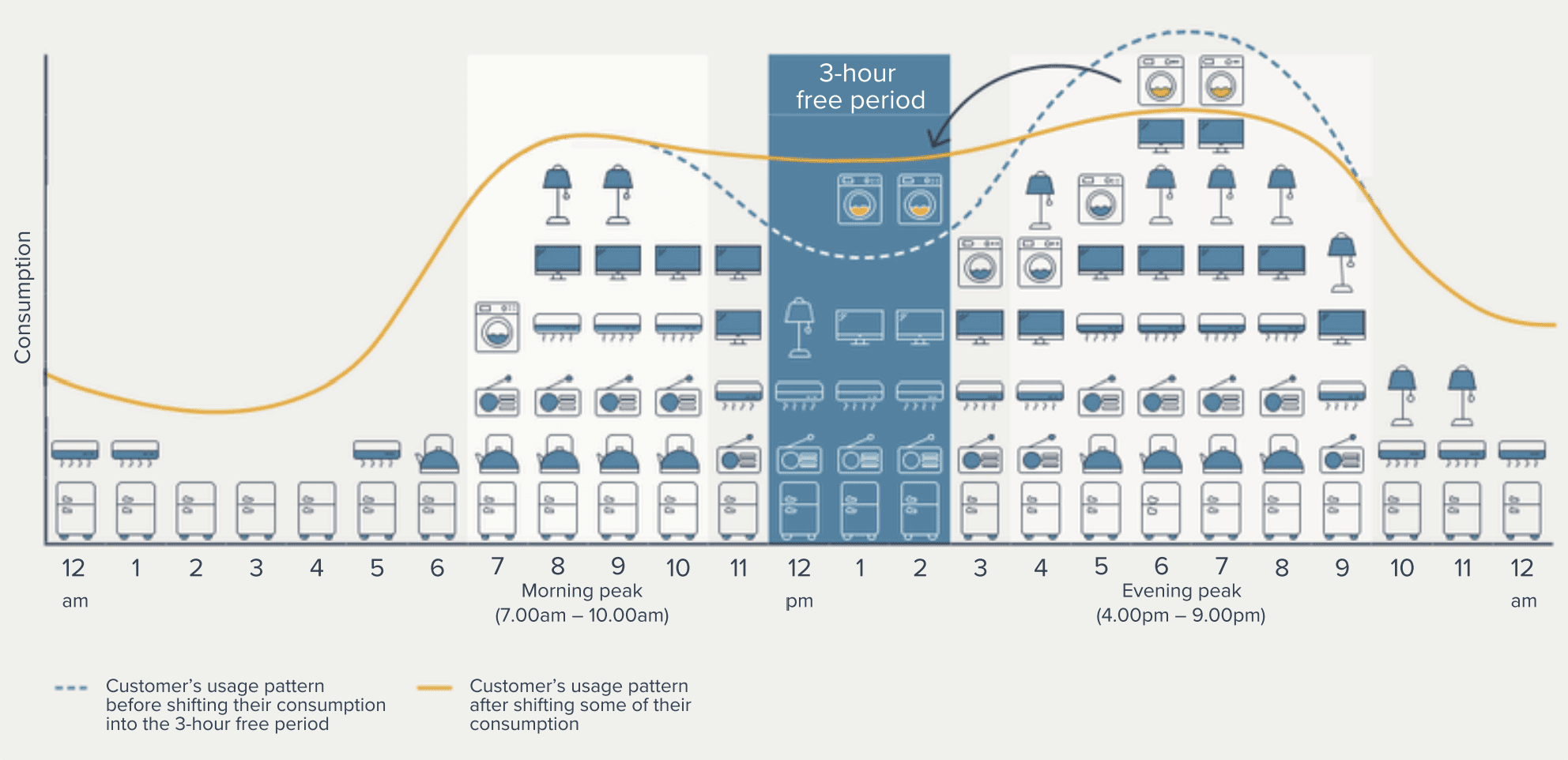
A graphic from the Australian Energy Regulator showing how the Solar Sharer Offer is expected to shift energy demand.
The plans with free electricity periods are supposed to be designed so households with typical electricity consumption patterns won’t pay any extra if they switch to a Solar Sharer Offer plan. While they may pay a little more outside of the free period, normal consumption in the free period will even it out.
But households with typical consumption patterns won’t save money unless they shift at least some electricity use to the free period. This will be easy with a battery or an EV that’s sometimes parked at home during the day. But there are plenty of other ways to do it. You can put a timer on your hot water system or other appliances, or heat or cool your home during the day using your air conditioner. The better your home’s insulation and weather sealing, the better this will work, so you may want to consider improving it now to beat any rush and be ready for winter.
If you want my opinion on whether it’s fair that you’ll only save money if you shift electricity consumption to the free period — yeah, it’s totally fair. Their whole point is to shift shock juice use to the middle of the day and not to effortlessly make people’s lives better.
Not The Best Option For Solar Only Households
Keep in mind that if you have a decent sized solar system and no battery, you’re likely to be better off without a Solar Sharer Offer plan. This is because you probably use hardly any grid electricity during the free period. But if you do have a battery, it can be very worthwhile because you can charge it with up to 24 free kilowatt-hours on cloudy winter days when your solar system’s output may be minimal.
There are also electricity plans with periods of free electricity available right now. So, provided you have a smart meter, you don’t have to wait until July 1 to get one. They’re even available in Victoria, the mainland state that generates the least amount of electricity from solar, with only 17% coming from the sun. While not as impressive as South Australia’s 28%, they’re not being slack, as it’s double what it was 5 years ago.
The plan is to eventually extend the Solar Sharer Offer to all eastern states and the ACT, which makes sense, as there’s going to be a lot more solar in the future.
For more on the Solar Sharer Offer, read our explainer on how to get around the planned cap on free electricity.
Related