
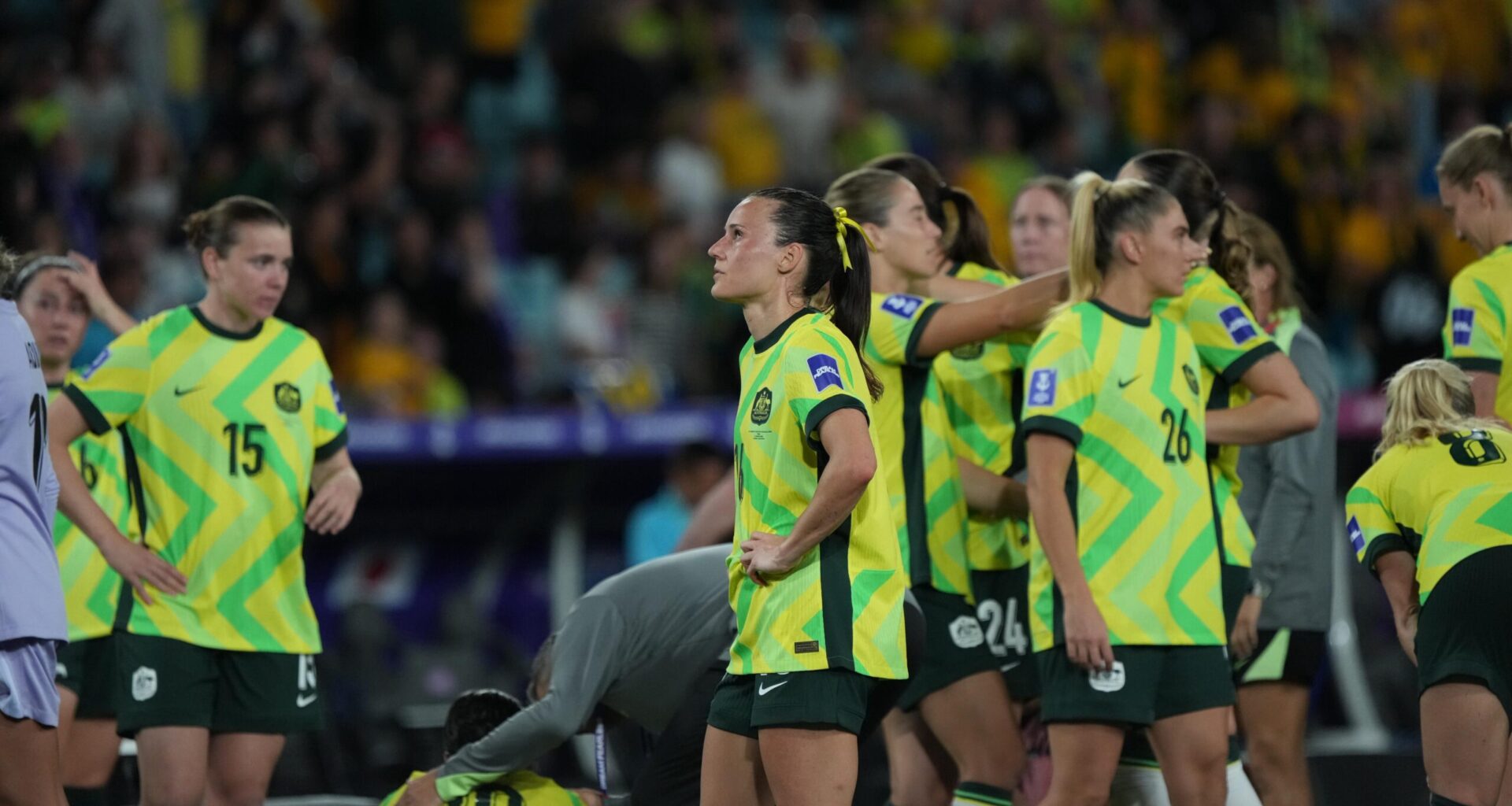
Defeat was still raw for Joe Montemurro, but he was already talking about the bigger picture for not just the Matildas, but Australian football in general, deep in the bowels of Stadium Australia with the clock nearing midnight on Saturday.
You have to; in moments where you have a captive audience, when you’re wrestling with defeat, pondering when that trophy might ever come, they’re the moments to seize to make sure laurels aren’t rested on or focus on grand plans are lost. Especially so in Australian football, which has a tendency to take two steps forward, rip that up, and take a step back just when you’re on the precipice of something.
This is a really interesting, delicate moment in time.
A Golden Generation of players won’t be around forever, in a team that needs to continue to capture the public’s imagination – and for all of the strides the Matildas have made over the last decade, nothing keeps you in the spotlight more than positive results – at a time when other nations are making ground or accelerating, rapidly, and when the domestic game is a world away from the 76,000 fans that packed Stadium Australia.
On the pitch
While it was brilliant to see the resilience and adaptability of this group of Matildas against North Korea and China, that was a means to the end that shows a winning mentality. The highlight for Montemurro was seeing elements of his plan come to life in the final, when the intensity went to another level – both that the players committed to it, and were able to execute against a side many thought Australia would not be able to compete with in football terms.
For Montemurro, it isn’t just for aesthetics or vanity. As an observer, it isn’t just a more enjoyable style of football to watch, it is one that yields dominance and results.
“That they can do what we’re trying to instil,” he said, when asked what was the biggest lesson he learnt from this camp. “Because, and I know all this talk about philosophy and game style and style of football and so on and so on, you’re probably sick of me talking about it.
“But for us to be a top team, we have to keep the ball and we have to be better with the ball. We have to be able to create situations with the ball.
“Doing it against one of the top teams in the world in the way we did it, that gives me hope, that gives me belief. But more importantly, it gives the players belief. That’s the most important thing because I’ve said all along, this team needs to believe more in who they are and what they can do and what they can achieve and this tournament has shown that.”
Ultimately, this side prepared for the Asian Cup like cramming for an exam, with Montemurro’s appointment in June only bringing with it three windows prior to arriving in camp the week of the tournament commencing. In that time, he had Sam Kerr, Kyra Cooney-Cross come in under difficult circumstances and he didn’t have Mary Fowler at all, but managed to find sparkles of her magic despite her limited preparation and continued pursuit of the right role in this side.
There were moments, and he called it out, when the side reverted to its old self. Now, the long term plan begins, with an eye on the World Cup in Brazil in 2027 and beyond.
The next step
We heard the phrase “being brave” throughout the tournament – in other words, backing your technical ability and the team’s tactics to play aggressively with the ball, while remaining in control.
This group has been together a long time, their attributes are well known, but to go to the next level, the Matildas need to be able to find the solution they couldn’t conjure on Saturday night.
“We are comfortable in preparing going forward,” Montemurro assessed.
“We’re comfortable in understanding when we need to go forward and also telling me that we can control tempo when we need to, to make sure that we’re positioning in the attacking third.
“The next phase is to make sure that when we do go forward… we need to dominate a little bit more in the attacking third.”
Then, getting right into the weeds of the tactics, he added: “I think the zone one and zone two, if you want to talk in those zones, we’re okay, we understand, but now we need to be dominant in those areas.”
Relying on physicality, or the prowess of individuals, especially once this generation moves on, has a ceiling. It’s something that’s concerned onlookers for years, and we all got a glimpse of that reality during Kerr’s injury-cursed two years.
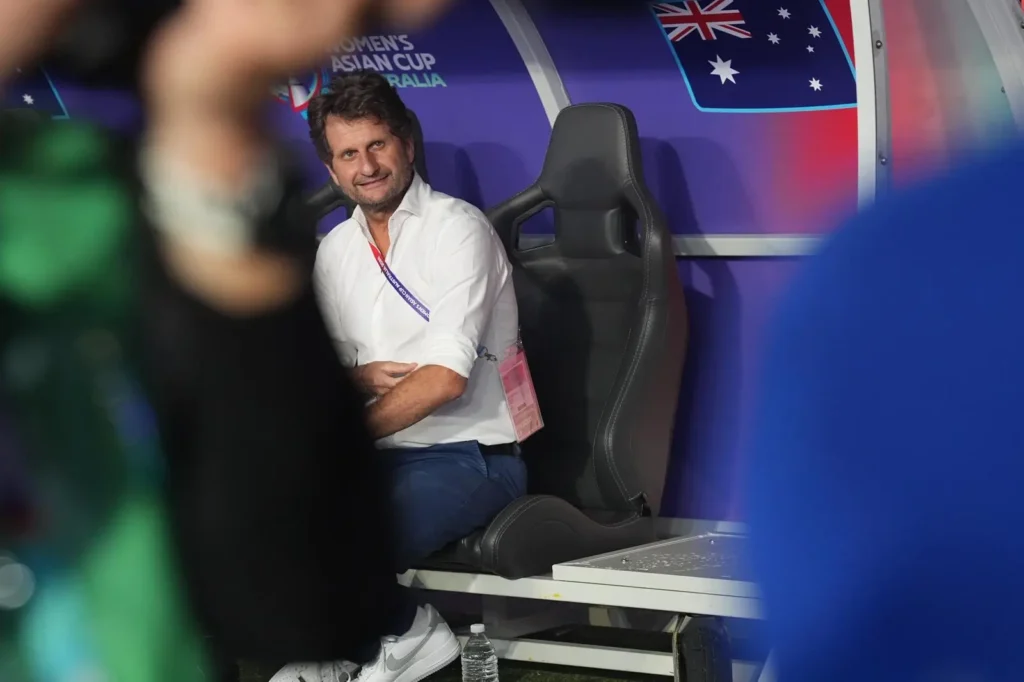 Joe Montemurro. Photo: Alice de Koster-Kitto / The Women’s Game
“What are the best teams in the world doing and where do we need to be?” Montemurro asked.
“Keeping the ball better, keeping the ball more. We have to control our situation and our destiny. From a technical perspective, we need to mould that with our physicality and our mentality.
“So we need to find that balance and I think we’ll be in good stead.
“We need to understand where we are technically, how we can compete technically.
“Our mentality is good, our physicality is good… they’re the sort of the areas I’m trying to introduce.”
The next cohort
For all the talk of the improved depth, the Matildas still relied heavily on established stars in this tournament. Montemurro went out of his way to call out those who didn’t get any minutes as part of a “depth chart” he is building with the other national team staff and junior national sides to develop options in tier 1, tier 2 and tier 3 and beyond, and particularly to identify options in areas where there is a lack of depth.
“We’ve got some exceptional players,” he said, making a point of noting the players we didn’t see over the last three weeks.
“It really seems that Alex Chidiac has done so well in Italy.
“They’re top players, I know Courtney Nevin made a couple of mistakes but she’s playing at Malmo, she’ll be playing Champions League.
“So we’ve got that next (cohort) with Mary Fowler, with Kyra Cooney Cross, with Ellie Carpenter, with Winnie Heatley, she’s become a world class defender in these three games. So it’s exciting but again we have to spread that over for everyone to understand, ‘we need you to do this to be a world-class player in the way we want to play’.”
While playing at home in an Asian Cup, realistically, presented the best chance for the Matildas to claim silverware with this cohort – it won’t be the last. Perhaps because they debuted so young, but these Matildas ‘veterans’ have years left in their careers. Besides Michelle Heyman, 37, Katrina Gorry, at 33, is the next oldest member of the squad.
Recently retired Matildas midfielder Chloe Logarzo Berryhill said on Paramount: “The girls seem to keep evolving.
“We’ve got Alanna Kennedy moving into the midfield, Sam Kerr moving over to the side. The older generation, sometimes people count them out, but I feel like this tournament – not just for the Matildas but all the teams – the older players really stepped up and have played their part and done incredibly well, evolving as individual players and helping the game.”
There is a group of seven stars aged 31 and 32 and when they do retire, they will likely retire at once.
That is enough time to properly plan for a transition, especially when the likes of Holly McNamara, Remy Siemsen, Amy Sayer, Kahli Johnson and the next generation of stars are getting blooded now.
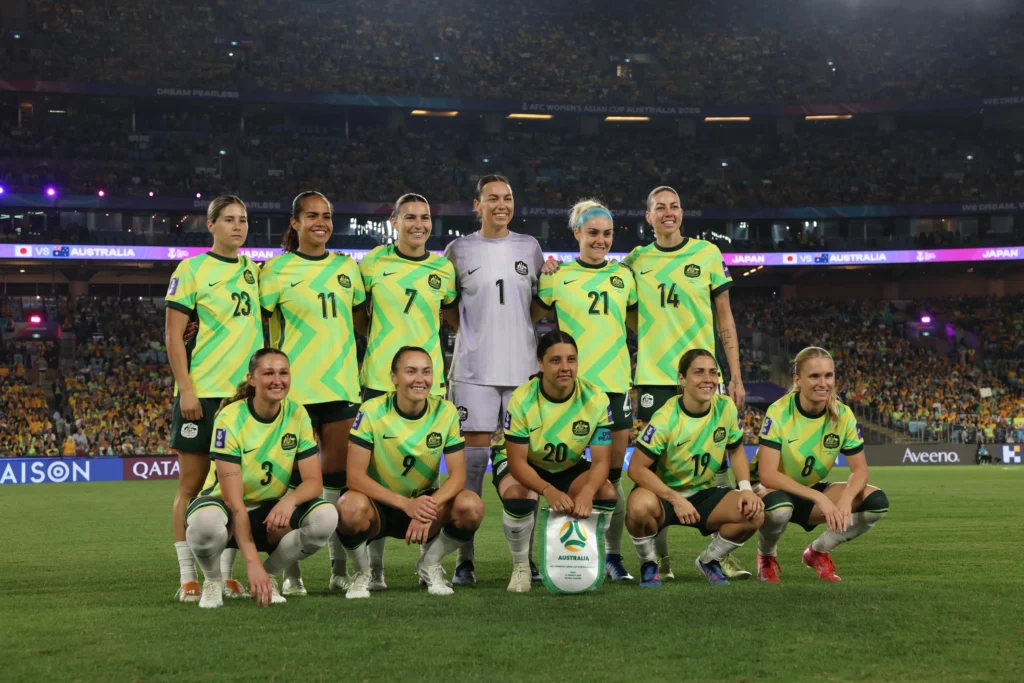
“They pushed the players that were probably playing,” Montemurro added.
“With that mentality, we’re already starting to form a great base.
“The good thing about it is that we’re doing a lot of communication with lot of these players and saying: we need you to be at this level in your club, playing regularly and this is what I need for you in your profile to come into the national team.
“So even that’s quite strategic in the way you’re going about that.”
Logarzo Berryhill, speaking after the final, assessed: “We’ve got great depth in key positions now, it’s what we haven’t had for a long time.
“Especially in the centre-back roles. Depth of midfield, being able to play so many variations and it all be equally as good. We just have not had that and its going to put us in really good stead going forward.”
She continued: “It’s incredible to see how the future of the Matildas will go with (Charlie) Rule, Heatley, (Clare) Hunt… I feel like a couple of years ago there would’ve been some question marks over who would’ve been stepping into those roles – and now we’ve got three choices.”
Former Matildas striker Ashleigh Sykes added: “That’s what I love about this squad… we talk a lot about the Golden Generation leading the team, but you look at what’s to come: Kyra Cooney-Cross dominating the midfield, (Kaitlyn) Torpey, Carpenter up and down the side, Heatley, Hunt, Rule as centre-back options.
“The future is still very bright for the Matildas particularly with more time under Joe Montemurro, implementing the style of play he wants to do with them.”
Unity of purpose
This, as ever, is the key question when it comes to Australian football.
The Matildas boss says he’s been working closely with junior teams, starting to work with member federations.
“There’s a lot of talent out there,” he said.
“We’ve just got to find that continuity that they know what their path is and what their development pathway is.
“And we need to challenge them, we need to give them international experience as quick as we can, we need to be playing good level football as quick as we can so when they get into these areas, they’ve seen it before. They’ve seen top level football. They’ve seen these situations. And that’s what we’re trying to create.
“I think some of these players, apart from the ones who are playing Champions League, they haven’t seen real situations of, (for example) we’ve got to chase a game, or we’ve got to hold on against North Korea.
“These are real situations where the more we do this, (the better).”
Then there are the matters off the park.
It is positive to see alignment between Football Australia, Football NSW and Football Northern NSW in lobbying the government for a NSW AFC Women’s Asian Cup Legacy Fund, calling for $34m a year over a decade to bridge the facilities gap that football participants have been crying out for, with a relevant focus on female-friendly and gender-inclusive facilities.
“Football Australia, alongside Football NSW and Northern NSW Football, is calling on the NSW Government to deliver a long-term grassroots football facilities fund to ensure the state can meet demand and secure a meaningful legacy for women’s football,” FA CEO Martin Kugeler said over the weekend.
Football NSW CEO John Tsatsimas, in a statement, added: “Historically, established and aging facilities do not cater for all gender use which doesn’t support growing participation by women and girls. Across NSW, fields currently lose around 34% of their capacity due to playing field conditions.
“These issues include lack of functional drainage infrastructure, insufficient lighting, no irrigation or substandard below ground infrastructure to cater for the significant use, growing demands and climatic conditions.
“We call on the government to invest in the largest participation sport in NSW to bridge the growing facilities gap in NSW which will deliver economic and social long-term benefits through connected communities.”
Also, a good game has been talked about leveraging this tournament for the A-League Women. But will it happen? What’s the plan? How are the Matildas fans being connected into the A-League?
It isn’t just critical for the momentum to continue off this campaign but to continue to enhance the product so it is not just compelling for this swelling cohort of Matildas fans who are not coming to games in their own backyard each weekend, but also to the actual Golden Generation themselves, who might consider coming home if the league is in a fit enough state when they decide to do so.
On the weekend, I did see an Alanna Kennedy goals package from her time playing at Sydney FC run on Paramount – which is great, except, that audience watching likely already knows that. It’s spreading the gospel that is key.
There is so much to play with. But that alone will not be enough.
The big picture
All those off-field issues and a united game are critical, but the Matildas are the tip of the iceberg.
Now that Montemurro has the keys, the opportunity for someone with intimate knowledge of every touchpoint of the game here through to the highest levels in Europe is a chance for Australian football to unite behind a plan – and for once, stick to it. Or at worst, not railroad it.
He explained, passionately, that he’s building “our identity as a footballing nation” and “creating a mentality” that this is the football we’re going to play, which goes beyond the 16 players who play a Matildas game.
“The thing for me is to make sure that our mentality is this type of football, the way we want to play, we want to dominate games, obviously, because that’s what the best teams in the world are doing,” he explained.
“So can we dominate games like Japan? Probably not, but we can find a way where, hey, we can have control with the ball, but also find ways without it.”
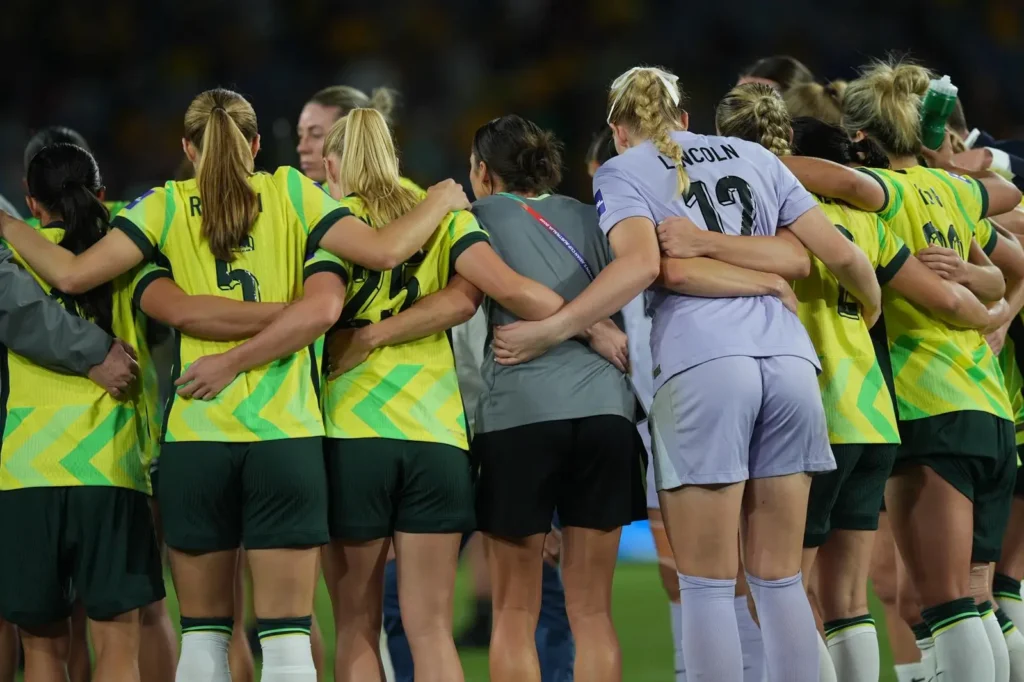
 The Matildas’ unity of purpose against Japan. Photo: Ranin Kousari / The Women’s Game
There was a lot of talk of Japan leading into this game; ditto North Korea and China. Montemurro is working on changing that mentality.
“The whole idea of that is going into games with our ideas, not so much being scared of the opposition,” he said.
With one exception.
Football in Australia tends to change tack cyclically and if something “doesn’t work, we start something else, then we do something else, then we go somewhere”.
“We’ve got to decide who we are, what we want to be, where we want to be in 10, 15 years time and stick to it,” Montemurro said.
“Stick to it. We’re chopping and changing. We’ve either got to believe in an identity of who we want to be and where we want to go and it has to start at youth levels and we have to now just keep that consistency going.
“I think our biggest problem is sticking to a program, sticking to something and saying this is what we believe is going to be us in the next 15, 20 years.
“You can’t pretend to produce players where you start something and in three years you start something new or do something else.
“We’re talking a country of Japan of 130 million people. They’ve got obviously a bigger pool to choose from and they make tough decisions at young ages and they stick to the program. They stick to their development processes and there’s a way of going about it.
“We unfortunately are different in the way we go about things. We’re different, whether it’s private academies or clubs, when a player at a young age enters into a program and then the next year they’re going to another club or changing or this or that, it’s tough, it’s tough for the player because you don’t have any consistency.
“So for me, it’s consistency in programs but understanding what our identity is, who we are, what are we good at and where we think we could go.
“Sorry I’m mumbling because it’s something really close to my heart.”