
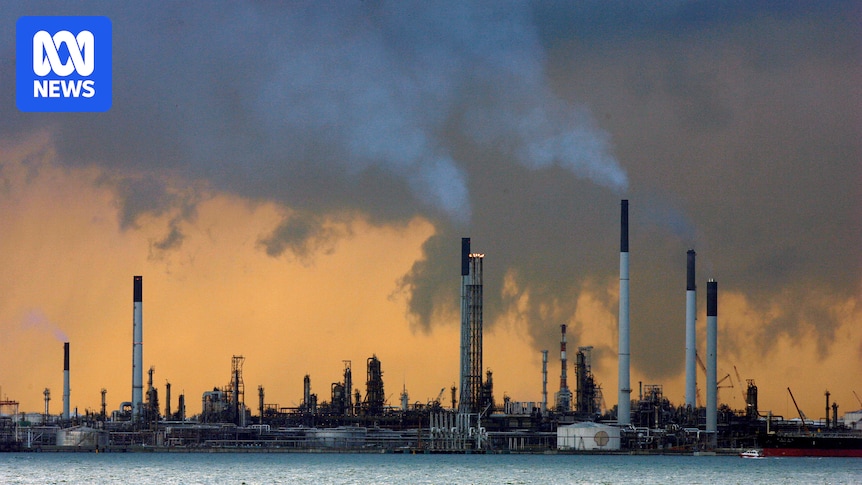
Markets are more worried about the war in Iran than they were a couple of weeks ago when I wrote that they were getting it all wrong, but they’re still too complacent.
Three days ago, the International Energy Agency said this was the greatest “supply disruption in the history of the global oil market” and called for people to work from home.
Iran war live updates: For all the latest news on the war in the Middle East, read our blog.
The global share market index dipped at that, but not much — less than 1 per cent. Maybe the full gravity of the situation will hit this week.
On Thursday last week, the Brent crude oil price spiked to US$119 a barrel then fell after US Treasury Secretary Scott Bessent floated the idea that maybe the US would lift sanctions on Iranian oil that was already at sea to increase supply – which occurred on Saturday.
The reaction was bonkers, but it showed how badly the market wants to believe everything will be OK.
Allowing Iran to sell oil to fund its war effort was an act of desperation that will likely prolong the conflict.
Meanwhile, the behaviour of Bessent’s cabinet colleague, Secretary of War Pete Hegseth, is a window into something else entirely.
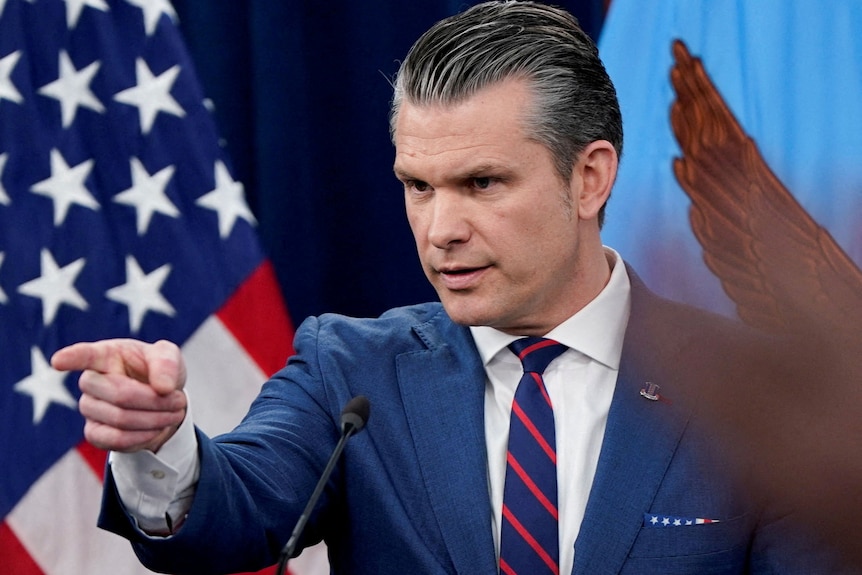
Pete Hegseth recently told CBS: “The providence of our almighty God is there protecting those troops”. (Reuters: Elizabeth Frantz)
Pete Hegseth’s crusade
Hegseth told an interviewer on CBS: “The providence of our almighty God is there protecting those troops, and we’re committed to this mission.”
“Not only are we warriors armed with the arsenal of freedom, we ultimately are armed with the arsenal of faith,” he said at a National Prayer Breakfast.
Hegseth wrote a book in 2020 called American Crusade, in which he declared that the US military was “the only powerful, pro-freedom, pro-Christian, pro-Israel army in the world”, and without it, “Communist China will rise — and rule the globe. Europe will formally surrender. Islamists will get nuclear weapons and seek to wipe America and Israel off the map.”
Trump may have lost a ‘game of chicken’ with Iran, which exposed a red line
As analyst Richard David Hames wrote last week: “Every framework designed to limit state violence assumes that war is a means toward some calculable end: security, deterrence, and eventual resolution. Remove that assumption and the frameworks dissolve.”
Donald Trump is commander in chief, not Hegseth, so his crusade could be overruled and over the weekend Trump seemed to be preparing his exit, posting on Truth Social: “We are getting very close to meeting our objectives as we consider winding down our great Military efforts in the Middle East with respect to the Terrorist Regime of Iran.”
Adding to the idea that the framework of preventing a nuclear Iran is dissolving was a story in The Guardian last week reporting that Iran was on the point of agreeing to “significant” changes to its nuclear program when the war began.
The Guardian quoted someone who was briefed on the talks: “It was not a complete deal, but it was progress and was unlikely to be the Iranians’ final offer. The British team expected the next round of negotiations to go ahead on the basis of the progress in Geneva.”
If that’s true, and there have been other reports to that effect, then Israel and the US weren’t responding to a failure of the diplomatic efforts to get Iran to give up its nuclear ambitions, and their actions could be seen as deliberately sabotaging them.
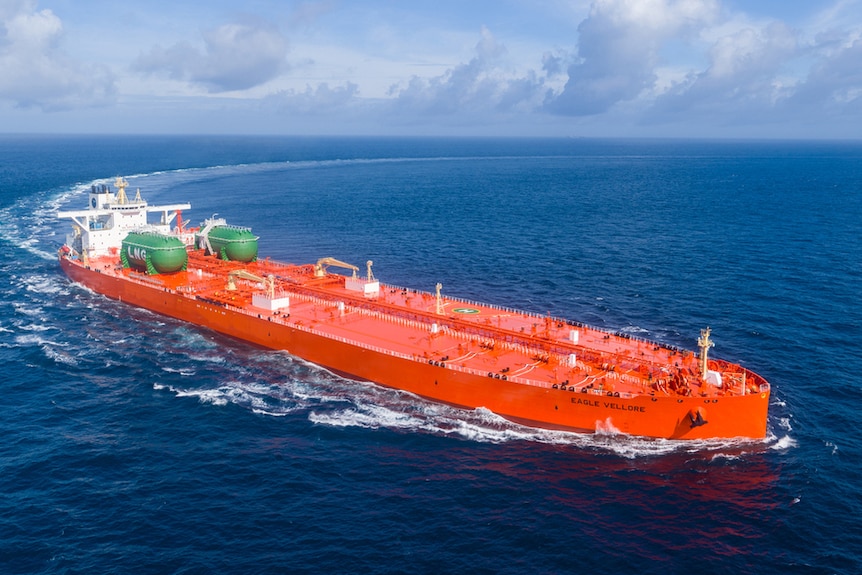
The Eagle Vellore was the last South Korea-bound tanker to make it through the Strait of Hormuz before it was effectively closed. (Supplied: AET Tankers)
Strait of Hormuz ‘won’t return to its pre-war status’
A few other things suggest that the markets’ benign assessment of the war is wrong and that the damage to the world’s, and Australia’s, economy could get worse before it’s over.
The closure of the Strait of Hormuz didn’t happen simply because Iran was threatening ships, but because maritime insurers cancelled cover for vessels and this may be hard to put back.
So, reopening the Persian Gulf might not be easy. Even if the US withdraws, declaring victory, as Trump seems to be preparing to do, insurance could remain withdrawn for months, and in any case Israel and Iran could keep fighting, with the other Gulf states roped in.
In fact, Iran’s parliamentary speaker, Mohammad Bagher Ghalibaf posted on X last week that “The Strait of Hormuz situation won’t return to its pre-war status”, implying that Iran now sees the narrow waterway as a sovereign asset to be used for strategic leverage.
LoadingIran’s drone capacity disastrously underestimated
Separately, it’s worth remembering that this war comes after a long history of failures and mistakes, starting with the CIA and MI6 coup in 1953 that removed an elected prime minister, Mohammad Mossadegh.
His removal led directly to the disastrous 1979 revolution, because the Shah then went full tyrannical kleptocrat, complete with secret police, torture, Swiss bank accounts, palaces and food flown in from Maxim’s in Paris for his parties.
The revolution wasn’t just devout Muslims following the Ayatollah, but a coalition with middle-class merchants, students and hungry, disenfranchised working classes.
The Americans completely missed what was going on, or at least those in Washington did (the Ambassador William Sullivan knew but was ignored).
They could have forced the Shah to have an election, or even removed him, instead of extravagantly praising and backing him as Jimmy Carter did.
But once the revolution happened, and the US embassy staff were taken hostage for 444 days, including the catastrophic rescue attempt in April 1980, it was all too late — America was humiliated, just five years after the humiliating evacuation of Saigon that ended the Vietnam War.
In the Strait of Hormuz, Iran unleashes a plot years in the making
Now there’s been another intelligence failure, or perhaps more accurately an underestimate, about Iran’s Shahed drones. It’s not that the CIA missed them — Iran’s drone program was known about since 2021, and from 2022 they were being given to Russia to send into Ukraine, which was also well known.
But it appears US analysts completely misjudged the importance of them, and specifically their economic asymmetry.
A Shahed drone costs about US$30,000 while the interceptor missiles needed to shoot them down cost millions.
Western military systems, including Australia’s, are all about size and expense — missiles to fight missiles, submarines against submarines, big bombs dropped on buildings from far away — not swarms of cheap drones.
So, while the ostensible reason for this war is stopping Iran acquiring nuclear weapons, in some ways its five-year-old drone-making program looks just as dangerous.
New age of drone warfare weirder, scarier, more paranoid than we can imagine
Iran knows that if it uses a nuclear bomb, it would be suicidal, especially if it was against another nuclear state like Israel, which is something all nine nuclear-armed countries know: nuclear weapons are all about defensive intimidation.
The cheap Shahed drones are entirely offensive and very effective, and it seems no-one paid enough attention to them.
The bottom line is that Iran cannot be bombed into a counter-revolutionary regime change, and in fact the people are probably angrier at America and Israel now than at their own rulers.
Nor can those rulers easily be wiped out, or the country easily invaded.
The most likely scenario now is a US withdrawal followed by a drawn-out conflict between Iran and America’s Middle East allies, including Israel, with the Strait of Hormuz closed to Iran’s enemies for a long time.
The impact of that on markets and the global economy would be biblical.
Alan Kohler is finance presenter and columnist on ABC News and he also writes for Intelligent Investor.
Loading…