
Less than a week before MotoGP arrives in Austin, where the attendance of Liberty Media’s leadership is expected, the image projected in Goiania is surely not the one the new bosses would have wanted.
Almost three decades after the last Brazilian Grand Prix, the return of the series became a nightmare with torrential rains impacting the area where the Ayrton Senna Autodrome is located, leading to local flooding.
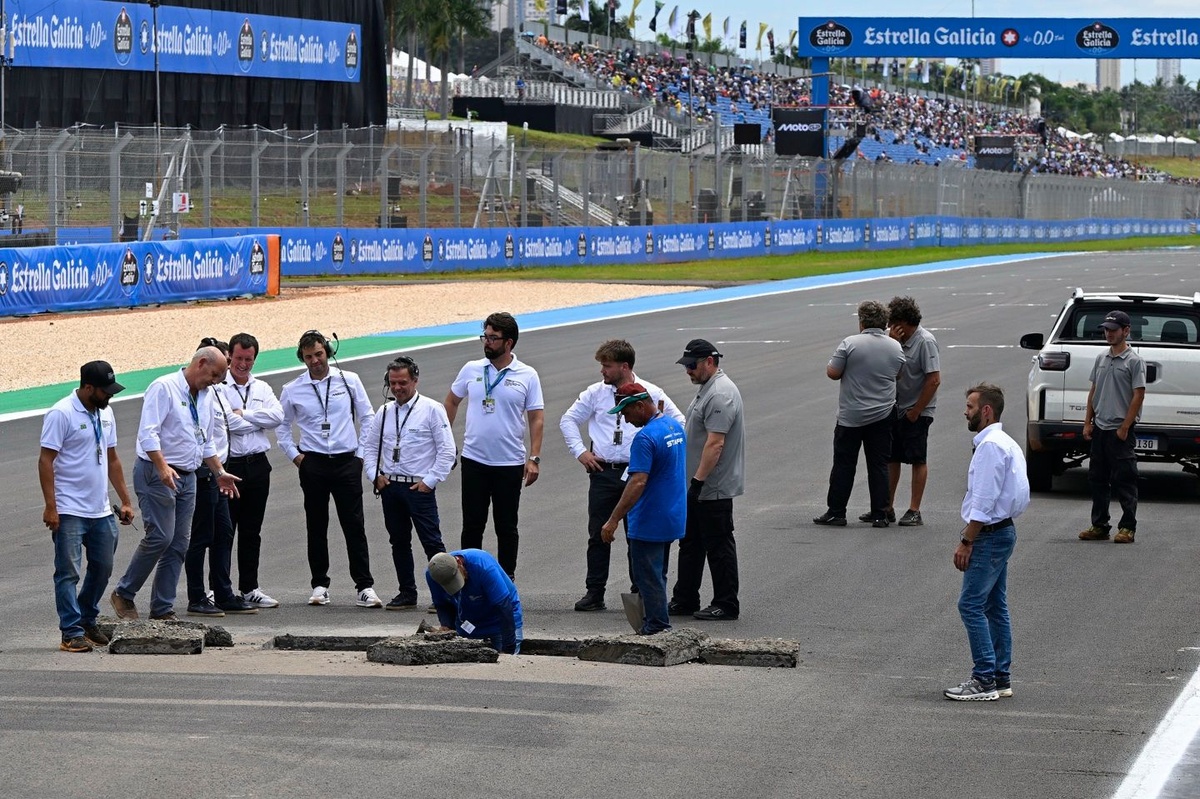
This exposed the seams of the applied protocols, which must now be reviewed to avoid images like those seen on Saturday, when the schedule was irredeemably altered due to the sinkhole that appeared on the main straight; it led to delaying the sprint race by more than an hour and a half.
The first setback lies in the location of Goiania, which is situated in the tropical zone of Brazil, where the rainy season extends from December to March. It so happens that, historically, the third week of March is the one that accumulates the most water of the entire year.
The high levels of rainfall that fell from Monday and continued through Tuesday caused several areas of the facility to be left under water. In the images to which Autosport had access, the entry corner to the finish line and the access to the pitlane could be seen as completely flooded, as well as the tunnel entrance to the paddock.
But, on Wednesday, after the workers had battled without rest, the panorama began to clear with the help of the sun coming out and the rise in temperature. The situation even led the authorities of the State of Goias to send around 30 prisoners from nearby prisons, who were assigned the tasks of removing debris, as part of a reintegration programme. Friday saw the start of track action, though the sessions were conditioned, in part, by the reappearance of the rain.
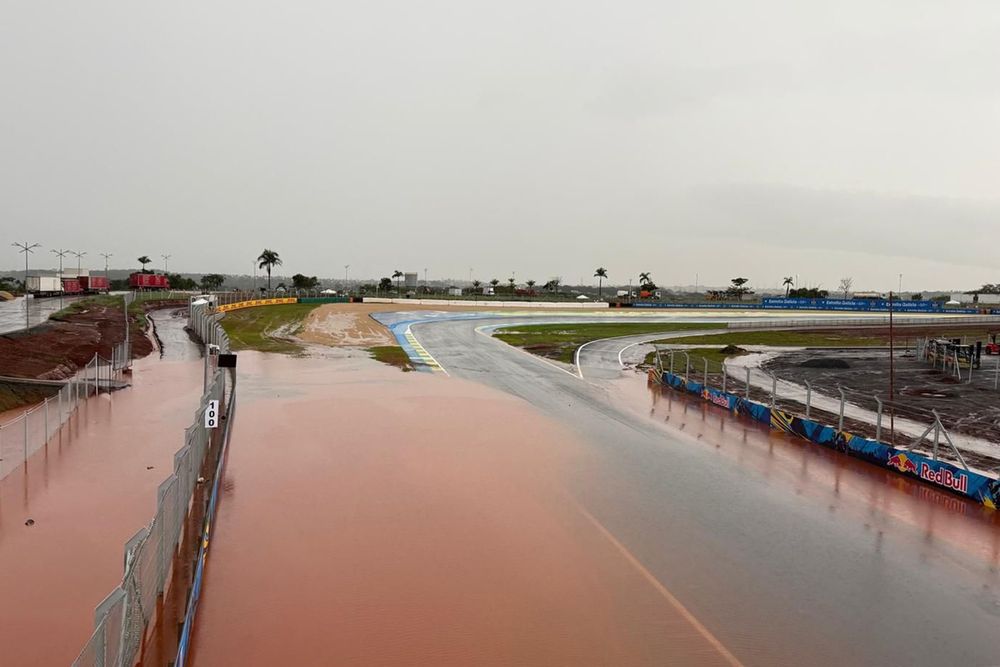
Heavy rains over Brazilian circuit
Saturday, however, everything became a little more complicated, after the riders discovered, just following qualifying, a protrusion that concealed a considerably large hole, right on the main straight.
The usual protocol in these cases was set in motion, and after an on-site inspection by the personnel in charge of safety and operations, the decision was taken to suspend activity to repair the hole, which was increasingly growing in size. The affected area was opened, cleaned and filled with cement before being sealed again with asphalt plates.
A patch job that saved the day, exclusively, for one reason. “Because the hole was off the racing line, only because of that,” said Marc Márquez, after winning the sprint. “These are things that happen on new circuits. There was a moment when I got a bit angry, because for a rider it is not easy to activate, deactivate and concentrate again. We have our rituals. It has to be improved for the future. For a new circuit, there are already undulations, given that the ground underneath moves.”
His Ducati team-mate Francesco Bagnaia added: “I think we have come here a bit early and things were not one hundred percent finished. But all the effort they are putting in is allowing us to race, and the track is very beautiful.”
To all these problems, we must add that just five minutes before the start, right there on the starting grid, Race Direction decided to shorten the race from 31 to 23 laps. Initially, it was suggested that Michelin made the decision, but the head of the tire manufacturer, Piero Taramaso, denied it: “It was a surprise to us, just like it was to everyone else. The tires were good enough for 30 laps, and the bikes were on the grid with enough fuel to complete the entire race. It was Dorna’s decision, not ours. It seems that the asphalt is degrading in turns 11 and 12,” he stated, pointing to problems with the track surface. This situation only compounded a complicated weekend for the championship, given the image of real-time improvisation projected to the world.
In its eagerness to incorporate new countries into its ever-expanding calendar, Dorna opted to return this year to Goiania, which already hosted three editions between 1987 and 1989.
In recent years, the local authorities have worked to return to the MotoGP programme, a desire that was consolidated in 2024, with an announcement in between. From the very beginning, the planned date for the return was set in 2026, but the reality experienced this weekend invites one to think that the works were not finished on time, and the deficit of services is notable in a championship that aspires to grow at all levels.
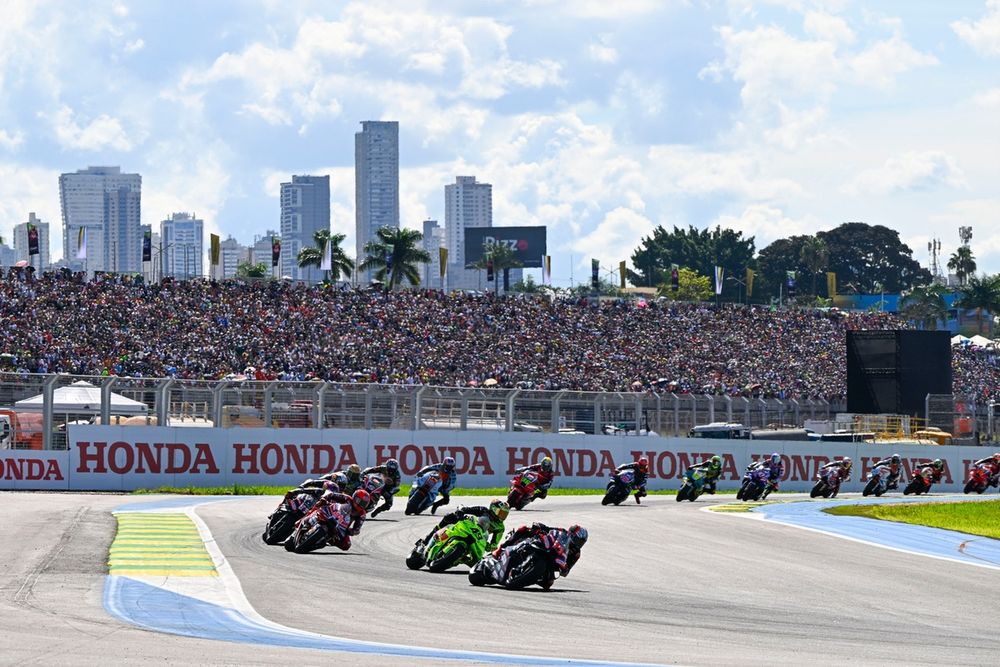
Marco Bezzecchi, Aprilia Racing
Photo by: Gold and Goose Photography / LAT Images / via Getty Images
The local promoter of the race is the company Brasil Motorsport, the same one that is in charge of organising the Formula 1 event in Interlagos, and whose CEO is Alan Adler.
Although its capital is private and it has great experience in the organisation of events related to motorsport, the situation this weekend has overwhelmed the company. According to what Autosport has learned, the investment made for the renovation of the circuit is around 250 million reais, which is almost $50million.
The injection included the resurfacing of a track settled on very porous subsoil, which with the downpour has shifted. That explains the sinkhole, although that has not been the only problem. The patches of water have not disappeared at any moment, despite the heat, and despite having gone 24 hours without rain, “it seems like it rains underneath the circuit”, described Marquez.
While it is true that the local administration did not give the green light until last year to the budget item destined to refurbish the old circuit, to turn it into a facility in line with current standards, the example of this weekend implicitly entails the need to review certain control protocols.
“I am very sorry to see these things,” said Trackhouse team boss Davide Brivio. “I am very disappointed with the level of preparation at this circuit. We are repeatedly told that MotoGP needs to improve, but to reach the level we intend to reach we cannot allow these situations.
“In the meetings we have had recently, they ask us to invest more in exposure, to make ourselves more visible and to update and improve our hospitality. But MotoGP has to fulfil its part. What we want is not to see ourselves in these situations.
The point was taken up by Bagnaia: “The image of the championship to the outside is not my problem. I only hope that Dorna and Liberty Media are capable of understanding well how to improve.”

Watch: Brazilian Bike GP 1989
We want to hear from you!
Let us know what you would like to see from us in the future.
– The Autosport.com Team