
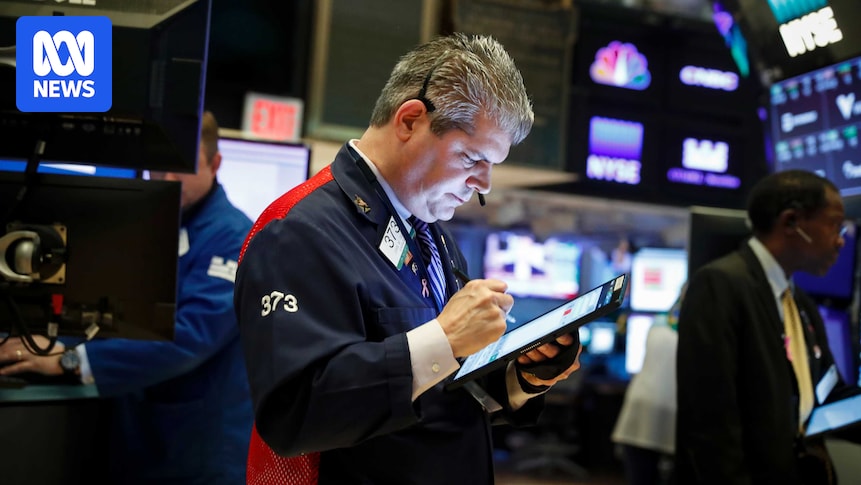
If one wanted to take a positive view of Wall Street’s Friday session, it would be something like “it could have been worse”.
A couple of social media posts from US President Donald Trump along the lines of “we’re considering boots on the ground” and “we don’t want a ceasefire with Iran” had the S&P 500 heading for a 4% capitulation by mid-afternoon in New York.
Not long after, another post suggesting that, on second thoughts, we’re “thinking of winding things up in Iran” brought equities traders out from under their desks to start tentatively buying again.
Around 6pm (NY time), yet another post issuing Iran with a “48-hour ultimatum” before its energy grid is wiped out popped up. About the only thing left to trade was Bitcoin. It crashed.
The net result for equities was still a hammering.
S&P 500: 1.5%Dow: -1.0%Nasdaq: -1.9%
It was the third consecutive session of losses on Wall Street, with the S&P 500 down almost 2% for the week.
Europe was down 3.6% for the week after diving 2% on Friday.
The ASX 200 gave up 2.2% over the week, and if futures trading is any guide, it will tumble around 1.8% on opening today.
Among Friday’s headline news; Iran attacked a Kuwaiti oil field, Iraq basically declared its entire oil exporting operations shut, reports of US deploying thousands more troops to the Middle East emerged and an ultimatum to open the Strait of Hormuz was issued.
Oil prices shot up, the global benchmark Brent Crude climbed another 3.3% to more than $US112/barrel, global bond yields kept rising as the spectre of oil-fuelled inflation loomed larger and anxiety ratcheted up.
“The market is finally settling into the idea that this may go on longer than initially expected, and I think that’s why markets are selling off,” Longbow Asset Management’s Jake Dollarhide told Reuters.
“This conflict may go on not for just a few weeks, but maybe beyond several months.”
As IG analyst Tony Sycamore noted, oil continues to hold a vice-like grip on all other asset markets.
“Over the weekend, headlines have swung dramatically between dovish and hawkish tones,” Mr Sycamore said.
“Reports initially surfaced that President Trump’s team had begun discussions on what potential peace talks might look like.”
Mr Sycamore said that was quickly superseded by a high-stakes, 48-hour ultimatum directed at Iran: reopen the Strait of Hormuz or face strikes on its power plants.
“If the ultimatum is not walked back before tomorrow’s re-open, we will likely see global equity markets extend last week’s falls as oil prices spike higher again,” he said.
While the Australian dollar slipped against the Greenback on Friday, over the week it made a solid 0.6% gain, to close at 70.23 US cents.
Gold fell again, down another 3.2%, back under $US4,500/ ounce.
In what seems to be a bit of developing trend, the marginally less precious than it was metal notched its eight straight weekly decline.
The fears of a global slowdown saw base metals such as copper and aluminium extend their losses.
Copper, often viewed as a barometer of global economic growth fell 1.8% on the LME to be down more than 6% over the week.
Aluminium dipped 1%.
Iron ore rose around 1% to above $US108/tonne as news filtered out that China would again impose restrictions on BHP products after easing them for a week to try and take some heat out of the market. It didn’t seem to work.
Cryptos continued their bad recent run. Having climbed back above $US76,000 on Tuesday, Bitcoin has given up more than 5% since to be back around $68,000.