

With an average starting line-up age of 28 years and 223 days, Fulham are the 2025-26 Premier League’s oldest team. On Saturday afternoon at Craven Cottage, it was the freshest face in their ranks who made the telling difference.
Nineteen-year-old Josh King sparked a 3-1 comeback win, equalising after Zian Flemming had given Burnley the lead and then assisting Harry Wilson for their second. It was King’s first Premier League goal, a dream moment for the attacking midfielder, even if he might have imagined opening his account with something a little more spectacular.
King swung to volley Sander Berge’s floated pass and missed, before the ball ricocheted off the inside of goalkeeper Martin Dubravka’s left leg and popped up for the teenager to swivel and knock into an empty net. The close-range strike is illustrated by the red line on his player dashboard below.

For an attacking player as obviously talented as King, who made his league debut for Fulham in December 2024, it is surprising it has taken this long to get off the mark. But nothing comes easy for teenagers in the rough and tumble of the modern Premier League.
Even for the most precocious talents, regular game-time in the division is rare. King is now on 1,141 Premier League minutes for Fulham this season, making him one of just five players currently aged under 20 to reach four figures. Only 30 have hit that mark since 2018-19. Wolverhampton Wanderers’ 18-year-old forward Mateus Mane tops this season’s list (1,282), and even he has played less than 50 per cent of his team’s available minutes.
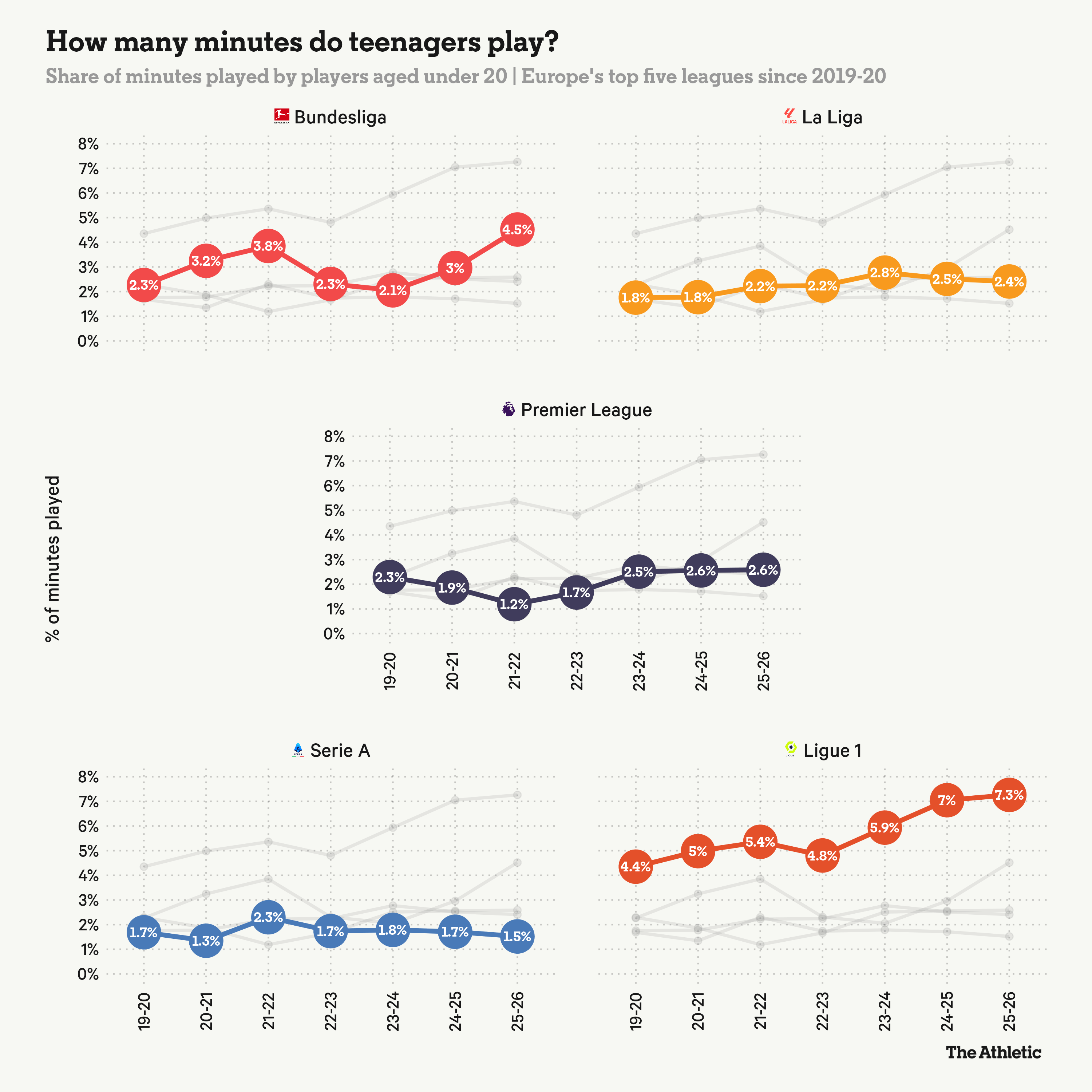
This season’s Premier League has featured a stronger physical edge, with increased reliance on set pieces, higher intensity off the ball, and fast, direct counter-attacks. This unforgiving, robust environment makes it difficult for slight, younger players, such as King, to impose themselves.
Fulham head coach Marco Silva called him a “top player” after the game, but said he has had to work hard to add decisive end product in the final third.
King’s goal makes him the 14th teenage goalscorer in the Premier League this season, the highest total over the past eight seasons, with these bright sparks combining for 27 goals. Junior Kroupi, the 19-year-old who coolly dispatched a penalty on Friday night to earn Bournemouth a 2-2 draw at home to Manchester United, accounts for a third of those, scoring nine times. No other player has scored more than twice.
This combination of inexperience, physical readiness, and patchy output makes managers hesitant to trust in youth. These are valid concerns, but teenagers often offer something that offsets these disadvantages: fearlessness on the ball. When Max Dowman came on to the pitch at 0-0 against Everton last weekend, the 16-year-old betrayed none of the anxiety palpable from the Emirates crowd and his own toiling team mates.
Instead, he drove at the defence every chance he had. His forward thrust helped Arsenal unlock David Moyes’s stubborn defence, with his cross leading to Viktor Gyokeres’ late opener, before he sealed the game with a breathtaking run on the break. “Every time he got the ball, he made things happen”, Mikel Arteta told reporters after the game, and the numbers back up Arsenal’s manager: Dowman attempted more take-ons (five) than anyone else, despite only going on in the 74th minute.
The graphic below shows that young players regularly attempt more take-ons than their more senior team-mates. Those aged 20 or under have 2.4 dribbles per 90, while those over 30 rarely contribute more than one a game.
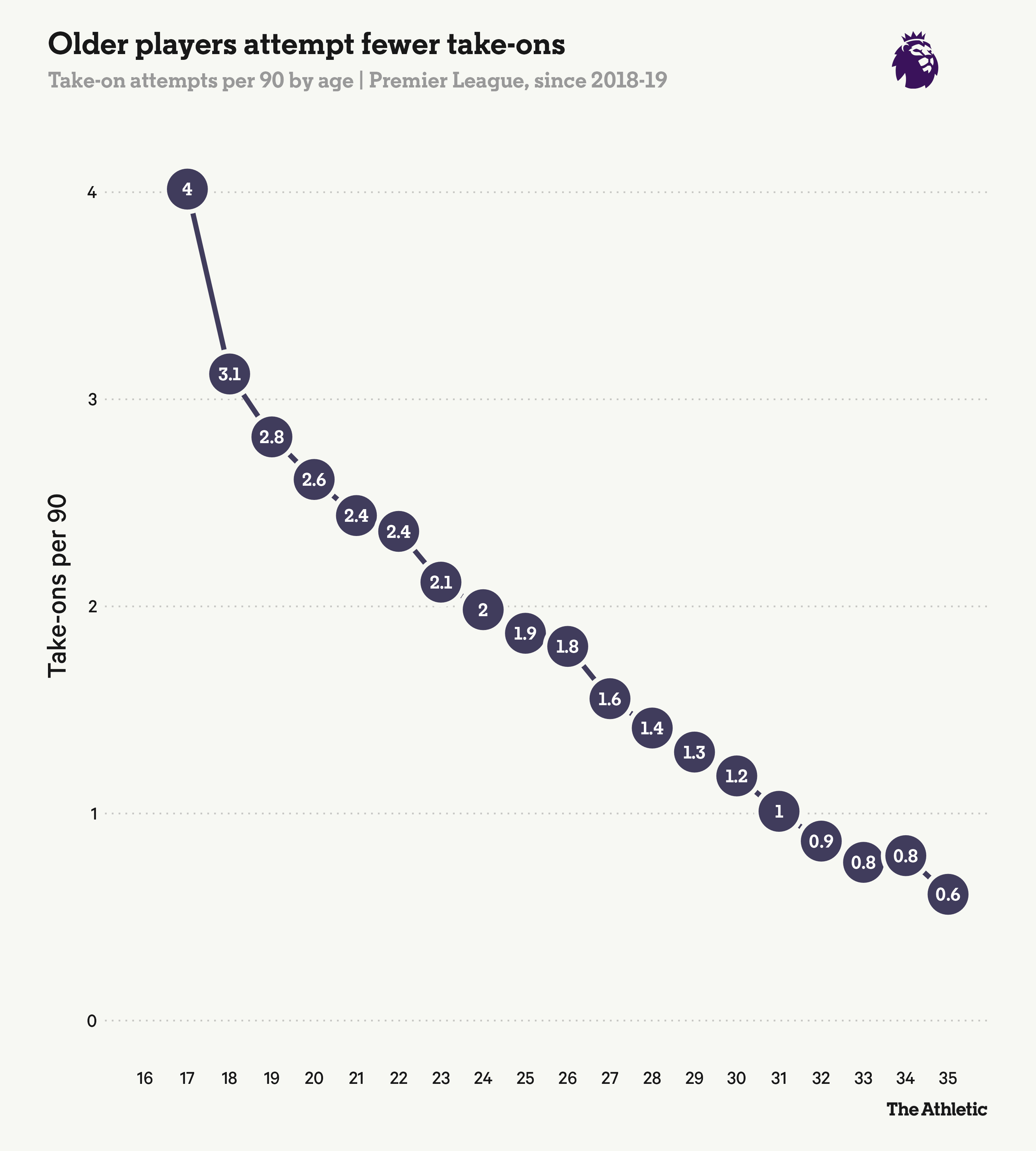
This is partly because older wingers who lose a yard of pace are quickly filtered out at the elite level, but that is not the whole story.
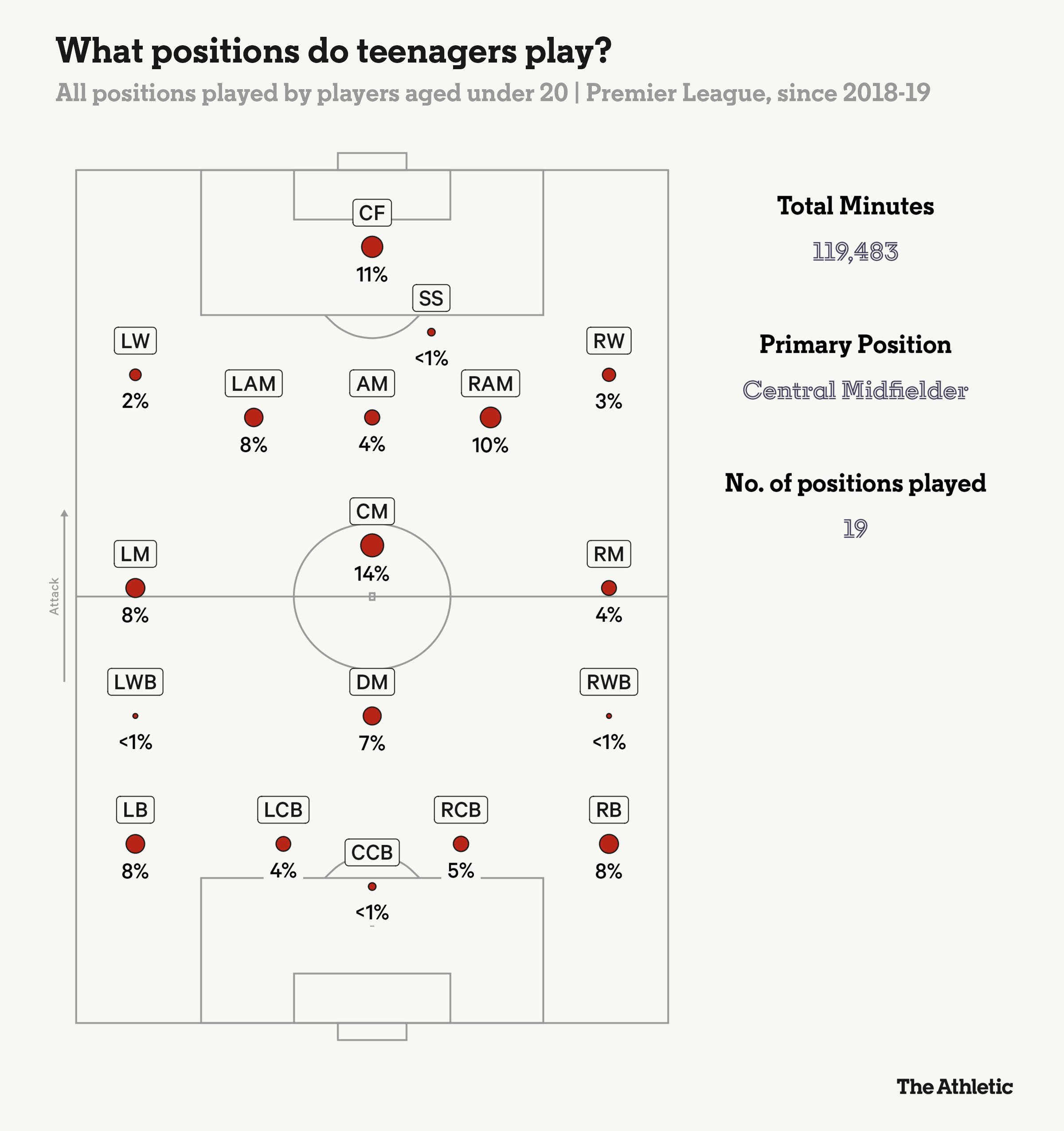
The map below shows that teenage minutes since 2018-19 are spread across the outfield positions, not just among rapid, jinky attackers.
Take-on completions are at an eight-year low, at 13.7 per game. Aggressive man-to-man pressing and compact low blocks have produced more congested, attritional games this season. Nimble, unpredictable youngsters can prise these defences open.
“To create chances against a low block, you need pace and individual special moments to create an overload,” Liverpool head coach Arne Slot told reporters after their 0-0 draw away to Leeds United in January. King almost broke the deadlock with one of those on Saturday, driving from halfway through a crowd of Burnley players before producing a tame finish at Dubravka.
It was reminiscent of the disallowed goal he scored against Chelsea at the start of the season, ruled out by VAR for a foul in the build-up, a decision that Howard Webb, chief refereeing officer at Professional Game Match Officials Limited (PGMOL), later called “wrong”. Fulham named the chalked-off effort as the club’s goal of the month for August, probably in protest of the decision, but also in recognition of its quality.
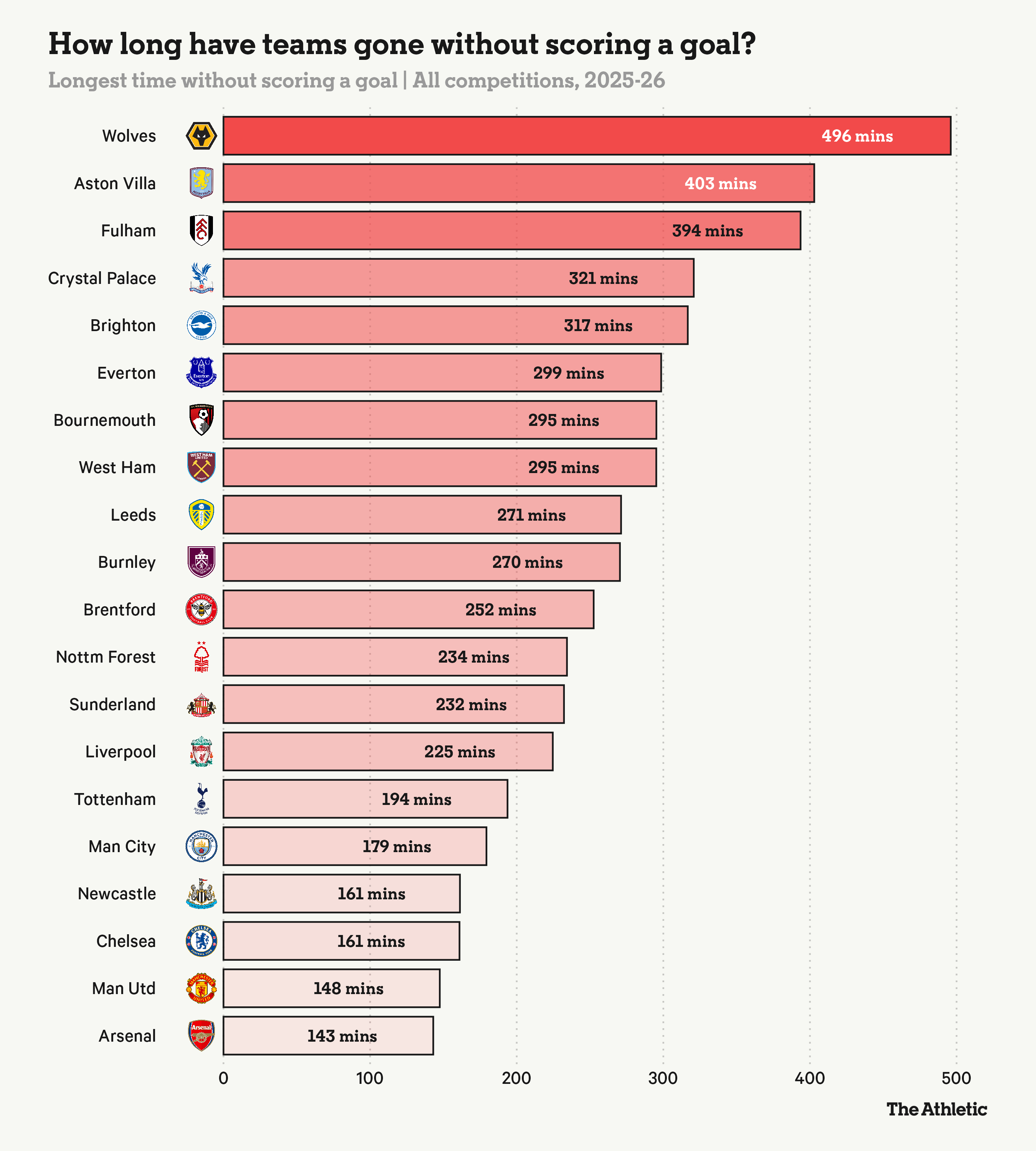
King’s scruffy effort on Saturday will not win any accolades, but it was a deserved reward for a player who injected drive and purpose into a Fulham side that has looked slow and ponderous in possession, having gone six-and-a-half hours without scoring in all competitions.
The Premier League has been accused of stale, dull football this season.
The antidote to this hardened cynicism?
One could do worse than take in the youthful exuberance of King and the division’s exciting crop of teenage talent.