
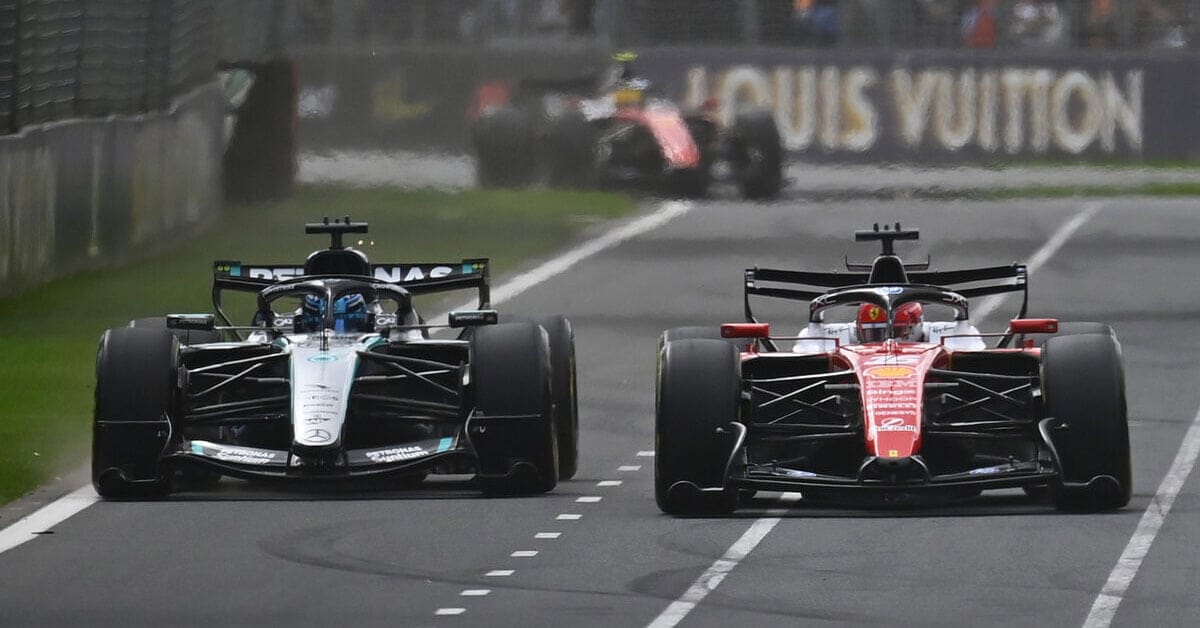
Spring is now very close to arriving and winter is finally, and quite noticeably, beginning to loosen its grip across Europe. We have therefore decided to take advantage of this short but valuable pause in the racing calendar to carry out a more in-depth comparison between the power units that are currently allowing George Russell, Andrea Kimi Antonelli, Lewis Hamilton and Charles Leclerc to consistently fight for the most coveted and competitive positions in the championship standings, at least based on what has clearly emerged from the opening two rounds of the current Formula 1 season.
At this stage of the championship, Mercedes is without any real doubt the team and manufacturer to beat. Ferrari team principal Frédéric Vasseur, speaking at the conclusion of the Chinese Grand Prix weekend, explained in a detailed manner that there was still a performance gap of approximately five tenths of a second to close to the Stuttgart-based manufacturer, at least when focusing specifically on overall race pace and long-run consistency. Whether this gap can be attributed entirely and exclusively to the power unit remains difficult to determine with absolute certainty, but it is quite evident that from a purely technical and engineering perspective related to the power unit, the engineers working in Brixworth appear to have discovered and developed something extra compared to their direct rivals.
Comparison between the two power units leading the way in F1
The key question that naturally arises at this point is what exactly this additional performance advantage consists of, and above all, in which specific technical area it can be identified. In order to try to better understand this aspect, we decided to carefully compare the official technical specifications of the two power units. Naturally, we were not expecting to uncover any hidden secret or revolutionary solution through such a straightforward analytical approach, yet despite this, some interesting and noteworthy details have still emerged from this comparison.
First of all, if we place the two sets of technical specifications side by side, both those relating to the internal combustion engine and those referring to the hybrid ERS system, the impression is that we are looking at two completely identical power units. If we were to interchange the data between the two, at least in terms of the declared and publicly available technical characteristics, we would essentially be dealing with what appears to be the same exact power unit architecture. Clearly, however, this is not the reality, as subtle but crucial differences remain hidden beneath the surface.
Both manufacturers, in fact, choose to disclose certain technical data while deliberately omitting other key details. On the official Mercedes platform, it is specified that the internal combustion engine is capable of reaching rotational speeds of up to 15,000 revolutions per minute, a figure that is notably absent from Ferrari’s official technical documentation. On the other hand, Ferrari provides very precise details like the bore and stroke of the pistons, information that the engineers in Brixworth have carefully decided not to reveal publicly, likely for competitive and strategic reasons.
Manufacturers disguise ICE power figures, this is where the 2026 battle will be decided
If the two power units appear so remarkably similar on paper, the logical question becomes where Mercedes is actually able to make a tangible difference. Could it be purely a matter of superior energy management? That hypothesis does not appear entirely convincing. Even though the MGU-K system is technically designed and engineered to recover up to 9 megajoules of energy per lap, drivers only make use of a portion of that available energy during both race and qualifying conditions. These usage values are continuously being adjusted and fine-tuned by the FIA on a race-by-race basis. For instance, during the Melbourne weekend, the available energy was set at 8 megajoules for the race and 7 megajoules for qualifying, with an additional 0.5 megajoules available in race conditions when a driver is running within one second of the car ahead, thus encouraging overtaking opportunities.
The most crucial and significant figure that is missing when examining the official technical sheets of both Ferrari and Mercedes is the actual and effective output of the internal combustion engine itself. Neither of the two manufacturers has chosen to disclose this specific number, even though it represents the exact value that will be taken into consideration for the so-called ADUO evaluations. At present, the only confirmed and officially declared power figure available is the 350 kW associated with the hybrid ERS system.

What makes this situation particularly interesting is the fact that the data relating to the power output of the combustion engine is not truly absent, but rather cleverly disguised or indirectly presented, and this approach is used by both Mercedes and Ferrari. Both manufacturers refer to a maximum fuel energy flow of 3000 megajoules per hour. Expressed in this particular format, the figure can simultaneously appear both informative and somewhat ambiguous. However, those who are more familiar with technical units of measurement will quickly recognize that this value effectively represents the maximum theoretical power that can be extracted from the fuel when operating at peak energy flow conditions. It is important to underline that this represents pure theoretical power, without taking into account any form of system loss, and therefore should not be confused with the actual usable output delivered by the engine.
Starting from this assumption, and performing a relatively straightforward conversion, it becomes evident that the fuel could theoretically reach a value of approximately 830 kilowatts at maximum energy flow. This is an extremely high and impressive figure, but it must inevitably be reduced quite significantly due to the inherent inefficiencies and losses associated with the Otto cycle system used in these engines. During the previous regulatory era, the efficiency of the internal combustion engine was generally estimated to be around 50 percent. This represents an exceptionally high level of efficiency for a combustion engine, achieved progressively over many years of development, and a level that, at the present time, no manufacturer is consistently able to fully reach under all operating conditions.
What is particularly striking and somewhat surprising, however, is the growing number of indications and paddock rumors suggesting that the Mercedes power unit may already be operating at efficiency levels that are approaching very close to that theoretical threshold.
If we were to simply halve the 3000 megajoules per hour value by applying a 50 percent efficiency rate, the result would be approximately 415 kilowatts of power generated by the internal combustion engine alone. This calculation helps to clearly explain why the FIA has decided to impose a regulatory cap of 400 kilowatts on the ICE output for the 2026 Formula 1 season, effectively targeting an efficiency level of around 48 percent as a realistic and achievable benchmark for all manufacturers.
It is also important to emphasize that these calculations are based on the assumption that teams are already capable of reaching the 3000 megajoules per hour fuel energy flow during certain phases of a race weekend. This may still represent a development target that has not yet been fully achieved in real-world conditions, but rather one that manufacturers are actively aiming to reach over the course of the season. Achieving this objective will also depend heavily on the continuous development of fuel technology, which remains a crucial and often underestimated aspect of overall power unit performance.
The competitive battle between engine manufacturers during the current season will revolve around the ability to get as close as possible to that 400 kilowatt threshold. In other words, since all manufacturers are declaring the same maximum fuel energy flow, the decisive and differentiating factor will be which team is capable of achieving the highest level of efficiency from its internal combustion engine across a variety of operating conditions. The focus will therefore be on approaching as closely as possible that 48 percent efficiency target set by the governing body.
The main factors that have a direct and significant influence on engine efficiency include temperature and pressure within the combustion chamber, the overall quality and completeness of the combustion process, the compression ratio of the engine, as well as the various thermal and mechanical losses that inevitably occur within such a complex system. Each of these elements plays a crucial role and requires extremely precise optimization.
At the present moment in time, manufacturers are not permitted to publicly disclose the exact figure relating to the usable power output generated exclusively by the internal combustion engine. This specific value will be carefully monitored and analyzed by the FIA in order to determine which manufacturers may require additional development allowances to close the performance gap to Mercedes more rapidly through the ADUO system. Only once these evaluations have been completed will it be possible to carry out more accurate and definitive comparisons between the different power units.
While this analysis has primarily focused on the manufacturers currently competing at the very front of the field, it is quite clear that the same technical reasoning and performance considerations also apply to the rest of the power unit suppliers, namely Audi, Red Bull Powertrains, Honda, and, starting from next season, Cadillac as well, all of whom are working intensively to reach similar efficiency targets under the evolving Formula 1 regulations.
Mar 22, 2026Sofia Bianchi
Let other Scuderia Fans know about us


