
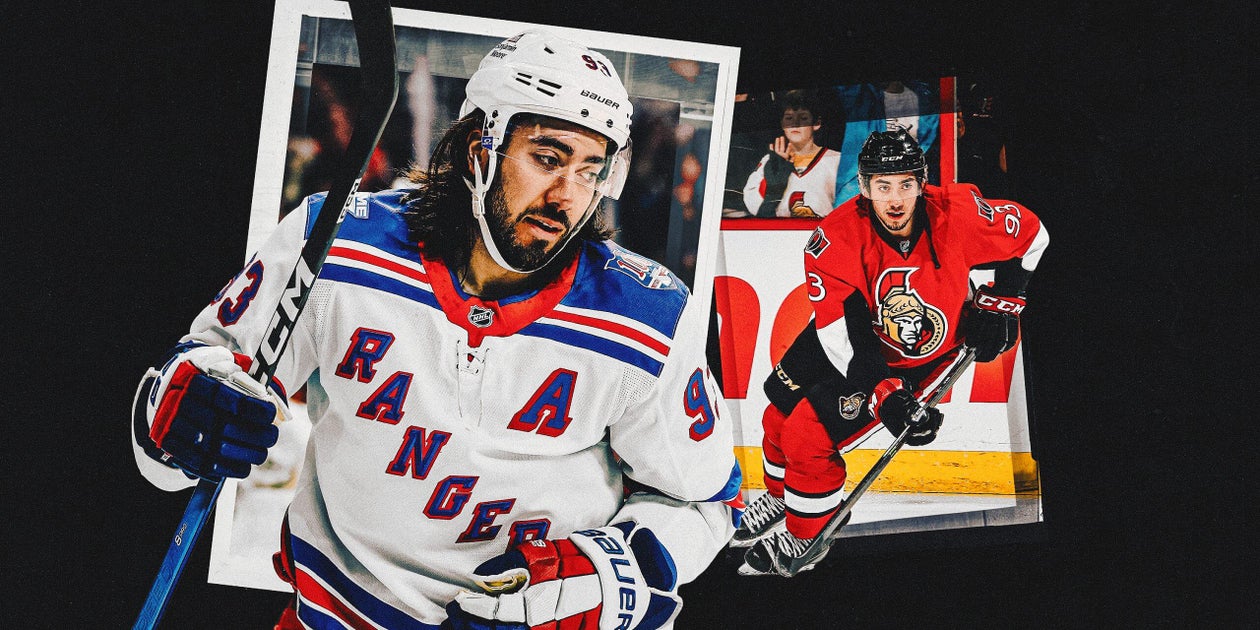
NEW YORK — Irma Helin Zibanejad knows how an athlete’s mind operates. She played soccer in Sweden’s top league, appeared in a national team game and now works as an analyst on Swedish television. As someone who’s been through the all-encompassing nature of competition, she’s well aware it’s hard for an athlete to pause mid-career and feel proud.
Yet, that’s exactly what she wants her husband, New York Rangers center Mika Zibanejad, to do Monday when he plays his 1,000th NHL regular-season game, a major accomplishment in NHL circles.
“Everything is about winning and Stanley Cups, and that’s obviously his biggest goal,” she says. “But I really hope for him to just stop and breathe and take everything in.”
Fittingly, Zibanejad’s milestone comes against the Ottawa Senators, the team that drafted him with the No. 6 pick in 2011 and the only other club for which he’s played. The Rangers will treat him to an on-ice pregame ceremony and present him and his family with gifts.
As Zibanejad accepts the praise, Irma wants him to think back to his days growing up in Stockholm, where his parents worked multiple jobs so he and his brother could play hockey. She hopes he can picture the little boy who maybe didn’t have the highest-quality stick and know that now he’s a member of an exclusive NHL club. To, in her words, “be very, very present and be able to say ‘Good job, Mika. You did this.’”
Zibanejad’s achievement is an opportunity to reflect on the moments that led him to this point, from his early days in Ottawa to his peak with the Rangers and current status as the team’s longest-tenured player. All of it has impacted who he is now as a 32-year-old veteran: a thoughtful presence and skilled, two-way skater who, considering his resurgence this season, appears to have plenty more good games ahead of him.
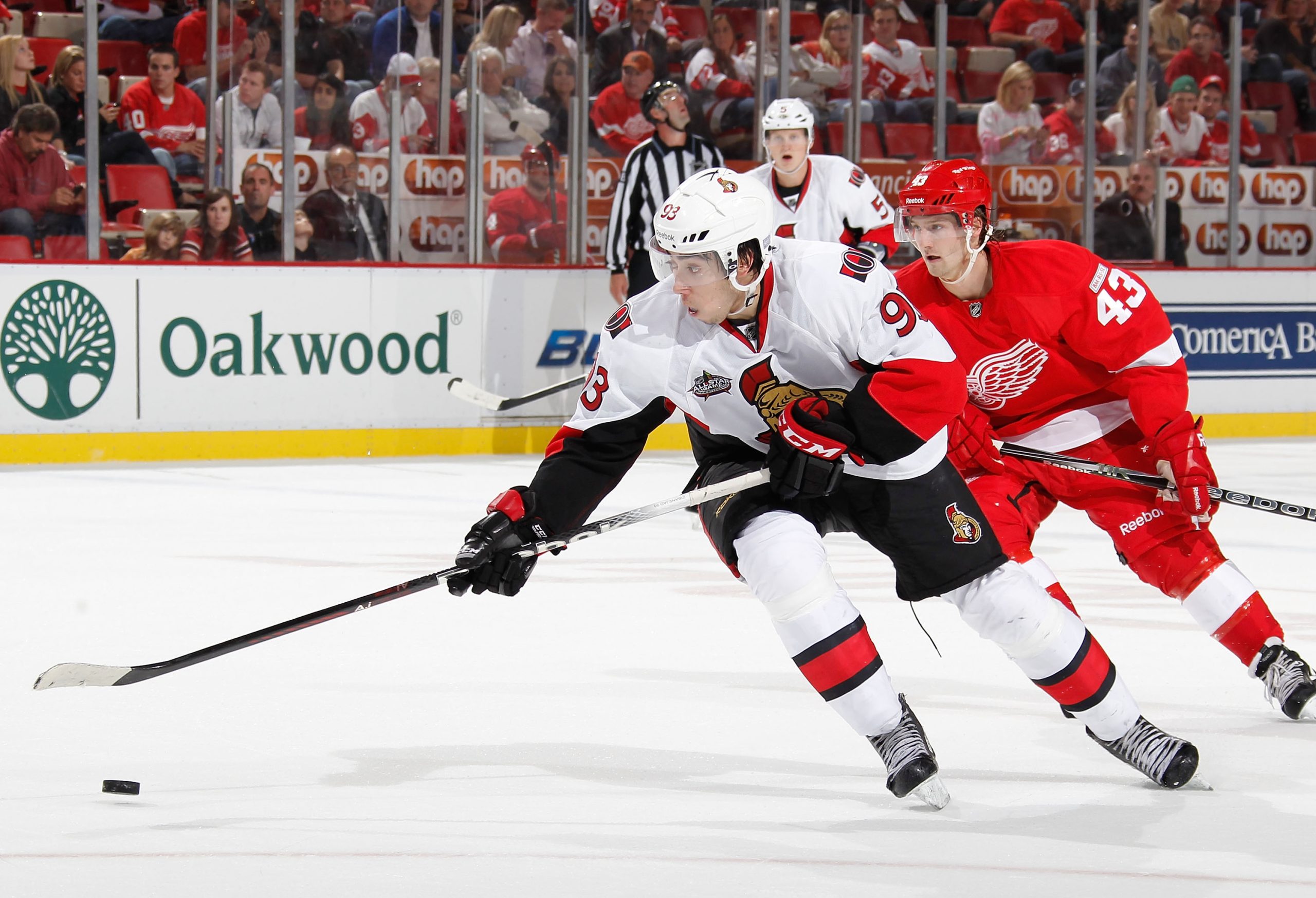
Mika Zibanejad made his NHL debut in Detroit on Oct. 7, 2011, with Ottawa. (Gregory Shamus / Getty Images)
Games played: 1
Oct. 7, 2011
Zibanejad arrived at Senators rookie camp in September 2011, his 18-year-old face young and his hair not yet grown into the shoulder-length style he sports today. Quickly, Ottawa coach Paul MacLean sensed confidence under his quiet demeanor. He pulled him aside and gave him a challenge: Be a leader among the rookies.
The center proceeded to have “one of the best rookie camps we’d had (since) before I got there,” MacLean says now. At full-team training camp, he earned a spot on the Senators’ opening night roster. His first game came at a historic venue — Detroit’s Joe Louis Arena — against a Red Wings roster full of Swedish players Zibanejad admired. Late in the third period, Zibanejad managed to keep a puck away from Hall of Fame defenseman Nicklas Lidström and cycled it in the offensive zone, leading to his first NHL point: a secondary assist on defenseman Filip Kuba’s goal. The entire experience, he says, felt surreal.
After nine NHL games, the Senators reassigned Zibanejad to Djurgårdens, his hometown club in Sweden, for further development. But his NHL cameo gave him a taste of the high level of play and a hockey-loving market that would soon feel like home.
Games played: 11
Jan. 30, 2013
MacLean’s words echoed in Zibanejad’s head as he took the ice with the Senators’ second power-play unit against the Montreal Canadiens. “Shoot, shoot, shoot,” the coach had told him on the bench. So, in his second NHL game of the lockout-shortened 2012-13 season, Zibanejad wound up for a slap shot from above the left faceoff circle. Time on the power play was expiring, and Zibanejad was far from the net. Canadiens goalie Peter Budaj looked straight at him.
“A bad shot to take, really,” Zibanejad says.
But he followed his coach’s orders. The shot hit Canadiens defenseman Alexei Emelin, bounced off the ice and ricocheted over Budaj’s right shoulder, giving Zibanejad his first NHL goal. A bit lucky? Sure. But a memorable moment in his early Senators years.
Zibanejad says he learned “a lesson every day” spending time around the Ottawa veterans. Captain Daniel Alfredsson, a fellow Swede, helped him with his one-timer technique, and Jason Spezza was a good example at center. Longtime winger Chris Neil provided Zibanejad with guidance in the gym, then played him in fiery ping-pong matches after workouts. They’d play best-of-three sets, Neil remembers, and the winner got to whack a ping-pong ball at the loser’s back.
Zibanejad also grew close with Erik Karlsson, only three years his senior. Weeks into Zibanejad’s NHL career, the ascending defenseman joined in a joint Halloween costume with Zibanejad and fellow Swedish rookie David Rundblad. The three Swedes donned wigs, painted their faces and went as members of the rock band Kiss. Karlsson still looks at the picture sometimes and laughs.
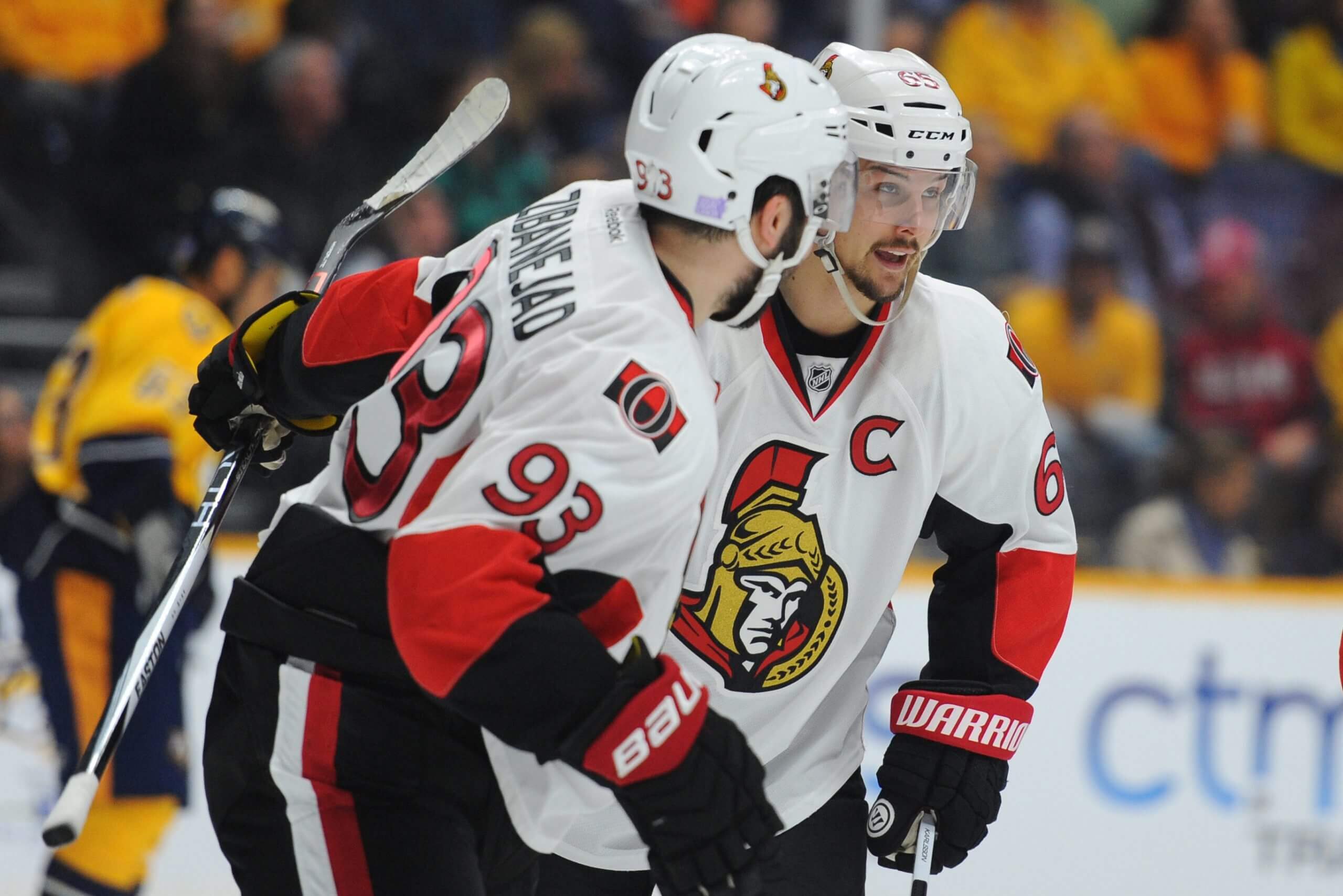
Mika Zibanejad grew close with fellow Swede Erik Karlsson when they played together on the Senators. (Christopher Hanewinckel / USA Today)
Games played: 108
March 16, 2014
Zibanejad didn’t crack a smile after scoring on Colorado Avalanche goalie Semyon Varlamov. There were only six seconds left in the third period, and Ottawa was still down 3-1. His one-time blast from the blue line was impressive, but the game was already lost.
Still, the goal stands out in Zibanejad’s mind. Four days earlier, at the Senators’ skills competition in front of fans, he had won the hardest shot competition with a 106 mph blast. He didn’t fully trust the radar gun, but now he had successfully used his power in a game. The one-timer was becoming a threat.
Over the next 12 years, the blistering shot would become Zibanejad’s signature. Fifty-six of his 344 career goals have come off slap shots, per NHL Stats. Since the start of the 2019-20 season, only Steven Stamkos, Alex Ovechkin and David Pastrňák have scored more on that type of shot than Zibanejad (44 goals).
“Nice to have his one-timer in my Rangers life,” says former teammate Artemi Panarin, who has assisted more Zibanejad goals (90) than any other player.
Zibanejad watched Ovechkin — the master of the one-timer — as a kid, and he began working on the shot in junior hockey. Coming to the NHL helped him perfect it, in part because he had access to any type of stick he wanted. He experimented with different curves and flexes, searching for the design that best helped the puck explode off his stick.
“You go from having six sticks for the whole season (in Sweden) to being able to go (through) three, four sticks a game,” he says.
It all contributed to him discovering one of the most dangerous shots in the sport.
“The puck comes off his stick differently than most,” Rangers coach Mike Sullivan says. “That, to me, is the sign of a true goal scorer.”
Games played: 281
July 18, 2016
Zibanejad knows his limits, and one thing he can’t do is sing. So, he’s found a way to make music without relying on his voice: DJing. He performed a set at an Ottawa club in 2013 and, 10 years later, took the stage at Lollapalooza Stockholm.
At one point during Zibanejad’s Senators tenure, MacLean had a conversation with him about his side passion. The coach wanted to ensure his prized prospect wasn’t going to be up all night DJing in clubs over the summer. Zibanejad explained to him why he finds it fulfilling.
“It’s an hour and a half, two hours of my life that I get to do something different, and I get to express it in music,” Zibanejad says.
By the end of the conversation, MacLean apologized for feeling suspicious.
“It was never an issue,” the coach says.
On a summer day after his fifth season, Zibanejad was working on some tunes in his newly purchased Ottawa house. When he took a break to grab his phone, which was charging in the kitchen, he was greeted with a surprise: His lock screen showed four missed calls, four messages and four emails, all from his agent.
When Zibanejad called back, he learned news that caught him fully off-guard: He’d been traded. The Rangers had acquired him and a second-round pick for Derick Brassard and a seventh-round pick.
“I wasn’t sure how to react,” he says.
So he called Karlsson, who was golfing nearby. The defenseman didn’t believe his friend; surely, he told Zibanejad, the news was not correct.
But it was. Karlsson cut his golf round short and rushed to Zibanejad’s house. They sat together, processing. Zibanejad found it weird that his family members were congratulating him, though he understands it more in retrospect now that he has a sense of the Rangers’ history. As the news settled in, he began to feel excited.
“All in all, maybe it was the best thing for him in the end,” Karlsson says.
The trade turned into one of the most successful Rangers transactions ever. In Zibanejad, they got a future No. 1 center: someone who would become part of their core for years to come.
Games played: 283
Oct. 15, 2016
In the first period of his second game with the Rangers, a loose puck bounced to Zibanejad in front of the St. Louis Blues’ net. He backhanded it into the slot, where winger Chris Kreider found it and whipped a shot past Carter Hutton.
With that, a connection was born. A Zibanejad assist on a Kreider goal happened 105 more times in their nine seasons as teammates. During that span, which ended when the Rangers traded Kreider to the Anaheim Ducks in June, they developed a bond on and off the ice that Kreider says is “borderline familial.”
Kreider describes Zibanejad as warm and sensitive, but he quickly saw how fiery his friend can get in competitive situations. The two played the FIFA video game during a trip early in the 2016-17 season, and Kreider — the worse player of the two — scored first. He then turned to stall tactics, taking advantage of the lack of icing calls in soccer and constantly booting the ball to the other end of the field. A furious Zibanejad was never able to find a tying goal.
“He had no business beating me in FIFA,” he says, a note of defiance creeping into his voice years later.
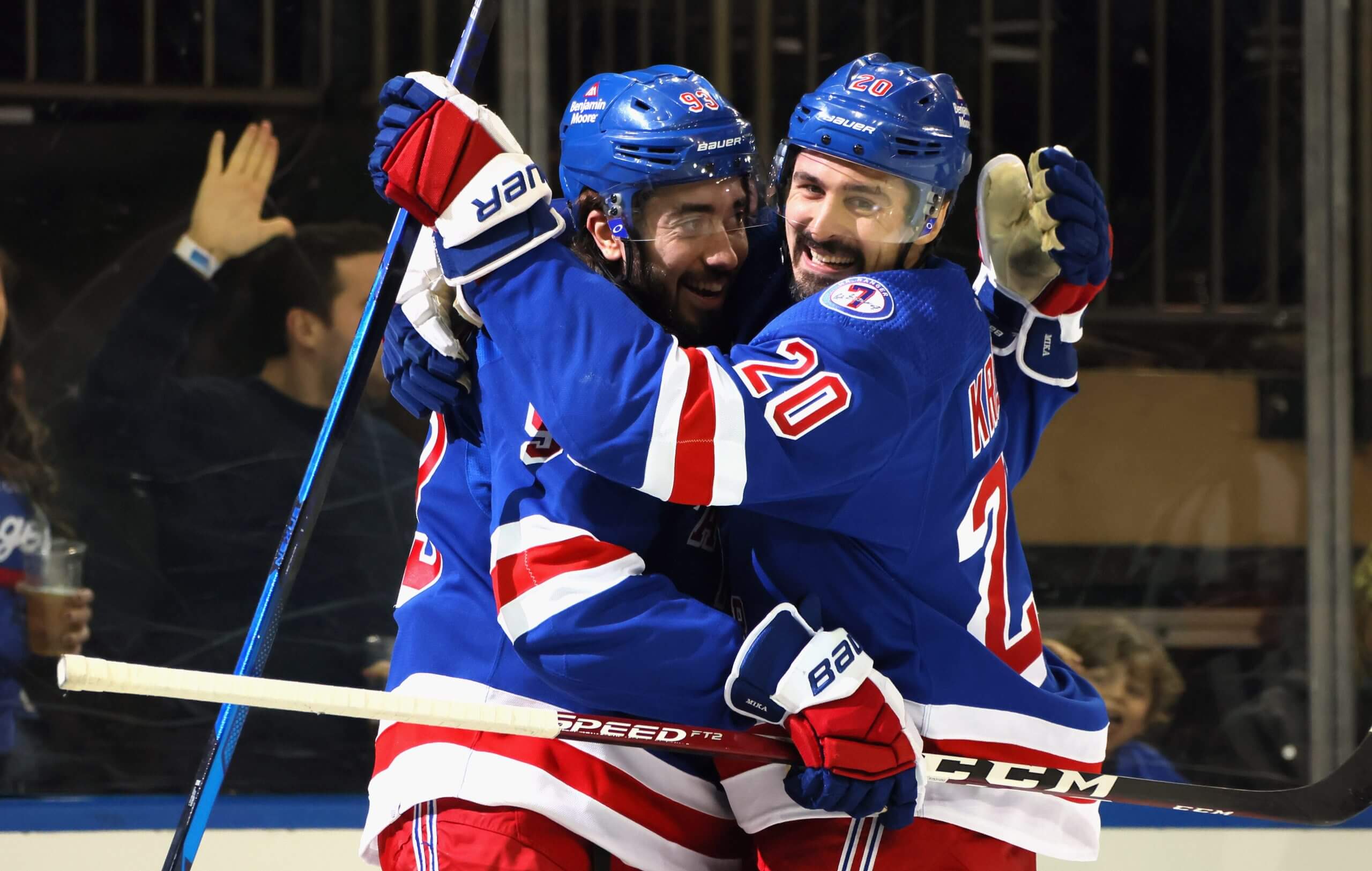
Chris Kreider and Mika Zibanejad celebrate a Kreider goal on March 25, 2022. (Bruce Bennett / Getty Images)
The two had lockers next to each other at the MSG Training Center, and Zibanejad still has a Kreider hockey card in his stall. When Kreider got married in 2023, Zibanejad was his best man.
On the ice, they became frequent linemates. Their production peaked in 2021-22, when Kreider had a 52-goal season and Zibanejad was a point-per-game player. The connection extended to the power play and penalty kill, too. The Rangers were an elite special teams club from 2021-22 through 2023-24, and Zibanejad credits Kreider’s net-front screens with helping plenty of his slapshots beat goalies. Zibanejad is the franchise record holder in power-play goals (122), and Kreider is tied for second (116).
Kreider laced up for 585 regular-season games with Zibanejad, more than 100 clear of the next-closest player (Panarin, 467).
Zibanejad’s 2-year-old daughter, Ella — who loves going to games at Madison Square Garden — hasn’t realized that her dad’s longtime teammate is gone. While at games, she sometimes points to a player on the ice and shouts, “There’s Chris!”
Irma doesn’t correct her.
“I don’t want to break her heart yet,” she says.
Games played: 337 (Postseason games played: 21)
April 20, 2017
With the Rangers’ 2017 first-round series against Montreal deadlocked 2-2, Game 5 went to overtime. Late in the extra period, Kreider found Zibanejad with a cross-ice pass on a rush. Zibanejad finished past Hall of Fame goalie Carey Price, then jumped up and down in front of the glass.
Zibanejad calls it one of his favorite goals. It’s his only playoff overtime winner to date, though he’s had other notable postseason moments, including a late, game-tying goal in Game 7 of the 2022 first round against the Pittsburgh Penguins and appearances in two conference finals. In total, Zibanejad has appeared in 74 playoff games (16 with the Senators and 58 with the Rangers) and ranks sixth in New York history with 55 playoff points.
Games played: 545
March 5, 2020
Zibanejad was in a suit in March 2020, ready to leave his Midtown apartment for a walk to Madison Square Garden. His dad, Mehrdad, was visiting from Sweden and wished Mika luck as he headed toward the door.
“I’ve never seen you score a hat trick live, and today’s a good day for it,” Mehrdad said.
This wasn’t a frequent request. Mika said he’d oblige, not knowing the night would turn into arguably the best of his career.
Less than a minute into the third period, Zibanejad made good on the pregame promise, finishing a Pavel Buchnevich pass from behind the net for his third goal. In the family section in the Garden’s lower bowl, Irma and Mehrdad looked at each other and screamed. Fans chucked hats — as well as a scarf, pillow, rainbow wig and beachball — onto the ice.
“Then he just continued,” Irma says.
He potted a rebound off a Kaapo Kakko shot for a go-ahead goal in the final two minutes of regulation. The Washington Capitals tied the score 59 seconds later, but what appeared like a setback was really just a chance for an overtime coronation. In the extra period, Zibanejad beat goalie Ilya Samsonov on a breakaway, giving him his fifth goal of the night.
After the goal, which tied a Rangers single-game record, Zibanejad came to a stop at the corner of the ice. He pulled both of his elbows into his chest and unleashed a scream. A grin never left his face as his teammates mobbed him. It was a special scene: a reminder that a random Thursday game can become history. When Irma saw her now-husband after the game, all she could do was laugh in disbelief.
Zibanejad finished that season, which was shortened by COVID-19, with 41 goals in 57 games, leading the league in goals-per-game rate among qualified skaters. He was assertive every time he stepped onto the ice, attacking dangerous areas with long strides, and appeared on Selke Trophy ballots for his two-way play. It was his game at its best.
Games played: 972
Jan. 2, 2026
Zibanejad enjoyed about as good a regular-season day as an NHL player can have. In the morning, he found out he’d made Sweden’s Olympic team. At night, playing in the Winter Classic at loanDepot Park in Miami, he had one of the best outdoor games in NHL history, leading the Rangers to a 5-1 win. He scored the first-ever hat trick at a Winter Classic and set an NHL record with five points in an outdoor game.
The Rangers have had a disappointing season as a team. They entered the year with playoff hopes, especially after hiring two-time Stanley Cup-winning coach Mike Sullivan, and have instead fallen to last place in the Eastern Conference. In a year of limited positives, Zibanejad has been a major bright spot.
“He’s quietly had a really strong season for us,” said Sullivan, who kick-started a strong relationship with Zibanejad by visiting him in Stockholm over the summer.
Zibanejad has 30 goals and 67 points in 69 games, his best scoring rate since 2022-23. He’s remained defensively responsible, and he’s helped mentor younger teammates, including current linemates Alexis Lafrenière and Gabe Perreault. His game isn’t at its 2019-20 level, but he’s showing he can still be a strong top-six center.
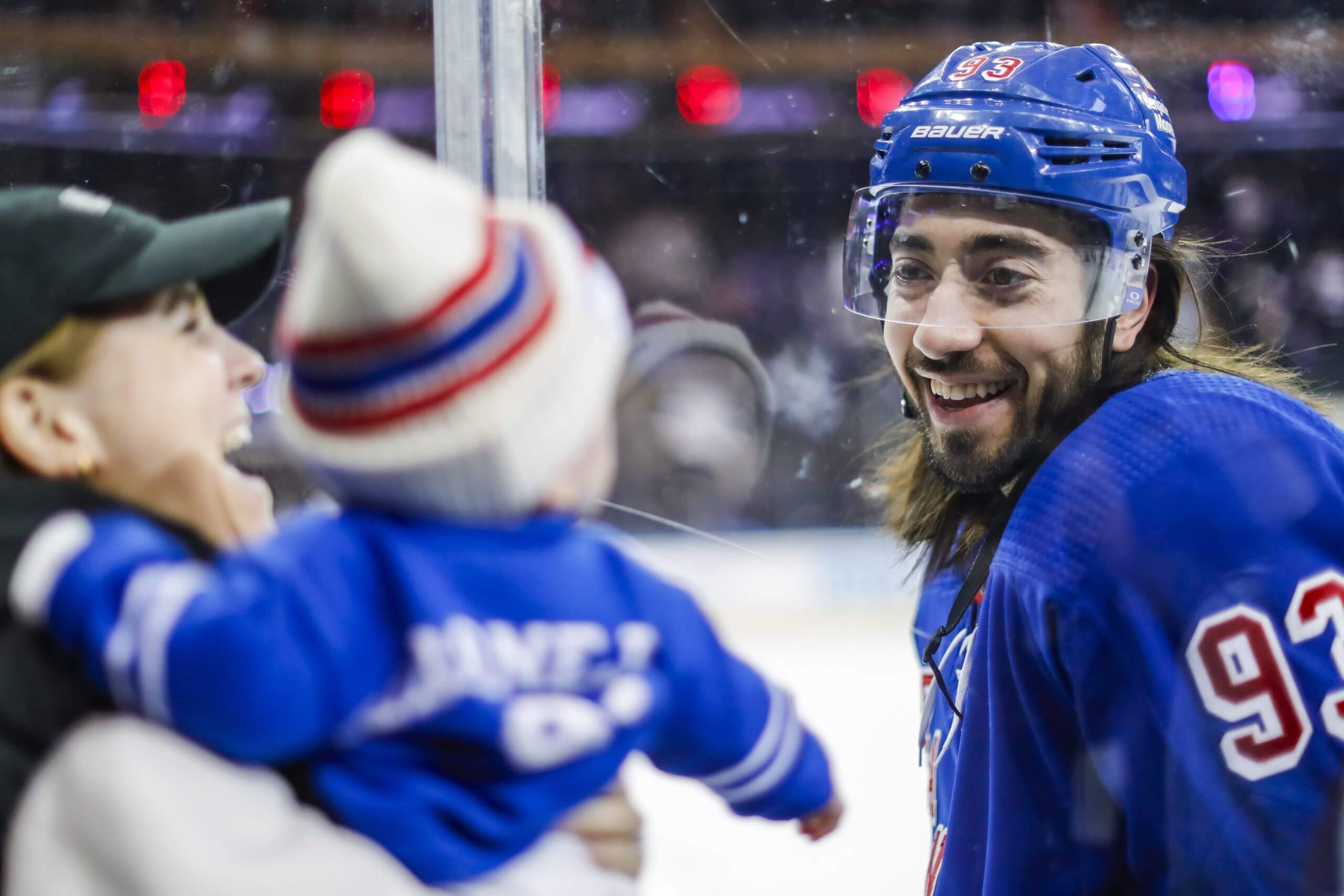
Ella loves going to Madison Square Garden and “has, in a sense, grown up inside those walls,” Irma says. (Jared Silber / NHLI via Getty Images)
That didn’t necessarily feel like a guarantee during the 2024-25 season, especially during the first half. Zibanejad struggled, scoring only six goals and 21 points through the team’s first 36 games. Physically, he felt fine. Mentally, he didn’t. His confidence was down, and he was overthinking: an occasional side effect of his cerebral nature. He describes the lack of results as draining.
He managed to salvage the second half of the season, then won a bronze medal at the 2025 World Championships. He carried the momentum into 2025-26, during which he’s appreciated the trust of Sullivan and the coaching staff.
“I feel more like myself,” he says. “Back to my old ways.”
“To develop and grow from that instead of the opposite makes me really proud of him,” Irma adds. “He’s had even better seasons, but this (year has) made me the most proud of him.”
Games played: 999
March 22, 2026
Zibanejad felt more nervous than usual heading into Sunday’s Rangers versus Winnipeg Jets game. A long list of family and friends had already made the trip to New York in anticipation of Game No. 1,000, so he wanted to make sure to avoid injury. He was successful, playing 23:29 and scoring a power-play goal on his trademark one-timer. After the Rangers’ 3-2 shootout loss, teammate Lafrenière mentioned the impending accomplishment to Zibanejad. He’d made it.
“The jitters start now,” Zibanejad said.
His milestone comes at a precarious time for the Rangers. In a letter to fans in January, president and general manager Chris Drury announced the team was entering a retool. Shortly after, he traded Panarin, and more changes will likely follow this offseason. Zibanejad says his understanding is that Drury’s retool will differ from a full rebuild, which he experienced with the Rangers starting in 2018 and included the team trading multiple core players for picks and prospects.
Zibanejad’s $8.5 million average annual value contract runs through 2029-30, and he has a no-movement clause. He and the team’s players with full trade protection can evaluate the team’s landscape this summer, but as long as they want to stay in New York, they can.
Reflecting on his time with the Rangers, Zibanejad is grateful for the opportunities the team has given him, be it his position as alternate captain or the big-money contract trusting him to play for a historic club.
“I feel like I thrive in that (environment),” he says. “I’m happy for that opportunity. Each year (has) just been growing to love this place and love this city.”
The Rangers face an uncertain future, but Zibanejad doesn’t have to focus on that on Monday. He can instead look back at his journey to the 1,000 game milestone and bathe in the adulation that comes with it.
“We should all appreciate him for what he’s done, what he’s doing, what he will do,” Kreider says. “He’s one of a kind.”
— Vincent Z. Mercogliano contributed to this story.