

March 23, 2026 — 7:30pm
Save
You have reached your maximum number of saved items.
Remove items from your saved list to add more.
Save this article for later
Add articles to your saved list and come back to them anytime.
Got it
AAA
There is something missing from the widely recognised stages of grief. Developed by Elisabeth Kübler-Ross in the late 60s, the five-stage model that includes denial, anger, bargaining, depression, and acceptance, sadly omits guidance for bureaucratic torture.
This additional stage of grief I shall call “one flew over the executor’s nest”, is an administrative hamster wheel from hell that befalls loved ones who must finalise the deceased’s estate. This stage has no order, rather it’s a marathon that runs concurrently and beyond all the other stages, and tests the emotional fortitude of someone who, although stricken with grief, must prioritise developing a relationship with a justice of the peace.
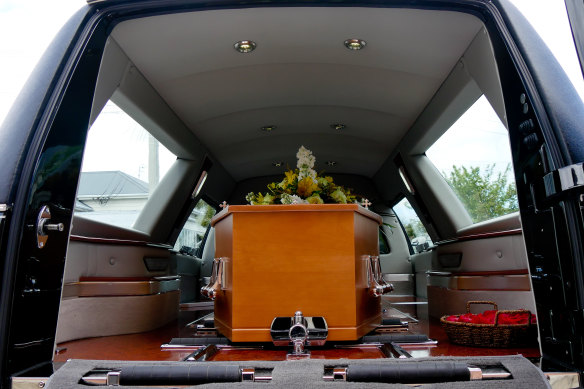 Both the superannuation provider and the ATO knew Dad was dead, yet the money ended up in an account that was for a living, working, taxpayer.Shutterstock
My dad has been gone three years, and it is only now I feel I can write this article without crawling into a corner and lying in a foetal position. That, and a recent Herald article about another victim of the insane bureaucracy and cost that dying incurs, has compelled me to ask why the simplest of estates are so difficult to finalise.
My father died at 84, a single man with no assets except some superannuation and the contents of his bank account, the total of which sat under the NSW requirement for probate. I thought this was great and that commonsense had prevailed when it comes to smaller, uncomplicated wills. With no probate, I was able to create a bank account and a tax file number in the estate name and consolidate all the funds. I paid the tax due from the estate, then distributed the remainder to the beneficiaries.
There was no house, no investments, no Cayman Island accounts, or contestants. I administered this on my own and saved the modest estate any legal costs, ensuring the only beneficiaries were the ones written in the will. The hardest part up to this point was being confronted everyday by the constant reminder that my dad had died. Having to repeat his date of birth, date of death, and get yet another certified copy of his death certificate was like a Chinese-burn of grief being inflicted over and over.
If only it had ended there. A year after dad died, six months after I had finalised his estate, a class-action against his superannuation provider relating to commissions succeeded, and they owed dad $1400. The money was sent to the Australian Taxation Office (ATO) under his name.
This slow-motion mugging went on for nine months and saw me spend hours retelling my dilemma to ATO call centre staff.
I contacted the ATO assuming it had been placed into Dad’s estate tax account, the one I opened without probate nearly a year earlier. I kept calling until I got someone who didn’t ask me to put Dad on the phone, and it was discovered that this posthumous money had been placed into Dad’s personal tax account.
Both the superannuation provider and the ATO knew Dad was dead, yet the money ended up in an account that was for a living, working, taxpayer. In my dad’s case, an account that had been inactive for over a decade.
Now I was caught in the hamster-wheel of hell. The same ATO that was happy to recognise my authority enough to pay the deceased estate’s tax obligations, was now refusing to refund the $1400 they owed the estate.
This slow-motion mugging went on for nine months and saw me spend hours upon hours retelling my dilemma to ATO call centre staff who were happy to listen to my sorry tale and offer no solution. My apologies to other callers who were waiting in queue.
Related Article
I escalated the issue to the Taxation Ombudsman where at least I got a straight answer. Just because the Supreme Court of NSW didn’t require probate, the federal Australia Taxation Office does. The anomaly as to how I managed to create an estate tax file number is still a mystery.
My dad worked nightshift for 50 years in a plastics moulding factory. He paid his taxes and superannuation to secure his retirement. My compulsion to spend hours of my time in this sanity-sucking nightmare was driven by my obligation as executor, and my love for him.
The final test in this Squid Game for the bereaved was the advice that I should seek probate in NSW to satisfy the ATO. Imagine the confusion in the NSW probate office receiving an application for an estate that had been finalised.
I’m saddened to say I fell at the last hurdle and couldn’t finish the race. I received an email from the Supreme Court of NSW saying they could not process the probate application. Why? Because my middle name did not appear in the will.
As there would be no return to the estate after costs in pursuing this further, I’d like to ask the ATO to use my dad’s money wisely. Funds that were stolen by his superannuation fund, then stolen again. As for me, there comes a time where you have to lose the will, to live.
Jo Pybus is a writer and host of Alex the Seal podcast.
Save
You have reached your maximum number of saved items.
Remove items from your saved list to add more.
From our partners