
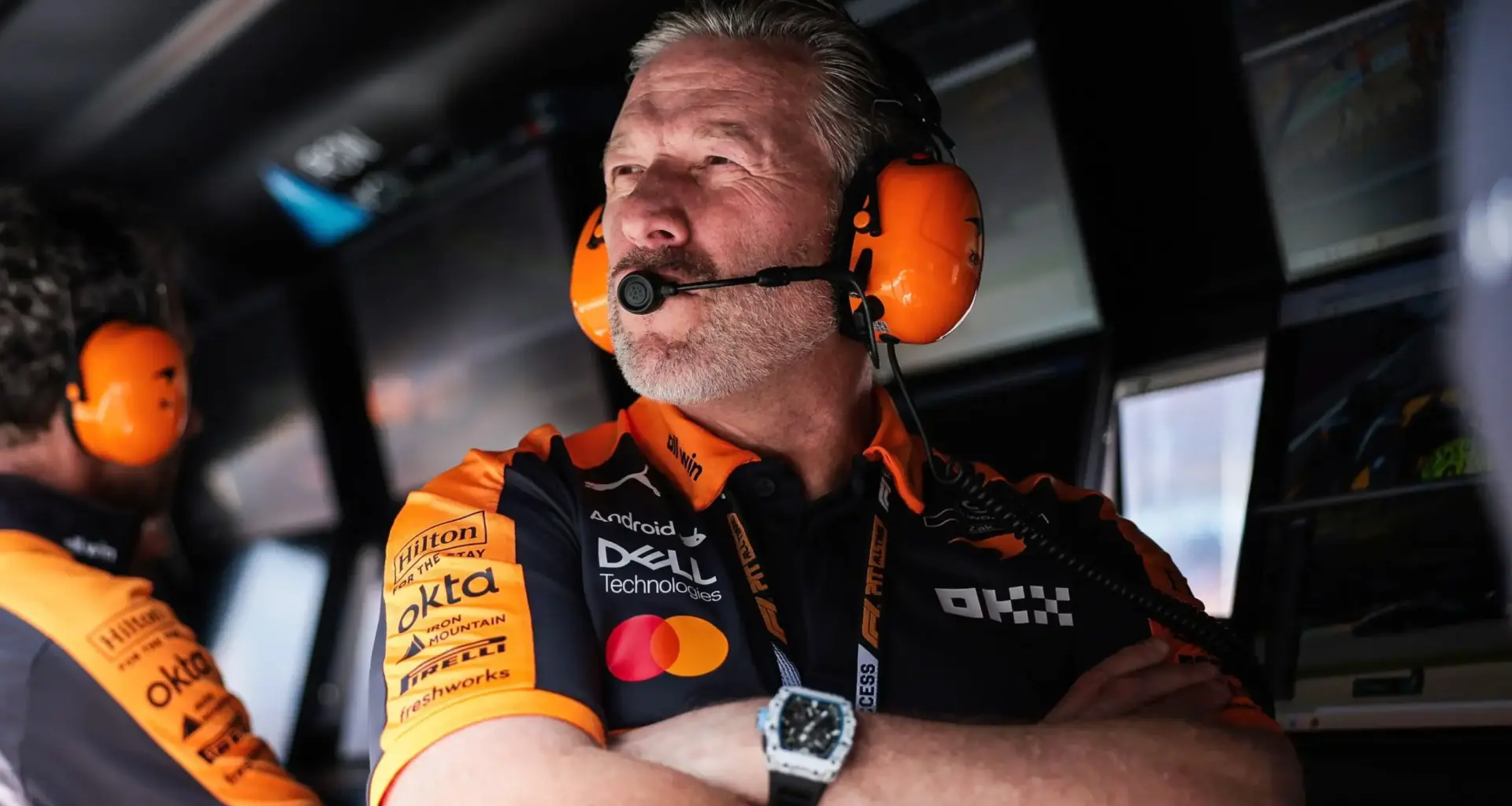
McLaren suffered a rare double DNS at the recent Chinese Grand Prix as Lando Norris and Oscar Piastri both failed to make the race start.
With the team voicing dissatisfaction with its current setup with Mercedes, might McLaren once again look for a works partner ahead of the next F1 rule changes? Better still, why not take a leaf out of Red Bull Powertrains’ book and build its own power unit?
Why McLaren might be forced to consider its future with Mercedes
A version of this article originally appeared in PlanetF1.com’s conclusions from the 2026 Chinese Grand Prix
Want more PlanetF1.com coverage? Add us as a preferred source on Google to your favourites list for news you can trust
McLaren is unlikely to be the only team to suffer this sort of indignity in 2026.
At the start of a new era, and with these fragile new engines, we are currently at the height of DNS season, when the risk of little gremlins emerging within touching distance of the race start is as high as it has been for years.
In the rush to brand McLaren’s Chinese Grand Prix a disaster, it was widely overlooked that Audi has only seen one car take the start at the first two races of this season.
It could happen to any of them at any time.
It just so happened to be McLaren, amazingly with both cars at once, in Shanghai.
Yet the double DNS for Lando Norris and Oscar Piastri has come at a particularly fascinating time in the team’s relationship with Mercedes.
Lando Norris vs Oscar Piastri: McLaren head-to-head stats for F1 2026 season
F1 2026: Head-to-head qualifying statistics between teammates
F1 2026: Head-to-head race statistics between teammates
As noted in PlanetF1.com’s conclusions from the Australian Grand Prix, McLaren is back to feeling like a second-class citizen at the start of 2026, convinced that the works Mercedes team is doing something its customers can’t, or simply haven’t worked out how to do yet.
It was Ron Dennis, the former McLaren team principal, who remarked more than a decade ago that teams with customer engines cannot win a world championship in the modern era.
McLaren’s success since 2024 – back-to-back constructors’ titles and a drivers’ championship with Norris – has been held up as evidence that Dennis’s theory was wide of the mark.
Yet in terms of setting a team up for long-term, sustained success through different rules cycles?
Maybe Ron was on to something after all.
No doubt it helped McLaren during the ground-effect era that Mercedes got itself so muddled on the chassis side that it could not benefit from the inherent advantages – packaging, integration, optimisation – provided by its own engine.
McLaren is with Mercedes for at least the medium-term future having announced an extension of the partnership until 2030 almost three years ago.
That, however, only came after a period of extremely heavy petting (inviting the chairman as a guest at Suzuka, hiring one of the WEC drivers as an official reserve) with Toyota.
Haas has since become Toyota’s most likely option for an F1 return with some expecting a full takeover of the team over the coming years.
Yet in light of McLaren’s glitchy start to 2026, and the apparent discontent with Mercedes, might this be an avenue Zak Brown and Andrea Stella revisit in their post-2030 planning?
Or, alternatively, and given that the team is already producing an in-house powertrain for its 2027 WEC hypercar, might now be the time for McLaren to finally consider taking a Red Bull-style plunge by establishing its own specialist engine division?
If a company like Red Bull, with far wider interests than motorsport, can do it, why can’t McLaren?
McLaren Powertrains, anyone? It does have a ring to it…
What did Ron Dennis say about customer engines in modern F1?
Ron Dennis’s comments about teams needing a works engine came following a challenging start to the ill-fated McLaren-Honda reunion in 2015.
McLaren had parted ways with Mercedes at the end of 2014, the first year of the V6-hybrid engines, to reunite with Honda, which powered the team to world championship glory with Ayrton Senna and Alain Prost in the late 1980s and early 1990s.
With the Honda power unit proving slow and unreliable in the early months of 2015, Dennis reiterated his confidence that the partnership would eventually succeed.
He told the official Formula 1 website at the time: “I’ve said it before and I’ll say it again: we have a mountain to climb, but climbing it we are and scale its summit we will. That I guarantee.
“McLaren and Honda share a passion to win in Formula 1 – we’ve done it before and we’ll do it again.
“And, for a team to win in Formula 1, you need to have a multinational motor manufacturer as your power unit partner and in Honda that’s exactly what McLaren has got.
“Look, we enjoyed huge success when Mercedes-Benz was our power unit partner for many years, winning world championships with both Mika [Hakkinen] and Lewis [Hamilton].
“But the fact is that a team doesn’t tend to enjoy the same level of success when its status is downgraded from power unit partner to power unit customer.
“Well, with Honda, we don’t have that problem, because Honda is our power unit partner and a massively committed one to boot.”
McLaren and Honda eventually parted ways at the end of the 2017 season, within a year of Dennis being ousted from the team following a power struggle.
Both parties have gone on to enjoy success in F1 in the years since.
Honda powered Red Bull driver Max Verstappen to four consecutive world championships between 2021 and 2024, with McLaren enjoying title success in 2024/25 after returning to a Mercedes customer supply in 2021.
It emerged last winter that Dennis personally apologised to then-McLaren racing director Eric Boullier for severely underestimating how far behind Honda was with the development of its 2015 engine.
Want to be the first to know exclusive information from the F1 paddock? Join our broadcast channel on WhatsApp to get the scoop on the latest developments from our team of accredited journalists.
You can also subscribe to the PlanetF1 YouTube channel for exclusive features, hear from our paddock journalists with stories from the heart of Formula 1 and much more!
Read next: Max Verstappen can’t catch a break