
Parmesan and prosecco safe for Australian producers, feta and gruyere names to go
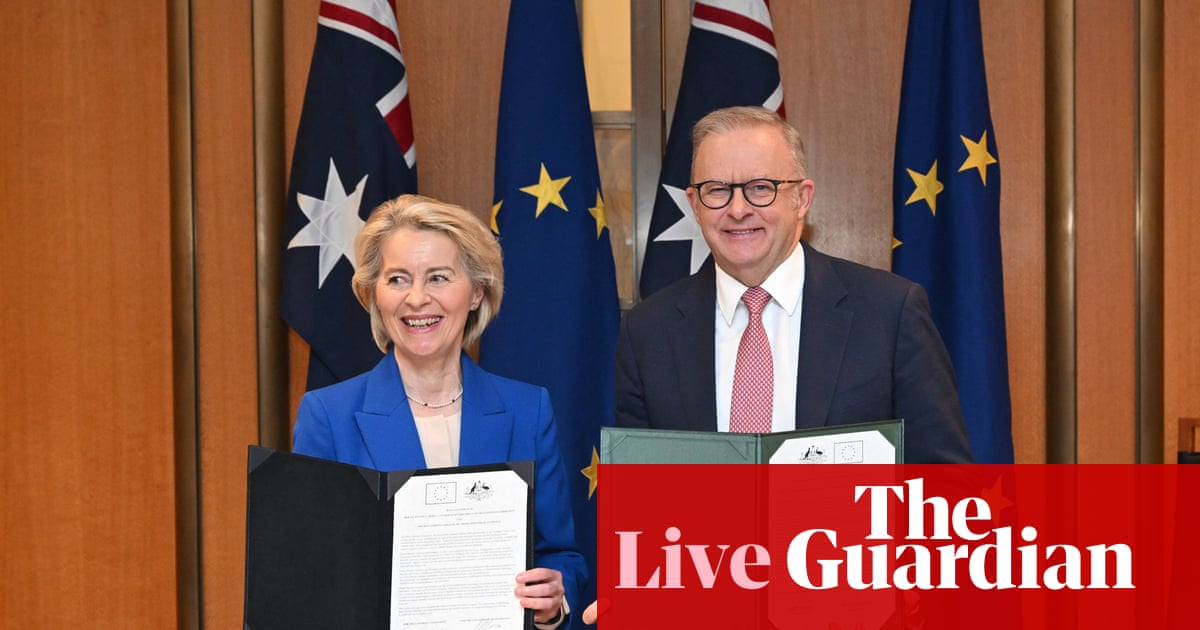
After many years of negotiations, including three with the current government, the two parties have signed what they’ve called a “win-win” deal.
But what’s actually in this new agreement?
On the big sticking point of naming rights, Australian producers will get to keep calling their products parmesan and kranskies, and Australian winemakers will be able to make and sell prosecco domestically.
BUT there will be a “grandfathering and lengthy phaseout” of naming rights for feta, gruyere and romano.
For everyone else at home, the removal of Australian tariffs on imports from the EU will make things like European wine, spirits, biscuits, chocolates and pasta cheaper.
Albanese said:
double quotation markOne of the things about Australia is that, with the exception of First Nations, people, were all either migrants or descendants of migrants, and many of those have come from Europe, and that’s why, whether it’s Greeks coming here and creating feta, or Italians coming and doing parmesan, or people from eastern Europe doing kransky sausages, those things. It’s a connection with Europe. Part of our strength is our people to people relations as well. I think all of that understanding and engagement has assisted.
(As mentioned above, those communities will eventually lose the naming rights for feta and a few other products.)
Updated at 21.00 EDT
Key events
Show key events only
Please turn on JavaScript to use this feature
‘Europe is in a dangerous moment’: von der Leyen
The European Commission president offers sober words on the state of the global reality.
Europe has faced more than four years of conflict in Ukraine, since Russian’s invasion, along with the new threat of war in the Middle East.
Ursula von der Leyen, who earlier told us that Europe offers stability in an increasingly uncertain world, says that stability is changing.
double quotation markCountries that built economic models on the very premise of the stability and safety they provide are facing a new reality. The world we live in is brutal, harsh and unforgiving. It feels upside down. What we knew as certainties are in question. The comfort blanket of yesterday is ripped away. It is confronting … Europe is changed.
She says to Australia, “distance is no longer a protection or a luxury”.
PM says security deal with EU a safeguard against uncertainty
Albanese says the defence and security deal, also agreed to by the two world leaders today, is a safeguard against uncertainty and volatility.
He says the deal also seats the foundation “for our future prosperity, resilience, security and stability”.
double quotation markRight now, we’re all dealing with the challenges thrown up by the conflict in the Middle East and Russia’s illegal and immoral invasion of Ukraine which has brought war to the very edge of the European Union.
Every global shock underscores the importance of the second milestone moment in your visit, the signing of the new Australia-EU security and defence partnership.
Albanese welcomes Von der Leyen to the House of Representatives. Photograph: Lukas Coch/EPA
Following the prime minister, the opposition leader, Angus Taylor welcomes Von der Leyen, saying Australia is “an heir to the European achievement”.
He says Australia is the beneficiary of “Christianity’s influence” on values and “science’s influence on reason”.
double quotation markWe, too, are the beneficiaries of the great changes that arose from the revolution in France and from the industrial revolution in Great Britain. And we, too, are the beneficiaries of the imagination of European builders and painters and the inspiration of European composers and writers.
When Europeans set sail on treacherous seas to discover and settle unknown lands, they brought legacy with them, some good, some not so good, but Australia has been gifted with the institutions and ideas of an enlightened Europe.
He seems to gloss over colonisation and its continued devastating impact on First Nations people today.
Updated at 21.20 EDT
Von der Leyen to address parliament
The House of Representatives is full to the brim with members and senators crowding in to hear Ursula von der Leyen’s address.
Before she begins, the prime minister, Anthony Albanese welcomes her as the first international female leader to address the parliament.
He heralds the free trade agreement finally greenlit after eight long years of negotiation:
double quotation markThe Australia-European free trade agreement will be a once-in-a-generation achievement that will create jobs and prosperity for generations to come. This was a logical step for two natural partners but, as we know, it was not inevitable.
Through generations of hard work, aspiration and a deep love of this country, European immigrants and their descendants have enriched and shaped modern Australia and, in so many ways, they are a living link between our continents.
Updated at 21.09 EDT
 Sarah Basford Canales
Coalition hopeful of byelection ‘circuit breaker’
The opposition is hopeful the upcoming byelection in Farrer for Sussan Ley’s old seat will be a “circuit breaker” for its poor momentum over the past 12 months.
In its usual party room meeting this morning, the Coalition heard from its revamped leadership, Liberal leader, Angus Taylor, and Nationals leader, Matt Canavan, on the fuel crisis and upcoming existential challenges for the parties.
Chief among those is reclaiming support from former Coalition voters who have deserted them for Pauline Hanson’s One Nation party. It’s understood Taylor said the Liberals want to win the voters back and are focusing on core issues they’re passionate about, including energy security, national security and family policy.
Canavan said he saw the Farrer byelection on 9 May as a circuit breaker while adding the opposition needed to be winning seats everywhere, including in the cities.
That last point is interesting because voters have all but abandoned the Coalition in metropolitan areas federally.
Updated at 21.04 EDT
 Patrick Commins
Meat exporters decry ‘profoundly’ disappointing EU trade deal
It hasn’t taken long for the meat industry to brand the minutes-old free trade agreement with Europe as “the worst ever”, saying the sector has been “profoundly let down”.
In the middle of a press conference by Anthony Albanese and Ursula von der Leyen, the president of the European Commission, Meat and Livestock issued a statement saying the newly minted agreement had not delivered the level of access the government had committed to achieving during the long, drawn-out negotiations.
Andrew McDonald, chair of the Australia–EU Red Meat Market Access Taskforce, accused the prime minister of badly disappointing meat exporters.
double quotation markThe agreement is a long way from anything resembling ‘free and fair trade’, particularly given Australia already provides the EU with quota‑and tariff‑free access for meat products like pork, while the A‑EU FTA locks in perpetual volume constraints on Australian red meat entering the EU.
This outcome also sits uneasily beside the EU’s rhetoric of providing ‘a level playing field for all’ and its claims that Australia is a ‘like‑minded’ partner. In practice, this agreement delivers neither fairness nor reciprocity.
McDonald said New Zealand’s access to the EU market remained far ahead of Australia’s.
double quotation markTo land a deal so far below what other suppliers have secured is genuinely bewildering.
Updated at 20.59 EDT
Parmesan and prosecco safe for Australian producers, feta and gruyere names to go
After many years of negotiations, including three with the current government, the two parties have signed what they’ve called a “win-win” deal.
But what’s actually in this new agreement?
On the big sticking point of naming rights, Australian producers will get to keep calling their products parmesan and kranskies, and Australian winemakers will be able to make and sell prosecco domestically.
BUT there will be a “grandfathering and lengthy phaseout” of naming rights for feta, gruyere and romano.
For everyone else at home, the removal of Australian tariffs on imports from the EU will make things like European wine, spirits, biscuits, chocolates and pasta cheaper.
Albanese said:
double quotation markOne of the things about Australia is that, with the exception of First Nations, people, were all either migrants or descendants of migrants, and many of those have come from Europe, and that’s why, whether it’s Greeks coming here and creating feta, or Italians coming and doing parmesan, or people from eastern Europe doing kransky sausages, those things. It’s a connection with Europe. Part of our strength is our people to people relations as well. I think all of that understanding and engagement has assisted.
(As mentioned above, those communities will eventually lose the naming rights for feta and a few other products.)
Updated at 21.00 EDT
Von der Leyen says ‘time to go to the negotiation table’ to end war in Middle East
The European Commission president says negotiations with Iran should take place to end the conflict.
double quotation markThe situation is critical for the energy supply allies worldwide.
We all feel the knock-on effects on gas and oil prices, our businesses and our societies, but it is of utmost importance that we come to a solution that is negotiated, and this puts an end to the hostilities that we see in the Middle East.
Asked what role European nations will have in the strait of Hormuz, including after it opens, von der Leyen says that EU leaders have said they could engage in an operation once hostilities end.
double quotation markSo the leaders in the European Union have been very clear that at the when the hostilities end, they could envisage an operation, a mission. But of course, it is not for me to judge on their decision to provide the necessary capabilities in the strait of Hormuz.
Updated at 20.54 EDT
European union offers ‘stability and predictability’: Von der Leyen
The first question from journalists comes from Finn McHugh who asks Von der Leyen whether Donald Trump’s tariffs have forced the EU to compromise more, after spending years in negotiations with India, Latin America and Australia.
She doesn’t explicitly name Donald Trump, but does say that in an unpredictable world, Europe is offering stability.
She says free trade agreements benefit both sides and that “rules-based trade is the right way to go”.
double quotation markWith a growing unpredictability and uncertainty worldwide … countries are longing for stability and predictability, and this is what Europe, the European Union, is offering. And therefore it was basically an open door on both sides where we started our negotiations, knowing that we want a situation where a free trade agreement leads to a win-win situation for both sides.
President of the European Commission, Ursula von der Leyen. Photograph: Lukas Coch/AAP
Albanese adds that Australia stands for free and fair trade.
double quotation markAt a time where that is under some pressure globally as well, I think this agreement sends a message … to the world that it is possible to stick to the rules, to engage in a way that benefits both of our nations.
Updated at 21.00 EDT
‘Trust matters more than transactions’: Von der Leyen
Von der Leyen also calls the deal a win for both parties, and is the latest of the EU’s attempts to sign free trade agreements with other nations. It has recently signed deals with India and Latin America.
The government says the trade agreement will result in 98% of the current value of Australia’s exports entering the European Union duty free.
She says the deal is part of a move towards “collective resilience”.
double quotation markToday, we are telling an important story to a world that is deeply changing, a world where great powers are using tariffs as a leverage and supply chains as vulnerabilities to be exploited.
In our story, open rules-based trade delivers positive sum outcomes. Trust matters more than transactions. It is a story of building strength at home and diversifying abroad through a reliable network of agreements that we respect and uphold.
Updated at 21.03 EDT
Iran’s attacks on commercial vessels in Gulf ‘must be condemned’: Von der Leyen
Ursula von der Leyen, standing beside Anthony Albanese, begins her address to the media with her concerns on Iran’s threats over the strait of Hormuz.
She says Iran’s attempts to block vessels in the strait and its attacks on unarmed commercial vessels in the Gulf must be condemned.
double quotation markThe recent attacks by Iran on unarmed commercial vessels in the Gulf, attacks on civilian infrastructure, including oil and gas installations, and the de facto closure of the strait of Hormuz by Iranian forces is unacceptable and must be condemned.
Updated at 21.02 EDT