
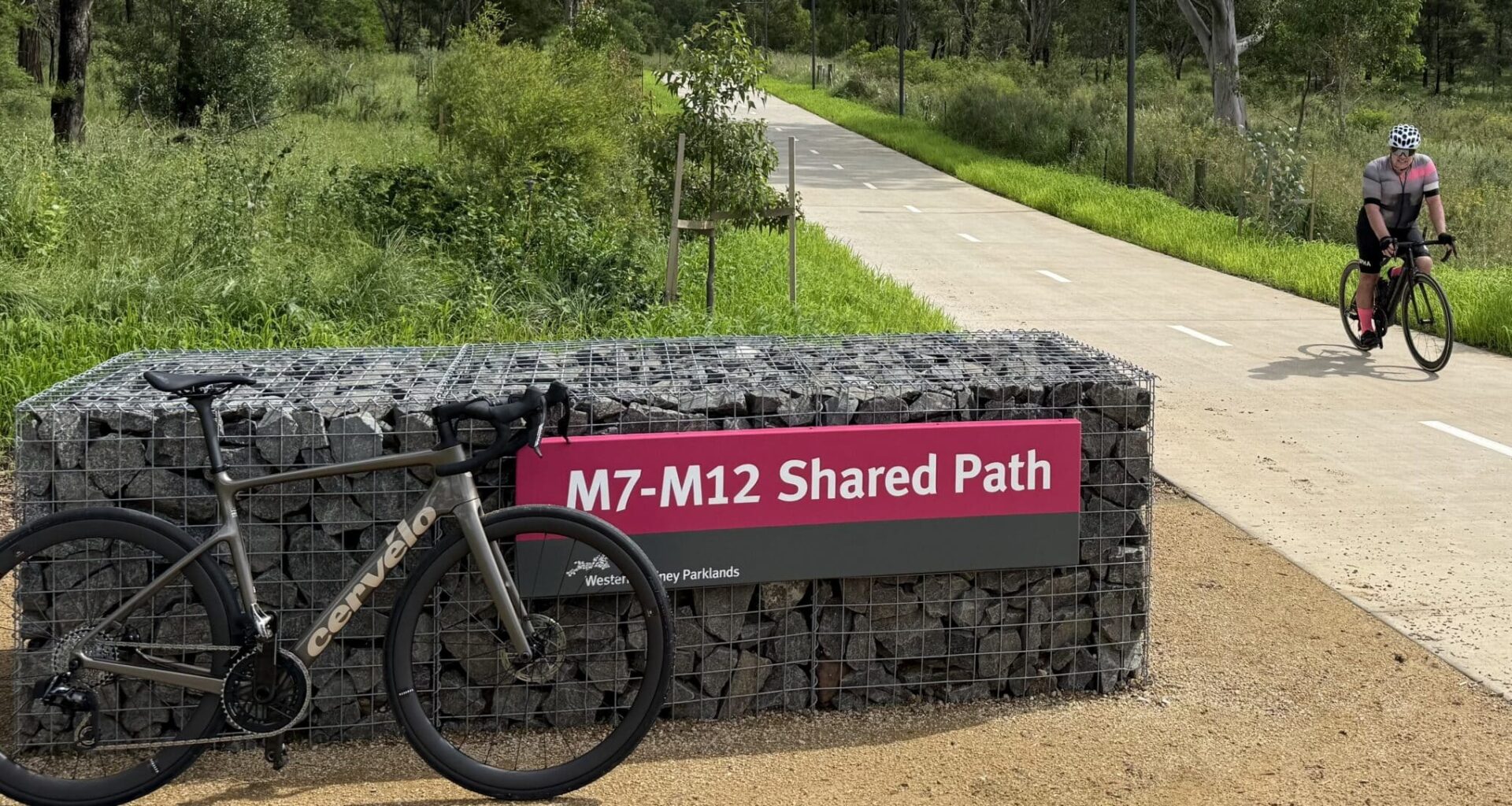
The M12 Motorway shared path — known as the Emu Track — has recently opened to riders, and is proving very popular among local and visiting riders. Bicycle Network rode the trail over the weekend. Here’s what we found.
There are bike paths, and then there are bike paths. The M12 Emu Track — the new cycling and walking corridor that peels off the M7 Bikeway and threads west through Dharug Country toward Western Sydney Airport — falls firmly in the latter category.
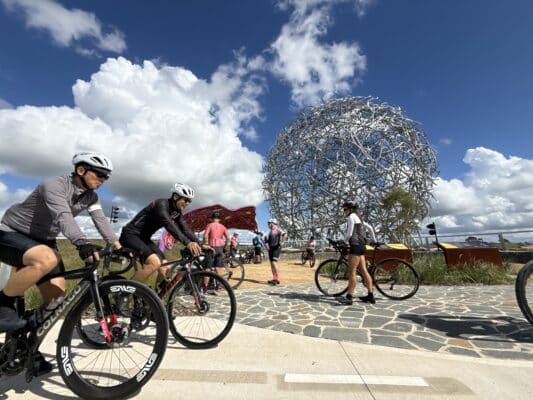
Officially opened on March 15, the path was already humming when I rolled out on Sunday morning for Ride On Magazine and Bicycle Network’s In the Loop newsletter. In the two to three hours I was on the track, I conservatively counted somewhere between 300 and 400 riders.
Bike riders of every description were out there — commuter bikes, old bangers pulled from the garage, and the latest top-end race-level team bikes rolling along. Young families, seasoned roadies, mountain bikers, and everyone in between. And happy faces all round.
A blank canvas, brilliantly used
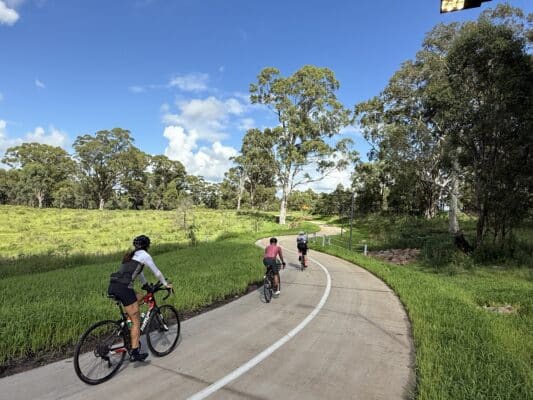
What makes the Emu Track so impressive is what it isn’t — it’s not a path retrofitted into existing urban infrastructure, threading between driveways and traffic signals. It’s greenfield construction on open parkland.
The path surface is safe, smooth, very well made and incredibly well planned. When developers start with a blank canvas, a rarity in most of our cities, seamless world-class cycleway projects become possible and that’s exactly what’s happened here. Combine the new M12 with the old favourite, the M7, and you’re looking at more than 50 kilometres of pure uninterrupted cycleways – a 100+km out and back without crossing a single road or putting a foot down.
Notes for early riders
Sydney copped torrential rain last week, and the path did flood. Debris washed across the surface in places, and I spotted a number of riders dealing with punctures. In some sections, the soil on the path’s edge sits at almost the same level as the cycleway surface, meaning any heavy rain brings grit and debris straight onto surface.
This may settle over time, or it may require attention from contractors or maintenance crews. Either way, we’d recommend double-checking you’ve packed a spare tube or puncture repair kit.
Shade is another consideration. There are plenty of rest stops along the route, but the shade structures I encountered seemed strangely positioned and unusually angled. The shade cover at the ‘Emu in the Sky’, for example, is on the southern side of the rest area while the harsh mid-day and afternoon sun comes from the north and northwest.
Riding through time
One of the unexpected highlights of the Emu Track is the quality of its interpretive signage. The path passes through Country with thousands of years of story, and the installations along the way do genuine justice to that history.
The signage covers Dharug Country’s six seasons — a living ecological calendar quite distinct from the European four-season model. Each season is defined not by temperature or calendar date, but by the movements of animals and the behaviour of plants:
Gurbany Buraga (February–March): fog descends, golden orb spiders appear in abundance, yam plants flower, and emu begin to breed.
Maryung Burrawa (April–May): the Great Emu constellation appears in the night sky — a signal that emus are nesting and should not be hunted.
Wadanguli Dumarang (June–July): wattle blooms, eels and mullet move upstream, black swans hatch, and it is Guwiyang — fire time.
Gudugulung Ngurrawa (August–September): turtles move through Country, days lengthen, wombats raise their young, and brolgas dance.
Wirriga Ngurrawa (October–November): goannas emerge from termite mounds, black snakes move, birds hatch.
Manga Manga Ngurrawa (December–January): lightning and rain, heat, and a time when kangaroos must not be hunted.
The six seasons’ knowledge and planting along the M12 was informed by Leanne Watson (Dharug knowledge holder) and Frances Bodkin (botanist and D’harawal Elder).
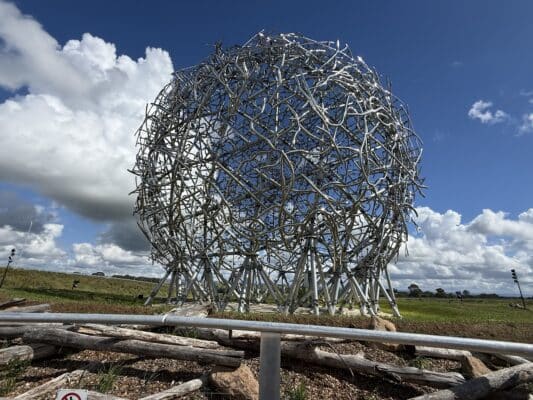
Then there’s the path’s most prominent installation: The Great Emu in the Sky.
In Aboriginal astronomy, the Great Emu constellation isn’t formed from stars — it’s formed from the dark spaces between them, stretching across the Milky Way. The sculpture is constructed from stainless-steel branches representing eleven unique landscape forms — ridgelines, silcrete, sightlines and waterways — that mark significant features of Dharug Country. It features an array of internal lighting and speakers that play a variety of bird calls.
Anthrax vaccines and turkey nests
The path also passes through the site of the McGarvie Smith Institute and what was the University of Sydney’s first veterinary farm, operating from 1937 to 1955. It was named after bacteriologist John McGarvie Smith, who developed a single-dose anthrax vaccine for sheep and cattle in the 1890s — a breakthrough that played a critical role in the development of Australia’s live export industry. On his deathbed, he gifted the vaccine to the NSW Government, which passed it to the CSIRO to produce.
Then there are the fascinating Turkey Nests, but we can’t spoil all of the trail’s secrets in this preview.
On one ride you move from 60,000 years of Indigenous knowledge, through 1890s veterinary science, through mid-century farming history, to a glimpse of a brand new international airport still under construction on the horizon. It’s a genuinely fascinating and rewarding journey.
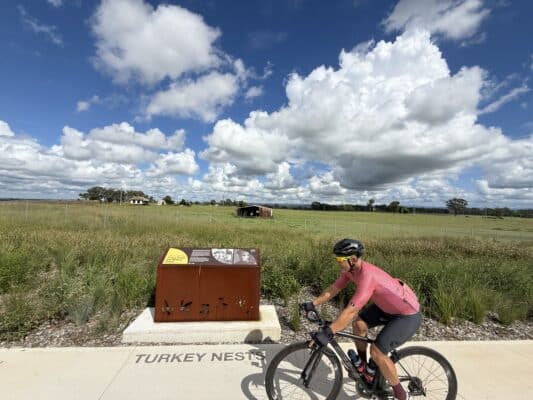
Green shoots
The Emu Track is a credit to the NSW Government. It joins a run of impressive new infrastructure that’s been coming online across Sydney in recent years. It also signals planners and developers are finally starting to see the light and take cycling infrastructure seriously.
M12 101
Route: M12 Emu Track with access via the M7 Cycleway at Horsley Park.
Country: Dharug Country.
Distance: Combined M7 + M12 gives a 50 + km one-way / 100 + km out-and-back corridor.
Surface: Sealed shared path, high quality, but take care around surface debris.