


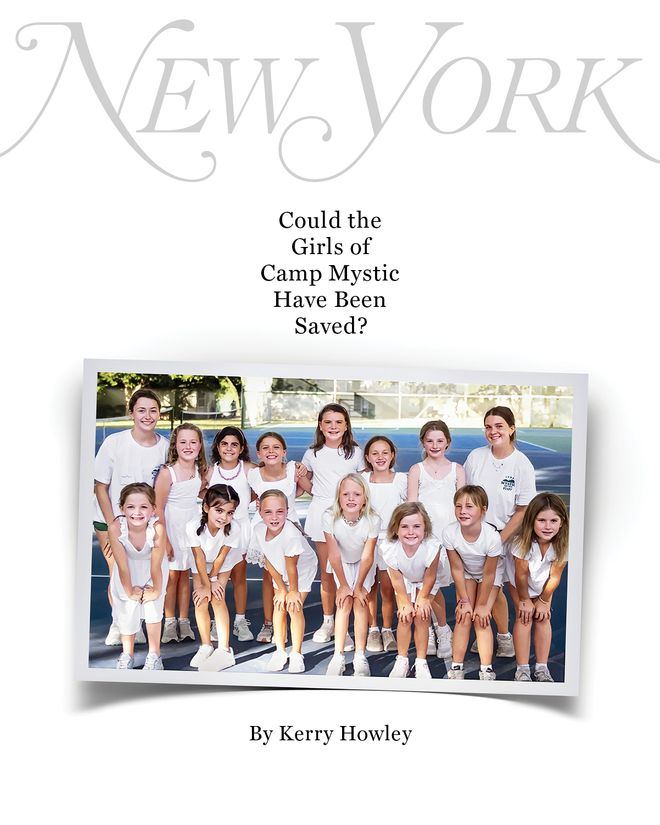
A group of Bubble Inn campers and counselors days before the flood. Front row (from left): Lila Bonner and Janie Hunt. Back: Linnie McCown, Abby Pohl, Katherine Ferruzzo, Chloe Childress, Eloise Peck, and Sarah Marsh.
Photo: Courtesy of the subjects
The women sound like men who have been to war: They can only try to tell you. “It was a place,” says a former camper, “I have been doing my best to re-create in my life wherever I have lived.” And another: “The closest I have felt to God.” “You know,” another alum tells me, “the poignancy of, I, I can’t be a child again. I can’t be innocent like that again. I can’t have my whole life ahead of me again.”
When rain hits New York, Alexa Fleet is transported back to her cabin, Bubble Inn. She had never heard such storms as those, “as if the Earth were releasing everything it had.” They were “terrifying, so loud, so hard, so intense. It imprints on you. I yearn for a storm like that. It felt cleansing.” Those summers, six of them, were raw with “everything a girl feels so deeply at 13.” As a second-grader, she would begin building out a calendar toward summer, x-ing out every day from January until June that she had to wait until camp, when finally the world would not revolve around the needs and achievements of boys. “You’re quiet and smile 11 months of the year,” she said, “but there you were safe — the gates were closed — it was just you and the girls. Your personality could de-thaw.”
Could the Girls of Camp Mystic Been Saved?
Alexa, 31, now volunteers at a camp for girls who have lost a parent or sibling. Claudia Sullivan, 75, moved to the Texas Hill Country because of camp, became a teacher because of camp, wrote three evocative, intelligent books about camp. These are clear and plausible connections, though among the skills gained at Camp Mystic is the ability to connect any life achievement to these annual four-week sessions. A lobbyist was better able to take her political opponents in stride because Mystic had taught her to see her work as part of a “tribe game.” A woman could better endure the deaths of her father, mother, and two siblings because she was prepared for disappointment after “not making war-canoe stern as tribe captain.”
There are more than a dozen camps within 20 miles of one another in Hill Country, many of them on the banks of the Guadalupe River. You’re a La Junta family or a Heart O’ the Hills family, or maybe you just aspire to be. Mystic wasn’t the camp of private planes and air-conditioned cabins; that was Waldemar. It wasn’t the most rustic; that was Longhorn. It was, the owner of a competing camp told me, a place associated with Christian innocence, a certain idea of wholesome girlhood.
They remember lying in bed, the sound of oscillating fans, the scratch of an armadillo outside the cabin. The scent of rain on dry land. They remember the smell of bathing suits drying on a clothesline and the way their washed clothes were so starched they’d have to peel them apart. They remember the night sky arcing over them. They existed outside the reach of television; the night that men walked on the moon, Claudia lay on a verdant hill, stared up at the stars, and imagined.
They remember and so they go back, again and again. Reunions are withheld until former campers turn 35; middle-age women reconvene in cabins, lower themselves into the river, talk of divorces and wayward children and breast cancer.
The gates were closed. Time stopped. A spell was cast. They remember the water of the Guadalupe. It was motionless in early morning, recalls Claudia, “like glass.” “Look at the river,” she told a group of girls in 1970-something. By that time, she was a counselor. “It’s still asleep.” She was the camp’s theater director, and she was putting on a play; the play was, as it happens, Peter Pan. Around 9:30, the river would wake up, ripple in the wind, and at certain moments, a sweet floral scent swept toward the camp; it reminded Claudia of a perfume old ladies of the time wore, Jungle Gardenia.
The girls were out on the lawn under the shade of the cypress trees that marked the boundary between Mystic and the outside world. “Come smell it,” Claudia told the little girls.
“What is it?” Someone asked.
“It’s the gardenia fairy.”
“Claudia,” a girl asked. “What does it mean?”
“It means,” she said, “that something wonderful is about to happen.”
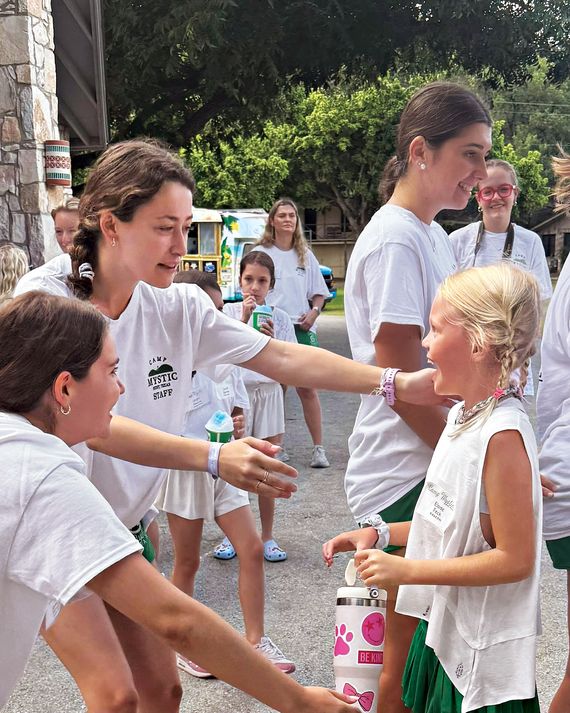
Katherine Ferruzzo, Chloe Childress, and Eloise Peck.
Photo: Courtesy of the subjects

Ellen and Gwynne Getten.
Photo: Courtesy of the subjects
Nine months ago, on the Fourth of July, Jennie and Doug Getten slept late in their spacious home in Houston. Jennie had been with girlfriends, and Doug, a partner at a major Texas law firm, had been at a work dinner. When Doug woke he realized he had missed a voice-mail from Mystic, where their girls, Ellen, 9, and Gwynne, 11, had been since earlier that week. “Hi, Doug. This is Paige, the Austin rep at Camp Mystic. If you wouldn’t mind just calling our office or calling me back whenever you get a chance,” she said, and gave the number, “just as soon as you can.”
The voice-mail was from 10:07 in the morning, the tone calm, distantly professional, the level of urgency you might expect if your child had had an issue at school. Whenever you get a chance. Jennie sat on the stairs, not particularly concerned, though as she had said good-bye to Ellen she had worried terribly about sending her youngest daughter away for four weeks. As Mystic’s bus was about to leave, Jennie had forced her way on to hug Ellen one last time, to the annoyance of the woman in charge. “Mom!” Ellen had said. “What are you doing? I’m fine.” Earlier in the summer, Jennie had called one of the camp’s directors and spoken to her at length about Ellen’s tree-nut allergy. Ellen was an ebullient, strong, freckled 9-year-old who loved to eat; on a trip to Italy, she had become obsessed with the idea of finding the best Bolognese. She often had pasta sauce on her clothes.
Jennie called Paige from Austin, who was, according to the Gettens, a parent volunteer rather than a member of Mystic’s staff. “I just wanted to let you know,” Jennie recalls being told, “that Ellen is unaccounted for.” Paige from Austin had no further information.
Jennie and Doug weren’t sure what to do with the words unaccounted for. It sounded to them just like chaos at a camp of some 550 girls, a kind of extended administrative issue. Should they wait until the girls were located?
Jennie texted Mary Liz Eastland, one of the camp’s directors. “Has Ellen been found?” she asked. “No, have not found her yet. We’re missing all the Bubble Inn,” Mary Liz wrote back, referring to Ellen’s cabin. “Where did they go????” asked Jennie. “They were evacuating with Dick and water came up very fast,” said Mary Liz. Dick Eastland, Mary Liz’s father-in-law and the camp’s owner, was also missing.
“I didn’t even know it was raining,” the father of a camper would later say. It was humid but stagnant in Houston, as if the mist could not gather itself for a proper downpour. Jennie and Doug took off in their bigger car because they’d be returning with two girls and their two capacious trunks full of clothes. They drove through River Oaks, their neighborhood, Houston’s most desirable — manicured hedges, boxed gas flames, mature trees over grass clean of fallen leaves — 300 miles west, toward the rolling plains of Hill Country. On the four-hour drive, they were fielding calls from friends and fellow parents. Twenty-seven girls were missing, which was, in its way, comforting: The camp could not truly have lost 27 girls. Jennie did not begin to panic until she picked up the phone and heard someone from her church. It was their minister. “I want to pray with you,” he said. Why? thought Doug.
The Gettens did not know their River Oaks neighbors, Wendie and Matthew Childress, but Chloe Childress had been to camp for ten summers straight and was, at 18, one of two counselors charged with overseeing Ellen’s cohort in Bubble Inn. By the time the Gettens woke up the Childresses were already on their way, having abandoned plans for a Fourth of July at their club. Matthew had resisted driving to Mystic — surely this was all over nothing, surely they didn’t want to spend all day in the car — but Wendie, concerned by texts from other moms, had pressed. Chloe was comically capable, highly social. Matthew called her his “machine.”
The parents were told to gather at Ingram Elementary, a school 13 miles and a 20-minute drive from the camp. The Childresses arrived a little after 1 p.m., among the first parents to show. There were tables and laptops to log parents in when they arrived and water and clothes and blankets. Matthew began to feel very nervous, though he still knew basically nothing about the scope of the flood that had enveloped the town he was not in. He did not want to wait by a pile of blankets in another town for his missing daughter; he wanted to speed toward the river and start moving trees. But others had tried and gotten nowhere. The roads were blocked, impassable.
More families spooled into the school’s gymnasium. Matthew knew about a quarter of them, including his brother and sister-in-law, there to collect their daughter. Matthew paced. He walked into the AC, then out into the 100-degree heat, in and out, did loops in the parking lot, past the playground, past the yellow buses, all of it under the shadows of passing helicopters. People hugged him awkwardly, and he could tell they knew he was marked in some way; parents were talking about which girls were unaccounted for. It was a strangely social place to live through the worst day of your life.
By afternoon hundreds of parents had arrived to reunite with girls who would be helicoptered from the camp and bused into the school parking lot. Around 3 p.m. a city employee got on the loudspeaker. “Okay,” she said, “we’ve got these first five girls coming.” Matthew went back inside and was hit with a blast of AC; maybe they would say Chloe’s name, maybe she had been found after all. When the last of the five names was called, terror shot through his body. “Holy fuck,” he said and grabbed his sister-in-law’s arm. “I might never see my daughter again.” He started to weep.
This was now his cycle. He would be normal seeming, chatty, for 30 minutes, surrounded by people he knew with whom he could converse, at which point he would break down, sob, grab someone.
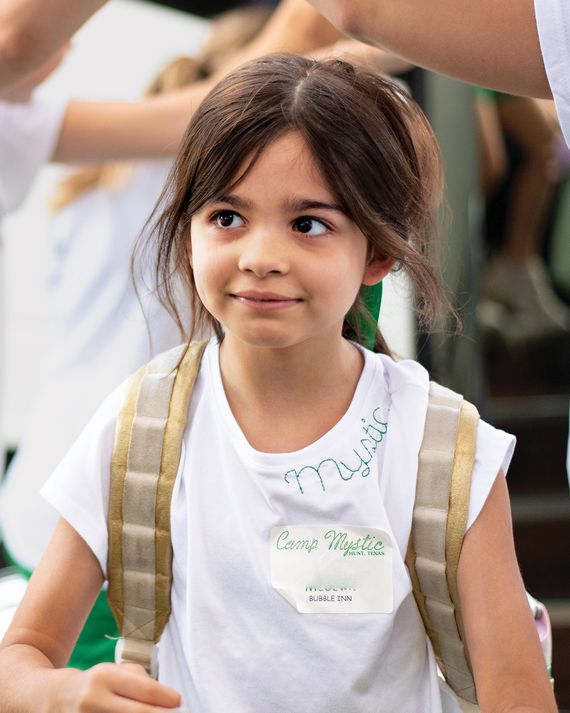
Linnie McCown.
Photo: Courtesy of the subjects
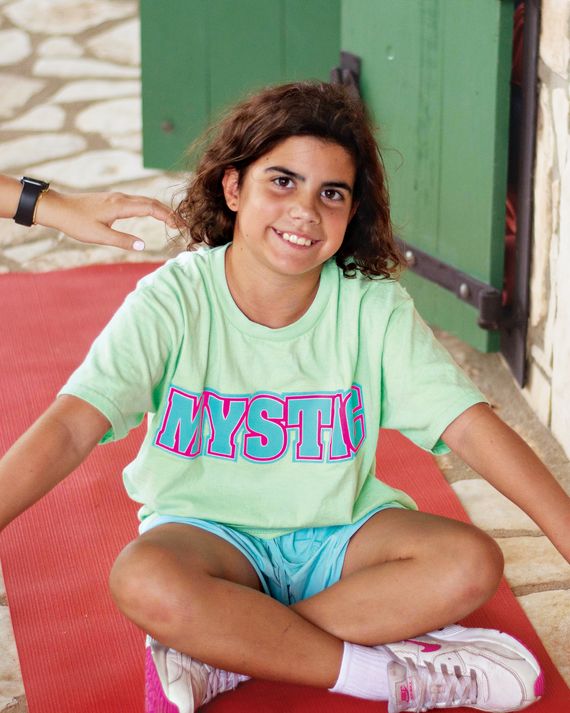
Lila Bonner.
Photo: Courtesy of the subjects

Cile Steward.
Photo: Court Exhibit, Will and CiCi Steward v. Camp Mystic, via Travis County District Court
“Thank you, Jesus, for saving my girl!” a grandmother cried as she hugged a child. What about my girl? thought Michael McCown, the father of a missing 8-year-old named Linnie. Some of the parents of the missing asked to be put in a separate room so they would not have to watch barefoot children reunite with their weeping parents, but Matthew Childress would not set foot in this separate room; it felt like giving in to something he was fully committed to resisting. No one had told Jennie Getten affirmatively that her older daughter was safe. When she finally appeared, Gwynne was wearing someone else’s T-shirt and her sleeping mask on her head. Her legs and Crocs were muddy. They could hear other mothers crying. Gwynne clutched her mother and let out a guttural wail. “I don’t know where Ellen is,” she cried. “I don’t want to be an only child.”
Some of the parents were powerful people, but this was and would remain for many months a situation where the normal levers of power ceased to function. As Doug Getten was driving to Mystic, he reached out to Senator Ted Cruz, who was on vacation in Greece. Cruz called back within the hour and said he was about to discuss the flood with the president. Doug would also be in contact with Lieutenant Governor Dan Patrick and Representative Wesley Hunt. He was assured that there were resources ready to help. There were helicopters standing by.
A city employee pulled aside some parents. They broke into sobs and were walked out of the room. Matthew wanted to pull off his skin.
He called her Chloe Madeline, ChloChlo, Chlomax, which became Max, which became Maximus. She was both a rule follower and a chaos agent. She was a proud dork, a slinger of factoids. “Studies show!” she would say, sticking a pointer finger in the air, ready to lay down some instruction. She was given to jump into a split; “Film this,” she’d say to someone the moment beforehand. She’d convince everyone to go out for karaoke and then hog the mic. She’d convince everyone to play a drinking game, cheat at shotgunning drinks, then claim she had won. She was a chronic joiner — tennis, cross-country, cheer, Honor Council — and a prolific winner of awards at school. In fourth grade she won an award for “well rounded” students who showed “leadership”; she was delighted to win and admitted later that she had assiduously planned her win, getting perfect grades, being seen helping others, jumping up to help the teacher with any minor task. She was a 17-year-old with a LinkedIn page. She was Matthew’s running partner and concert date. She suffered from anxiety she had inherited from him. Was it his OCD that had driven him to the habit of kissing her face 17 times? This started when she was a newborn, on one of those endless days when she woke up so early and the hours between naps seemed interminable. She did not want to be kissed 17 times as she grew older, so Matthew merely said “Seventeen!” as she went off to bed. She shouted it back: “Seventeen!”
In retrospect, parents of the unaccounted for would notice that none of the Eastlands was present at Ingram. Dick and his wife, Tweety, had for 40 years run the camp, had raised their family on the camp, and now lived alongside their three boys, three daughters-in-law, and numerous grandchildren on the camp. Mary Liz, whom Jennie Getten had initially texted, was a daughter-in-law, someone who had started off as just another camper and ascended through marriage to the level of Eastland.
Twice, Jennie had to be put in an ambulance; she was having panic attacks. There was a rumor that the girls had been found on an island with Dick. There was a picture of this island with the grainy faces of unidentifiable girls. Matthew called a friend and asked her to open the picture on her laptop and zoom in; he couldn’t make out anything on his phone.
“Just tell us where you think they are,” Jennie texted Mary Liz. “They’ll send the helicopters to find the island and these girls. Just tell us where you think they are.” Mary Liz did not respond.
Late that night, the parents were taken even farther away, to Kerrville’s Trinity Baptist Church, a full 30-minute drive from the camp, and told to wait in a gathering space that resembled an airport lounge. It was freezing inside and 100 degrees outside. Parents curled up on the floor, laid themselves on couches, found a pew.
It had been through Matthew, not Wendie, that Mystic and the Eastlands came into the Childresses’ lives. Matthew’s mother and sisters had gone; he’d been visiting the place since he was a child, and he had expected his grandchildren would go there as well, though unlike most of the other parents who send their children to Mystic, Matthew does not identify as religious. He identifies as logical. His brain, he told me, “is like a filing cabinet.” He was three weeks into a new job as the chief operating officer of a law firm; Wendie is a corporate litigator. Most of Chloe’s friends’ mothers did not work, but Chloe had grown up in a household where the parents split parenting duties equally, and Matthew felt that had been healthy.
That night Matthew closed his eyes and opened them and it was 5:30 a.m. He began to sob, which made his wife sob; he curled up next to her. The mother of Bubble Inn’s other counselor, Katherine Ferruzzo, came over to them, lay next to them, and hugged them. The distance he had traveled in 24 hours, when he’d gotten up for a day of drinks at the club, was unfathomable.
It would be okay, he thought, as long as his phone did not ring. If his phone rang, it would all be over. The word no one wanted to hear was Grimes, the name of the funeral home where the bodies were being taken to be identified. Matthew did not want more platitudes. He wanted information. He wanted numbers. He called his most logical, straightforward friend and talked for an hour. He took a shower. He imagined Chloe on a limestone bluff reassuring younger campers. Perhaps she was alive in a tree. Perhaps she was unconscious but breathing. By this time, no one believed in the island anymore. Everyone knew Dick Eastland was dead.
“Have you heard any updates?” Jennie texted Mary Liz. “No, I have not.” “Well, can you please ask the sheriff’s office to please update us?” “You’re getting all the information at the church.” “We’re not getting any information at the church,” Jennie said. “We have no information.”
A picture was circulating of girls walking to the safety of the two-story rec hall through the rain. The picture was a comfort to Caitlin Bonner, who was waiting at home for news of her 9-year-old, Lila. Caitlin had gone to Camp Mystic for ten years. She had been a counselor at Bubble Inn, where her daughter was staying this term. She knew where those girls were walking; they were walking right near Bubble Inn. Surely, Lila was therefore alive. Lila loved the color purple, all animals, and hugs. She had been voted “Best Manners” by her cabinmates.
Every so often, someone would start wailing and then the quiet would resume. At 10 a.m., there was to be a press conference. Someone wheeled a TV out to where the parents were waiting. Onscreen, a man in a giant white cowboy hat, the sheriff, read off another screen, his phone. He spoke uncertainly, mispronouncing words and jamming one sentence into another like a child forced to read aloud at school. “Tragic incidents like this affect us all,” he said. “Appreciate y’all.” He assured them there would be other press conferences later.
Michael McCown woke up at a friend’s house on July 5 and could not bring himself to go to the church as he had been told. He’d already spent a day waiting at the school. He’d already been called to Grimes, where he stared down at a little girl who was not Linnie and thought, What now? Instead of going to the Baptist church, he drove to Walmart. He bought a five-gallon bucket, a rope, towels, rain boots, and a machete. There was one road into Hunt, and it had been largely cleared by Saturday morning. It all looked to him “like a war zone, like Ukraine,” but he did not allow himself to think about what that might mean for his daughter. Cypress trees lay on their sides, whole root systems exposed. He saw trucks folded around tree trunks. He drove past the shattered remains of the beloved Hunt Store, where campers often grabbed a burger on their way to Mystic, past what had been the post office that processed mostly camper mail from Hunt to home, past a distance marker that read UVALDE: 88. The road hugged the river and beyond the river rose a wall of limestone. When he reached the camp two game wardens stood in his way. He told them his 8-year-old was in there and he was going in. “Be careful,” they said.
Linnie had taken a bus from Austin to camp; Michael had never seen the place, the tightly clustered stone-and-wood huts in which campers slept, the vaulted log-cabin structure where they dined, the once-green, now brown expanse from which rose limestone bluffs. Among the fallen trees was a smattering of stuffed animals and brightly colored clothes, neon pink and green, as if they had been dropped from above, each item carefully labeled with a child’s name. He knew the name of his daughter’s cabin, Bubble Inn, and asked a couple in a car — he thought they were caretakers — where that was. Inside, he found Linnie’s shark watch and her capybara stuffie.
He was in shock, running on adrenaline. Michael left behind everything he had bought at Walmart and walked downriver in a kind of fugue, over trees and boulders in a light rain. I’m just going to walk this river until I find something, he thought, one step at a time, one boulder at a time. The river smelled of dead fish. At the edge of the property he came across Dick Eastland’s black Chevy Tahoe, crumpled, the windshield punched in, wet tree debris on the roof and bumper. Michael kept walking. Linnie was an uncommonly beautiful brown-haired little girl who loved to dance, who taped pictures she’d drawn all about the house, who had dyslexia and, once, in the presence of another girl struggling to read, put her hand on the girl’s back and said, “It’s okay, we’ll read it together.” Michael had thought there would be snakes, but there were no snakes. There were no mosquitoes. Ahead of him was an overturned cypress tree, and in the bit of space between the root system and the trunk he saw something, a pair of legs. It was a little girl, nude, face down. He walked around the body. It was not Linnie. He flagged down some emergency responders, helped them free the body from the tree, and headed back toward Linnie’s cabin. He felt there wasn’t much more he could do. He got in his truck and drove the 30 minutes to join the others at the church, where he would be the only one among them to know how bad things really were.
Jennie Getten still believed, firmly, that Ellen was alive. She had just won second place in a swimming competition; she was strong. At 3 p.m. they wheeled the TV out again. Matthew Childress wanted to know precisely what the first responders had seen as they scanned the river. The parents held hands.
“What I have observed in this community over the past 24 hours,” said Governor Greg Abbott brightly, “is what I call quintessential Texas.” He went on about quintessential Texas — unity, gratitude. “We know that President Trump, he loves Texas, for one. He’s deeply concerned,” said Abbott. “I want to express my thanks to President Trump for his entire administration … He always tells me about his love for the people of the State of Texas.”
Matthew felt sick. Kristi Noem was there too, talking to an audience that included parents waiting for news, any news, of their little girls. “President Trump is absolutely heartbroken,” Noem said, “and the loss of life is absolutely devastating to him and Melania.” She continued to talk about the president, who was not there, and his concern. “Your city manager has done an extraordinary job,” said Representative Chip Roy. “Your sheriff has done an extraordinary job.” He couldn’t “say enough” about Abbott and Noem. It went on like this for 33 minutes, at the end of which Matthew knew nothing he had not known before.
Matthew sat on the floor slamming back bottles of water. Parents were angry; why were they being stonewalled? There was another press conference that evening, this one with local officials. Afterward the officials came to the church to speak to the parents. They told them what their schedule would be like the next day, where and how they would continue to wait. As an official was speaking, the aunt of a missing 8-year-old interrupted. “At least tell us how many people you have found alive,” she said. “You’ve not told us even that.”
After a brief silence, the Kerrville city manager took the microphone. “Zero,” he said. “We have not found anyone alive.”
Matthew went to the bathroom, and when he came back, the Eastlands had appeared: Tweety, Mary Liz, and Edward. Mothers hugged Tweety and murmured condolences for Dick. Edward sat down next to Wendie; Mary Liz was sitting at her knees. If Matthew had known then what he came to know later, he would have asked them to leave.
The Eastlands stayed for less than half an hour, and shortly after that Matthew felt his phone buzz in his pocket. He held it up to show Wendie and the other parents that someone from Kerrville was calling and picked it up. He heard the word Grimes. The moments after that are lost to memory. He dropped the phone and collapsed. A little later his brother drove him a mile and a half to a worn-down two-story white brick building called Grimes Funeral Chapels. He was taken to a back house to view the body. “Close that gate!” someone said, and through an open gate, before anyone could close it, Matthew saw many body bags.
Chloe was blue and cold, and at first he did not recognize her, so transformed was she by her submersion in the Guadalupe. She smelled of brackish water. He did not know this yet, but her body had traveled over two miles downriver, where it was found on the riverbank behind a club called Crider’s. Her face was bruised. It had not, he concluded, been a peaceful death. He walked out of the room and sat in a chair and cried. Some security guys came to help him up, and in the moment he assumed they were just being helpful, but later he realized they needed him to move on; they had to “keep this flow going,” given how many bodies were stacked up. He was letting them lead him out when he thought of something, shook them off, and walked back into the room. He opened the door, kissed her bruised face 17 times, and left.
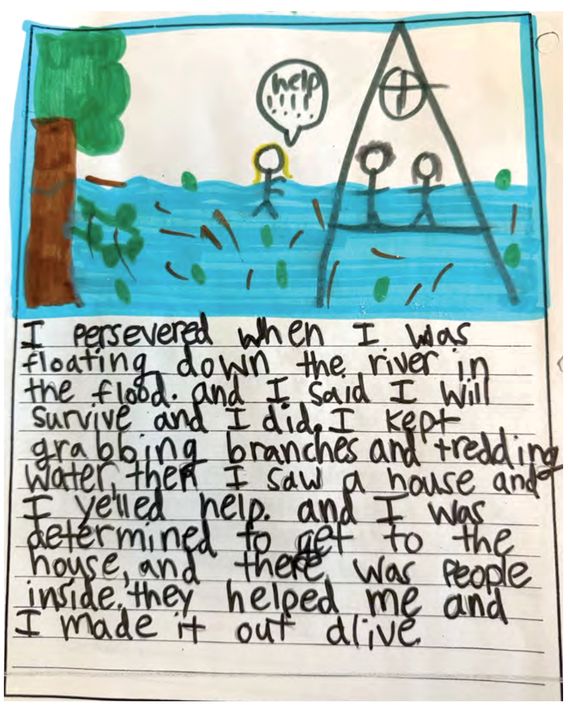
A Twins-cabin camper’s remembrance of the flood.
Photo: Court Exhibit, Will and CiCi Steward v. Camp Mystic, via Travis County District Court
It had been the deadliest American flash flood in 50 years, with 137 killed across RV parks and riverside hotels, campgrounds and vacation rentals. Water rose in some places more than 20 feet in 45 minutes. Other camps were submerged, other cabins ripped from their foundations, but no other camp reported a single death. In one case an 8-year-old at summer camp survived the flood, while at a nearby RV park, her father, mother, and two brothers were washed away.
From the beginning camp alums had trouble disentangling their grief from their intense loyalty to Dick and Tweety Eastland. “NEVER have I EVER felt unsafe at Camp Mystic nor have any of us EVER seen the river rise to this extent,” wrote Mary Beth Weatherford in a widely shared Facebook post. The media, she said, was causing divisiveness. “Those cabins, Twins I and II and Bubble Inn are NOT CLOSE TO THE RIVER! … This was an unforeseen tragedy.”
Dick had loaded his truck full of girls and died alongside them; weren’t he and Tweety also therefore victims? “The most selfless man I think to ever live,” a counselor called him on Fox News, her voice breaking. Edward had been swept away with the girls of the Twins cabin but had survived by holding on to a tree. The water had come on so fast.
Dick’s family had owned the camp for more than 80 years, and Dick and Tweety had run it since 1987. “Rock stars,” Mimi Schwartz called them in a 2011 Texas Monthly article about various members of Dick’s family suing one another. “Texas’s most socially ambitious helicopter parents cultivate them, honor them, and praise them, partly because they are good company” and partly because of the waiting list; it was common to hear Mystic girls say they had been placed on the list when they were born. When you dropped off your girls at camp, Tweety would be there, dressed in green and white, and Dick in his khakis and white collared shirt. On your way out, Dick would shake your hand and look you in the eye and say, “Thank you for trusting me with your daughter.”
Tweety was small and thin and blonde and had been for decades wearing the same bright-red lipstick; she left it on your cheek when she kissed you, and she meant to. She wandered the camp surrounded by a pack of admiring little girls who would grow up to be part of her world, and when those girls became women who lost husbands or parents, she was known to materialize at their sides, ready with the right words delivered in her southern lilt. As a camper, you might take a cooking class with Tweety, but only when you ascended to counselor would she share the recipe for her famous cookies. “She taught you how to be a Texas lady,” one former camper told me. “She’d go to one cabin almost every night, and come and do devotionals with you, and teach you how to be a lady.” She wore red nail polish, and you could wear red nail polish too; Tweety’s red polish was for sale in the commissary. “They were gods,” a former camper told me, “untouchable. I was always in awe of their ability to play off that they knew who you were.” When they went out in Houston or Austin or Dallas, they were surrounded by a network they had created, the Mystic mafia. “You would come up to them and be like, Tweety! Oh my God, hi!”
Dick, 70, stout and balding, wore bifocals when he read a prayer at vespers. “Like a character out of the ’20s or ’30s” was how one Mystic mom put it. Dick rode around camp on his golf cart, and as he passed a girl, he’d stop to take her to the next activity. It wouldn’t matter if you were 20 feet from your destination; he’d wait for you to load your stuff and get in. Over time Dick taught thousands of girls to cast lines into the lake, paying special attention to girls who struggled. A mother told me Dick spent 30 minutes helping her friend’s child overcome her fear of touching a fish. “And he’d make the biggest deal if a girl caught one,” Dick’s son Britt told me when I visited the camp in February. (The Eastlands declined to make Tweety available or answer any questions directly pertaining to the Fourth of July.)
On the first day of camp each girl pulled a piece of paper from a hat and was assigned to one of two tribes, Tonkawa or Kiowa. The season would end with “war canoe,” in which girls donned war paint and Native American headdresses and raced in the Guadalupe. Sundays they dressed entirely in white and bookended the day with Scripture: devotionals in the morning, vespers in the evening. It was the camp’s greatest honor to be named a “James Eastland cup girl” at the end of a term and a lesser but substantial honor to be an “M girl.” Campers could not call home; they wrote letters. There was a history, and one competed to know it. “What is the elevation of Camp Mystic?” was a question the girls were asked in a trivia game in the days before the flood. 2,200 feet. What was the year of the great flood? 1932.
This last summer was Dick and Tweety’s 50th wedding anniversary. “The campers had all done skits where they had re-created their wedding,” the mother of a camper told me. “And Dick and Tweety both participated.” The mother spoke to Dick and Tweety for a while before she left with her daughter, a week before the flood. “And I just thought this was such a love story. And I left feeling all warm and gooey inside.”
One week after the flood, a 41-year-old -Mystic alum named Ashley Smith was interviewed on television in shorts and an AC/DC T-shirt. Smith had very nearly died in an Airbnb and had been transported to a church, she later told me, where she helped care for bewildered people who had been mangled by the force of rushing water. She toweled the hair of a young man with a deep, dirty gash in his leg and in the depths of the church found choir robes to cover people whose clothes had been ripped from their bodies. On television, she turned the subject to Mystic. “There’s no other place on earth I would want my little girl to be,” she said into the camera, “where she is loved so much they would die trying to save her.”
At camp the girls had written letters home and sent them on to the post office that no longer existed, which is to say the parents returned home to letters written by their deceased 8- and 9- and 10-year-old daughters. Doug and Jennie Getten could not bring themselves to open Ellen’s letters; they remain sealed. Eight-year-old Blakely McCrory knew her family was preparing for a move and clearing out the house, and she had concerns about her toys. “Dear Mommy,” she had written, and then, down the side of the letter:
P.S.
please don
t give my Bar
bie
dream
house
When Matthew Childress got home to Houston he opened Chloe’s door. “This door is never to be closed again,” he told his family. If it were closed, they might come to fear the room. It would be full of ghosts. They would never have the courage to walk into it.
Edward Eastland asked if he could play a song on his guitar at Chloe’s funeral and was slotted to do so until Matthew learned more about the timeline of events at Camp Mystic in the early hours of the Fourth of July. The first flash-flood warning had reached Dick at 1:14 a.m.: LIFE THREATENING CONDITIONS EXIST. MOVE IMMEDIATELY TO HIGHER GROUND. Around 2 a.m., a pair of counselors walked to the office and warned staff that their cabins were flooding; they were sent back to their cabins to shelter in place. Chloe had probably died around 4 a.m. “It’s like, Wait a minute,” Matthew told me the first time we talked. “There’s three hours. What the fuck is happening? ” He told a friend to tell Edward he would not be part of the ceremony, was not to sit with Chloe’s friends, and was not to “hold court.”
“I went to seven funerals in one week,” Jennie Getten told me later. They were navigating “a level of darkness I didn’t even know was possible,” said Blake Bonner, Lila’s father. Heaven’s 27 is what they called the dead, which led many people to make the mistake of thinking there were 27 sets of grieving parents when there were, in fact, 26; Lacy and John Lawrence had lost 8-year-old twins.
It became clear early on that not all the parents would move through their pain in the same way. There would be parents who could not get out of bed. There would be parents who turned to religion. Matthew’s grief was directed outward. He wanted information. He wanted to know. He learned that he had sent his daughter to a camp situated on a 100-mile stretch of land with thin, rocky soil and bedrock that did not absorb rising water; he learned that this stretch was called “flash-flood alley.” He learned that the camp itself was situated at the confluence of the Guadalupe River and Cypress Creek, making it particularly susceptible; he learned that cabins were washed away when it flooded in 1932 and that it had weathered major floods in 1978 and 1987, when ten children died evacuating from a neighboring camp. He learned that in 1984, because of flooding to which everyone had apparently become accustomed, Tweety was airlifted from the property so she could give birth to Edward, her fourth son; for years, Edward was called, as a result, “Chopper.” Matthew learned with a growing sense of horror that Camp Mystic had appealed to FEMA in 2013, 2019, and 2020 to reclassify 30 structures listed as lying in a floodplain. FEMA granted the appeals.
“Cabins were in the goddamn floodway,” Rob Young, a professor of coastal geology at Western Carolina University and the director of a program that studies flood patterns, told me. Young could not sleep for two nights after reading the news. “In the floodway, we expect velocity, a charging river. Someone should be in jail.” The notion that the flood was not predicted, he says, is “bullshit”: “It was predicted. It was absolutely predicted.” But expert opinion “collapses at the local level.”
Jennie and Doug waited eight days for someone to find Ellen. They never saw her body, and Jennie is not certain it was “whole.” The search-and-rescue team sent her a pink Croc on which Jennie had placed a name sticker to help Ellen keep track of her shoes. Most parents to whom I spoke, regardless of what question I might ask, would begin their story with the strangely casual call from Mystic and continue walking through the days until they’d found their child’s body; this span of time composed a nightmare that closed with the terrible relief of certainty.
A week after Matthew and Wendie left Kerrville, another counselor dropped off Chloe’s backpack at their doorstep. Wendie unzipped it, surrounded by a few friends. Inside were earbuds and sunglasses. They found a three-ring binder, a counselor manual. Wendie’s friend flipped through it. There was a page that read EMERGENCY INSTRUCTIONS and on it a single paragraph about rising water: “In case of flood,” counselors in Chloe’s part of camp must “stay in their cabins unless told otherwise by the office. All cabins are constructed on high, safe locations.”
As he reflected on these instructions, it seemed to Matthew that he had taught his daughter to follow the rules, she had done so, and it had killed her.
“The river is beautiful,” Dick had once said, in a line that would be quoted in many forthcoming lawsuits, “but you have to respect it.” He had advocated for a flood-warning project in the ’80s after the ten children died, but the system was no longer operational by 2000. “This is just a pure tragedy,” the mother of a camper who had been to Mystic earlier in the summer told the San Antonio Express. “Nobody is responsible for anything bad that happened here. This is just a freak event. Nobody is at fault.”
Tweety had rendered Mystic significantly more religious than it had been before her arrival, and it was to biblical language that she turned when she did reach out. “Dear Katie and Clark,” she texted Katie and Clarke Baker, parents of 8-year-old Mary Grace, “We are grieving with you. All I can say is trust in God’s sovereignty … he will not let you down. I love you.” Tweety sent the text to at least three other families; for each of these families, the text began “Dear Katie and Clark.”
The families formed a dad group text and a mom group text. One dad was in the mom group as well; this was Matthew, “just so I can hear and see what’s being discussed and keep myself educated,” and “to politely remind the moms that these texts are discoverable.” Some of the parents had in common a measure of privilege beyond what you might infer from the ability to pay $8,000 for four weeks of summer camp. The father who lost twins is a partner in the same law firm as Doug Getten; his wife is a partner in another major firm. Blake Bonner is a partner in a Dallas-based private-equity firm. Davin and Anne Lindsey Hunt, who lost their daughter Janie, are heirs to one of the largest oil fortunes in Texas.
“I woke up sad this morning,” Matthew might tell the dads. “When do you get sad?” They shared theories as to what had gone wrong. “It wasn’t until after my daughter’s funeral,” Blake told me, “that I realized I didn’t know a single thing about what happened that morning.” Why had Britt Eastland waited until 7:22 to call 911? Why had they believed for so long that 27 girls were “unaccounted for” when at least one of those girls was thought to be dead in her cabin by sunrise? Edward had likely watched girls wash away downriver. Why had he sat with parents at the Baptist church and allowed them to believe their daughters might still be alive?
To some families it was already beginning to seem as if the Eastlands had an unsettling ability to move on. A friend sent Michael McCown a picture of Tweety, smiling and dressed in white, at an event where she was handing out “M” awards to campers who had survived the flood and would otherwise have received them during the camp’s closing ceremonies. The event, Michael noticed, was held on the same day as his daughter’s funeral, which Tweety had attended. Only one of the Heaven’s 27 families was from Kerr County, and it was this family alone, closest to the Eastland’s orbit, that left the text group as it grew angrier.
In late July, Matthew was introduced to a lobbyist. He, the other parents, and sympathetic lawmakers quickly drew up SB1, a camp-safety bill that would require camps to keep cabins out of floodways, to have evacuation plans, and to provide walkie-talkies in the cabins. The legislation was law 18 days from the moment it had been introduced, which everyone figured was probably a record. The way this news was processed was interesting. In early September, the Today show’s Jenna Bush Hager, whose mother had once taught drama at Mystic, conducted an early interview with 12 grieving parents. The parents cried on-camera against a backdrop of their daughters’ pictures. Cile Steward had still not been found. “Every phone call, every text, your heart stops,” says her father, “because you hope it’s news that they’ve found your child.”
Halfway through the seven-minute segment, the background music rises an octave and the tempo picks up. “Last night, the bill was passed,” says Hager. “Our girls’ legacy,” Blake Bonner says, “is not that they died in vain.”
“It shows you that change is possible,” Hager tells her co-hosts, “even in a polarized country. Change is possible.”
“Yep,” says her co-host.
“Remarkable,” says Hager.
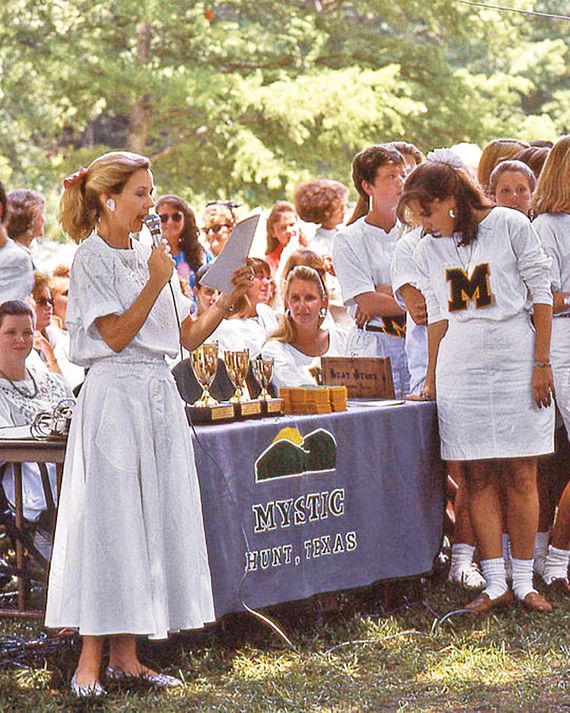
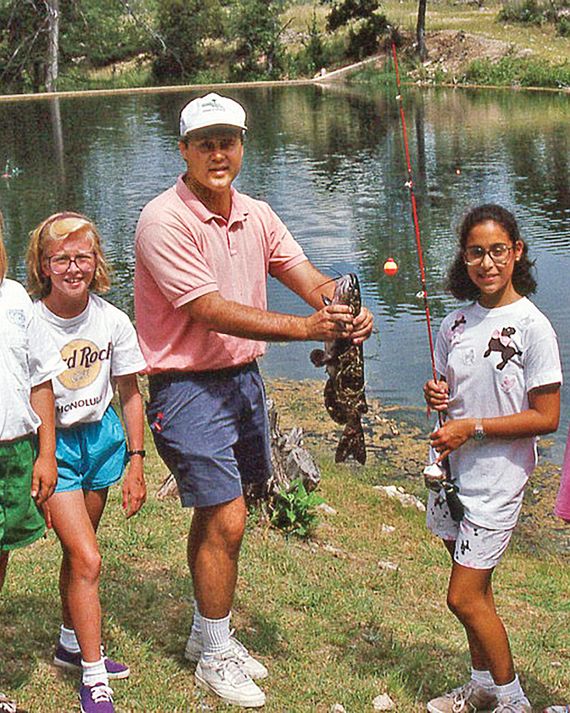
Dick and Tweety Eastland in 1991, soon after they took over as Mystic’s directors. Over the years, Dick was known for teaching thousands of campers how to fish while Tweety led many of the camp’s defining traditions. Photo: CampMystic.com Archives.
Dick and Tweety Eastland in 1991, soon after they took over as Mystic’s directors. Over the years, Dick was known for teaching thousands of campers ho… more
Dick and Tweety Eastland in 1991, soon after they took over as Mystic’s directors. Over the years, Dick was known for teaching thousands of campers how to fish while Tweety led many of the camp’s defining traditions. Photo: CampMystic.com Archives.
Camp had been dangerous and now it was safe. Hadn’t that been what the parents wanted? There was one lesson people were particularly primed to draw, and it was not about measured reflection on the past or the imprudence of building in a floodway. “The people there are quite resilient,” a Fox News host told a surviving counselor as he closed his interview. “Are you confident they will rebuild and make Kerrville better than ever?”
In the fall former campers started receiving photocopied handwritten pages in the mail signed “Tweety Eastland and Family.” “Our dear Mystic girls,” the letter read. “My family and I want to thank you for all your care, prayers and letters at this painful and sorrowful time for us and our beloved Camp Mystic. Continue to be strong and courageous. You are Mystic girls. The Lord is near. Where there is nothing, there is God. All shall be well. Camp is even more beautiful in heaven. Can you imagine the heavenly chorus of Dick and our precious Mystic sisters, singing songs together?” The letter went on to explain Tweety’s devotion to Saint Francis and to assert that Tweety and Dick had visited, twice, Assisi in Italy. In its invocation of their daughters (“precious Mystic sisters”) alongside the man they partially blamed for their deaths, the letter struck some parents as obscene. (“ ‘Camp is more beautiful in heaven’ … what?” was Matthew Childress’s response.)
Tweety’s missives seemed to emerge from an alternate reality in which they all grieved equally, stricken by tragedy for which they were all comparably blameless. This was increasingly not the lens through which the parents were looking, and it was certainly not where they were in September when the 26 families received an email with the subject line “A Message From Camp Mystic” from Tweety, her sons, and all of their wives.
“Of primary importance, we will be building a memorial at Camp Mystic dedicated to your precious daughters.” A paragraph down: “Camp Mystic Cypress Lake, which sustained no damage from floodwaters, will be opening in Summer 2026.” “The Lord,” she reminded them, “is close to the broken hearted.”
It had not occurred to the Bonners, the Gettens, the McCowns, or the Childresses that a Mystic camp session in 2026 would be open to debate. Blake Bonner had interpreted the email as an opening to a conversation, but two hours later the Eastlands had emailed the entire camp community with news that camp was indeed open for business. It was the Stewards who responded most forcefully. “You are preparing,” they wrote in response, “to invite children to swim in the very river that may still hold our daughter’s body.”
The families were thinking, in a new way, about the camp’s finances, which were private but involved numbers to which they had access. Parents paid around $8,000 for four weeks of camp; there were 550 campers on site during the flood, across two adjacent campuses: 375 at Guadalupe, which had flooded, and 175 a short walk uphill at Cypress Lake, which opened in 2020. A counselor like Chloe made less a salary than a kind of honorarium, around $1,000 for the same session. Polish workers brought over on work visas kept the dining hall running. It was easy to speculate, very conservatively, that the camp was making $10 million a summer. “When somebody says, ‘We’re a family-owned business,’ you think it’s kind of folksy,” Doug Getten told me as his three small dogs caused havoc around us and Jennie wiped tears from her eyes, “and not, like, the Ellisons acquiring Paramount.” There had been in 2011 the widely publicized Eastland lawsuit, in which Dick sued his brother over the complex way Mystic’s profits were shared among the family; the legal battle involved more than $6 million in fees, the brothers’ estrangement, and a profit-sharing arrangement that looked to some of the parents like an attempt to shield assets from future lawsuits.
Her daughter’s life, Malorie Lytal felt compelled to post on Facebook in December, “was meant for so much more than to teach Camp Mystic about common sense safety.” The feud between families and the camp was now fully public; the Stewards shared their response with the press, and the remaining families shared their intense opposition both to the opening and to a memorial on which they had not been consulted. It was at this point that the Mystic community closed ranks. Talking in public about the flood promised only backlash; you would offend either the families or the camp and its supporters, who appeared to constitute most Mystic alums. But one could, in conversations held beforehand, find the kind of reasoning at work in those who claimed to support both the parents and the camp. On a podcast called The Determined Society a Mystic mom named Aimee Key described driving her daughter home from camp. “If I had been in Bubble Inn, I would have drowned,” her daughter said. Her friends Lila Bonner and Eloise Peck had died. “Utterly gutting,” Aimee called it. “Knowing they were in a cabin that my littlest could have been in had anything been slightly different just brought both of us basically to our knees.” “It just really brings to light,” the host explained, “the fact that we don’t have any control. Like we, we don’t have control, and that’s a complete freak accident.” Camp Mystic is a “truly the most magical place,” Aimee said. It was important, she thought, to live “with faith and not fear.”
“What’s amazing about the situation,” the host pointed out, “is there was no wrongdoings. Not from the camp, not from the parents, not from the children. There’s literally nothing that anybody could have done to change the outcome, good or bad.”
Aimee’s attitude toward her daughters was this: “I’ve got to let you go back next summer … and trust that God hopefully is going to let you come home … And I’ve got to trust that, or else we just live locked in our little bubble wrap.”
The notion that fear was an inappropriate response to a flash flood that killed more than 130 people, that to respond by avoiding return to a camp where 27 girls had recently drowned would be to “live locked in bubble wrap,” appeared to be widespread amid former campers, as was the idea that one could “grieve with” the parents while maintaining one’s place on Mystic’s waiting list. “My heart is broken for them,” the father of three girls who had been at Mystic said of the parents of the dead, but also he would be sending his girls back; it was “different for each family.” The sky, proponents of the “no wrongdoings” theory would argue, dropped 100 billion gallons of water on Kerr County that day. That the camp regularly flooded did not strike the camp’s defenders as an argument for the families but for the lack of urgency with which the Eastlands had proceeded; floods were normal events, “fun,” multiple former campers told me, because you got to have breakfast in bed. Only two days prior to the beginning of the disastrous camp session, Mystic had passed with no issues an inspection by Texas’s Department of State Health Services. Many alums said that because the Cypress Lake campus was nominally distinct from the Guadalupe campus, it should be allowed to open. The ten campers who died in 1987 were in the process of evacuating by bus when they were swept away; evacuating carried its own risks.
A former camper who had survived the flood told me nothing and no one could have saved all the girls. “They say things like, ‘Oh, well, they should have had real adults in the cabins.’ I’m sorry, you could have had a Navy SEAL in that cabin and he would have not been able to save them all. I know how fast it rose. It wasn’t even raining at one o’clock in the morning, and by three o’clock, we were all fucked.” The risk of a flood was simply a risk with which one had to live. “Look,” she said, “we put our summer camps on the rivers because that’s where kids have fun. That’s where they canoe and they fish and they swim, and they do all of that, right? And there are risks everywhere. Everywhere. Everywhere we go, there’s unforeseen risks. And I don’t want to send my kid to camp in the middle of a city.”
In November, the Kerrville Area Chamber of Commerce handed Tweety an award to posthumously honor Dick, and in a December 2 email to parents, Tweety stated that girls returning to camp would be taking “a courageous step in their healing journey.” Mikal Watts, Mystic’s pro bono lawyer, argued that the Eastlands had saved 166 girls that night; he told Texas Monthly that “hundreds” of families have “literally begged them to reopen so that the ministry could continue.”
What comprised “the ministry” was an open question. Whatever the camp’s Christian priorities may be, economic and racial diversity do not appear to be among them. Mystic, camper turned doctoral student Alexa Fleet wrote in a complex Substack post about her experience, was a place where girlhood was valued and “white supremacy … was inherited gently,” a place the children of the wealthy gathered, strengthened the bonds of privilege, and sorted themselves into the University of Texas sororities they would one day join. When I asked parents about camp scholarships and other Christian-inflected attempts at charity, they mostly looked confused. “Ask if they go help build homes in Central America or water wells in Africa,” one of the fathers texted me. What is the ministry, he wondered, “besides making millions at a summer camp?” In February, while Britt Eastland and I were riding though Mystic on a UTV that someone had donated to the camp, I asked him to say more about the ministry. He said it was “all the activities that we offer.”
By August, Mystic was participating in a documentary, River of Angels (the producers “felt called” to make it), and the camp granted access to the parts of camp destroyed by the flood. The filmmaker, Shawn Welling, posted a video on Instagram of what many parents considered to be sacred space, the cabins where their children spent their last terrified moments. “We do not approve of this documentary,” Jennie Getten commented under the video, “and you are only adding to our suffering.” Welling appears to have deleted her comment and those of other mothers. The video remains up.
In early November, seven of the families filed three separate lawsuits against Camp Mystic, alleging negligence and detailing bizarre behavior by the Eastlands: “By repeatedly communicating to Plaintiffs that there was hope that their daughter was still alive even though Camp Mystic and the owners and directors knew dead bodies had been found,” the camp “caused Plaintiffs to experience severe distress. Defendants’ continuous lies and harassing and confusing statements to Plaintiffs and others were intentionally painful, hurtful, and humiliating.”
The Houston Chronicle asked readers whether the camp should open in 2026; they “overwhelmingly supported the camp’s reopening.” (“There is no family I trust more than the Eastlands,” wrote one parent.) When I visited the Childresses and Gettens in River Oaks in February, Doug Getten had recently told someone he wasn’t sure their friendship could continue if he sent his child to Mystic under its current ownership. “There’s always something,” said Jennie. She’d just heard about a Mystic fundraiser. “We don’t really go out socially anymore. If we do, it’s to a Heaven’s 27 event.” Her daughter Gwynne heard at school that the camp would reopen and was “extremely distressed.” “There’s no way,” she said. “That can’t be.” As we were chatting, we found our way into the Gettens’ open kitchen. Ellen was everywhere. Here was the pink Croc rescue workers had fished from the lake. Here was a picture Gwynne had drawn of her. Jennie opened a junk drawer: a pack of homemade coupons for Mother’s Day. One coupon for a hug. One to walk the dog. Ellen’s door was closed and Jennie had not yet been in the room. Each object demanded a decision no one wanted to make. “This is her watch,” Jennie said into the junk drawer.
It seemed to Matthew Childress that the broader camp community was going through the stages of grief for the camp itself: denial, bargaining, perhaps leading at some unknown time to acceptance that the camp they had known was gone. “The idea that your daughters will return to the same Camp Mystic is a farce,” Caitlin Bonner told me, “and anyone incapable of accepting that is as delusional as the camp leadership.” The parents had forcefully opposed the planned reopening, but the question of the proper way forward for a family that had built cabins in a floodway and ordered girls to stay inside them during a fatal flood remained unclear. It was the final lawsuit, filed in February by CiCi and Will Steward, that made the cleanest ask. “A place where 27 children died because adults ignored warnings is not a camp,” reads the complaint. “It’s a crime scene. Camp Mystic was not safe for Cile. It will never be safe for any child as long as the Eastlands are associated with it. They can never be allowed to operate a camp again.”
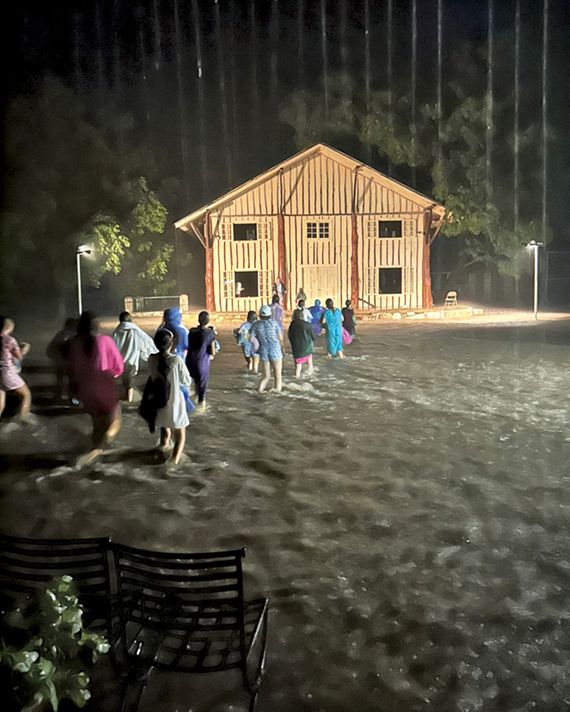
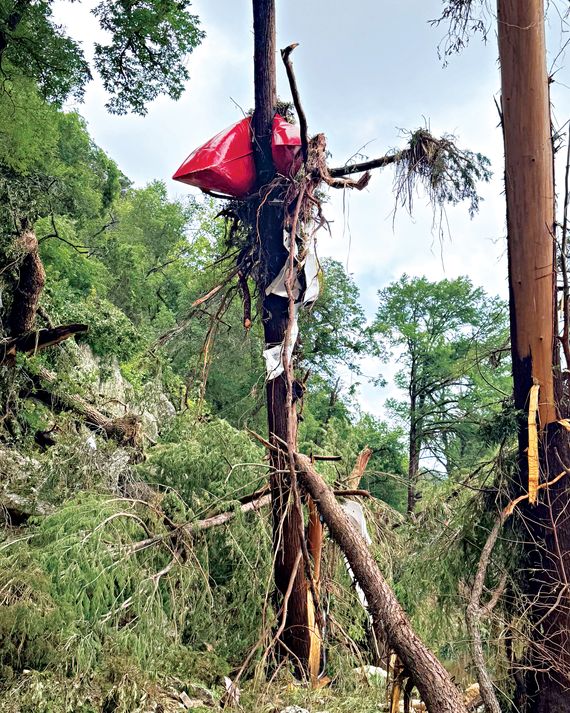
July 4, 2025, at 3:26 a.m.: Campers evacuate to the rec hall. July 5: While searching for his daughter, Michael McCown saw a canoe in a tree. Photo: Court exhibit, Cole and Allison Naylor, et al., v. Camp Mystic, via Travis County District Court (evacuation); Courtesy of Michael McCown (canoe).
July 4, 2025, at 3:26 a.m.: Campers evacuate to the rec hall. July 5: While searching for his daughter, Michael McCown saw a canoe in a tree. Photo: C… more
July 4, 2025, at 3:26 a.m.: Campers evacuate to the rec hall. July 5: While searching for his daughter, Michael McCown saw a canoe in a tree. Photo: Court exhibit, Cole and Allison Naylor, et al., v. Camp Mystic, via Travis County District Court (evacuation); Courtesy of Michael McCown (canoe).
In February, I drove through Hunt with Claudia Sullivan on smooth new road laid since July. The river was to our left, and though she had been living with this color-drained landscape for eight months, she was continually astonished by the clarity of the view. With the cypress and cedar trees washed away, all the foliage erased, you could see clear to the other side of the Guadalupe. Homes that had heretofore been hidden revealed themselves. “I don’t know where I am when I look at this,” said Claudia, who had spent most of her life here and written several books about Mystic. “I’m in another country.” We drove past the little that was left of the dance hall Crider’s, behind which Chloe’s body had been found, and, a few hundred yards from there, a tree-lined embankment where Linnie’s body had been found. A 63-year-old man named Jeff Ramsey and 8-year-old Cile Steward were still somewhere in the river beside us.
The SUV kept beeping. “It’s because I don’t wear my seat belt,” said Claudia. “I just don’t!” When she was younger, you piled into the back of a pickup. You didn’t wear a helmet on a bike. The kids at Mystic were perfectly safe, Claudia reminded me, for 100 years. No one had fallen off a horse. No one had wandered off into the woods. “We had a big jar of peanut butter on every table,” she said. No peanut-involved deaths.
“There used to be 20 vacation homes right here,” Claudia said, nodding toward the river. You could see the slabs. In a yard, Claudia saw someone she thought she recognized, a fit woman in her 60s in a college sweatshirt. She stopped the car and got out. They screamed, hugged, and smiled with profound and familiar joy. The woman had been Claudia’s camper at Mystic when she was a child more than 50 years ago; they’d last seen one another in the ’90s. The woman had lost her sister and niece in the flood. Her brother-in-law survived by hanging on to a tree. “I learned so much from you,” she said to Claudia, “about being a good person.”
As we drove, limestone bluffs rose against the river; these were the bluffs Matthew Childress had, when hopeful, imagined Chloe trapped on. The water had been so powerful it washed away rock. The body of one Mystic camper was found 30 miles away. We drove by the camp, turned around, and drove back. “Mystic did everything it knew how to do to the best of its ability. They did what they’d always done before, and it had always worked,” Claudia said. “And this time, it didn’t work.”
It hadn’t occurred to me how hard it might be for a camp family to pivot until my tour of the grounds with Britt Eastland, who had grown up on Mystic’s 750 acres with his brothers, raised his family there, and now oversees Cypress Lake with his wife, Catie, a former counselor. One of his brothers, James, died of heart failure in 2015; the other two live and work at camp with their wives and children. They were navigating their way back to stability in Dick’s absence. “We ask ourselves,” Britt told me, “What would Dad do?” The livelihoods and inheritances of the entire clan are tied up in summer sessions everyone had surely assumed would endure forever, a business whose very mission centered on the cultivation of tradition and therefore resistance to change. I asked Britt about the decision to open camp on May 30, to the enduring horror of so many parents of the dead. “Our faith is strong,” he said. “We’re called to do it.”
The parents of dead children are a problem. They stand opposed to our most basic and necessary illusions. Was there an underlying condition? we wonder of the child struck down by suicide or sudden illness, laying track between ourselves and tragedy. Were there signs? When Alex Jones refers to parents of murdered first-graders as crisis actors he expresses only the grotesque endpoint of a universal need. “I can’t imagine,” you say to the grieving parent, but this is just the issue: We do imagine. We do.
In March, the parents were pressuring the State of Texas to deny Mystic a license to operate while state investigations were underway. They had in this the public support of the lieutenant governor, who said it would be “naïve” for the Texas Department of State Health Services to grant a license under these circumstances. The Steward family asked the court for a restraining order that would preserve part of the camp as a “crime scene,” and both camp supporters and Heavens 27 parents showed up for a hearing in Austin. Some of the camp supporters on the right side of the room were in green, with “I camp Mystic” pins; some of the parents on the left side of the room were in purple, Cile’s favorite color. Camp supporters had brought children; Jennie recognized a girl from Gwynne’s cabin. In an attempt to demonstrate the severity of the flood, the Eastlands’ lawyer played video footage with audio. As the sound of girls’ screams filled the room, parents hid their faces and covered their ears. The lawyer turned off the audio. In the end, the court agreed to a temporary injunction preventing further remodeling to Guadalupe, though nothing in the order would prevent Cypress Lake from reopening for the 853 girls who were, according to Mystic’s lawyer, signed up to attend. These public attempts to close the camp triggered an outpouring of anger from its defenders. On Facebook, Liberty Lindley, the mother of a 9-year-old who survived the flood on a mattress, a story the 9-year-old would be telling in River of Angels, argued passionately for “the choice to return.”
“I wish my daughter had the ‘choice to return,’” responded Katie Baker. “Oh wait, she was left in her cabin to drown.”
“I really do hate that we believe different sets of facts,” said Lindley, who would reference Baker’s “hate” and thirst for “vengeance” in her lengthy response. “I beg you to please see that we are trying to honor you in our healing.”
“There’s no difference between my interpretation of the timeline and theirs,” Blake Bonner told me, and he was right: There is little disagreement about what happened that night. The disagreement is about who is at fault and how to respond. Parents who opposed the reopening would continue to employ the rhetoric of “safety,” and Mystic’s defenders would continue to argue, probably correctly, that Cypress Lake was and remains a place where children are in no obvious physical danger, but the battle over Mystic’s future raises much more subtle questions than whether cabins should be outfitted with walkie-talkies. Outside the purely legal realm, whether Mystic should reopen in 2026 is not a question of safety. It is a question of propriety, dignity, and, ultimately, shame.
On the night of July 3, Cile Steward ate fajitas for dinner in the dining hall close to her cabin. The girls of Twins I and II and Bubble Inn had a dance party. Ten p.m., every night, was bedtime. Gwynne Getten, 11, tucked in Ellen, 9. “I love you,” she said. “I love you too,” Ellen said. Gwynne returned to her cabin closer to the river.
In a cabin called Giggle Box Ainslie Bashara and her two co-counselors were tasked with calming 16 girls. They were 8, 9, 10. “Little girls are afraid of lightning,” Ainslie told the host of a Christian talk show days later. “So afraid.” It sounded as if someone were setting off fireworks inside. The windows were open, which, in the absence of air-conditioning, they pretty much always were. Ainslie had no way of communicating with anyone. She had been out that evening, and when counselors returned from a night out, they were required to leave their cell phones at the office.
Dick and Edward Eastland received the flash-flood warning at 1:14 a.m. and were securing canoes at 1:45 a.m. Around 2:20 a.m. counselors from Bug House and Look Inn, where Gwynne was staying, walked to the office in the rain to tell Dick and Edward that their cabins were taking on water. They were told to return to their cabins and put down towels.
Some counselors would take it upon themselves to evacuate, and some cabins would be slowly emptied by Dick and Edward, who began evacuating the ones closest to the river around 3 a.m. They did so slowly. The littlest girls, girls like Cile and Ellen and Linnie and Lila, were in Twins and Bubble Inn, further from the river, closer to safety.
From their cabins, the littlest girls watched campers walk by them with pillows, toward the recreation hall. One of the girls who walked by these cabins was Gwynne. “Can we get my sister?” she asked her counselor as she walked by Bubble Inn. We can’t, the counselor told her.
The older girls walked to the rec hall, a high-ceilinged, rickety structure that was really only one floor but rimmed on three sides with a balcony you could reach by sneaking between the wall and an oddly placed staircase jammed against a door. Girls crammed onto the balcony. Water filled the space between and beneath them.
A staffer outside told Ainslie to stay in the cabin; hers was not directly adjacent to the river. “We need to leave,” some of her campers were saying. “Our cabin is safe,” Ainslie said, repeating what she had been told. “The other girls’ cabin is not. That’s why they’re leaving, but we are staying.” Ainslie hopped on a bed to close the glass over a screen. By the time she was finished, the water was as high as her ankles. “Everybody, shoes on,” she said. “We are leaving too.” Ainslie opened the door and water rushed in. She closed the door and held it closed with the trunks in which girls kept their clothes and journals and stuffed animals. Outside, she could hear screams coming from other cabins. She opened a window; she would push each girl out one by one. But the first girl, a 9-year-old, refused. Ainslie hopped out the window herself. She was shocked to find the water up to her knees. If the girl had gone, she would have been swept away.
Ainslie carried three or four barefoot girls a few dozen yards to a stone pavilion called Cricket Corner and told them to run from there up a steep, rocky hill from which sheets of rain were pouring toward the cabins. She went back for more. By the time she came for the last group, the water was up to her thighs. She could see flashlights in cabins where the girls had not gotten out. She could hear screams. The water, still rising, smelled like sewage. Between her and a cabin a few feet away were unpassable rapids. When she had all of the girls on the hill, shivering and crying, she told them to pray. They clapped their hands together hard. Can we pray about my stuffed animal in the cabin? Can we pray about the cabin we can see in front of us? Can we pray this rain will stop?
Mary Liz Eastland evacuated her four children from their house, which was taking on water, to Tweety’s house, but Tweety’s house would also flood. The four children and Mary Liz and Tweety broke a window, escaped the second house, waded around floating cars in a staff parking lot, and found higher ground with Britt and his family.
A 10-year-old girl who had already reached the rec hall realized that she had forgotten her blanket. She turned back for it and was taken by the river. In the cabin next to Giggle Box, Wiggle Inn, a night watchman named Glenn Juenke pulled little girls onto mattresses and watched them float. The water had swept up anthills, and ants floated on the surface, biting the girls and Glenn. “Who invited these ants to our pool party?” he asked in an attempt to lift their spirits. He scanned the water for snakes.
In Twins, a cabin steps from Wiggle Inn, girls were sucked out of doors and windows. “Lord Jesus, please stop the rain!” shouted Edward Eastland, who was also sucked out of Twins and survived by clinging to a tree. Some of the 8- and 9-year-olds would also survive by hanging on to trees, and one of those girls would later be asked to write an essay in school on the subject of perseverance. “I said I will survive and I did,” she would write. “I kept grabbing branches and tredding water.”
There would have been a time when Chloe Childress and Katherine Ferruzzo, the counselors of Bubble Inn, could have walked their charges through ankle-deep water to the rec hall, or the commissary, or up to Cypress Lake. There would have been a time when the water was too high for Linnie McCown and Ellen Getten, but low enough for Chloe and Katherine to save themselves. They stayed. Dick Eastland attempted, in his last moments, to evacuate Bubble Inn. He loaded girls, perhaps the whole cabin, into the Chevy Tahoe Michael McCown would later find smashed against a tree.
In the rickety rec hall, the water rose up toward the girls pressed against one another in the balcony. The building swayed. Girls soiled themselves. “Where is my sister?” Gwynne Getten asked. “Where is my sister?”
Claudia and her campers used to play a game. “Is this the real world?” they would ask of their camp life, or was the real world outside the gates? For as long as anyone can remember, Camp Mystic had been invisible from the road, hidden by a line of cypress trees. Drivers couldn’t see girls in their bathing suits from the road, and the girls couldn’t see passing cars from the lake. The cypress trees are gone now. A stranger driving by sees a line of dated institutional cabins, a lake green with algae, a place made beautiful only through strenuous acts of collective imagination.
“If someone builds an apartment building out of balsa wood,” Michael McCown asked me, “and that apartment complex catches fire and you die trying to save people, are you a hero?” Maybe you are. Dick’s heroism played a starring role in Mystic’s self-absolving narrative, but on the Fourth of July, it was not heroism, in particular, that Linnie McCown required. There was at play here something unspoken about different ways of being in the world, country people and city people, a world of relationships set against a world bound by rules. What Linnie needed was not courage but lawyerly caution, a camp sufficiently cowed by the legal responsibility of ensuring the safety of 550 girls that it would not dare place cabins in a known floodway and fail to evacuate them for hours after a warning. No one doubted that Dick Eastland would spend 30 minutes teaching a single girl to fish; it was with this lack of concern for clock time that he earned their devotion and also left them terribly vulnerable.
Matthew Childress returned to camp on an eerily beautiful day in early October, “trying to outrun my fears.” The camp seemed so much smaller than he had remembered. He found, in trunks set outside, a small pink blanket Chloe had been carrying with her since she was a newborn, and walked the distance from Bubble Inn to the rec hall: 300 feet, a 60-second walk for an adult. The distance from Bubble Inn to the hill on which Ainslie’s campers had survived was shorter, 70 feet, a 40-second walk. It was safe to walk at 1:14, when the first warning came, and it was safe to walk at 3:26, when a picture was taken of other cabins’ evacuations. Chloe died around 3:50, when Dick’s Apple Watch was submerged.
Matthew had been coming to this camp since he was a child dropping off his sisters. This was where he and Wendie watched, over ten summers, Chloe and her friends receive prize after prize: “M” girls, Cup girls. This was where the biggest, strongest girls were selected for the great honor of riding “war canoe,” the final battle between Tonkawa and Kiowa. After the canoe race, every girl would speak. “Every single one,” Childress told me, “starts with I want to thank Jesus for making all this possible, and I want to thank the Eastland family. Wendie and I would just kind of chuckle about it. Like, What a scam. This crazy cult.”
Looking back now, he sees something else: the cultivation, over time, of a bond stronger than reason, a shared identity sufficiently powerful to absorb the needless deaths of 27 of its own. Matthew and his allies had been trying to convince the community to grieve what Mystic had been rather than pretend it could carry on unchanged, but it wasn’t working. Their grief was already being transformed into lore. Someday, perhaps someday very soon, campers in white would together read Old Testament verses and the verses would be taken to refer to the tragedy already receding into the past. It was obvious to anyone who had a passing familiarity with camp culture that the girls would, with time, be rendered into ghost stories, part of the camp history the Eastlands so assiduously crafted. What was the year of the great flood?
Thank you for subscribing and supporting our journalism.
If you prefer to read in print, you can also find this article in the March 23, 2026, issue of
New York Magazine.
Want more stories like this one? Subscribe now
to support our journalism and get unlimited access to our coverage.
If you prefer to read in print, you can also find this article in the March 23, 2026, issue of
New York Magazine.