
Interim summary
If you’re just joining us, here’s a snapshot of the latest key developments in week four of the US-Israel war on Iran.
At least six people have been injured in an Iranian missile attack in Tel Aviv on Tuesday, Israeli media is reporting.
Iran earlier launched a fresh wave of missiles against Israel just hours after Donald Trump hailed “very good” talks to end the war and gave a five-day extension to his deadline on Iran to reopen the strait of Hormuz shipping lane or see the US “obliterate” its power plants. Tehran denied any talks took place, with the parliamentary speaker calling it “fake news … used to manipulate the financial and oil markets”.
An Israeli strike south of Beirut killed two people on Tuesday, Lebanon’s health ministry said, while strikes on the capital’s southern suburbs continued throughout the night.
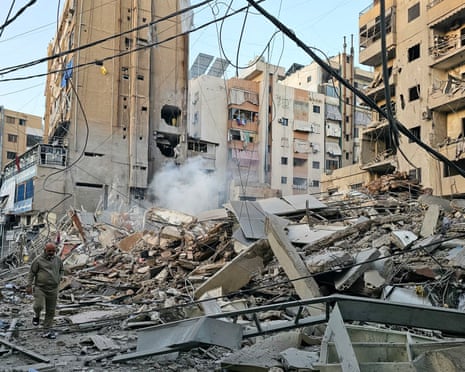 A man walks past debris at the site of an overnight Israeli airstrike in Beirut’s southern suburb of Bir al Abed on Tuesday. Photograph: AFP/Getty Images
The US will continue striking Iran and the five-day pause applies only to attacks on the country’s energy sites during the US-Iran talks, Semafor reported, citing a US official.
European Commission president Ursula von der Leyen said it was time for negotiations with Iran to end the war, given the global energy situation was now “critical”.
A Pakistani official and a second source told Reuters that direct talks on ending the war could be held in Islamabad this week. The official said US vice-president JD Vance as well as Trump envoys Steve Witkoff and Jared Kushner were expected to meet Iranian officials in Islamabad this week, after a call between Trump and Pakistan’s army chief, Asim Munir.
Benjamin Netanyahu said he had spoken with Trump and that Israel would continue its strikes against Iran and Lebanon. Trump saw a chance of a deal with Iran to “preserve our vital interests”, the Israeli PM said.
Israel said it had launched “wide-scale” strikes on Iran on Monday, while Tehran continued to fire missiles at the UAE and Saudi Arabia. The Israeli military also claimed to have hit struck the main security headquarters of Iran’s Islamic Revolutionary Guard Corps as part of a wave of strikes in Tehran.
British destroyer HMS Dragon arrived in the eastern Mediterranean, three weeks after an Iranian-made drone hit the British base of RAF Akrotiri in Cyprus, the UK’s defence secretary said. The British government has faced criticism for the slowness to deploy a warship to the region, after moves by Greece and France to send extra naval support to Cyprus after the attack.
Slovenia became the first EU member state to introduce fuel rationing in a bid to tackle disruptions caused by the Middle East war.
Updated at 03.40 EDT
Key events
Show key events only
Please turn on JavaScript to use this feature
Airstrikes targeting a site belonging to Iraq’s Shi’ite Popular Mobilization Forces in the country’s Anbar province killed at least 15 people, including the PMF’s Anbar operations commander, and injured 30 others, sources told the Reuters news agency.
The PMF confirmed the death of its Anbar commander, Saad al-Baiji, and 14 others. It accused the US of being behind the attack, saying an American airstrike targeted a command headquarters while personnel were on duty.
The PMF is an umbrella group of mostly Shi’ite paramilitary factions that was formally integrated into Iraq’s state security forces and includes several groups aligned with Iran. Iran-backed armed groups have launched attacks on US bases in Iraq since the outbreak of the US-Israeli war on Iran in late February.
We have not been able to independently verify Reuter’s report yet.
Bahrain’s ministry of interior said this morning that the country’s Civil Defence extinguished a fire at a site of a company after an Iranian attack. There were no immediate reports of any injuries or casualties.
Bahrain’s defence force said yesterday that it had intercepted and destroyed 282 drones and 147 missiles since the war was triggered by the killing of the former Iranian supreme leader, Ali Khamenei, in joint US-Israeli airstrikes on 28 February, which then led to Iran responding with attacks across the Gulf region.
ShareInterim summary
If you’re just joining us, here’s a snapshot of the latest key developments in week four of the US-Israel war on Iran.
At least six people have been injured in an Iranian missile attack in Tel Aviv on Tuesday, Israeli media is reporting.
Iran earlier launched a fresh wave of missiles against Israel just hours after Donald Trump hailed “very good” talks to end the war and gave a five-day extension to his deadline on Iran to reopen the strait of Hormuz shipping lane or see the US “obliterate” its power plants. Tehran denied any talks took place, with the parliamentary speaker calling it “fake news … used to manipulate the financial and oil markets”.
An Israeli strike south of Beirut killed two people on Tuesday, Lebanon’s health ministry said, while strikes on the capital’s southern suburbs continued throughout the night.
A man walks past debris at the site of an overnight Israeli airstrike in Beirut’s southern suburb of Bir al Abed on Tuesday. Photograph: AFP/Getty Images
The US will continue striking Iran and the five-day pause applies only to attacks on the country’s energy sites during the US-Iran talks, Semafor reported, citing a US official.
European Commission president Ursula von der Leyen said it was time for negotiations with Iran to end the war, given the global energy situation was now “critical”.
A Pakistani official and a second source told Reuters that direct talks on ending the war could be held in Islamabad this week. The official said US vice-president JD Vance as well as Trump envoys Steve Witkoff and Jared Kushner were expected to meet Iranian officials in Islamabad this week, after a call between Trump and Pakistan’s army chief, Asim Munir.
Benjamin Netanyahu said he had spoken with Trump and that Israel would continue its strikes against Iran and Lebanon. Trump saw a chance of a deal with Iran to “preserve our vital interests”, the Israeli PM said.
Israel said it had launched “wide-scale” strikes on Iran on Monday, while Tehran continued to fire missiles at the UAE and Saudi Arabia. The Israeli military also claimed to have hit struck the main security headquarters of Iran’s Islamic Revolutionary Guard Corps as part of a wave of strikes in Tehran.
British destroyer HMS Dragon arrived in the eastern Mediterranean, three weeks after an Iranian-made drone hit the British base of RAF Akrotiri in Cyprus, the UK’s defence secretary said. The British government has faced criticism for the slowness to deploy a warship to the region, after moves by Greece and France to send extra naval support to Cyprus after the attack.
Slovenia became the first EU member state to introduce fuel rationing in a bid to tackle disruptions caused by the Middle East war.
Updated at 03.40 EDT
We’re seeing images from the scene after an Iranian missile strike in Tel Aviv a short while ago.
Emergency personnel work at the site after Iranian missile barrages in central Israel on Tuesday. Photograph: Ronen Zvulun/ReutersIsraeli firefighters work to put out a fire after the attack. Photograph: Gideon Markowicz/ReutersSmoke billows in Tel Aviv after the strikes, which reportedly injured at least six people. Photograph: Ohad Zwigenberg/APShare
Updated at 03.04 EDT
Police say a munition carrying some 100km of explosives impacted in central Tel Aviv, leading to the widespread damage to buildings and vehicles, according to Israel’s Channel 12, cited by the Times of Israel.
Updated at 02.49 EDT
At least six injured in Tel Aviv attack – reports
Haaretz has updated to six the number of people lightly hurt in the missile attack in Tel Aviv.
The Times of Israel and Ynet are also saying six people were hurt, while the Jerusalem Post is saying at least six.
Updated at 03.29 EDT
Four in Tel Aviv wounded in Iranian missile attack – report
Four people have been wounded in an Iranian missile attack in Tel Aviv, Israel’s Haaretz is reporting.
The newspaper said several buildings in city were damaged, and that emergency services said the four people were lightly injured at one of the impact sites on Tuesday.
One building and its adjacent road were heavily damaged in central Tel Aviv, where cars caught fire, the report said.
Intercepted missile fragments also fell in Rosh HaAyin, causing minor damage. No casualties were reported there.
Haaretz also said rescue services were heading to the scene.
Earlier on Tuesday Iran fired three waves of missiles at Israel, with reports of an impact in the country’s north, the Israeli Home Front Command said.
Updated at 02.39 EDT
Israeli strike outside Beirut kills two, says Lebanese ministry
An Israeli strike south of Beirut killed two people on Tuesday, Lebanon’s health ministry said, while strikes on the capital’s southern suburbs continued throughout the night.
“The Israeli enemy raid on the town of Bshamoun in the Aley district resulted, in a preliminary toll, in the martyrdom of two citizens and the injury of five others,” the ministry said in a statement cited by Agence France-Presse.
Bshamoun is in the mountainous, Druze-majority Aley district south-east of Beirut and is outside of Hezbollah’s traditional strongholds, the news agency says.
In Australia, the number of petrol stations running out of fuel continues to climb as the Middle East war drags on, with at least 184 dry across the country’s three most populous states.
On Tuesday, 51 service stations in the state of New South Wales were out of fuel and 164 out of diesel, compared with 38 and 131 respectively the previous day, premier Chris Minns said.
In the state of Victoria, 101 service stations were out of petrol and 83 were without diesel, with the state’s energy minister saying demand had increased as much as 400% in some areas, Australian Associated Press reports.
In Queensland, 32 stations were out of regular unleaded and 47 stations had no diesel.
The rising shortages come as the Australian government’s fuel supply taskforce is to meet for the first time on Tuesday.
ShareVietnam to cut domestic flights over jet fuel shortage
Vietnam’s national air carrier will suspend nearly two dozen domestic flights a week starting next month because of limited fuel supplies caused by the Middle East war, the nation’s aviation authority has said.
The price of jet fuel has jumped since the war began more than three weeks ago, triggering soaring oil prices and fuel shortage fears.
“Vietnam Airlines plans to temporarily suspend operations on several routes from April 1,” totalling 23 flights a week, the country’s civil aviation authority said in a statement late Monday, cited by AFP.
“The limited supply of aviation fuel (Jet A-1) due to the conflict in the Middle East has put domestic airlines at risk of fuel shortages,” prompting the flight cuts, the authority said.
Major domestic routes and international flights would be maintained, it said.
Airlines in Vietnam were working on adding fuel surcharges on international routes that might be applied in April, it added.
Vietnam has recently asked for fuel support from several countries, including Qatar, Kuwait, Algeria and Japan, and on Monday signed a deal with Russia on oil and gas production in both countries.
Iran launched a fresh wave of missiles against Israel on Tuesday just hours after Donald Trump hailed “very good” talks to end the war, although Tehran denied any discussions took place.
Trump’s claim came ahead of his 48-hour deadline on Iran to reopen the strait of Hormuz shipping lane or see the US “obliterate” its power plants.
Early on Tuesday, state-run Iranian media reported another round of missiles fired at Israel. Emergency services released video of a damaged building and said a man in his 30s had suffered mild injuries but no other casualties were reported.
Lebanese state media, meanwhile, said Israel carried out seven air raids on southern Beirut overnight.
The Israeli military said it captured two Hezbollah fighters in south Lebanon on Monday, while also striking Beirut’s southern suburbs in its first attack on the Iran-backed militia’s stronghold in days.
ShareUS to continue attacking Iran despite pause – report
The US will continue striking Iran and the pause applies only to attacks on the country’s energy sites during what Donald Trump has called “productive” talks with Iranian leaders, Semafor is reporting, citing a US official.
“The stop on attacks for five days is only on their energy sites,” the news site quoted the unnamed official as saying.
“It is not on the military sites and the navy, and the ballistic missiles, and the defence industrial base. The initial initiatives of [Operation] Epic Fury will continue.”
The Semafor report also said Israel was not party to Washington’s talks with Tehran.
The report could not immediately be independently verified.
The Reuters news agency said the White House, US state department and the Pentagon did not immediately respond to a request for comment outside regular hours.
Trump on Monday said he had extended by five days his deadline to destroy Iran’s power plants if it did not fully open the vital strait of Hormuz.
Updated at 01.17 EDT
Israel’s military is reportedly saying search and rescue forces are on their way to several sites in the country’s south, where reports of impacts have been received.
More on Israel’s latest strikes on Beirut here: the military hit multiple neighbourhoods overnight in the Lebanese capital’s southern suburbs – a Hezbollah stronghold – saying it was targeting the Iran-backed group’s infrastructure.
No injuries were immediately reported, the Associated Press said.
Low-flying jets were heard over Beirut as the strikes took place.
The military had earlier renewed evacuation warnings for several neighbourhoods, while tens of thousands of residents had already fled the area.
Large fires and plumes of smoke were seen rising across the southern suburbs following the strikes.
Israeli strikes have so far killed more than 1,000 people in Lebanon and displaced around 1 million others, according to Lebanese authorities.
Smoke after an Israeli airstrike in Beirut’s southern suburbs on Tuesday. Photograph: Ibrahim Amro/AFP/Getty ImagesShare
Updated at 00.47 EDT
Israel targeted seven areas of southern Beirut overnight, Lebanese state media reported on Tuesday.
The state-run National News Agency, cited in an AFP report, said:
double quotation markEnemy warplanes launched seven raids overnight on the southern suburbs, targeting the areas of: Bir al-Abed, Al-Ruwais – outskirts of Al-Manshiyya, Haret Hreik, Sayyed Hadi Nasrallah Highway, Saint Therese, Burj al-Barajneh and Al-Kafaat.
The Israeli military has repeatedly bombarded south Beirut in recent weeks, while also carrying out deadly strikes elsewhere in the capital and across Lebanon.
Updated at 00.52 EDT
New Zealand to give cash to families as global fuel crisis worsens Eva Corlett
Nearly 150,000 New Zealand families will soon receive a weekly cash payment to help them afford petrol, the government has announced, in what is believed to be the world’s first fuel relief package that directly pays citizens since the Iran war began.
On Tuesday, prime minister Christopher Luxon and finance minister Nicola Willis announced roughly 143,000 families with children would get an extra NZ$50 ($29/£22) a week through a boost to the in-work tax credit – a payment to families with dependent children where at least one parent is in paid employment and neither parent receives benefits.
Another 14,000 families on slightly higher incomes will also be eligible for payments, but will receive less than $50 per week.
The increase will be temporary, lasting for one year from 1 April, or until the price of 91 octane petrol drops below NZ$3 ($1.75/£1.30) a litre for four consecutive weeks.
Petrol prices have increased roughly 40-50 cents a litre in New Zealand, pushing unleaded fuel to more than NZ$3 a litre on average since the Middle East conflict began.
Meanwhile, some petrol stations have reported running out of petrol as people rush to stock up. As of Tuesday, the country had 46 days’ worth of combined petrol, diesel and jet fuel stocks.
Notes saying ‘out of stock’ at a petrol station in Levin, New Zealand, last Thursday. Photograph: Marty Melville/AFP/Getty Images
See the full report here:
Updated at 00.07 EDT
Shares rally and oil rebounds as Trump extends Iran ultimatum
Recapping financial markets’ response after Donald Trump postponed the bombing of Iranian power plants: oil prices bounced back and Asian stocks rallied as immediate fears of a deeper energy shock were allayed.
Traders were quick to react to the reversal on Monday, sending crude futures tumbling and shares surging, while the US dollar and government bond yields fell, Reuters reports.
Most of the movement carried over to the Asian trading session on Tuesday, with MSCI’s broadest index of Asia-Pacific shares outside Japan rising 1.3%, while shares in Australia were up 0.7%.
Japan’s Nikkei advanced more than 2%, reversing most of Monday’s 3.5% decline.
Oil prices, meanwhile, edged higher on Tuesday after sliding 10% in the previous session. Brent crude futures were up 1% at $100.94 a barrel, while US crude rose 1.9% to $89.84.
Still, movement was highly volatile. “Markets are not out of the woods,” said Chris Weston, head of research at Pepperstone.
double quotation markPrice action could remain choppy into Friday’s revised deadline … The key question is whether participants see this as a genuine extension that brings a deal closer, or simply a delay that prolongs uncertainty.
Updated at 23.49 EDT
Opening summary
Welcome to our ongoing coverage of the US-Israeli war on Iran and its wider repercussions in the Middle East and globally.
Donald Trump has claimed the US and Iran have held talks in which the two sides had “major points of agreement”, and speculated that a deal could soon be done to end the war, a claim contradicted by Tehran.
Iran’s powerful Islamic Revolutionary Guards Corps (IRGC) called Trump’s words “psychological operations” that had no impact on Tehran’s fight, while parliamentary speaker Mohammad Baqer Qalibaf said it was “fake news … used to manipulate the financial and oil markets”.
Despite doubts about any direct negotiations, a European official said Egypt, Pakistan and Gulf states were relaying messages. On Tuesday, European Commission president Ursula von der Leyen said it was time for negotiations with Iran, given the global energy situation was now “critical”.
Speaking in Australia at the conclusion of a new free-trade agreement between the EU and Australia, she said: “The situation is critical for the energy supply allies worldwide. We all feel the knock-on effects on gas and oil prices, our businesses and our societies, but it is of utmost importance that we come to a solution that is negotiated, and this puts an end to the hostilities that we see in the Middle East.”
Ed chief Ursula von der Leyen addressing Australia’s parliament in Canberra on Tuesday. Photograph: Lukas Coch/Reuters
A Pakistani official and a second source told Reuters that direct talks on ending the war could be held in Islamabad this week. The Pakistani official said US vice-president JD Vance as well as Trump envoys Steve Witkoff and Jared Kushner were expected to meet Iranian officials in Islamabad this week, after a call between Trump and Pakistan’s army chief, Asim Munir.
In other key developments:
Trump said the threatened US strikes on Iranian power plants had been postponed after “very good and productive” discussions with Iran about a “complete and total resolution of our hostilities” in the Middle East. After hitting a four-year high, the price of oil fell dramatically following Trump’s comments, while stocks in Asia rallied.
Benjamin Netanyahu, meanwhile, said he had spoken with Trump, who saw a chance of an agreement with Iran, but added that Israel would continue its strikes against Iran and Lebanon. Trump believed there was a possibility of “leveraging the mighty achievements obtained by the Israeli and the US military, in order to realise the goals of the war in a deal – a deal that will preserve our vital interests”, the Israeli prime minister claimed in a video statement released by his office.
Israel said it had launched “wide-scale” strikes on Iran on Monday morning, while Tehran continued to fire missiles at the UAE and Saudi Arabia. The Israeli military also claimed to have hit struck the main security headquarters of Iran’s Islamic Revolutionary Guard Corps as part of a “wave of strikes that was completed a short while ago in the heart of Tehran”.
An Israeli strike also hit Beirut’s southern suburbs on Monday, Agence France-Presse quoted state media as saying, hours after the Israeli army issued an order for residents of the area to evacuate. An AFPTV live broadcast showed a cloud of smoke over the densely populated southern suburbs, which are considered a Hezbollah stronghold and have not been hit since Friday night.
Smoke rises from the site of an Israeli airstrike in Beirut’s southern suburbs on Tuesday. Photograph: Ibrahim Amro/AFP/Getty Images
British destroyer HMS Dragon arrived in the eastern Mediterranean, three weeks after an Iranian-made drone hit the British base of RAF Akrotiri in Cyprus, the UK’s defence secretary said. The British government has faced criticism for the slowness to deploy a warship to the region, after moves by Greece and France to send extra naval support to Cyprus after the attack.
Slovenia became the first EU member state to introduce fuel rationing in a bid to tackle disruptions caused by the US-Israeli war on Iran and Tehran’s retaliation on their allies in the Gulf.
Saudi Arabia’s defence ministry said it had intercepted and destroyed at least five drones over the kingdom’s eastern region.
The US embassy in Muscat lifted its shelter in place guidance for the city, but the guidance remains in place for the rest of Oman, the embassy said on X. It earlier issued a security alert for the whole country because of “ongoing activity”, without elaborating.
Updated at 03.32 EDT