
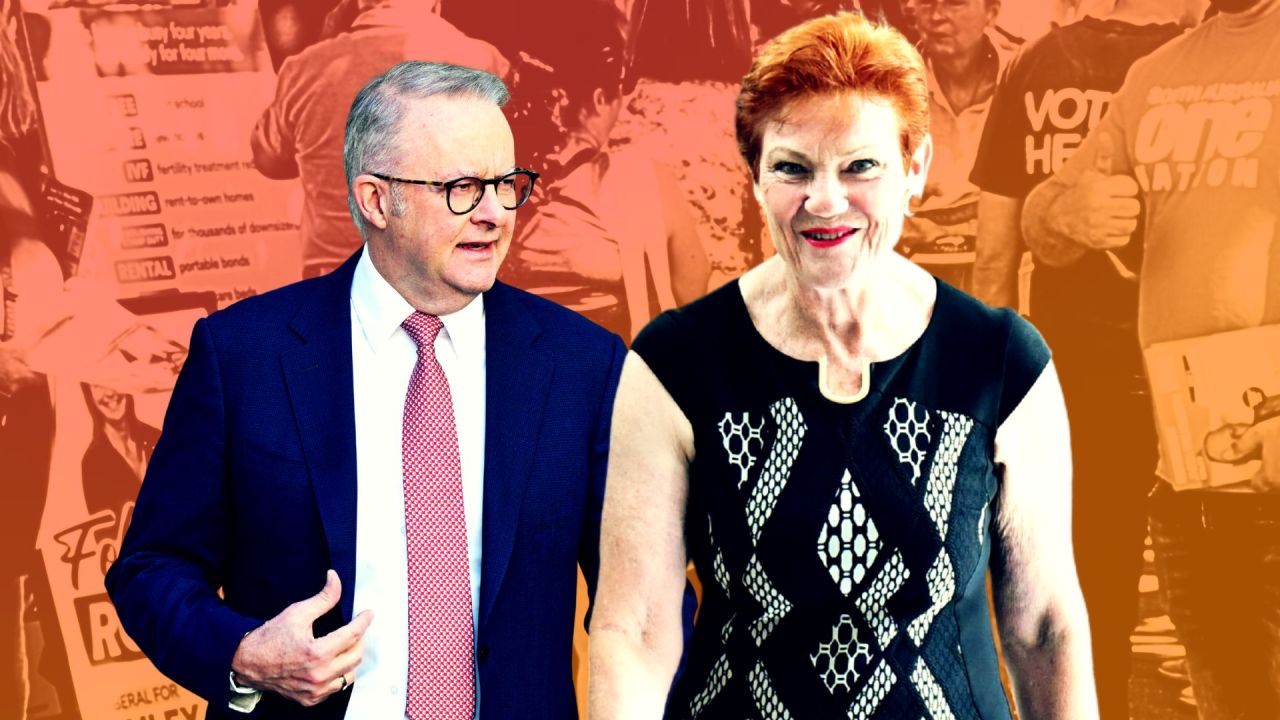
One Nation is quickly closing the gap on Labor, with exclusive polling showing Pauline Hanson’s party is just two points from becoming the most popular political party.
The Sky News Pulse / YouGov poll revealed One Nation lifted its primary vote to 27 while Labor’s fell a single point to 29.
Senator Hanson’s party is better placed to take on Labor than the Coalition in a two-party-preferred contest after preference flows, in One Nation’s strongest 2PP result yet.
Labor still commands a lead of 53-47 against One Nation, while the Coalition lags behind the government 54-46.
Support for One Nation is being driven by Australian battlers with those facing the toughest economic conditions more likely to vote One Nation.
Middle class Australians and those less impacted by economic uncertainty are still supporting Labor.
Working class voters were still most likely to support One Nation according to the latest poll, after support with the group surged over the beginning of the year.
Thirty-two per cent of all working-class respondents suggested they would vote for One Nation, a one per cent improvement since March 10.
It came despite pundits’ early claims that One Nation had only captured the attention of traditional right-wing voters.
A further 26 per cent of working-class voters would support Labor, while just 15 per cent would back the current Coalition.
Voters identified as working class comprised just over half of all respondents.
Just 12 per cent of “well-off” respondents supported Senator Hanson’s crew.
Instead, well-off Aussies largely backed Labor to lead the country, with 39 per cent of the group indicating it would vote again for the current government.
A further 31 per cent of well-off respondents supported the Coalition.
About 32 per cent of middle-class Australians would vote again for the Labor government.
The Coalition led One Nation among the group by just one per cent, 23 and 22 per cent of middle-class support respectively.
One Nation appeared to wrench away votes from the Coalition over December and January and has since consolidated support with modest gains amongst its core demographic.
Senator Hanson has transformed her persistent and at times controversial platform into a party of four seats in the federal Senate and one in the House of Representatives.
The party at the weekend converted its polling surge to a huge proportion of the primary vote in the South Australian state election.
Labor collected a decisive 38.1 per cent of the total primary vote, trailed not by the Coalition, but One Nation, according to the latest count.
One Nation collected 22.4 per cent of the primary vote as of Tuesday evening – the party’s strongest primary vote since the 1998 Queensland election.
The Liberals trailed on 19.3 per cent.
Senator Hanson claimed the newfound support at the booth was “just the start” of her movement and said she felt “vindicated” after three decades in politics.
“It’s not just a protest vote… you have no idea what the hell has happened in this country. There is a movement and there is an undercurrent, and it is people saying we’ve had a gutful, we want our country back,” she said.
“I feel different, I don’t know what it is, I’m excited, but I’m sort of holding my cards close to my chest in a lot of ways because I’ve been in this position before and it all falls apart because of preferences and the rest of it.”
Premier Peter Malinauskas warned on ABC Radio the election result could harm federal Labor in the long-term, despite the party stealing away predominately Liberal voters in the state election.
He said: “One Nation project patriotism in their form, we shouldn’t sneer at it… it opens up an opportunity for others to talk about patriotism in a way that I think reflects our country”.
Mr Malinauskas believed the support should not be discarded or treated as an anomaly.
His federal colleagues in the first Question Time since the election hardened their stance against Senator Hanson’s party.
Deputy Prime Minister Richard Marles said One Nation “have really only ever been about stunts and the vibe”.
MP Sally Sitou said One Nation had historically opposed policies benefiting working class Australians and likened the party to a “bad Tinder date”.