
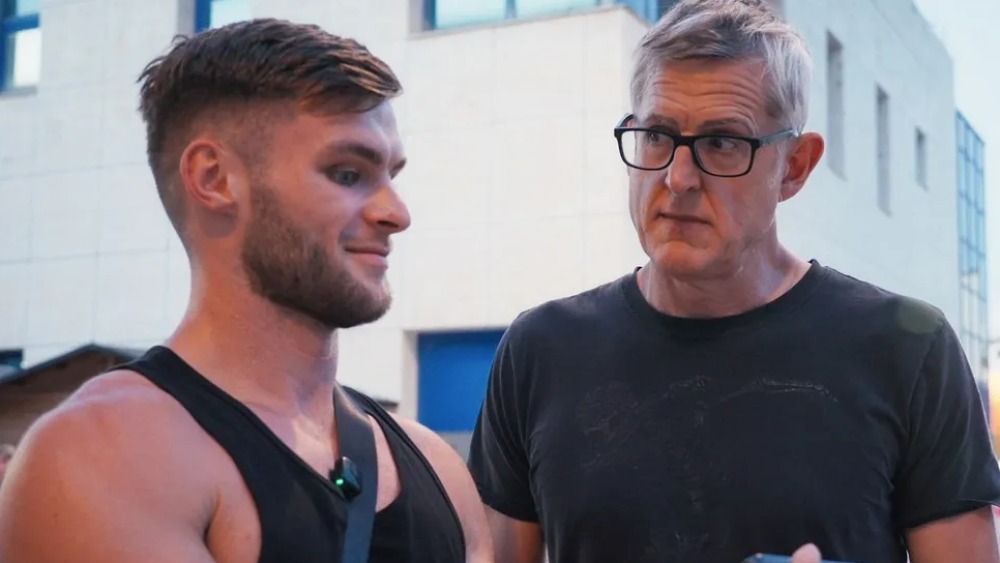
The Louis Theroux story I wanted to write was about what he learned while making his new Netflix documentary, “Inside the Manosphere,” which came out on March 11. In it, the filmmaker follows four so-called “masculinity” influencers who have grown sizeable online followings by loudly proclaiming themselves to be the apex of manhood. They espouse misogynistic, homophobic, scammy and violent views, predominantly for attention, which they then monetize.
But my encounter with Theroux, in a recent 30-minute Google Meet interview to promote the documentary, unexpectedly went in a different direction, one that suggested the U.K.’s most proficient public interrogator has a peculiar blind-spot when it comes to probing his own dogmas.
In October 2025, Theroux invited Pascal Robinson Foster, one half of the rap act Bob Vylan, onto his eponymous podcast to discuss his Glastonbury performance, in which Robinson Foster had led the thousands-strong crowd in a chant of “Death to the IDF,” and said things like, “Sometimes you got to get your message across with violence because that is the only language that some people speak.” (The police are reportedly investigating Robinson Foster again after he allegedly led the chant again during a pro-IRGC protest in London earlier this month).
Some of the criticism Theroux received for that episode — which resulted in British Airways pulling its sponsorship — included that he’d been too “soft” on Robinson Foster, although Theroux did challenge him about the impact of his words on the Jewish community. Theroux, whose 2025 West Bank documentary “The Settlers” has been criticized for its one-sidedness, also admitted during the conversation that he is uncomfortable with chanting “death to” pretty much anyone.
But the most contentious exchange came near the end of the episode, when Robinson Foster made a lengthy assertion that the IDF train U.S. police forces to use unspecified “tactics” as an example of Israel propagating “white supremacy” throughout the world. It’s a claim that has been repeatedly debunked, with even U.K. Prime Minister Keir Starmer dismissing it as an “antisemitic conspiracy theory.” Rather than point that out, Theroux responded that “Jewish identity in the Jewish community as expressed in Israel” has become a “prototype” for “an aggressive, militarised form of ethno-nationalism” inspiring tyrannical leaders across the West.
Given Louis Theroux has made a career out of asking people awkward questions, I didn’t shy away from the controversy when I interviewed him about “Inside the Manosphere.” Nor should it have been a surprise to him, as the Bob Vylan podcast episode has come up in a few of the interviews he’s done to promote the “Inside the Manosphere” documentary over the past month. So halfway through our chat, I read him back his comment verbatim and asked if he had any thoughts about it.
But rather than grapple in any meaningful way with what he had said or why it was controversial, Theroux claimed — wrongly — he’d made the comments in the context of a larger conversation about Israeli Prime Minister Benjamin Netanyahu and the Israeli government.
For about six minutes Theroux and I went back and forth as he refused to acknowledge the actual context of his statement let alone why it might have caused concern for the Jewish community. Eventually, with Netflix’s publicist getting increasingly antsy about the direction of the conversation, I abandoned hope of the documentarian indulging in any self-reflection and returned to asking him about “Inside the Manosphere.”
As it happens, “Inside the Manosphere” is great and terrifying. I’ve been a fan of Theroux’s since I was a kid, when I would watch his BBC documentaries with my parents, marvelling together as he effortlessly conversed with some of the most unlikeable and sinister people on the planet.
In his multi-decade career as an interviewer and documentarian, one of his most striking skills is the way he acts as a cipher in whatever crazy subculture he drops into. He gets to know his subjects, seemingly without judgment, while his almost caricature-ish Englishman persona — gently inquisitive, awkward, charming in that bumbling Hugh Grant way — enables him to ask questions with increasing potency until his victim is effectively garrotted with their own words, often without their even realizing until it’s too late.
It’s a tactic Theroux repeatedly and deliciously employs in “Inside the Manosphere,” quietly, almost passively, probing each delusional man — often in front of his credulous partner — until he is rendered literally speechless. The moment where Justin Waller’s girlfriend, pregnant with his third child, realizes how precarious her position is while Theroux softly asks Waller about marriage is both chilling and heartbreaking.
In another scene, we watch influencer Myron Gaines fervently asserting on his podcast that feminism and homosexuality are being “pushed” by “the Jews.” Later, alone in his home gym, Theroux gently asks Gaines if it’s become fashionable to “blame Jews for things in the redpill community.” The outspoken podcaster flounders. “Well…” he gasps, dropping the dumbbells he’s holding, before trailing off. “Can I get a drink of water then answer this one?” He returns to explain that it’s become a popular topic because it was “censored” for decades. The scene then cuts to another influencer that Theroux has been following, HSTikkyTokky (real name Harrison Sullivan), who is laughingly chanting “Fuck the Jews! Fuck the Jews!” on the streets of Spain.
Throughout the documentary, the audience is exposed to the influencers’ repulsive and often contradictory views, from fat-shaming to “one-way monogamy,” but it’s not until the last act that their antisemitism, some of it directed at Theroux himself, is unveiled as a sort of grand finale (Theroux is not Jewish, although some of the influencers think he is). It’s a poignant climax to a documentary meant to warn viewers about the dangers these men and their broadcasts pose to society, especially vulnerable young boys who idolize them.
But given Theroux’s own conflation of the Jewish community and the Israeli government, it also brought to mind a line in the documentary when he says to HSTikkyTokky, in an effort to point out his hypocrisy: “Do you think there’s a contradiction there?”
This is what Theroux said on his own podcast, in response to Foster Robinson’s claims:
“I think I’d add to that, there’s an even more macro lens which you can put on it, which is that Jewish identity in the Jewish community as expressed in Israel has become almost like an acceptable quote-unquote way of understanding ethno-nationalism, so it’s like they’re prototyping an aggressive, militarised form of ethno-nationalism which is then rolled out, whether it’s by people like Viktor Orban or Trump in the U.S. It’s become a certain sense of post-holocaust Jewish exceptionalism[…]”
That’s a big statement. In fact, it’s one that sounds worryingly like a pseudo-intellectual version of what the manosphere influencers are saying. Toward the end of “Inside the Manosphere,” images and clips of antisemitic content flashes on screen while Theroux says in a voiceover: “It was a pattern across the world of influencers to push false narratives about a shadowy cabal who is plotting the social downfall of the West.” Now here was Theroux claiming that the Jewish community was the “prototype” for how governments in Hungary and the U.S. are contributing to their countries’ downfall.
When I read it back to Theroux and asked him what his thoughts were, he replied: “Yeah, I mean, all I’d say on that is that, really, it was an attempt — it was sort of drawing on what Netanyahu is doing? And, you know, I made a film called ‘The Settlers,’ and it was based on what I see as this creeping anti-democratic, ethno-nationalist ideology that I see in parts of the Israeli government. So that’s what that was reflecting on. And I feel as though maybe it’s been taken, umm — misunderstood a bit?”
When I pointed out that the statement didn’t mention either Netanyahu or the Israeli government — just “the Jewish community” — he replied: “I’d encourage you to look at it in context, because the conversation was very much in the context of Israeli ultra-nationalism.”
At this point I decided to channel Theroux himself and replied gently but firmly: “It wasn’t. That was in response to [Robinson Foster’s] comment about IDF training American police.”
Theroux doubled down. “I’m confident that my comments were very much in the context of the way in which [the] Israeli ultra-nationalist cabinet has been taken by far-right elements internationally to sort of – they’re sort of esteemed as a model for what they’d like to do in their countries. Does that make sense?”
The more I thought about it the more it didn’t make sense. I had the podcast transcript in front of me, which showed Theroux’s comments had been made in response to a debunked claim that Robinson Foster was tenuously linking to a global white supremacist plot. In fact, neither the words “Netanyahu” or “cabinet” appear in the episode at all, according to the transcript available on Apple Podcasts. “Government” appears twice, but only in relation to the Glastonbury gig, while the word “Jew” or “Jewish” appears 12 times.
The story I wanted to write about Louis Theroux was not this one. “Inside the Manosphere” is a compelling documentary that lifts a rock on a small but pernicious subculture and I was curious about what he’d learned while making it. Did he think the influencers actually believed what they were spouting to their followers? (Theroux: “Whether or not it’s performative, it ends up at a certain point being real, and it is dragging the culture in a way that is real.”) Did he feel any sympathy for them, given many of them had had difficult childhood? (“It was hard to resist the idea that these were traumatized young men.”) What did it feel like to be clip-farmed? (“I suppose it felt exciting a bit.”) And, given Theroux’s formidable reputation, why did they agree to take part in the doc in the first place? (“I think Netflix means quite a lot to them.”)
That’s what I’d planned to lead this story with. But when I sat down to write it, I thought “What would Louis Theroux do?” He doesn’t bury his subjects’ words, even — or especially — the controversial ones. He presents them, largely without judgment, and lets them stand on their own merit.
So that’s what I decided to do too.