
Around 5000 years ago, during the early Mesopotamian period (circa 3000-2500 BCE), the first iterations of libraries began to emerge in society. Initially housing collections of records for temples and governments, and later transforming into repositories of literature and knowledge, the modern library has existed almost as long as the written word itself. Since then, libraries have remained a vital part of our society, serving as a meeting place, a place for quiet rumination and centres for storing and sharing knowledge.
With such a rich and storied history, libraries are often steeped with historical significance and housed within extraordinary architecture. From mahogany-lined reading rooms and soaring domed ceilings to stained glass windows and marble floors, libraries offer an experience that feels deeply transportive. So it’s only natural that a global list celebrating the world’s most beautiful libraries was developed – a collection by the 1000 Libraries team – offering avid readers and aesthetes alike a bucket list of must-visit book houses around the globe.
The Library of Trinity College in Dublin was named the world’s most beautiful, followed by Australia’s own, the State Library of South Australia, and the Abbey Library of St. Gallen in Switzerland in third. The second Australian entry in the top ten was the State Library Victoria, which ranked seventh, with the remaining libraries peppered around Europe and Brazil.
Read: 21 home libraries that will make a bookworm weak at the knees
The 10 most beautiful libraries, as voted by 1000 Libraries
Over a two-month period, 200,000 votes were cast by the global book-loving community in search of the world’s most beautiful libraries. Judged on historical architecture, innovative modern design, and that elusive “intangible quality that makes you want to lose yourself among the stacks”, a comprehensive list of the world’s 10 most beautiful libraries has emerged – a list that included two Australian institutions.
The Library of Trinity College, Ireland
State Library of South Australia, Australia
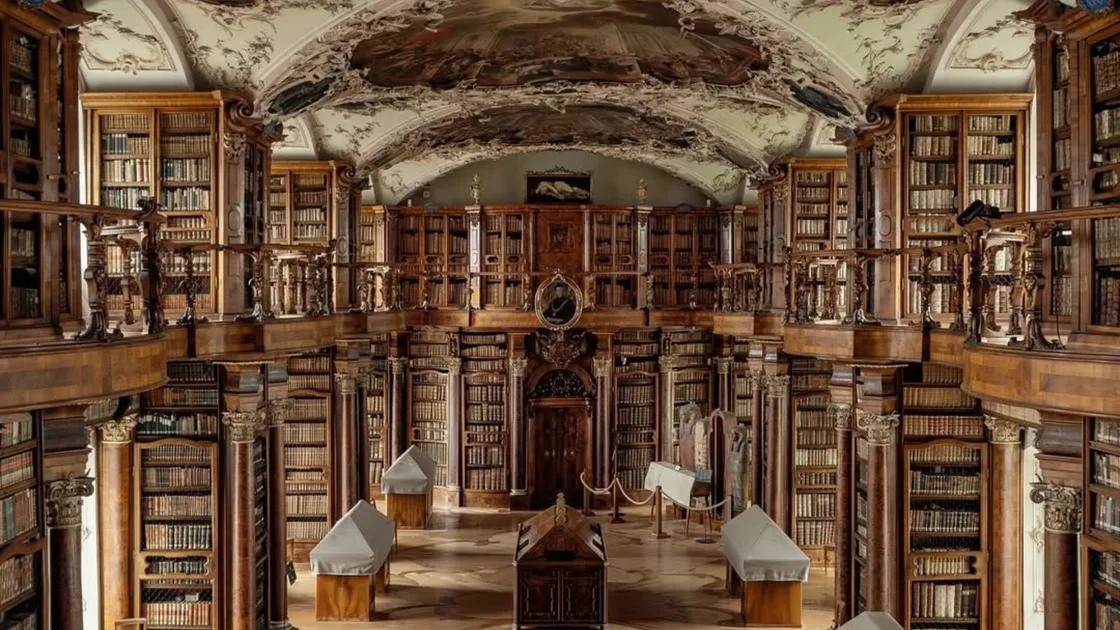
Abbey Library of St. Gallen, Switzerland
Duke Humfrey’s Library (University of Oxford), United Kingdom
Admont Abbey Library, Austria
Cuypers Library, Netherlands
State Library Victoria, Australia
The Royal Portuguese Cabinet of Reading, Brazil
Wiblingen Abbey Library, Germany
Sainte-Geneviève Library, France
Taking inspiration from this esteemed official ranking, we set out to discover more beautiful, grand, and impactful libraries around the world, from Europe to Australia.
More beautiful libraries around the world
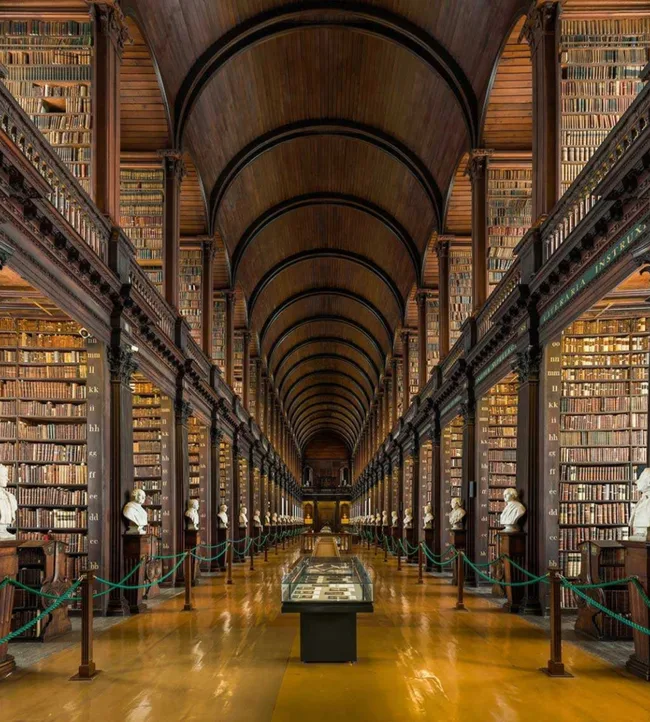 Photo: The Trinity College Library
The Trinity College Library
Ireland
Named by 1000 Libraries as the most beautiful in the world, the Trinity College Library – the largest in Ireland – has one of the most iconic library interiors in the world. Located in Dublin and with a 65 metre vaulted hall lined with 200,000 books, it is a perfect example of grand proportion and symmetry. Positioned at the end of each aisle, busts of philosophers and scholarly writers keep a watchful eye over the space, while the books arranged by size creates a sense of uniformity. It was originally constructed with a flat ceiling, but over time the barrel-shaped vault was added to accommodate its growing collection. It’s also home to the 1,200-year-old Book of Kells, one of the world’s oldest and most famous surviving medieval manuscripts globally, that yes, you will need to book in to see.
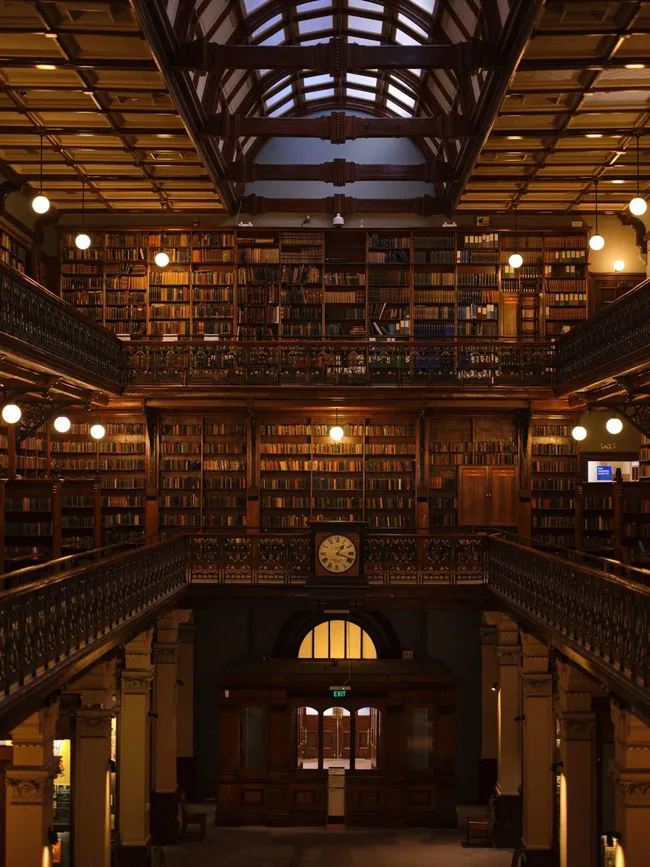 Photo: The State Library of South Australia
The State Library of South Australia
Adelaide, South Australia
Named by 1000 Libraries as the second most beautiful in the world is our very own State Library of South Australia. Boasting cast-iron detailing, an arched glass ceiling, tiered galleries and perfectly preserved 19th-century interiors, it’s no surprise that the time capsule has captured global attention. Known specifically for the Mortlock Wing, a Victorian gallery space designed by Colonial Architect E.J. Woods, books here were never meant to leave. Remarkably, the building has remained incredibly well-, almost perfectly-preserved allowing visitors to step back in time to the architecture of centuries ago, where grandeur and visual richness was commonplace.
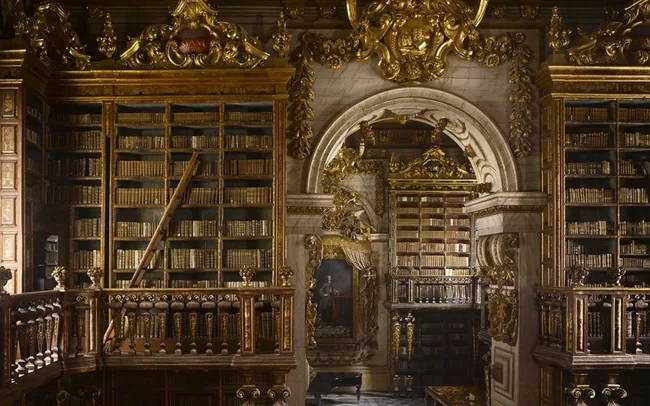 Photo: Biblioteca Joanina
Biblioteca Joanina
Portugal
A Baroque Library located within the University of Coimbra, Biblioteca Joanina is widely considered one of the most opulent in Europe. It was constructed in the 18th century in memory of memory of King John V, and these days holds over 60,000 books. Across three floors, each with their own elaborate distinctly different designs, gilded surfaces, exotic woods sourced from Portuguese colonies, and lacquered surfaces create a jewel-box effect. It is best known for its intricate microclimate preservation system, complete with two colonies of bats that protect the books from insects, thick moisture- and temperature-regulating walls, and low light to preserve delicate materials.
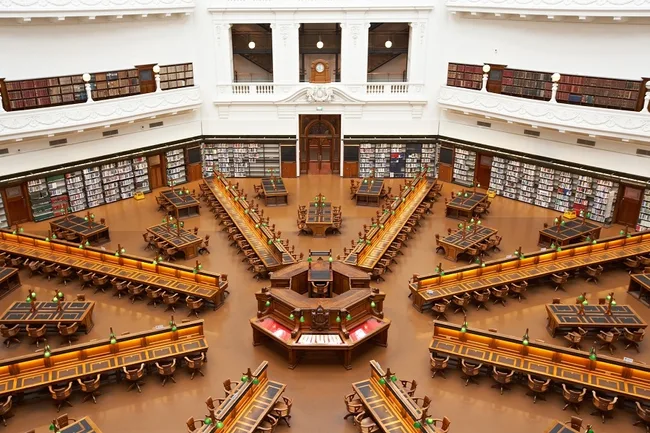 Photo: State Library Victoria
State Library Victoria
Australia
Voted lucky number seventh in the world by 1000 Libraries, the La Trobe Reading Room located within the State Library of Victoria in Melbourne, is a space where scale and symmetry create visual spectacle. As one of the largest reading rooms in the world with grand heritage details, the desks are carefully arranged to mirror the radial geometry of the architecture. It’s renowned for its iconic octagonal domed roof with an oculus that lets soft daylight filter in and, crucially, reduces harsh shadows.
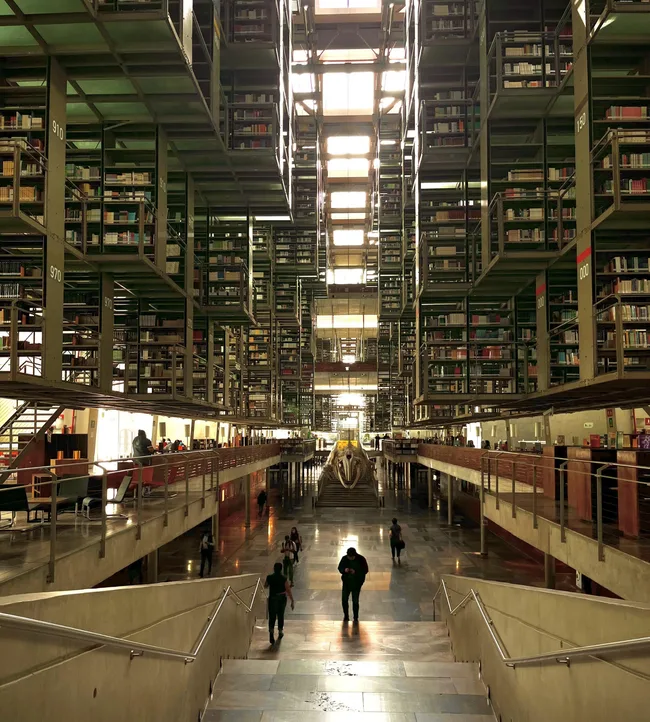 Photo: StevieFilmShots
Biblioteca Vasconcelos
Mexico
The Biblioteca Vasconcelos in Mexico City is a space where suspended shelves and a palette of steel, glass, and concrete combine to create a modern, gravity-defying effect. Designed by Mexican architect Alberto Kalach in 2006, it intentionally blurs the lines between library and urban space, with the raw, industrial aesthetic proving libraries don’t have to be traditional to be beautiful. As a 250-meter-long structure that’s home to 600,000 books and visually leads the eye to a 38,000 square-metre garden, mega-library was made to feel disorienting and challenge the traditional space.
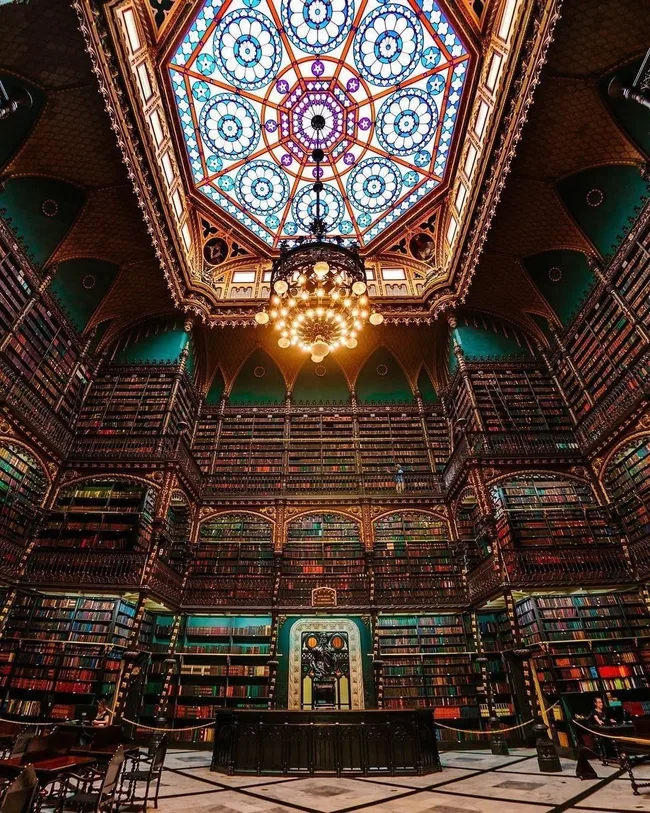 Photo: Instagram (@1000libraries)
The Royal Portuguese Cabinet of Reading
Brazil
The Royal Portuguese Cabinet of Reading with the largest collection of Portuguese literature outside Portugal, is often considered one of the most beautiful libraries in the world, thanks to its towering dark wood shelves, inherent theatricality, and grand stained-glass skylight. It was constructed between 1880 and 1887 to preserve Portugal’s literary works in Brazil following the South American country’s independence from the European nation in 1822. The Portuguese design style is instantly distinguishable; it boasts Neo-Manueline architecture, a style derived from the Late Gothic architecture of Portugal with highly ornate, eclectic stonework, maritime motifs, and intricate botanical carvings, and a facade that mirrors the Jerónimos Monastery in Lisbon, the nation’s capital. Inside, the walls are layered with dramatic decorative detailing, with no walls left bare.
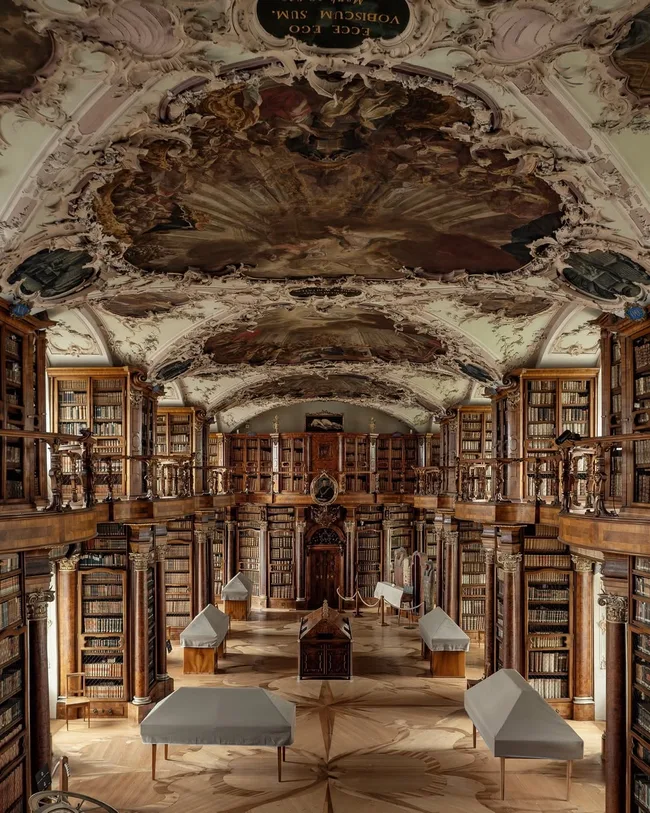 Photo: Instagram (@michaelthecanadian)
St Gallen Abbey Library
Switzerland
Another space recognised by 1000 Libraries, St Gallen Abbey Library is an incredibly beautiful, UNESCO World Heritage site that sits within a monastic complex. Dating back to the 8th century, it is best known for its intricately decorated ceiling, painted by Josef Wannenmacher between 1758 and 1767, the secular Baroque and Rococo style interiors and for housing over 160,000 books, including some of the oldest medieval manuscripts in Europe. Bearing the Greek inscription, “psyché iatreio,” which translates to “sanctuary of the soul”, it is a true sanctuary.
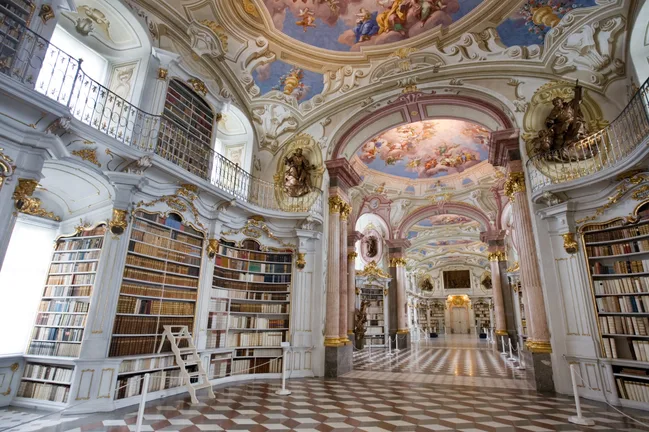 Photo: Wikipedia
Admont Abbey Library
Austria
The Admont Abbey Library in Austria is considered to have some of the finest architecture of the European late Baroque period. It is the largest monastery library in the world, housing approximately 70,000 volumes in the Main Hall, and 200,000 volumes in the library’s full collection. It exemplifies architecture as storytelling, from the ceiling frescoes by Bartolomeo Altomonte that depict the stages of human knowledge, and the library’s distinct zones that each represent stages of knowledge, to the sculptures that are positioned to guide people through the space. Bathed in light and swathed in bright white and gold, this ethereal space was the inspiration for the design of the iconic library in Disney’s Beauty & the Beast.
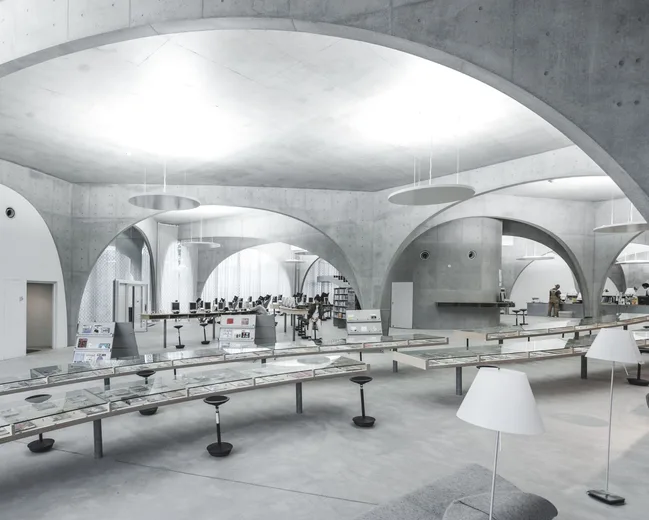 Photo: Tama Art University Library
Tama Art University Library
Japan
A modern space with sculptural concrete arches, glass walls and open-plan layout, the Tama Art University Library in Tokyo is a textbook example of minimalist architecture. Designed by Toyo Ito, a Pritzker Prize-winning architect, it was made to emulate a cave where people can learn, dissolving the boundaries between indoor and out. With no rigid study zones and varying distances between arches, this space feels organic and encourages movement and interaction with art and other forms of media.
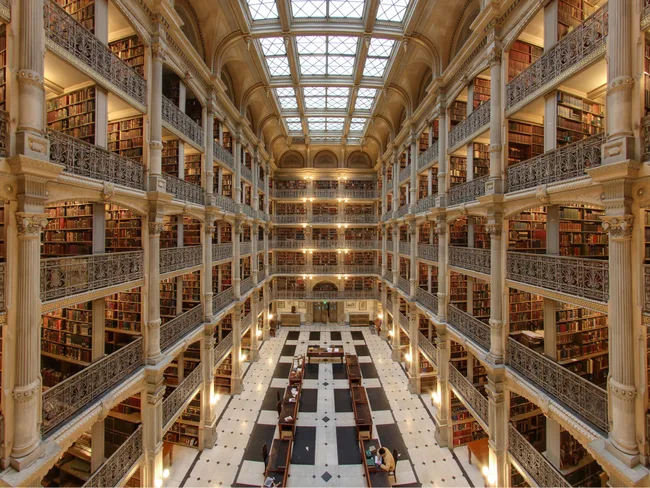 Photo: Johns Hopkins Libraries
George Peabody Library
USA
Founded in 1857, The George Peabody Library in Maryland, designed by Baltimore architect Edmund G. Lind, is a stunning venue known as the “Cathedral of Books”. Known for its soaring neo-Greco interiors, which is a more stylised evolution of Greek Revival architecture, the church-like proportions and six storeys of dramatic, cast-iron balconies lead the eye toward a 61-foot-high atrium. It holds just over 300,000 volumes, with many from the 18th and 19th centuries, including first edition Edgar Allan Poe works. It’s also an incredibly popular wedding and events venue.

Writer
Danielle Grover
Senior Content Producer