
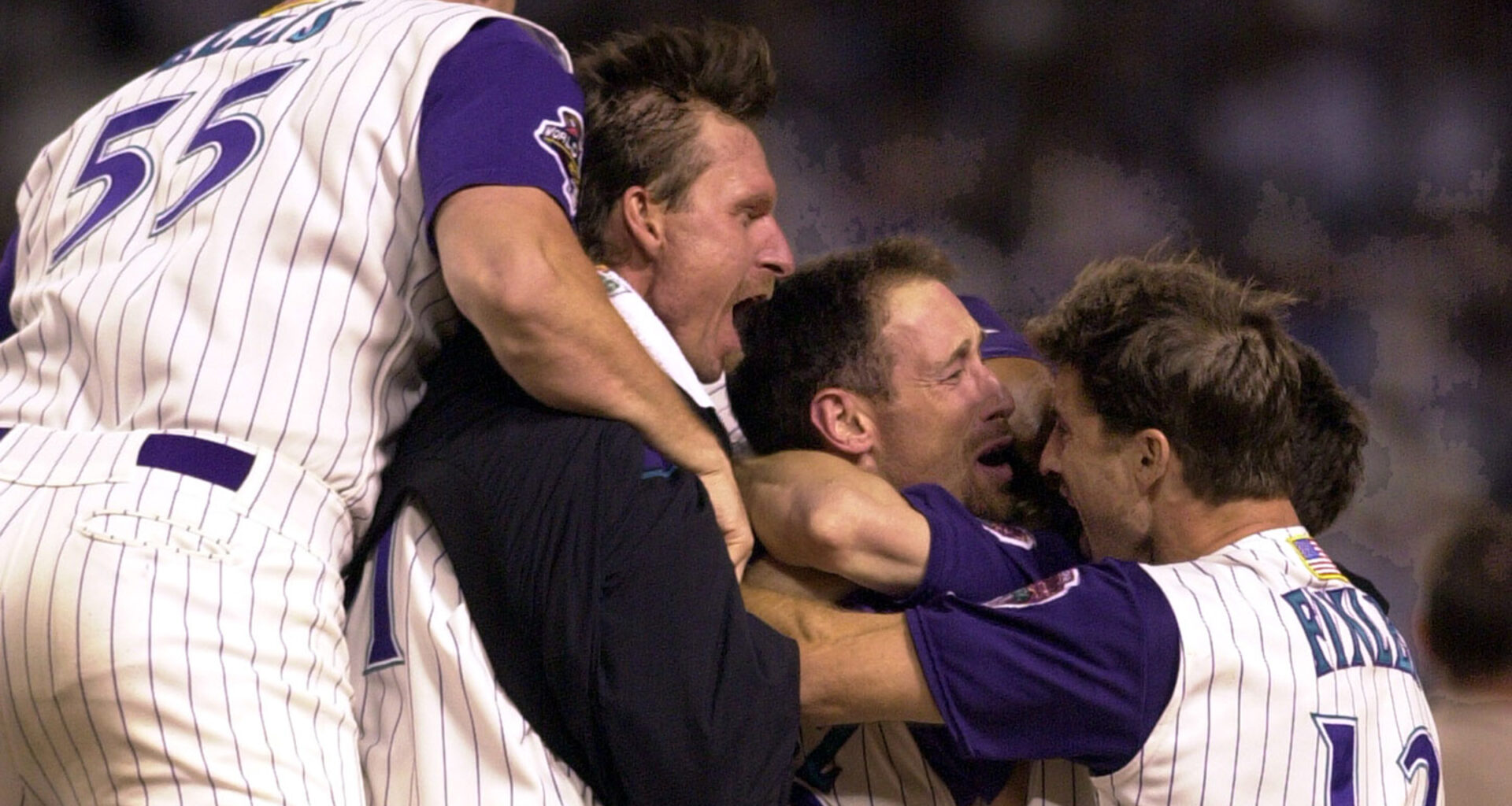
PHOENIX – Nearly 25 years later, Jerry Colangelo still remembers the moment like it was yesterday. Like many Arizona sports fans, he often replays the memory in slow-motion, savoring every tiny detail, every enormous sequence.
As wind swirled below the open roof of Bank One Ballpark, a monsoon of white pom-poms whirled around in the stands. Arizona fans, desperate for the city’s first professional championship, restlessly cheered to help their Diamondbacks storm back in Game 7 of the 2001 World Series against the vaunted, three-time defending champion New York Yankees.
New York, which the country had rallied behind in the aftermath of the tragic attacks on Sept. 11, led the Diamondbacks 2-1 in the ninth inning of an ultimate finale to an emotional back-and-forth series.
In a last-gasp effort to tie the game in its waning moments, Diamondbacks outfielder Luis Gonzales, who was in the midst of a career year, approached the batter’s box with one out, the bases loaded and a chance to alter history against Hall of Fame closer Mariano Rivera.
Gonzales unleashed the storm, muscling a bloop single to the outfield grass, over a drawn-in infield, to bring home Jay Bell, the game-winning run from third. As the ball slowly fluttered through the sky on an early November night, the crowd of close to 50,000 fans roared to a thunderous crescendo, euphoric as the Diamondbacks walked off the Yankees 3–2 in Game 7 of the World Series to bring Phoenix its first championship.
“When that happened, it looked like Jay Bell was running in mud,” Colangelo, the Diamondbacks’ owner at the time, said. “Like it was so slow for him to get from third base to home plate. Everything went silent for me when that happened, and then when he hit home plate, everything exploded.”
The title still stands as Phoenix’s only men’s major professional championship in the Valley’s history. (The Mercury have won three WNBA championships.) Fittingly, Colangelo, who earned the nickname the “Godfather of Phoenix Sports” for owning multiple professional sports organizations in the city including the Suns, Mercury and Diamondbacks, was the owner who delivered the title.
With rain pouring down and the Commissioner’s Trophy pinned to Colangelo’s side, the jubilant fans began chanting, “Jerry, Jerry, Jerry,” as he spoke on stage after the victory.
 Upon reflecting on the World Series, former Diamondbacks owner Jerry Colangelo said, “I felt like we were carrying the banner for the city, for the state, and (with) everything that we were doing, certainly the World Series, it could not have been any better.” (Screenshot of video by Abigail Hardy/Cronkite News)
“I felt like we were carrying the banner for the city, for the state, and (with) everything that we were doing, certainly the World Series, it could not have been any better,” Colangelo said.
Building a team to reach the mountaintop in just four years didn’t come easy.
As an expansion franchise that fielded a patched-up roster in its inaugural season, the spring of 1998, Arizona finished with a 65-97 record. Despite experiencing the typical on-field results of an expansion team, Colangelo remained pleased with the fan turnout and support for the franchise in its first year.
However, after failing to earn renewals from many of the Diamondbacks’ season-ticket holders the following season, Colangelo called a meeting with his executives. Originally, he had planned to build the roster slowly through the draft. Yet, with expenses starting to pile up and the honeymoon effect of a new franchise dying off, Arizona changed its approach.
The Diamondbacks needed to win, and quickly.
“I think we have to compete now to protect the investment that’s been made,” Colangelo told his partners in the front office. “If we’re successful in free agency, we’ll have a shot to win … You (have) got to pay the piper at some point, but I think it’s something we need to do to protect the investment everyone had made.”
Swinging big wasn’t contradictory to Colangelo’s philosophy, as he credits the risks he took for much of his success during his career.
“Nothing ventured, nothing gained,” Colangelo said. “You have to be willing to take risks. I would always say mine were calculated risks, not blind risks. But you can never be afraid to fail. Because I know ultimately if you’re right, you win.”
With a shift in mindset, Colangelo and general manager Joe Garagiola Jr. signed multiple marquee players in the fall of 1998, including left-handed pitcher Randy Johnson and outfielder Steve Finley, to multiyear deals in free agency.
Then, in 2000, Arizona made its most impactful move yet: a trade for then-Philadelphia Phillies right-hander Curt Schilling, a local product who went to Shadow Mountain High School.
“I just set out to win now,” Colangelo said. “And of course, (with) our new plan, we won three divisional titles and won a World Series in that short period of time. … the thrill of putting together people like Randy Johnson, Curt Schilling, Luis Gonzalez, Jay Bell, Matt Williams, Steve Finley, Tony Womack, it was fun.”
With the additions, Arizona littered its clubhouse with veterans who shared the same common interest later in their careers: winning a championship.
But they needed a manager to match its roster and build a new identity for the team. So, after three seasons with Buck Showalter, the Diamondbacks brought in Bob Brenly before the 2001 season. Brenly, a former player, had no managerial experience prior to taking the job in Arizona.
“I felt that we needed one manager who could relate to veteran players, and all of a sudden we were a veteran team,” Colangelo said. “We were not a young team, and so that puts a lot of emphasis on winning now. And Brenly, with his personality and his stature, I felt was a perfect fit.”
Mark Gonzales, a beat-writer for the Arizona Republic covering the Diamondbacks at the time, felt Brenly’s impact on the team quickly.
“In the first team meeting in spring training, Bob Brenly, according to people in the room, held up a thick binder and he said, ‘These are the team rules from last year,’ and he dropped them in the garbage can,” Gonzales said. “That was his way of saying we’re going to condense things and just play the game the right way.”
With the front office, coaching staff and roster all bought in under Colangelo’s vision for the organization, Arizona was primed to make a run.
“It all started at the top,” infielder Tony Womack said. “Jerry Colangelo was at the top and Joe Garagiola was under him. Everybody knew Jerry was at the top and it had to go through Jerry. … You gotta have one chief. That’s it. One chief, and then you’ve got a bunch of warriors below you and you’re going to have a chance to be consistent; a chance to win.”
Retooled and reenergized, the Diamondbacks marched to a 92-70 record to earn a National League West Division title.
In the past, Arizona had flirted with regular success, winning the NL West with 100 victories in 1999. However, with its new acquisitions, the club set its sights on performing in the postseason to a championship level, especially with its new one-two punch on the hill.
Johnson and Schilling combined for a 9-1 record in the 2001 playoffs. In the postseason run, Schilling maintained a 1.12 ERA to pair with 56 strikeouts, while Johnson nearly stood parallel to him with a 1.52 ERA and 47 strikeouts.
Shortly after the National League Championship Series, in which the Diamondbacks defeated the Atlanta Braves 4-1, Schilling and Johnson went into Brenly’s office and reaffirmed to their manager that they could pitch on short rest.
The two had vastly different personalities off the field. Johnson was a reserved introvert. Meanwhile, Schilling’s bold, sometimes brazen, persona gave him a polarizing image. Still, the pairing’s shared intensity within the lines helped them form a tight connection.
“These guys accomplished so much in their careers, yet were willing to do whatever it took to get the one thing they had never got, which was a ring, and they got it,” Gonzales said.
Schilling ended up making three starts in the World Series, while Johnson made two and earned three wins, including in the ever-so-important Game 7.
In Game 7, Schilling went toe-to-toe with Yankees’ pitcher Roger Clemens, tossing 7⅓ innings and allowing just two runs. Johnson came in to close the final 1⅓ in a poetic finish for the duo who helped carry Arizona to the World Series.
Appropriately, Schilling and Johnson earned co-Most Valuable Player honors of the World Series. With Johnson standing to his right, and the MVP trophy firmly tucked under his left arm, Schilling called the win “the perfect game,” citing the multiple contributions needed to secure the Game 7 victory.
He was right. Although he and Johnson commanded much of the attention, it took a complete team effort to propel Arizona throughout its playoff run. The ninth inning of Game 7 proved it.
Down 2-1 in the bottom of the ninth, the Diamondbacks’ offense had to go through the best to earn a victory: Rivera.
“There was not a feeling of dread,” Bell said. “We had already faced him three other times, but that being said, in the bottom of the eighth, he struck out the side, so we knew, ‘He’s got it going on tonight.’”
From Mark Grace’s leadoff hit to Damian Miller’s bunt to Womack’s clutch double down the right field line, several individuals helped deliver Phoenix’s first major professional championship.
“Everybody knew their job and everybody did their job,” Womack said. “Everybody was brought in for a reason. Randy and Curt were brought in for a reason. I was brought in for a reason. You had Gonzo’s big bat. …We put a bunch of pieces together, and all the pieces did their job.”
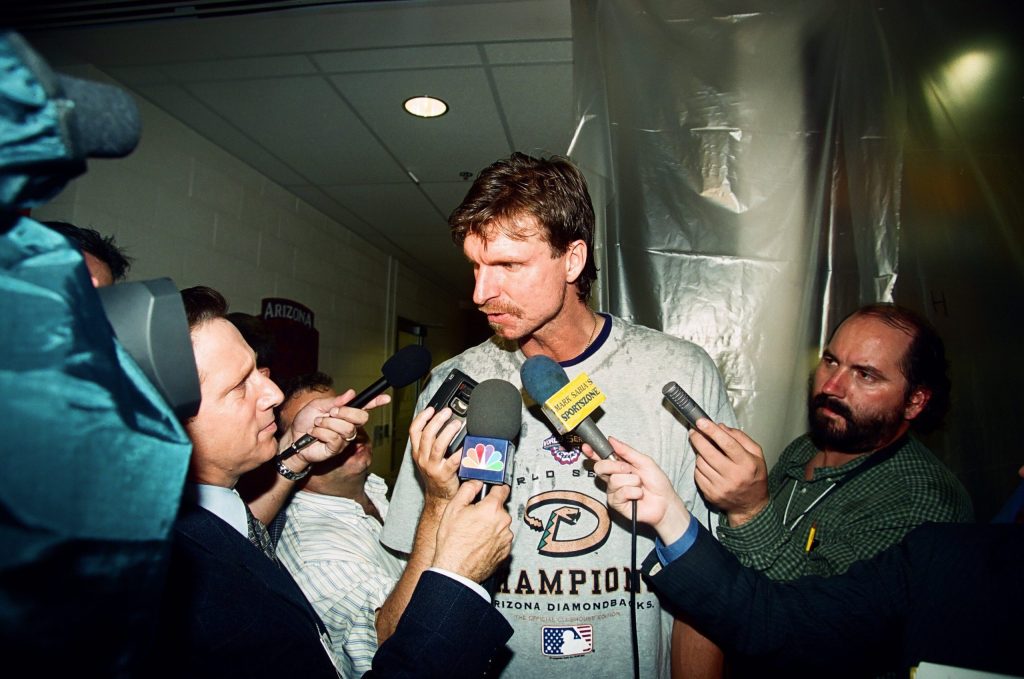 The Diamondbacks’ Randy Johnson talks to the media following Game 7 of the World Series against the New York Yankees on November 4, 2001 at then-Bank One Ballpark in Phoenix, Arizona. (Photo by Sporting News via Getty Images)
Beyond the accomplishment of earning a World Series, the backdrop of 9/11 will always be linked to the postseason run.
Playing in the wake of the Sept. 11 attacks created a unique set of circumstances around the World Series. The impact of the tragic event could be felt in different ways.
The city of New York rallied around the Yankees who, coming off three straight World Series titles and four in five years, had formed a dynasty.
After dropping the first two games, the home-field advantage provided the Yankees with a boost, as the Yankees handed Arizona a trio of gut-wrenching one-run defeats in New York, with two of the losses coming in extra innings.
Following his back-to-back blown saves in Game 4 and Game 5, then-22-year-old right-handed closer Byung-Hyun Kim crouched at the foot of the mound and stared at the ground in disbelief, creating an iconic image that still lives in Arizona sports infamy.
“It was pretty tough for him to recover from that,” Gonzales said. “I’m not sure that he fully recovered after what happened at Yankee Stadium. The fact that they blew the Yankees out in Game 6 and then Johnson came in relief in Game 7 masked what could have been a sticky situation for them and him.”
Outside the lines, its impact could be felt as well. On their first off day in New York, several Diamondback players visited a still-smoldering Ground Zero to pay tribute to those lost in the attacks of Sept. 11.
“It was a surreal experience,” Bell said. “To play the Yankees in the wake of 9/11 and to have the opportunity to go down to Ground Zero, it was extremely impactful and humbling to look at something that devastating.”
Beginning with the first game of the series, there was a heavy presence of security at both venues with snipers dotted throughout the stadium.
Perched at a piano raised above home plate, singer and songwriter Ray Charles performed a powerful rendition of “America the Beautiful” before Game 2 that drew tears from viewers watching across the country. Then, dressed in a bulletproof vest, President George W. Bush made an appearance at Yankee Stadium to throw out the first pitch before Game 3.
“There were just so many questions that nobody had answers to,” Bell said. “We weren’t sure what was going to happen. (MLB) paused for that full week, and we were excited to get back. But as I look back in retrospect, we returned to play rather quickly, and it was a good thing for the psyche of the players, but it was also good for the psyche of the United States. And the way everything happened, it just seemed right to have New York in the World Series.”
Amid a time of uncertainty, the 2001 World Series served as a vehicle of unification for the country, providing people with an escape for a brief period of time. It was an opportunity to start anew and return to normalcy.
For the Diamondbacks, it was an opportunity to deliver something the state hadn’t yet experienced: a championship.
And while Arizona awaits its next World Series title almost 25 years later, Colangelo will always be grateful for having the chance to deliver its first.
“There’s a lot of uncertainty in life,” Colangelo said. “I was blessed to be in a position to have a chance to have something like that happen.
“I think back when I first arrived, back in 1968. I came out for a visit from Chicago. What I saw that day was, in my mind, a blank slate, an empty canvas. … I saw an opportunity to paint your own portrait here, because I knew in my heart of hearts, this was going to be a great growth market, and that certainly has proven out.”
This <a target=”_blank” href=”https://cronkitenews.azpbs.org/2026/03/26/anniversary-diamondbacks-2001-world-series-title/”>article</a> first appeared on <a target=”_blank” href=”https://cronkitenews.azpbs.org”>Cronkite News</a> and is republished here under a <a target=”_blank” href=”https://creativecommons.org/licenses/by-nd/4.0/”>Creative Commons Attribution-NoDerivatives 4.0 International License</a>.<img src=”https://i0.wp.com/cronkitenews.azpbs.org/wp-content/uploads/2026/02/favicon1.png?resize=85%2C85&ssl=1″ style=”width:1em;height:1em;margin-left:10px;”>
<img id=”republication-tracker-tool-source” src=”https://cronkitenews.azpbs.org/?republication-pixel=true&post=101340″ style=”width:1px;height:1px;”><script> PARSELY = { autotrack: false, onload: function() { PARSELY.beacon.trackPageView({ url: “https://cronkitenews.azpbs.org/2026/03/26/anniversary-diamondbacks-2001-world-series-title/”, urlref: window.location.href }); } } </script> <script id=”parsely-cfg” src=”//cdn.parsely.com/keys/cronkitenews.azpbs.org/p.js”></script>
Canonical Tag:
Copy Tag
Article Content:
‘Carrying the banner for the city’: 25th anniversary of Diamondbacks’ 2001 World Series title evokes fond memories
Adam Kunin, Cronkite News
March 26, 2026
PHOENIX – Nearly 25 years later, Jerry Colangelo still remembers the moment like it was yesterday. Like many Arizona sports fans, he often replays the memory in slow-motion, savoring every tiny detail, every enormous sequence.
As wind swirled below the open roof of Bank One Ballpark, a monsoon of white pom-poms whirled around in the stands. Arizona fans, desperate for the city’s first professional championship, restlessly cheered to help their Diamondbacks storm back in Game 7 of the 2001 World Series against the vaunted, three-time defending champion New York Yankees.
New York, which the country had rallied behind in the aftermath of the tragic attacks on Sept. 11, led the Diamondbacks 2-1 in the ninth inning of an ultimate finale to an emotional back-and-forth series.
In a last-gasp effort to tie the game in its waning moments, Diamondbacks outfielder Luis Gonzales, who was in the midst of a career year, approached the batter’s box with one out, the bases loaded and a chance to alter history against Hall of Fame closer Mariano Rivera.
Gonzales unleashed the storm, muscling a bloop single to the outfield grass, over a drawn-in infield, to bring home Jay Bell, the game-winning run from third. As the ball slowly fluttered through the sky on an early November night, the crowd of close to 50,000 fans roared to a thunderous crescendo, euphoric as the Diamondbacks walked off the Yankees 3–2 in Game 7 of the World Series to bring Phoenix its first championship.
“When that happened, it looked like Jay Bell was running in mud,” Colangelo, the Diamondbacks’ owner at the time, said. “Like it was so slow for him to get from third base to home plate. Everything went silent for me when that happened, and then when he hit home plate, everything exploded.”
The title still stands as Phoenix’s only men’s major professional championship in the Valley’s history. (The Mercury have won three WNBA championships.) Fittingly, Colangelo, who earned the nickname the “Godfather of Phoenix Sports” for owning multiple professional sports organizations in the city including the Suns, Mercury and Diamondbacks, was the owner who delivered the title.
With rain pouring down and the Commissioner’s Trophy pinned to Colangelo’s side, the jubilant fans began chanting, “Jerry, Jerry, Jerry,” as he spoke on stage after the victory.
“I felt like we were carrying the banner for the city, for the state, and (with) everything that we were doing, certainly the World Series, it could not have been any better,” Colangelo said.
Building a team to reach the mountaintop in just four years didn’t come easy.
As an expansion franchise that fielded a patched-up roster in its inaugural season, the spring of 1998, Arizona finished with a 65-97 record. Despite experiencing the typical on-field results of an expansion team, Colangelo remained pleased with the fan turnout and support for the franchise in its first year.
However, after failing to earn renewals from many of the Diamondbacks’ season-ticket holders the following season, Colangelo called a meeting with his executives. Originally, he had planned to build the roster slowly through the draft. Yet, with expenses starting to pile up and the honeymoon effect of a new franchise dying off, Arizona changed its approach.
The Diamondbacks needed to win, and quickly.
“I think we have to compete now to protect the investment that’s been made,” Colangelo told his partners in the front office. “If we’re successful in free agency, we’ll have a shot to win … You (have) got to pay the piper at some point, but I think it’s something we need to do to protect the investment everyone had made.”
Swinging big wasn’t contradictory to Colangelo’s philosophy, as he credits the risks he took for much of his success during his career.
“Nothing ventured, nothing gained,” Colangelo said. “You have to be willing to take risks. I would always say mine were calculated risks, not blind risks. But you can never be afraid to fail. Because I know ultimately if you’re right, you win.”
With a shift in mindset, Colangelo and general manager Joe Garagiola Jr. signed multiple marquee players in the fall of 1998, including left-handed pitcher Randy Johnson and outfielder Steve Finley, to multiyear deals in free agency.
Then, in 2000, Arizona made its most impactful move yet: a trade for then-Philadelphia Phillies right-hander Curt Schilling, a local product who went to Shadow Mountain High School.
“I just set out to win now,” Colangelo said. “And of course, (with) our new plan, we won three divisional titles and won a World Series in that short period of time. … the thrill of putting together people like Randy Johnson, Curt Schilling, Luis Gonzalez, Jay Bell, Matt Williams, Steve Finley, Tony Womack, it was fun.”
With the additions, Arizona littered its clubhouse with veterans who shared the same common interest later in their careers: winning a championship.
But they needed a manager to match its roster and build a new identity for the team. So, after three seasons with Buck Showalter, the Diamondbacks brought in Bob Brenly before the 2001 season. Brenly, a former player, had no managerial experience prior to taking the job in Arizona.
“I felt that we needed one manager who could relate to veteran players, and all of a sudden we were a veteran team,” Colangelo said. “We were not a young team, and so that puts a lot of emphasis on winning now. And Brenly, with his personality and his stature, I felt was a perfect fit.”
Mark Gonzales, a beat-writer for the Arizona Republic covering the Diamondbacks at the time, felt Brenly’s impact on the team quickly.
“In the first team meeting in spring training, Bob Brenly, according to people in the room, held up a thick binder and he said, ‘These are the team rules from last year,’ and he dropped them in the garbage can,” Gonzales said. “That was his way of saying we’re going to condense things and just play the game the right way.”
With the front office, coaching staff and roster all bought in under Colangelo’s vision for the organization, Arizona was primed to make a run.
“It all started at the top,” infielder Tony Womack said. “Jerry Colangelo was at the top and Joe Garagiola was under him. Everybody knew Jerry was at the top and it had to go through Jerry. … You gotta have one chief. That’s it. One chief, and then you’ve got a bunch of warriors below you and you’re going to have a chance to be consistent; a chance to win.”
Retooled and reenergized, the Diamondbacks marched to a 92-70 record to earn a National League West Division title.
In the past, Arizona had flirted with regular success, winning the NL West with 100 victories in 1999. However, with its new acquisitions, the club set its sights on performing in the postseason to a championship level, especially with its new one-two punch on the hill.
Johnson and Schilling combined for a 9-1 record in the 2001 playoffs. In the postseason run, Schilling maintained a 1.12 ERA to pair with 56 strikeouts, while Johnson nearly stood parallel to him with a 1.52 ERA and 47 strikeouts.
Shortly after the National League Championship Series, in which the Diamondbacks defeated the Atlanta Braves 4-1, Schilling and Johnson went into Brenly’s office and reaffirmed to their manager that they could pitch on short rest.
The two had vastly different personalities off the field. Johnson was a reserved introvert. Meanwhile, Schilling’s bold, sometimes brazen, persona gave him a polarizing image. Still, the pairing’s shared intensity within the lines helped them form a tight connection.
“These guys accomplished so much in their careers, yet were willing to do whatever it took to get the one thing they had never got, which was a ring, and they got it,” Gonzales said.
Schilling ended up making three starts in the World Series, while Johnson made two and earned three wins, including in the ever-so-important Game 7.
In Game 7, Schilling went toe-to-toe with Yankees’ pitcher Roger Clemens, tossing 7⅓ innings and allowing just two runs. Johnson came in to close the final 1⅓ in a poetic finish for the duo who helped carry Arizona to the World Series.
Appropriately, Schilling and Johnson earned co-Most Valuable Player honors of the World Series. With Johnson standing to his right, and the MVP trophy firmly tucked under his left arm, Schilling called the win “the perfect game,” citing the multiple contributions needed to secure the Game 7 victory.
He was right. Although he and Johnson commanded much of the attention, it took a complete team effort to propel Arizona throughout its playoff run. The ninth inning of Game 7 proved it.
Down 2-1 in the bottom of the ninth, the Diamondbacks’ offense had to go through the best to earn a victory: Rivera.
“There was not a feeling of dread,” Bell said. “We had already faced him three other times, but that being said, in the bottom of the eighth, he struck out the side, so we knew, ‘He’s got it going on tonight.’”
From Mark Grace’s leadoff hit to Damian Miller’s bunt to Womack’s clutch double down the right field line, several individuals helped deliver Phoenix’s first major professional championship.
“Everybody knew their job and everybody did their job,” Womack said. “Everybody was brought in for a reason. Randy and Curt were brought in for a reason. I was brought in for a reason. You had Gonzo’s big bat. …We put a bunch of pieces together, and all the pieces did their job.”
Beyond the accomplishment of earning a World Series, the backdrop of 9/11 will always be linked to the postseason run.
Playing in the wake of the Sept. 11 attacks created a unique set of circumstances around the World Series. The impact of the tragic event could be felt in different ways.
The city of New York rallied around the Yankees who, coming off three straight World Series titles and four in five years, had formed a dynasty.
After dropping the first two games, the home-field advantage provided the Yankees with a boost, as the Yankees handed Arizona a trio of gut-wrenching one-run defeats in New York, with two of the losses coming in extra innings.
Following his back-to-back blown saves in Game 4 and Game 5, then-22-year-old right-handed closer Byung-Hyun Kim crouched at the foot of the mound and stared at the ground in disbelief, creating an iconic image that still lives in Arizona sports infamy.
“It was pretty tough for him to recover from that,” Gonzales said. “I’m not sure that he fully recovered after what happened at Yankee Stadium. The fact that they blew the Yankees out in Game 6 and then Johnson came in relief in Game 7 masked what could have been a sticky situation for them and him.”
Outside the lines, its impact could be felt as well. On their first off day in New York, several Diamondback players visited a still-smoldering Ground Zero to pay tribute to those lost in the attacks of Sept. 11.
“It was a surreal experience,” Bell said. “To play the Yankees in the wake of 9/11 and to have the opportunity to go down to Ground Zero, it was extremely impactful and humbling to look at something that devastating.”
Beginning with the first game of the series, there was a heavy presence of security at both venues with snipers dotted throughout the stadium.
Perched at a piano raised above home plate, singer and songwriter Ray Charles performed a powerful rendition of “America the Beautiful” before Game 2 that drew tears from viewers watching across the country. Then, dressed in a bulletproof vest, President George W. Bush made an appearance at Yankee Stadium to throw out the first pitch before Game 3.
“There were just so many questions that nobody had answers to,” Bell said. “We weren’t sure what was going to happen. (MLB) paused for that full week, and we were excited to get back. But as I look back in retrospect, we returned to play rather quickly, and it was a good thing for the psyche of the players, but it was also good for the psyche of the United States. And the way everything happened, it just seemed right to have New York in the World Series.”
Amid a time of uncertainty, the 2001 World Series served as a vehicle of unification for the country, providing people with an escape for a brief period of time. It was an opportunity to start anew and return to normalcy.
For the Diamondbacks, it was an opportunity to deliver something the state hadn’t yet experienced: a championship.
And while Arizona awaits its next World Series title almost 25 years later, Colangelo will always be grateful for having the chance to deliver its first.
“There’s a lot of uncertainty in life,” Colangelo said. “I was blessed to be in a position to have a chance to have something like that happen.
“I think back when I first arrived, back in 1968. I came out for a visit from Chicago. What I saw that day was, in my mind, a blank slate, an empty canvas. … I saw an opportunity to paint your own portrait here, because I knew in my heart of hearts, this was going to be a great growth market, and that certainly has proven out.”
This article first appeared on Cronkite News and is republished here under a Creative Commons Attribution-NoDerivatives 4.0 International License.
Copy Content
Tracking snippet:
Copy Snippet