
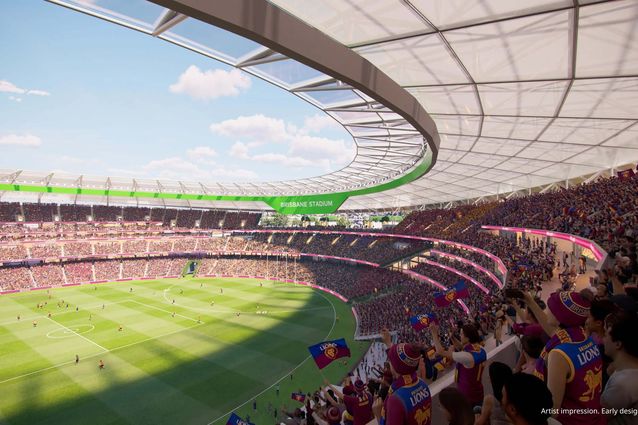
The Games Independent Infrastructure and Coordination Authority (GIICA) has released renders of the design-in-progress for the new Brisbane Stadium at Victoria Park, while also announcing architect appointments for several regional venues being built for the Brisbane 2032 Olympic and Paralympic Games.
Cox, Hassell and Azusa Sekkei’s design for the new Brisbane Stadium, first unveiled in January as the city’s main Olympic venue, has reached a recent milestone, with the stadium’s location within Victoria Park, along with the field size and orientation, now decided.
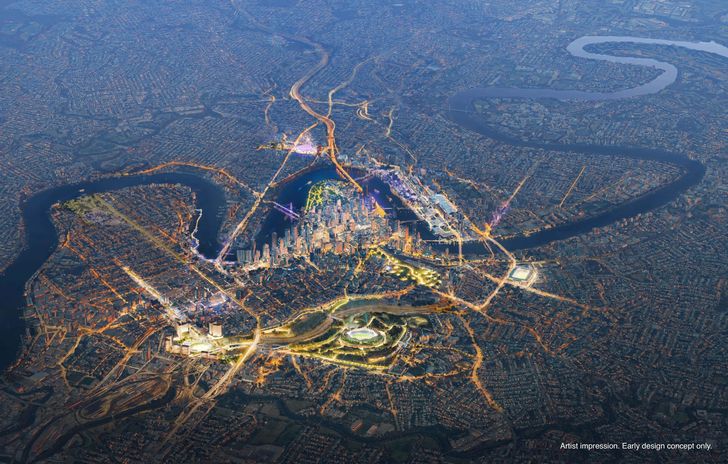
The 63,000-seat stadium is set to be positioned centrally within the park, located near Gilchrist Avenue, with GIICA commenting that this location “maximises access to public transport and nestles the stadium in a naturally occurring amphitheatre.” According to the authority, this siting will also minimise congestion in the park’s northeast, where visitor entry points converge.
View gallery
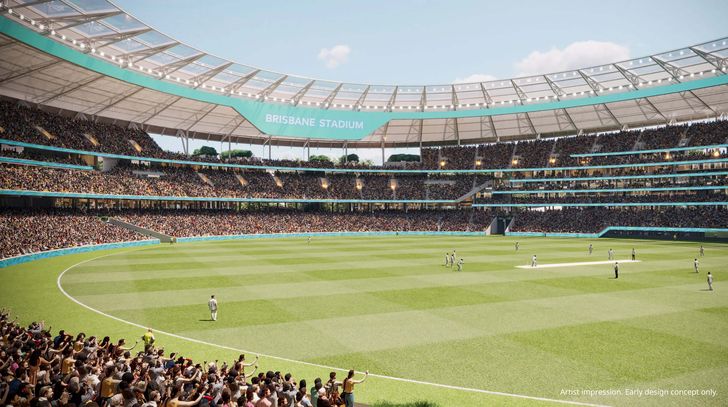
Once complete, Brisbane Stadium will be the city’s largest arena, and will be used for the Brisbane 2032 opening and closing ceremonies, and athletic events, as well as the AFL, cricket and concerts after the games. According to GIICA, the field will be equivalent in size to the Melbourne Cricket Ground (MCG) and oriented east–west so that the sun, wind and operational needs of the AFL and Cricket Australia are met.
Drawing inspiration from the Queensland verandah, the early concept design for the stadium is described by the architects as “simple and deliberate: a stadium in the landscape.”
“Rather than placing a 63,000-seat object on top of Victoria Park, the stadium will nestle into the parklands and allow the landform and vegetation to do the work,” the architects’ design statement reads.
“The stadium bowl sits in a valley between two ridges … Spectators pass through nature and parkland rather than climb toward a monument. The park flows over and around the venue, softening its edge and binding it to the park and forest slopes. It is less a building in a park, but instead a park that flows around and through a stadium.”
View gallery
The form, which is distinguished by a “floating” roof, is designed to privilege shade, breeze and access, so that it feels “active on event days, but generous and open on all other days,” the design statement notes.
Cox Architecture director and chair Richard Coulson commented that the vision, which is currently being developed with stakeholder input, “responds to place with the inclusion of technology that people will expect in a world-class venue.”
“The evolving arrangement of the stadium in the park will be a key part of unlocking the connectivity of the park with the wider precinct and the city,” he said.
Hassell managing principal Lucy O’Driscoll added, “Every element of our design responds to Queensland’s unique climate and lifestyle, ensuring the stadium can accommodate not only global events, but also becomes an enduring part of the state’s daily life and legacy for generations to come.”
According to GIICA, early site preparations are due to begin in June, with early works planned for later this year and construction set to begin in 2027.
View gallery
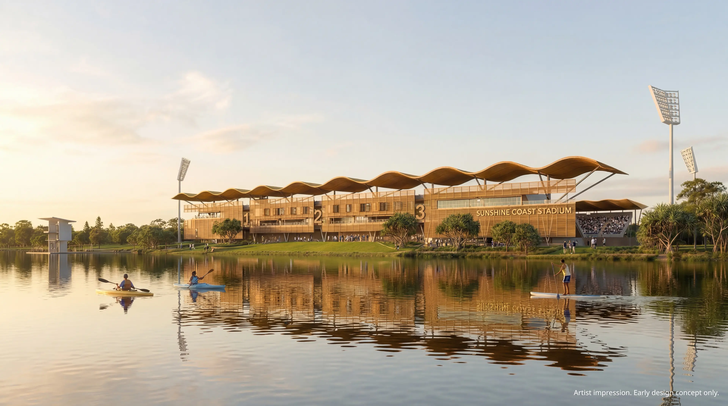
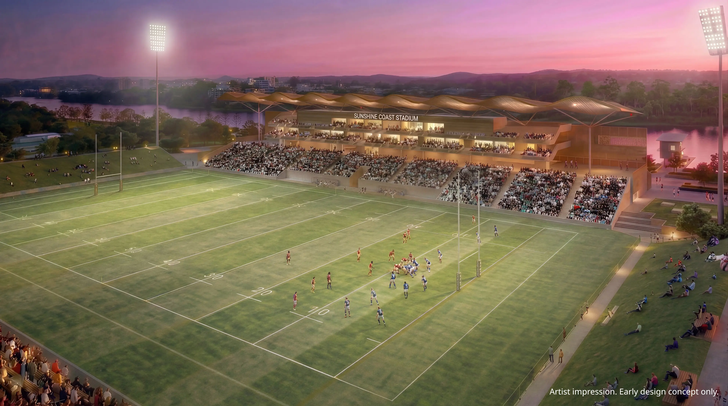
Upgrades to the Sunshine Coast Stadium are likewise expected to commence construction in 2027, following development of the design and site preparation this year.
GIICA has announced that a six-month selection process has resulted in the appointment of Architectus as the principal architect of the project alongside international sports architecture specialist HKS.
The upgrades include new eastern and western grandstands, and elevated seating bowls, increasing capacity from 1,046 to more than 10,000 seats in legacy mode – and 20,000 seats for the Olympic Games’ football events – along with new community and event spaces, and improved player amenities and accessibility.
View gallery
“Architectus has long embraced the Coast’s subtropical lifestyle – open spaces, natural ventilation, and a seamless flow between indoors and outdoors,” GIICA’s communique reads.
Reflecting on their approach, Architectus principal Dr Stephen Long commented, “We’ve conceived delicate, floating roof forms inspired by the Glass House mountains, the meandering Mooloolah River and the gentle shoreline curves of Bokarina Beach,” he said. “Breezy undercroft spaces recall the forest experiences of the coast and hinterland.”
Architectus group director communities Mark van den Enden added, “We’re excited to be designing a stadium that feels like a revelation – expressing a modern, outdoor-loving culture set in a landscape that’s both cinematic and authentic, capturing the future of how people want to live, gather, recreate and celebrate.”
View gallery
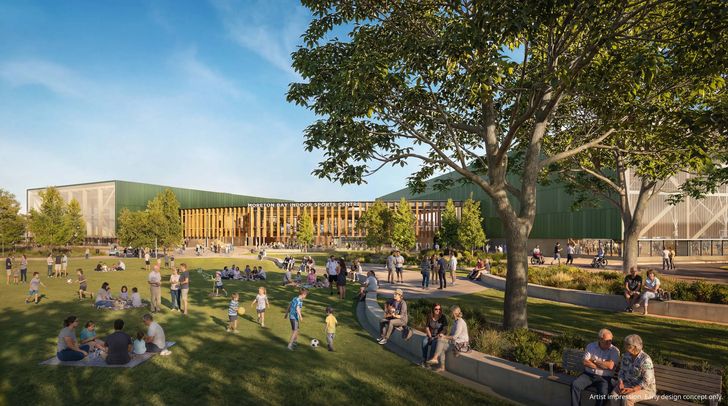
Some 50 kilometres south, the new Moreton Bay Indoor Sports Centre is also progressing through planning and design, with global sports design firm Populous newly announced as the principal architect of the new Olympic venue.
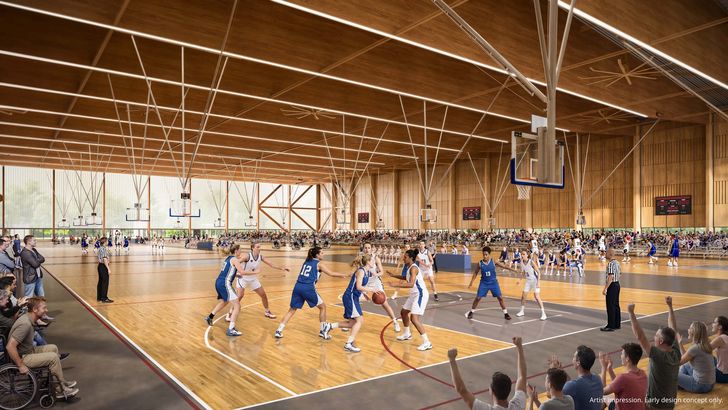
The centre will feature 12 multi-use indoor courts for basketball, netball, volleyball, futsal, pickleball and wheelchair rugby, accommodating up to 10,000 spectators during the Brisbane 2032 games.
According to GIICA, Populous’ concept design highlights the local landscape and lifestyle, capturing breezes and light, and pairing indoor activity with outdoor green space for the community to gather and play.
View gallery
Populous principal Brayden Goodwin said the venue would serve the growing Moreton Bay region.
“As one of the largest facilities of its kind in South East Queensland, the new centre will help address the increasing community demand for indoor sports facilities in the region and will be designed by Populous with legacy in mind,” Mr Goodwin said.
The venue will be owned and operated by the City of Moreton Bay Council, with construction anticipated to begin in 2027.