
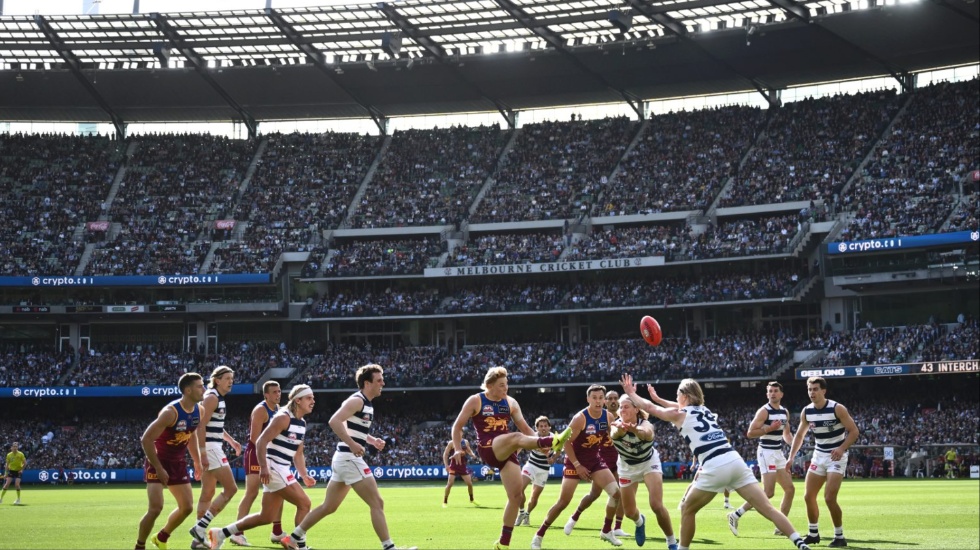
Action from last year’s AFL Grand Final between Geelong and Brisbane. Photo: AAP
It takes either some pretty strong will, or far more likely, a spectacular capacity to misread the room, to piss off the football public as frequently as the AFL has lately.
Where do you even start here? Suffice to say chief executive Andrew Dillon’s tenure thus far has been notable mainly for some poor decisions and even poorer defences of them.
Take the ongoing fall-out from this year’s “Opening Round”, something which always seemed a pretty flimsy premise for causing such logistical disruption to a new AFL season.
That was the case in 2024, even when things went relatively smoothly, let alone last year when a cyclone forced the postponement of two games, one of which wasn’t actually played until after every other scheduled home and away fixture had been run and won.
And this year has just been an on-going schemozzle, clubs with ridiculous length breaks between games, brilliant weather on sunny weekend afternoons not taken advantage of and Melbourne grounds left vacant, and the ladder again pretty meaningless for a couple of months until teams have finally all played the same number of games.
Then there’s the blatant price gouging which has gone on with the premature declaration of “fully-ticketed” games at the MCG clearly turning thousands of would-be attendees away.
All that disruption and diluting of the start of a new AFL season has clearly far outweighed any perceived benefits of “Opening Round”, and Dillon and the league would actually win more plaudits for taking ownership of the miscalculation than doggedly regurgitating rubbery TV ratings numbers.
But pick a contentious issue, and the AFL response has inevitably been similar. Defend, deny, dig in. Regardless of whether it’s the latest slavish adoption of American practice, via the new wildcard finals, or umpiring standards, last year’s controversies involving Willie Rioli and Izak Rankine, Snoop Dog as the choice of grand final entertainment or Laura Kane’s position within the executive structure.
As personable and genuinely likeable as Dillon actually is, that rigid, automated-like defensive response pattern is becoming in the eye of the footy public a byword for the AFL in every respect; arrogant, unresponsive, staunchly refusing to read the room.
Which brings us to the seemingly annual grand final start time debate. And yes, another Dillon own goal in missing a golden opportunity to win back some of the good faith the AFL has lost from its fan base in recent times.
Football fans have time and again made it very clear they want the AFL grand final played in the traditional afternoon time slot, a whopping 82 per cent voting for the 2.30pm start in the most recent AFL Fans Association survey last year, and other media polls similarly emphatic.
The battle lines on this really haven’t shifted at all, as much because the punters know full well that the broadcasters are speaking purely out of commercial self-interest, without giving a stuff about history, tradition or simply even just what their audience wants. They’ve also, rightly, never been convinced about just how much of a commercial difference a later start makes, anyway.
PLEASE HELP US CONTINUE TO THRIVE BY BECOMING AN OFFICIAL FOOTYOLOGY PATRON. JUST CLICK THIS LINK.
But we’re doing battle on it again. You know the drill; broadcasters float the idea of a night or twilight grand final, complicit media types working for those companies and eager to get another “scoop” push it, AFL officials wave it away whilst leaving the door ajar, and we all accept that at some stage or other, resistance will prove futile, anyway.
This year, though, the networks and the AFL types more interested in appeasing their corporate masters than catering to the fans have been a bit smarter about it. How about Kylie Minogue on the proviso it’s at half-time of a twilight start?
Now, I’m neither here nor there on Kyles artistically, but is the supposed extra lure of a spectacular Minogue show in the dark worth messing around with the length of the half-time break as well as the start time and disrupting player routines in the most important game of them all?
And if your answer to that is yes, should the AFL be listening to you, anyway? And that’s the real point here.
This is a perfect opportunity for the AFL to show, just once, that it will put first the wishes of its dedicated fan base; you know, the ones who actually do tune in or turn up or both each week, not only come September.
This is a time when it actually could turn around some of the overwhelmingly negative vibes and cynicism about the game and how it is administered, by reaffirming its respect for the history and tradition of the most important occasion of the football year, at the expense of appeasing its corporate backers.
But, sadly, it appears the league is doing the tone deaf thing again.
When Dillon replaced Gill McLachlan as AFL boss nearly three years ago, he immediately put on record his preference for a traditional afternoon slot. Has pragmatism, though, or more specifically the relentless pushing of the broadcasters, got to him, too?
What seems obvious is that his position has softened dramatically, betrayed in his recent throwing about of completely shonky figures about equal thirds of the footy public favouring day, twilight and night grand final starts. That’s absolute rubbish, and he knows it. Unless he’s now drunk enough Kool Aid to believe 82 per cent somehow only equates to one-third.
Asked again his preference for a day or twilight grand final a couple of weekends ago, Dillon replied: “Tradition is really important, but so is progression.”
Well sorry, mate, you can try to spin another vanilla line in corporate speak, but in this case, you simply can’t appease both sides of the argument. And if you do end up backing the horse we all suspect you’re going to, trust me, as far as the football public is concerned, you’re not coming back from there.
This article first appeared at ESPN.