
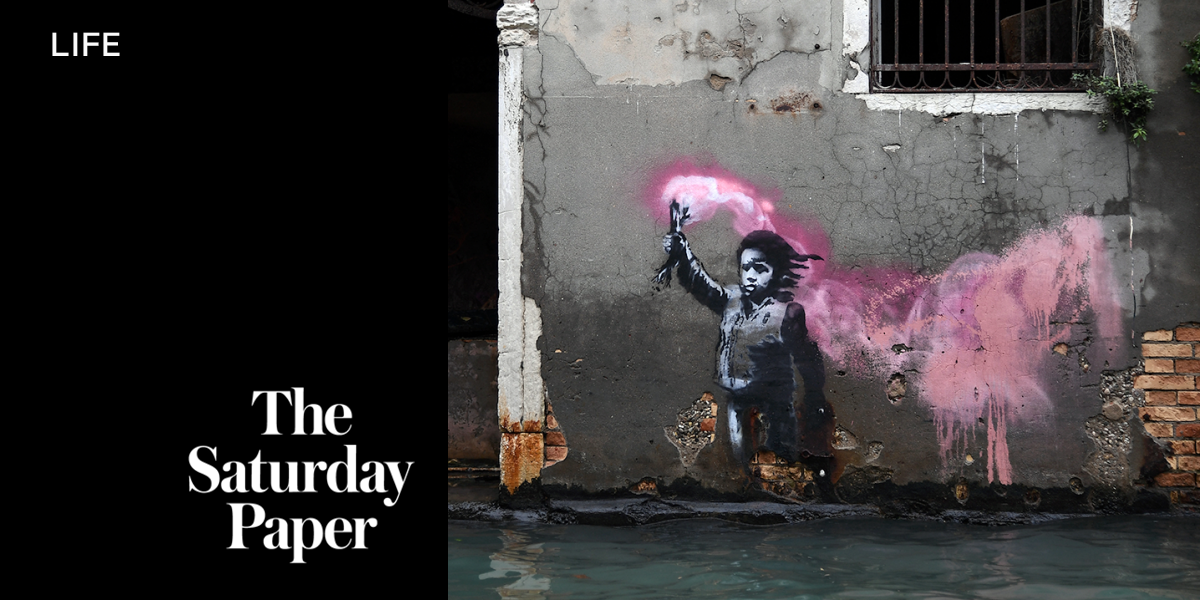
For anyone curious, the identity of the man who is very likely Banksy has been known for almost 20 years. It can be pieced together through old Reddit threads, dead message boards and bits of reporting from British tabloids. Photos identifying the person have been published for almost as long. For a time, plausible deniability was just enough for it never to be confirmed. No person who has claimed to know Banksy has ever come forward to out him.
This is where the artist’s identity being kept secret for all that time slips into the magical: many people have always known who he is but never broke the compact. That wide circle includes friends and enemies, family, art world associates, managers, fellow graffiti artists, famous musicians and people in law enforcement and the courts. No one has ever decided to ruin the illusion of Banksy’s anonymity. Collectively, they somehow agreed to keep a secret, possibly with some non-disclosure agreements, rather than ever, say, sell it to the highest bidder.
Into this magic recently waded Reuters, claiming to have definitively unmasked Banksy. They did, if you want to read it. Yet publishing this exposé raises an important question: was unearthing a single piece of unreported evidence that confirms who many people have said for years is Banksy really in the public interest? Is it an earth-shattering revelation? Or just a flex from journalists taking smug pleasure in ruining one of the longest-running pieces of performance art ever executed?
Quite the quandary, one might imagine: to wrestle with whether spoiling something that many have found joy in, not to mention the privacy of one of the wealthiest artists of modern times, was the right thing to do?
“Yet we concluded,” the news service wrote, “that the public has a deep interest in understanding the identity and career of a figure with his profound and enduring influence on culture, the art industry and international political discourse”.
There was no choice, you see, but to tell the kids that Santa wasn’t real.
Banksy will no doubt find a way to turn these events back on the press and make it into some new commentary he will reveal in time.
I once spent a few winter days with Jim Sanborn and his wife, fellow artist Jae Ko. In 1990, Jim hid a cryptographic cipher in a sculpture titled Kryptos that he had been commissioned to make for the CIA headquarters in Langley, Virginia. One section of the puzzle remains unsolved, despite several clues provided by the artist in the intervening years, including that the solution has to do with the nature of secrecy itself.
Jim and Jae Ko live and work on a small island on the Potomac River, where over the years a few deranged people have tracked them down with violent demands to be told the answer, which explains the No Trespassing signs. I sat across from them both at a local oyster bar, gently tortured by the knowledge that floating in their heads was the answer. They were the only two people in the world who had it in their minds. A third, Edward Scheidt, a retired CIA cryptographer, helped Sanborn encode the text but not the overall answer.
I would lie at night in the guest bedroom, running the fantasy that they would tell me, just because. That I could be trusted forever with being the fourth person to ever know. I would prod Jim now and then, and he would say, “Oh gosh. It’s such a long time ago, I don’t think I can remember.”
Jim told me he didn’t mind whether or not it was solved in his lifetime. He would be happy for it to outlive him and for people to keep working on solving it. In creating it, that had been the point, even if he never anticipated it would prove so hard to figure out.
When I asked if he was worried that AI could brute-force crack the cipher, he shouted “no” in exasperation. “It’s not that kind of puzzle. It came from inside my mind; it will be solved by someone’s mind.”
We spent a lot of time that long weekend talking about how the secret would be kept once Jim and Jae Ko were no longer on this Earth, and how that presented a significant burden. The burden was both personal and logistical: what could ever be a bulletproof, secure way to guard it?
Some months later, the announcement was made that Jim had decided the best way to do this was to auction the answer. Whoever won could do with it as they wished. They could release it or stay anonymous and quiet indefinitely. I emailed Jim and Jae Ko, worried some psychopathic billionaire would buy it and eat the paper it was written on, losing the knowledge forever.
Then, before the auction had taken place, an accidental reporting discovery revealed that the answer had been sitting in plain sight for years, in the archives of the Smithsonian. The RR Auction page for Kryptos stated that the papers would be included for the winner. Jim had donated those papers – including the Kryptos answer, accidentally – to the museum while he was in the middle of cancer treatment and not in the greatest health or clearest mind.
Yet there it had stayed: the decryption for anyone to walk in off the street and look at, write down and do with what they liked.
The auction page details sent two curious writers on a mission to see for themselves if anything was there, and when it turned out there was, rather than publish their findings, they contacted Jim. An agreement was made that the secret would not be spoilt, and the Smithsonian likewise agreed to seal the archive until 2075. The solution was then auctioned to an anonymous buyer for US$962,500 last November.
This would have been an enormous scoop. The two writers, Jarett Kobek and Richard Byrne, knew this. Yet instead of publishing the answer, they decided to keep it to themselves out of a shared sense of honour and respect for the artwork. They also emphasised that finding the answer was not the same as solving it. They did not want to rob the international community of Kryptos sleuths of the decades of work already spent trying to crack it.
The unmasking of Banksy was met with an emphatic shrug in the wider media and the art world. Banksy, who had his name legally changed to David Jones when he was going to be outed back in 2008, will no doubt find a way to turn these events back on the press and make it into some new commentary he will reveal in time, in a wry and amusingly impish stunt that only he could come up with.
Kryptos will, eventually, be solved by someone, or a group of people, clever enough to think their way to the answer. If Jim Sanborn can be at peace with it going unanswered in his lifetime, then I, too, must be able to cope with the fact I might never live to see it solved.
It itches my brain horribly, this yearning for answers that I can’t have. All knowledge exists to be found, if only we could access it. This is one of the things that makes Kryptos art and much more than code; it pushes us to sit in the discomfort of not knowing.
That’s what it means to keep a secret: whatever you do, don’t tell anyone.
This article was first published in the print edition of The Saturday Paper on
March 28, 2026 as ” An artwork by Banksy in Venice.”.
For almost a decade, The Saturday Paper has published Australia’s leading writers and thinkers.
We have pursued stories that are ignored elsewhere, covering them with sensitivity and depth.
We have done this on refugee policy, on government integrity, on robo-debt, on aged care,
on climate change, on the pandemic.
All our journalism is fiercely independent. It relies on the support of readers.
By subscribing to The Saturday Paper, you are ensuring that we can continue to produce essential,
issue-defining coverage, to dig out stories that take time, to doggedly hold to account
politicians and the political class.
There are very few titles that have the freedom and the space to produce journalism like this.
In a country with a concentration of media ownership unlike anything else in the world,
it is vitally important. Your subscription helps make it possible.
Send this article to a friend for free.
Share this subscriber exclusive article with a friend or family member using share credits.

Used 1 of … credits
use share credits to share this article with friend or family.
You’ve shared all of your credits for this month. They will refresh on April 1. If you would like to share more, you can buy a gift subscription for a friend.
SHARE WITH A FRIEND
? CREDITS REMAIN
SHARE WITH A SUBSCRIBER
UNLIMITED
Loading…