
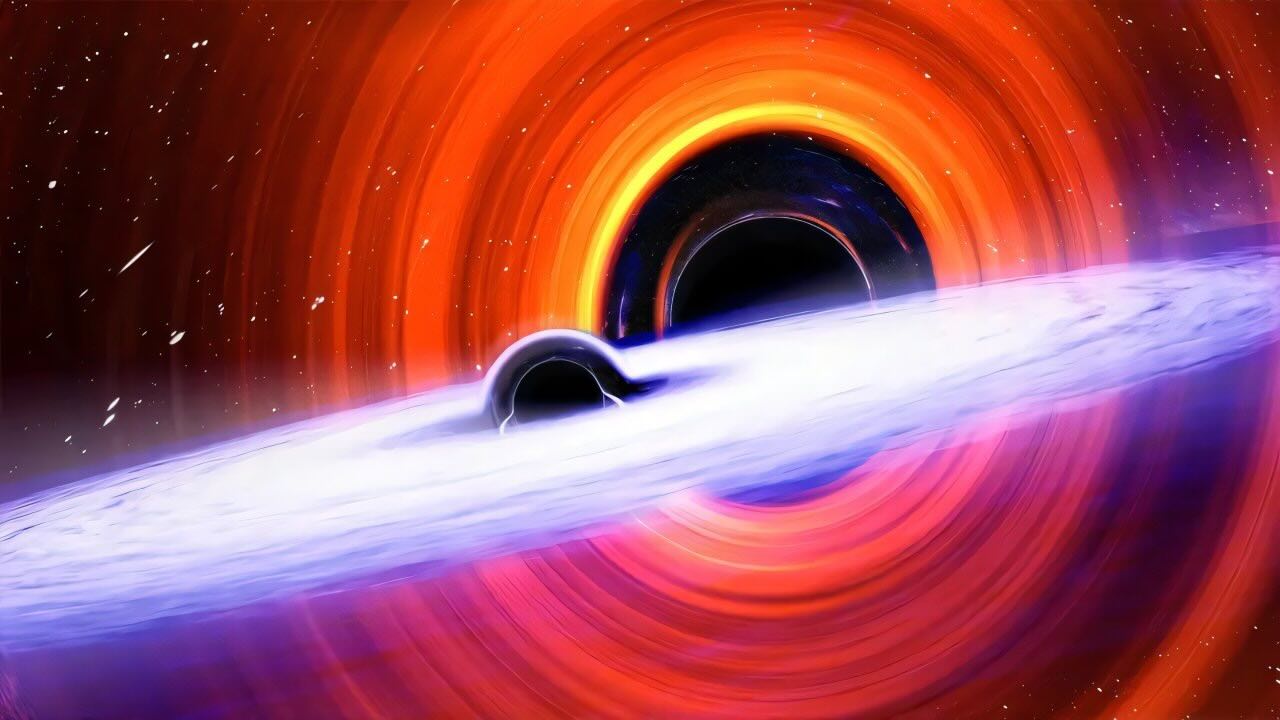
New research says that theoretical primordial black holes formed in the first moments after the Big Bang may be responsible for the dark matter that dominates our universe today.
According to astrophysicists, 85% of the matter in the universe is dark matter, a theoretical substance yet to be directly observed. In a recent paper to be published in The Astrophysical Journal, a pair of University of Miami astrophysicists say that a recent observation by the Laser Interferometer Gravitational-Wave Observatory (LIGO) was likely the first real-world detection of a primordial black hole, a discovery with major implications for the existence of dark matter.
Impending Black Hole Breakthrough
Soviet scientists Yakov Zeldovich and Igor Novikov first conceived of the idea of primordial black holes, and later, the late astrophysicist Stephen Hawking suggested that these theoretical objects may explain dark matter.
The University of Miami researchers say their new work, furthering Hawking’s ideas, is only the first step on what may be a years-long journey to confirm the existence of primordial black holes and understand their role in dark matter. These giant holes in spacetime would represent some of the earliest objects in the universe, forming mere fractions of a second following the Big Bang.
“We believe our study will aid in confirming that they actually do exist,” said co-author Nico Cappelluti, an associate professor in the College of Arts and Sciences’ Department of Physics.
Their work is rooted in a mysterious LIGO observation of a gravitational wave last year, generated from the collision of two black holes.
A Strange Black Hole Observation
“The most common black holes form as the result of a supernova, the death of a massive star,” Cappelluti explained. “So, their masses can range from a few times the Sun’s mass to billions of solar masses.”
Last year, LIGO issued a controversial alert about a merger far outside these normal parameters, with one of the objects weighing less than 1 solar mass. Some astronomers suggested that the signal was a fluke—a mere bit of noise in LIGO’s detectors, in other words. Still, the University of Miami researchers believe there is much more to the observation; to them, this could be the first signature of a primordial black hole ever to be detected.
“We attempted to estimate how many primordial black holes may exist in the universe and how many of them LIGO should be able to detect,” said co-author Alberto Magaraggia, a PhD candidate. “And our results are encouraging. We predict that subsolar black holes like the one LIGO may have observed should indeed be rare, consistent with how infrequently such events have been seen so far.”
The team says not only is their explanation the best fit, but no conventional explanation can account for the strange signal, which has been written off by other scientists.
The Source of Dark Matter
“Our research indicates that these primordial black holes could account for a significant portion, if not all, of dark matter,” Cappelluti said.
The work is promising, but the pair concede that they are a long way from confirming the observation as a primordial black hole, let alone fully understanding the relationship of these early objects to dark matter. For now, all the researchers can do is wait, hoping that LIGO will detect another, similar signal to support their contention.

“We’ll need to detect another such signal or even several others to get the smoking-gun confirmation that they are real,” Cappelluti said. “But what is clear is that they cannot be excluded as being real.”
The technology responsible for detection is only improving, with LIGO already scheduled for future upgrades, along with the ESA’s upcoming LISA and the US Cosmic Explorer project, which are set to dramatically increase the sensitivity of gravitational wave detections.
Hopefully, the next intriguing cosmic signal captured on these next-generation devices will provide more conclusive evidence, if not final confirmation of these long-sought celestial mysteries.
The paper, “Implications for PBH Dark Matter from a single Sub-Solar–Mass GW Detection in LVK O1–O4,” is available in prepublication form on arXiv.
Ryan Whalen covers science and technology for The Debrief. He holds an MA in History and a Master of Library and Information Science with a certificate in Data Science. He can be contacted at ryan@thedebrief.org, and follow him on Twitter @mdntwvlf.