
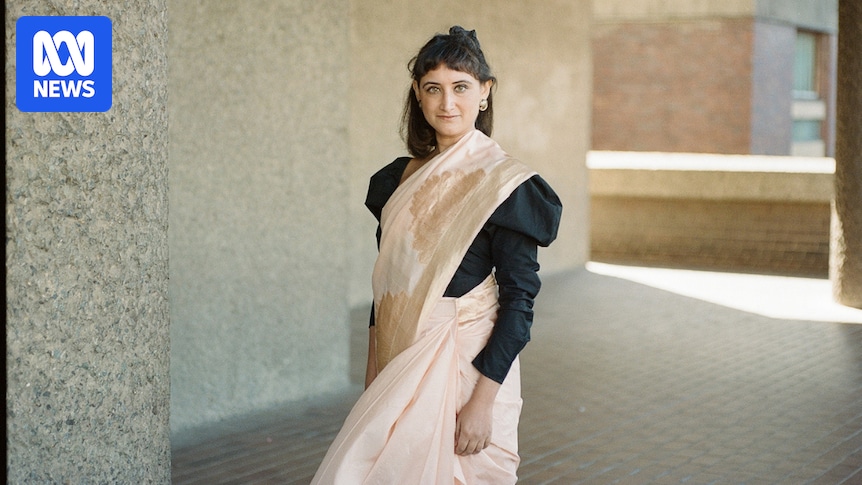
When Priya Khanchandani first walked into London’s Design Museum in 2020, proposal in hand, she wasn’t simply pitching an exhibition.
She was proposing a reframing of one of South Asia’s oldest garments — the sari.
Khanchandani, the museum’s head of curatorial at the time, wanted to show how the 5,000-year-old garment has been reinvented, and reshape how it is understood and worn.
Growing up in a London family, Khanchandani says she found herself being part of a diaspora in the UK that didn’t know much about the sari, other than that “it might be worn by somebody’s grandma”.
But what was once dismissed as old-fashioned has become a powerful symbol of reclaimed heritage and social change, she says.
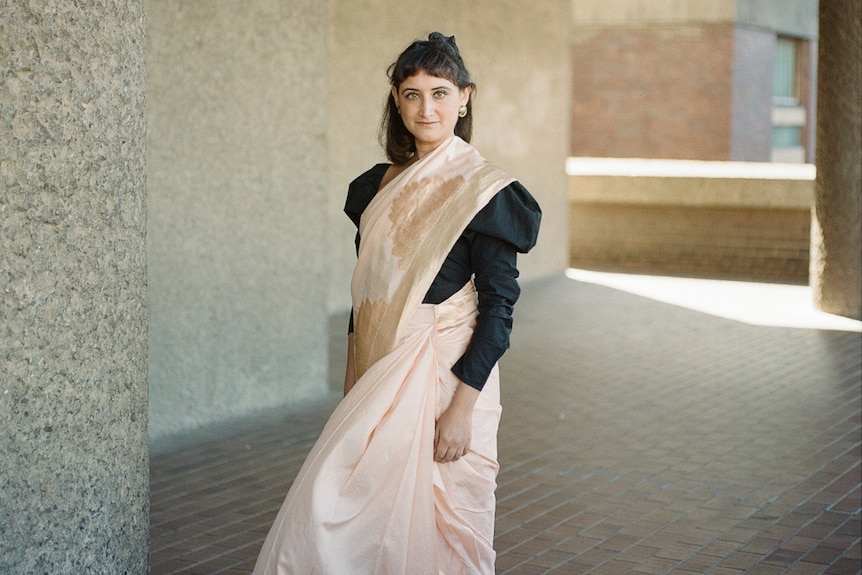
The Offbeat Sari, as Priya defines it, is a mode of individual expression and a countercultural statement. (Supplied: Articulate Advisory)
Worn as an everyday garment by some and considered by others to be formal or uncomfortable, the sari has multiple definitions.
Conventionally an unstitched drape wrapped around the body, which can be styled in a variety of ways, its unfixed form has enabled it to morph and absorb changing cultural influences.
But in recent years, the sari has been reinvented. Designers are experimenting with hybrid forms such as sari gowns and dresses, pre-draped saris and innovative materials such as steel.
While living in Delhi for a year, Khanchandani observed women wearing saris in the busy streets, boutiques and designer pop-ups.
“The saris they wore defied convention,” she says.
“They were bold and free-flowing, sometimes worn over T-shirts and even with sneakers.
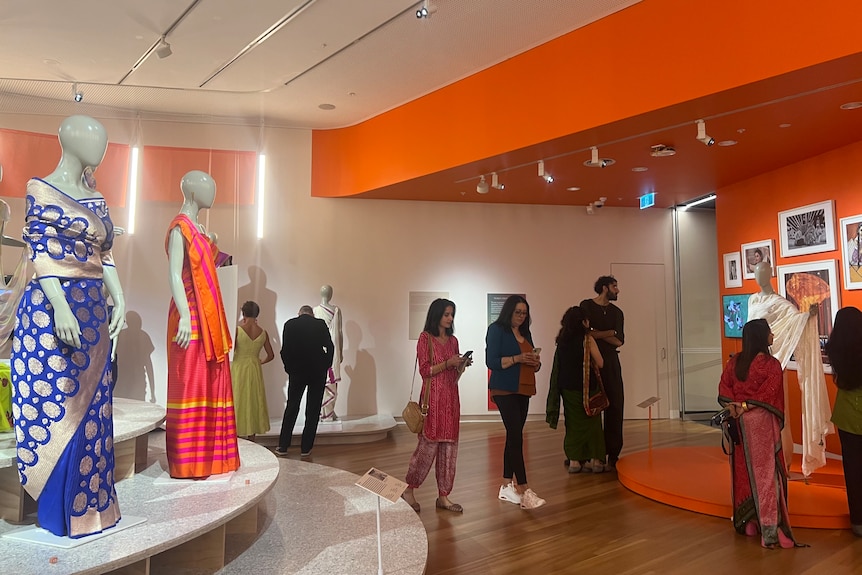
The exhibition features 54 saris by some of India’s leading designers. (ABC News: Angelica Silva)
“I decided audiences around the world needed to see this story. I think having been a journalist, I saw the sari through the lens of storytelling.”
Pioneering fashion
The exhibition was initially produced by London’s Design Museum in 2023. Now, it has made its Australian debut at Melbourne’s Bunjil Place Gallery.
It brings together 54 saris by India’s most renowned designers, such as red-carpet designs by Sabyasachi Mukherjee, Tarun Tahiliani and Anamika Khanna, including versions worn by Lady Gaga and Deepika Padukone.
Also featured are innovative garments from contemporary Indian designers such as Raw Mango, Rimzim Dadu, NorBlack NorWhite and Akaaro by Gaurav Jai Gupta.
“Many of these brands, I think, pioneered the sari for the modern, intellectual woman,” Khanchandani says.
The exhibition unfolds across three sections.
The first, Transformations, shows the experimental approaches to drape and silhouette, from a sari made of sequins cut from hospital X-ray film to one made entirely out of recycled bottles.
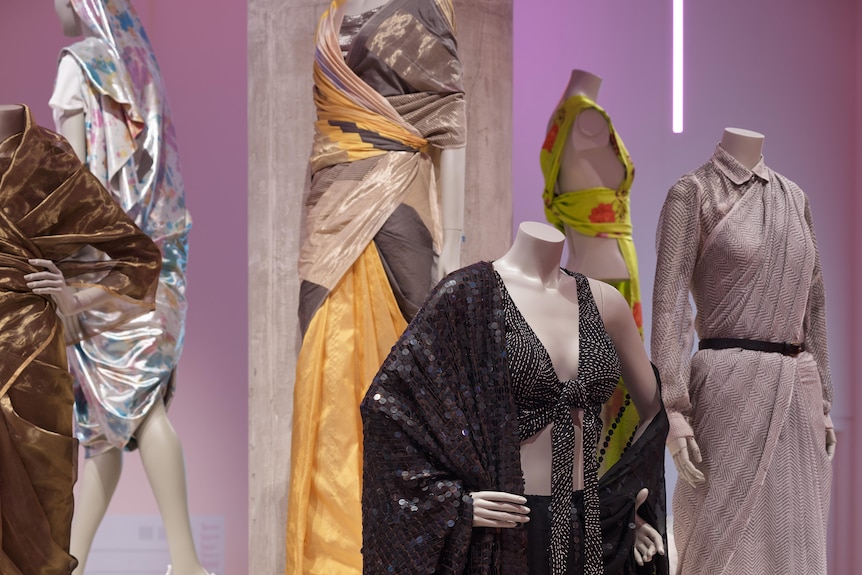
The exhibition features an X-ray sequinned sari by Abraham & Thakore. (Supplied: Andy Stagg)
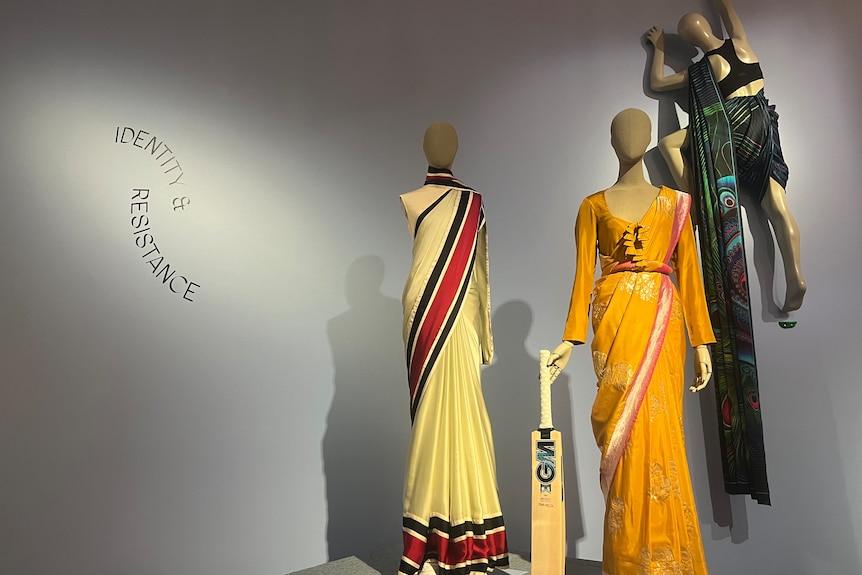
The second, Identity and Resistance, shows designers experimenting with unconventional materials, embedding messages about pollution, conservation, sustainability and social change into yards of fabric.
One sari featured in this section, Khanchandani says, is worn by a group of rural women in the Indian state of Assam who are raising awareness for an endangered species of bird, the hargila.
“They’ve embroidered it onto the border of their saris. And they’ve also made this papier-mache headpiece that they wear with it.” she says.
“The sari has become not just clothing, but social commentary.”
Another stand-out is the pink sari worn by the Gulabi Gang, a prominent Indian women’s movement founded by activist Sampat Pal Devi, fighting corruption, child marriage, and advocating for victims of domestic abuse.
Known for wielding bamboo sticks in their bright pink saris, they work mostly in rural north India, engaging in non-violent protests and active intervention to protect women.
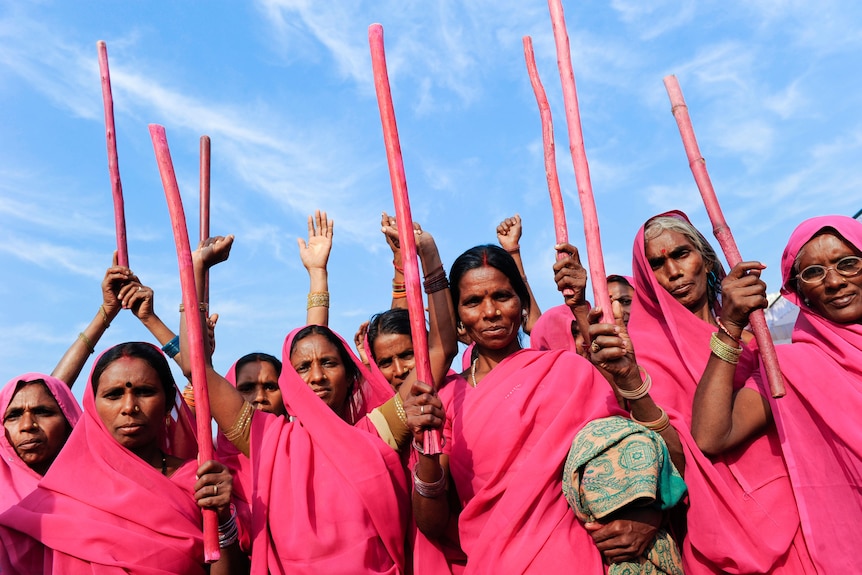
The Gulabi Gang is a powerful women’s movement formed in 2006 by Indian social activist, Sampat Pal Devi. (Supplied: Joerg Boethling)
Lastly, New Materialities showcases how far the sari has come in textile innovation, from ultra-fine stainless-steel saris to unusual pairings of cold hard metal and fluid silk.
Strong style for strong women
For Khanchandani, each sari featured in the exhibition dispels a common myth: that the sari is associated with female passivity and uncomfortableness.
“When actually, the sari has been, and was always, worn by women doing things like fishing, by labouring, housework, even sports like cricket,” she says.
“It wasn’t just something worn by wealthy women going to parties, and I think reviving that true spirit of the sari is so important.”
Priya Khanchandani says she wants to dispel the myth saris are uncomfortable and only worn at parties. (ABC News: Angelica Silva)
For some members of the South Asian diaspora, exhibitions like The Offbeat Sari are doing something deceptively rare.
It’s taken South Asian clothing that has often been flattened into cliches of “traditional”, “ethnic” and “exotic”, and completely reframed it as the centre of global artistic conversation.
“South Asian wear and Indian attire was not embraced while I was growing up,” said Daizy Maan, Co-Founder of Australian South Asian Centre (ASAC).
“We hid away from it for so long,” the Punjabi Australian, who worked with Bujil Place’s community engagement team, says.
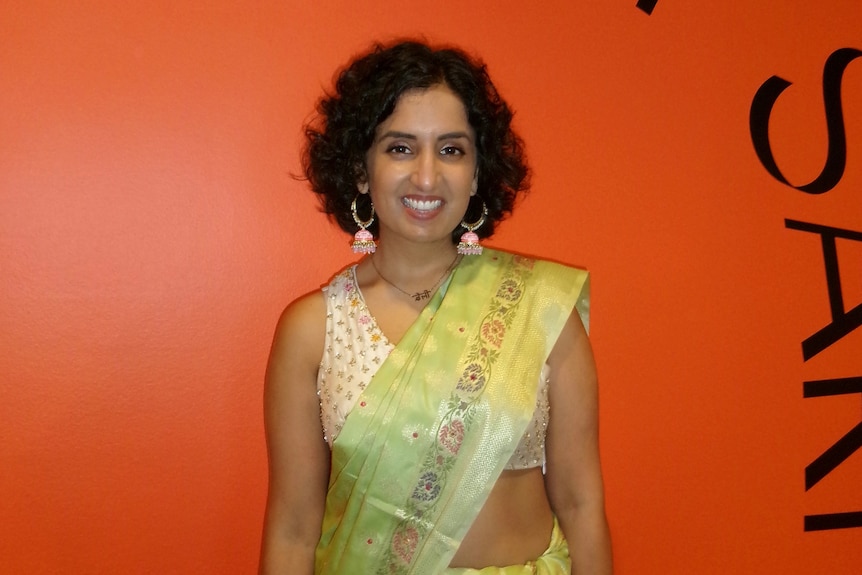
Growing up, Daizy wanted to hide her Indian identity by not wearing traditional clothing out in public. (ABC News: Angelica Silva)
She adds that exhibitions like The Offbeat Sari put South Asian fashion and history centre stage inside legitimate spaces like museums.
“It’s phenomenal to see something as beautiful as the sari be celebrated by people from all different backgrounds,” she says.
“I don’t remember the last time I saw an exhibition focused on South Asia, bringing together so many people in Australia.”
The Offbeat Sari is now showing at Bunjil Place, Narre Warren until August 30.