
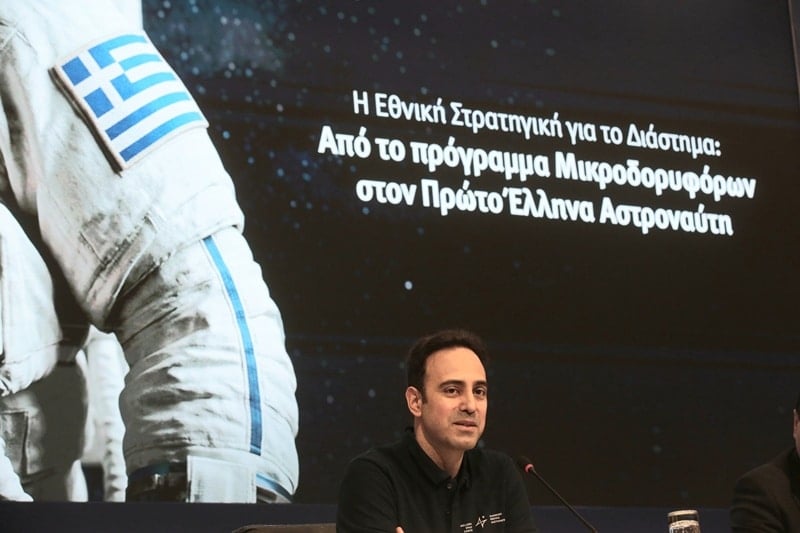
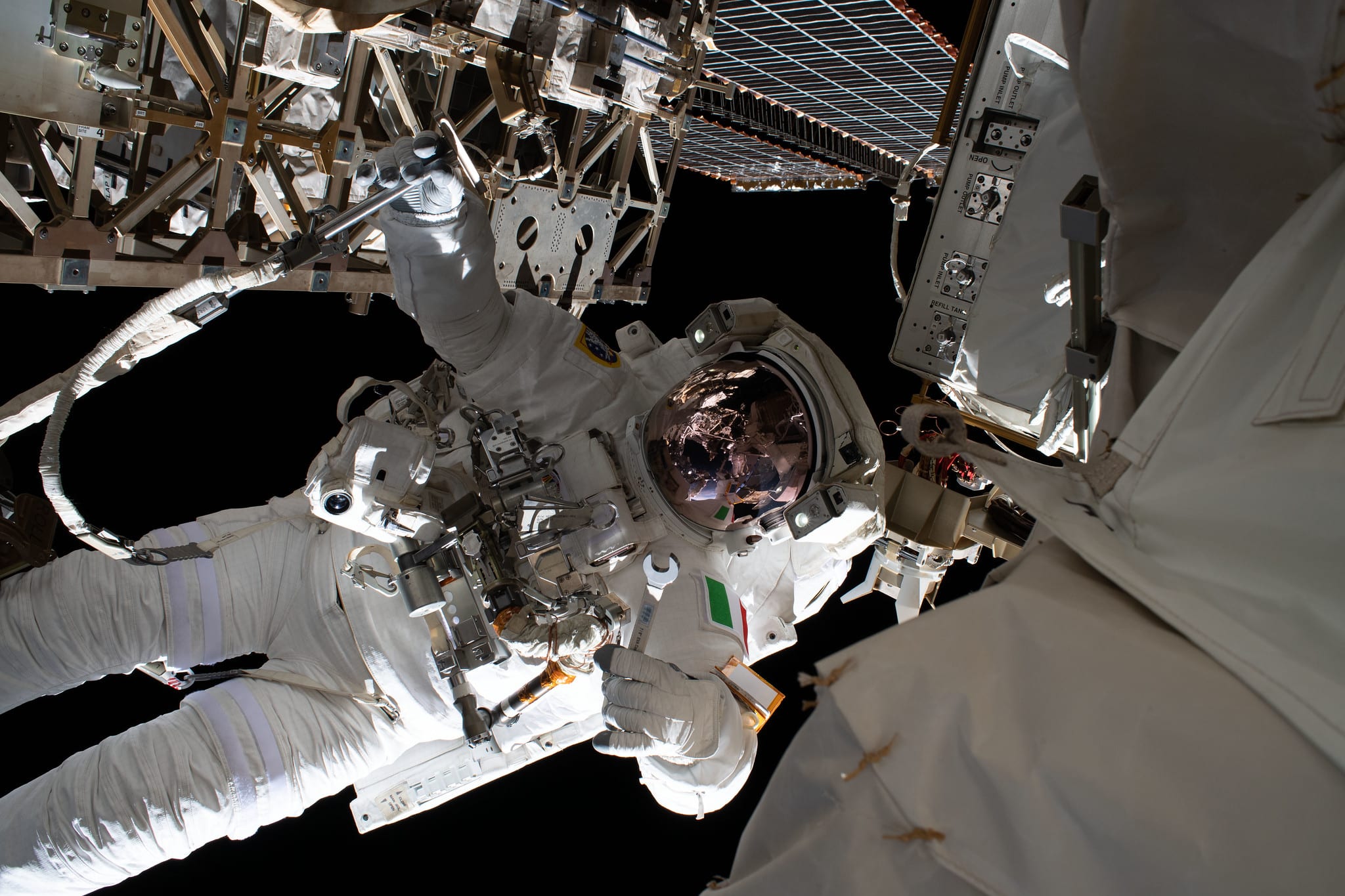
 Adrianos Golemis, a doctor for the European Space Agency, has become the first Greek to pass the organization’s test to become an astronaut. Credit: NASA Johnson. CC BY 2.0/flickr
Adrianos Golemis, who previously worked as a doctor for the European Space Agency, will be the first Greek to enter ESA’s astronaut-training program, Digital Governance Minister Dimitris Papastergiou said on Monday.
The medic has worked at ESA studying how long missions affect astronauts’ bodies. His astronaut training begins in April with a three-month introduction to life and research on the International Space Station. He will later start a year-long intensive program when Greece decides to send an astronaut on a research mission.
Golemis said the program gives Greece its first representation in ESA astronaut training and strengthens ties between the Greek aerospace sector and Europe. “Any research we carry out for astronauts and any technology we develop for space, the aim is to return it to Greece,” he said, noting microsatellites as a key example.
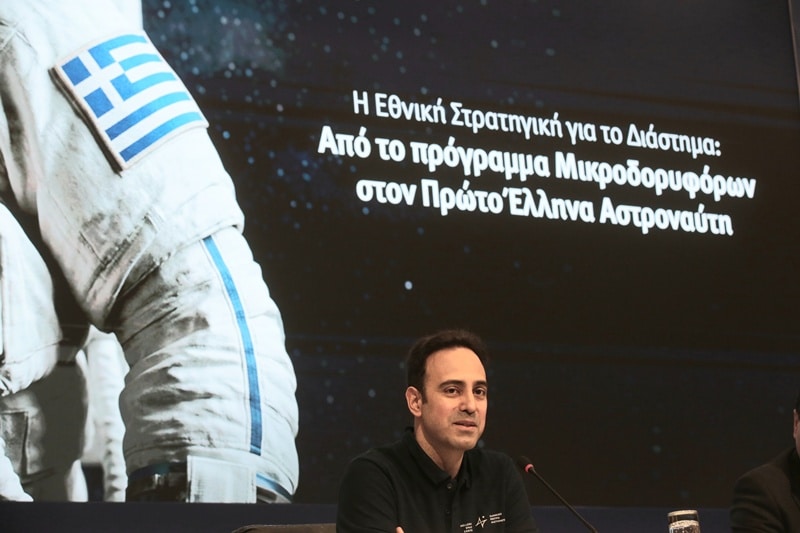
Adrianos Golemis at a press conference in Athens. Credit: AMNA/Alexandros Vlachos
Every year, around 22,500 hopefuls apply for the European Space Agency’s (ESA) exams to become an astronaut, and each year only 25 are selected to progress through the three rounds of basic training, advanced training, and mission-specific training.
Golemis passed the exams after years working for the agency as a doctor. “When I was younger, I used to think that the job I’m doing now, that is, an astronaut doctor…is something exotic, [and] it’s not for Greeks,” he revealed. He used to think of the job as one limited to geniuses.
However, he said in speaking to Euronews, “This is not the case. Effort, persistence and of course an inclination” are what is needed.
First ESA Greek astronaut is a space flight surgeon
Speaking as a space flight surgeon, Golemis related the effects that being in space can have on the body. “Our bodies are made, [and] evolutionarily adapted in an impressive way to perform on earth. When we leave the earth, where there is gravity and all the protection of our planet, we are exposed to new dangers, so a body that is made to perform a lot on earth is taken out of the earth and suffers, at least for a few days,” he told Euronews.
“So we have nausea, vomiting, all these symptoms that we expect and know,” he said. “We see that astronauts who stay in space for six months or more usually develop some vision problems [which]…some overcome…on earth. For some it may last a life time.”
Astronauts spend half of their careers in training. Immediately after recruitment, they undergo a one-year basic training at their duty station, the European Astronaut Centre.
The European Space Agency website says:
“Becoming an ESA astronaut is extremely competitive. The last call for ESA astronauts took place in 2021. Once selected, ESA astronauts typically complete a minimum of three to four years of training before flying to space for the first time. ESA’s astronaut training is coordinated and implemented by the Astronaut Training Team based at EAC. The first phase for any successful astronaut candidate is known as basic training.”
“Basic training takes 12 months. During this time, astronaut candidates are introduced to the fundamentals of spaceflight, gain a detailed overview of all Space Station systems and transportation vehicles such as US commercial crew vehicles (SpaceX and Boeing), complete survival training, practice how to conduct a spacewalk and start learning special skills like Russian language, robotic operations and spacecraft rendezvous and docking.”
As can be inferred, ESA training for potential astronauts is especially rigorous. Golemis’ achievement is thus nothing short of impressive.